
For this post in particular, I emphasize at the outset: I am a lawyer, but I am not your lawyer, and I am not licensed to practice law in North Carolina. You should not rely on this post for legal advice. For information or guidance specific to your situation, you should talk to an attorney licensed in your jurisdiction with relevant experience. The views expressed here (“Views”) are not legal advice. Views are mine alone. Views should not be attributed to anybody else, including (but not limited to) my employer, employer’s clients, friends, family, or pets (current, former, or future).
On October 31, police in Sunset Beach, North Carolina charged Kathleen Lincoln, owner of Marvelous Issues Comic Shop, with a felony for violation of North Carolina’s obscenity statutes stemming from Lincoln’s distribution of comic books at a trunk or treat event in Sunset Beach. According to press reports, the offending material was Grendel Tales: Devil’s Hammer #1 (1994) (“GT:DH #1”), which, according to the publisher’s website “begins the tale of Petrus Christus, the lone survivor of a town gruesomely massacred by a band of Grendels.” The book depicts that massacre, as well as associated torture and desecration of the dead. Lincoln is free on a $20,000 unsecured bond, and has a probable cause hearing scheduled for November 18.
Based on the available documents, it’s difficult to understand the prosecution’s (which I’ll shorthand as the “State”) theory of the case. The warrant for Lincoln’s arrest includes the following:
On or about the date of offense shown and in the county named above the defendant unlawfully, willfully, and feloniously did KNOWINGLY DISSEMINATE TO E.H., MINOR AGE AND THUS UNDER THE AGE OF 13 YEARS, MATERIAL, COMIC BOOK CONTAINING IMAGES OF MEN AND WOMEN ENGAGED IN SEXUAL CONDUCT, WHICH THE DEFENDANT KNEW AND REASONABLY SHOULD HAVE KNOWN TO BE OBSCENE WITHIN THE MEANING OF GS. 14-190.1. THE DEFEDANT WAS 59 AND THUS 18 YEARS OF AGE OR OLDER AT THE TIME OF THIS OFFENSE.. [sic]
N.C. Gen. Stat. 14-190.1(b) provides a definition of obscenity:
For purposes of this Article any material is obscene if:
(1) The material depicts or describes in a patently offensive way sexual conduct specifically defined by subsection (c) of this section; and
(2) The average person applying contemporary community standards relating to the depiction or description of sexual matters would find that the material taken as a whole appeals to the prurient interest in sex; and
(3) The material lacks serious literary, artistic, political, or scientific value; and
(4) The material as used is not protected or privileged under the Constitution of the United States or the Constitution of North Carolina.
Based on that definition, I see three problems with the State’s claim that Lincoln’s conduct (as I understand it from news articles) violated the statute. Keep in mind that, because of the word “and” at the end of subsections (b)(1), (2), and (3), the offending content has to satisfy every single one of the factors above to be “obscene” under the statute.
The statute (at (c)) broadly defines “sexual conduct” as including three categories. Subsection (1) is what you’d expect in such a definition. As relevant here, subsection (2) extends the definition to cover nudity that is “lewd exhibition.” Finally, subsection (3) includes torture or physical restraint “of or by a nude person or a person clad in undergarments or in revealing or bizarre costume.” I see two issues here.
First, while there’s nudity depicted in GT:DH, I don’t understand how it could be construed as “lewd.” If the North Carolina legislature meant to capture all forms of nudity in the statute, it wouldn’t have qualified “exhibition” with the term “lewd.” Maybe I’m as oblivious as Mr. Magoo, but I don’t see how the State can argue that there’s some sort of prurient charge to these particular images.
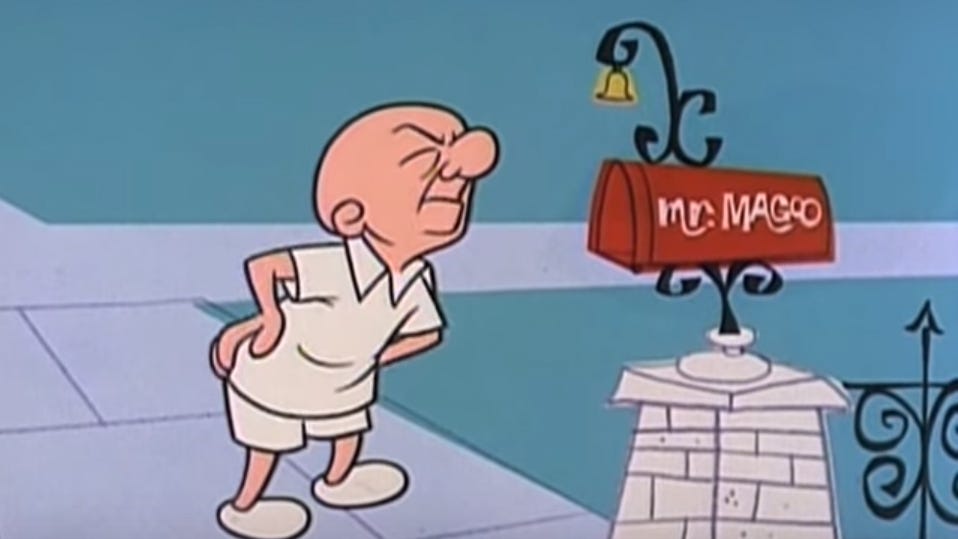
Not seeing the lewdity in the nudity
Second, while GT:DH does depict torture of nude persons, there’s no accompanying “person clad in undergarments or in revealing or bizarre costume.” Note also that the statute, by its terms, appears to include restraint “…of or by…a person clad in…bizarre costume.” No nudity required. So if, for example, I depicted the Philadelphia Flyers’ beloved-but-bizarre mascot Gritty in restraints, have I created obscene material under North Carolina’s statute? Hint: if your statute allows for these outcomes, it’s probably not well-drafted.
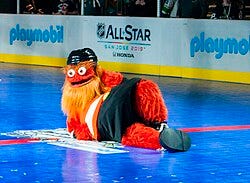
Just add restraints.
“Prurient” is one of those words you only see in a legal context. Basically it means “intended to titillate.” Even if you grant that the material within GT:DH #1 satisfies North Carolina’s definition of “sexual conduct” I can’t see how this material appeals to the prurient interest.
GT:DH #1 depicts a massacre of a village and attendant torture and desecration. There are also a few images of male nudity, but not in a sexual context. Heavy stuff, to be sure, but there’s a similar issue here as with the “lewd exhibition” point above. If the State is going to argue that this material “appeals to the prurient interest in sex,” then it’s hard to see how any material depicting nudity of either gender does not satisfy the standard.
The Grendel Tales series is a collection of stories told in Matt Wagner’s Grendel universe. Wagner has received Eisner awards for various Grendel works. Netflix has reportedly explored optioning the Grendel property. DC Comics has included Grendel in cross-overs with Batman - surely a vote of confidence in the artistic merit of the Grendel universe from one of the largest publishers in comics. Rob Walton, the creator of this particular entry in the Grendel universe, has been an Eisner nominee (not for this work, but for others). Anybody could also spin out an argument about the literary, political, or artistic merits of a depiction of the horrors of conflict.
One issue for Lincoln is subsection (d) of the statute:
Obscenity shall be judged with reference to ordinary adults except that it shall be judged with reference to children or other especially susceptible audiences if it appears from the character of the material or the circumstances of its dissemination to be especially designed for or directed to such children or audiences.
The context of Lincoln’s distribution of the books - at a trunk or treat event obviously intended for children - probably supports applying subsection (d). It’s not clear to me what this means for the analysis,1 but it could allow a court to require that Lincoln justify the artistic merit of GT:DH with respect to an audience of trick-or-treating kids rather than with respect to an ordinary adult. Functionally, this puts a (potentially heavy) thumb on the scale in favor of the State in a court’s consideration of the literary/artistic merit factor above, which I think would weaken what is otherwise one of the strongest arguments Lincoln has in her favor.
There are some other arguments Lincoln could make, including whether she intentionally distributed the offending book to kids (e.g., if she just grabbed the dollar-comic-box from her store, put it on a table at the trunk-or-treat without knowing the book was in there, and a kid grabbed the book, she may not satisfy that intentionality requirement). The statute also has a cop-out factor ((b)(4)) excluding any material protected or privileged under the North Carolina or U.S. Constitution, so she could make constitutional arguments about the protected nature of GT:DH. But I’ll leave it there for now.
This certainly isn’t the first obscenity case implicating comic books; throughout their history as a mass-entertainment medium, the content of some comics has captured the attention of politicians, law enforcement, and fretful parents. The Comic Book Legal Defense Fund exists for a reason (and is aware of this case). Debates about the content available to children have raged throughout the U.S., most recently with respect to books available in local and school libraries.
Each of the arguments above would require research and analysis, and would be expensive to litigate fully. Regardless of whether you like GT:DH (it’s pretty heavy for my taste), it doesn’t seem fair to force somebody to defend a felony case for what, at bottom, is an error in judgment. Consider also the additional consequences that a felony conviction carries. It’s worth thinking for a moment about whether the best forum for resolving disagreements about these issues is a criminal court. I don’t think it is.
Once more, in case you forgot: I am a lawyer, but I am not your lawyer, and I am not licensed to practice law in North Carolina. You should not rely on this post for legal advice. For information or guidance specific to your situation, you should talk to an attorney licensed in your jurisdiction with relevant experience. The views expressed here (“Views”) are not legal advice. Views are mine alone. Views should not be attributed to anybody else, including (but not limited to) my employer, employer’s clients, friends, family, or pets (current, former, or future).
There’s probably case law on it, but you need to hire me if you want me to research it. That’s also why (once more, for those of you in the back who need to hear it again) you SHOULD NOT RELY ON THIS ARTICLE FOR LEGAL ADVICE.
No posts
Comments
Nothing yet. Say the first thing.
Sign in to join the conversation.