
At some point in parenting, you stop planning your dinners around sleep schedules and start planning them around activity schedules.
And when those activities are sports or high-energy practices, there’s an added layer of complexity: making sure kids are fueled enough to perform well, without feeling too full or uncomfortable during practice.
We got our first taste of this when my two daughters started competitive gymnastics. Practices ran from 5 to 8 p.m. Monday through Thursday, which quickly made our usual family dinners impossible. I knew they needed something to eat before those long practices, but a full dinner just wasn’t going to work.
As both a mom and a dietitian, I had to rethink what “dinner” looked like on practice nights. After some trial and error, we found a rhythm that worked for us.
Today I’m sharing how I navigate this stage and how I make sure my kids are still well-fueled, even when dinner doesn’t happen at its usual time.
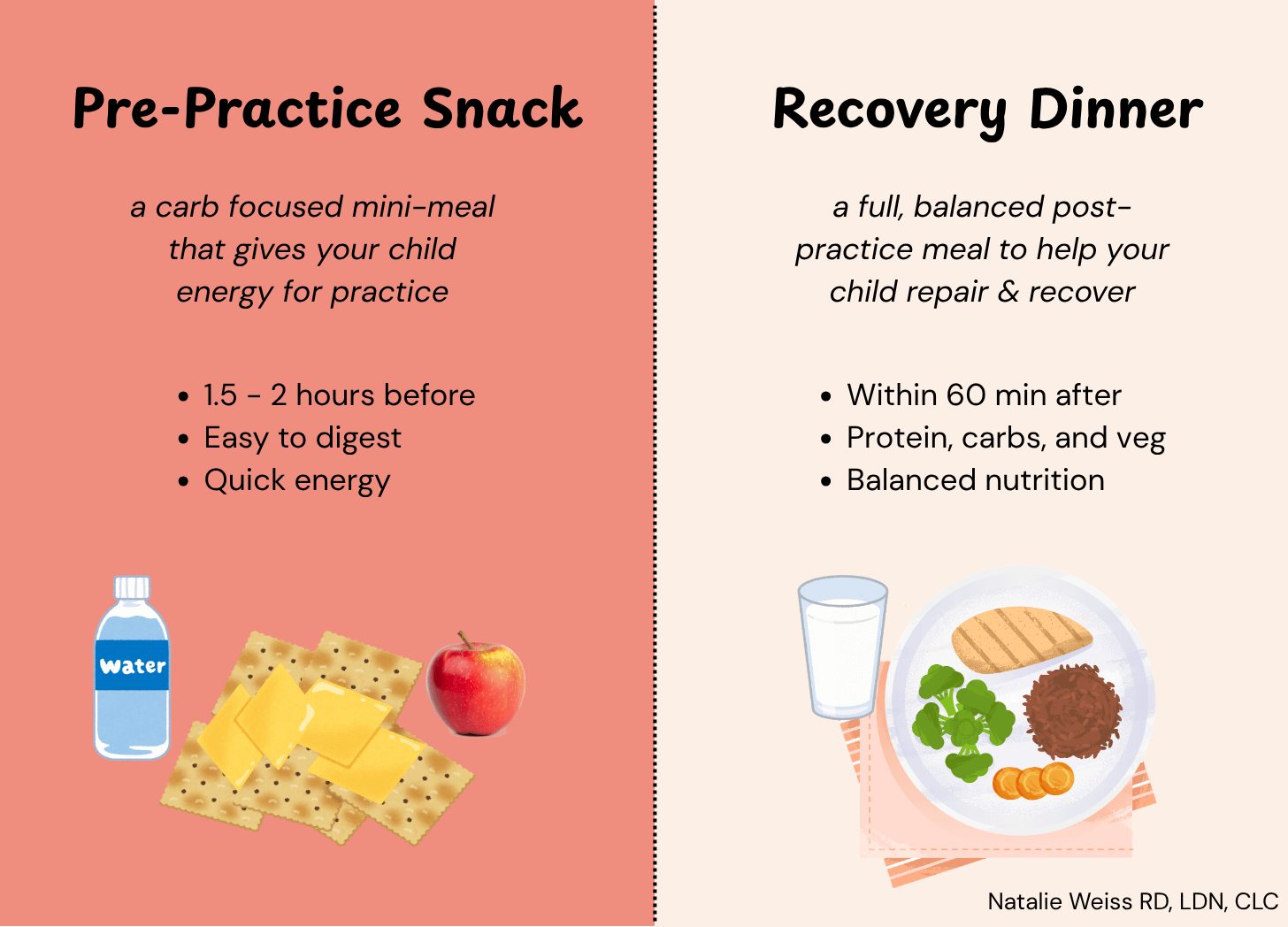
The simplest way to think about evening practice nutrition is to stop thinking of dinner as one meal. Instead, split it:
Pre-Practice Fuel (1.5 to 2 hours before practice): A carbohydrate-focused mini-meal that gives your child energy for practice.
Recovery Dinner (within 30 to 60 minutes after practice): A balanced meal with protein, carbs, and vegetables that helps the body recover and provides the nutrition they missed.
When: About 1.5 to 2 hours before practice starts. If school ends at 3:00 and practice is at 5:00, this means eating when they get home.
What: Focus on carbohydrates with a small amount of protein. Keep fat and fiber low as these slow digestion and can cause stomach cramps during activity.
Good options:
A bagel with a thin spread of peanut butter and jam
Toast with honey and a banana
A bowl of cereal with milk + berries
A turkey and cheese sandwich
Graham crackers + milk + sliced strawberries
A fruit smoothie
Crackers + cheese + fruit
Granola bar + fruit
Pretzels + hummus + fruit
Ramen noodle cup
How much: This should feel like a substantial snack or a light meal.
What to avoid: Fried foods, heavy sauces, large portions of meat, high-fiber bars, big salads, or anything greasy. These sit heavy and can cause nausea or cramping during practice.
What If There’s Less Time?
Sometimes the schedule doesn’t cooperate. Here’s how to adjust:
60 to 90 minutes before practice: Go smaller and simpler. A piece of fruit with a few crackers, an applesauce pouch, toast with jam, or a small bowl of cereal.
30 minutes or less before practice: Keep it very light. Maybe just a banana, a few pretzels, or a sports drink. Anything heavier risks an upset stomach.
No time at all (eating on the way): An applesauce pouch, a handful of pretzels, or a sports drink sipped in the car. Something is better than nothing.
When: Within 30 to 60 minutes after practice ends. If practice ends at 7:00, aim to eat by 8:00.
What: Now is the time for a balanced meal with protein, carbohydrates, and vegetables. The body is primed to absorb nutrients and repair muscles right after exercise, so don’t wait too long.
This is the time when I pull out what I made the rest of the family for dinner, but if it’s really late (after 9pm), I usually offer something lighter like a bagel with cream cheese and then focus on a heavey breakfast the next morning.
Recovery dinner examples:
Grilled chicken with rice and roasted vegetables
Pasta with meat sauce and a side salad
A burrito bowl with rice, beans, chicken, and salsa
Scrambled eggs with toast and fruit
A hearty soup or stew with bread
Stir-fry with rice or noodles
Bridge the gap: If dinner won’t be ready right when your child walks in the door, give them a quick recovery snack to hold them over like chocolate milk (one of the best recovery drinks available), yogurt with fruit, or cheese and crackers. Then serve the full meal when it’s ready.
Gatorade was created in 1965 at the University of Florida to help college football players replace fluids and electrolytes lost during intense training in the heat.
When it’s not used during exercise, it’s essentially a sugar-sweetened drink with added electrolytes.
So when is it actually useful?
In simple terms, most guidelines suggest that water is usually enough for exercise under 60 minutes. For longer or more intense workouts, a sports drink can be helpful.
The American Academy of Pediatrics takes a more conservative approach and generally advises against routine use of sports drinks for most children. However, they also recognize that for youth athletes involved in longer or higher-intensity training or competition, sports drinks can play a legitimate role in supporting hydration and performance.
The bottom line: For most routine activities under an hour, water does the job just fine. Save sports drinks for when your child is working hard for over an hour, playing in the heat, or competing in a long tournament.
Think in two parts: a carb-based pre-practice snack (or mini meal) and a balanced recovery dinner after practice.
Closer to practice = smaller and simpler. Focus on easy-to-digest carbs like fruit, bread, or crackers.
Water is usually enough for practices under an hour. For longer or higher-intensity sessions, a sports drink can help support energy and fluid needs.
Eating “late” after evening practice is ok, and often necessary for recovery.
There is no perfect way to time dinner on practice nights. I’m mostly just trying to keep my kids fueled, supported, and feeling good through the activities they enjoy. Even as a dietitian, it doesn’t always go perfectly. Sometimes their appetite is off, sometimes the timing gets tricky, and honestly, we’ve learned a lot through trial and error (and a few stomachaches along the way).
What activities are your kids in right now, and how are you handling meals and snacks around them? I’d love to hear what’s working (or not working) for your family.
As always, thanks so much for being here!
Thomas DT, Erdman KA, Burke LM. American College of Sports Medicine Joint Position Statement: Nutrition and Athletic Performance. Medicine & Science in Sports & Exercise. 2016.
Desbrow B, McCormack J, Burke LM, et al. Sports Dietitians Australia Position Statement: Sports Nutrition for the Adolescent Athlete. International Journal of Sport Nutrition and Exercise Metabolism. 2014.
Sawka MN, Burke LM, Eichner ER, et al. American College of Sports Medicine Position Stand: Exercise and Fluid Replacement. Medicine & Science in Sports & Exercise. 2007.
Selected Issues for Nutrition and the Athlete: A Team Physician Consensus Statement. Medicine & Science in Sports & Exercise. 2013.
Herring SA, Kibler WB, Putukian M, et al. Mass Participation and Tournament Event Management for the Team Physician: A Consensus Statement (2024 Update). Medicine & Science in Sports & Exercise. 2024.
Beck KL, Mitchell S, Foskett A, Conlon CA, von Hurst PR. Dietary Intake, Anthropometric Characteristics, and Iron and Vitamin D Status of Female Adolescent Ballet Dancers Living in New Zealand. International Journal of Sport Nutrition and Exercise Metabolism. 2015.
Sports Drinks and Energy Drinks for Children and Adolescents: Are They Appropriate? Pediatrics. 2011.
Adolescent Consumption of Sports Drinks. Pediatrics. 2018.
Comments
Nothing yet. Say the first thing.
Sign in to join the conversation.