
Nearly two years ago now I came up with a bright idea (oh, I am ever full of ideas!) to find other ways for my community to engage with wildlife in their creativity. To build a relationship with them, rather than the one-tutorial-after-another treadmill that was beginning to feel extractive, rather than relational. To find ways to embody their lessons, to sing their songs in pencil and paint in a ways that feels expansive and abundant and full of wonder. I settled on weaving our creative attention through the stories from our past (Wild Herstory), the stories of beings that live in lands we may never see as individuals (Wild Kinship) and the relationships we can build with the wild right outside (and even inside) our homes (Wild Home).
When I released the first Wild Herstory in May of 2025 it was an experiment - I was hopeful it would stick, and it did. But oh, this thread (and the others) have evolved so much now too, now that I am committed to releasing a new magazine each month.
I am revisiting the content of that first Wild Herstory here today, though in a much shorter form, and adding just a couple of things that would be included now too, were she to be this next month’s herstory. In fact, I may revisit 3 or 4 of the early ones and make a special edition - see, never short of ideas! Freya and Falcon, Artemis and Bear, Morrigan and Raven, hmm, I think that would be a lovely re-adventure!
For now though…
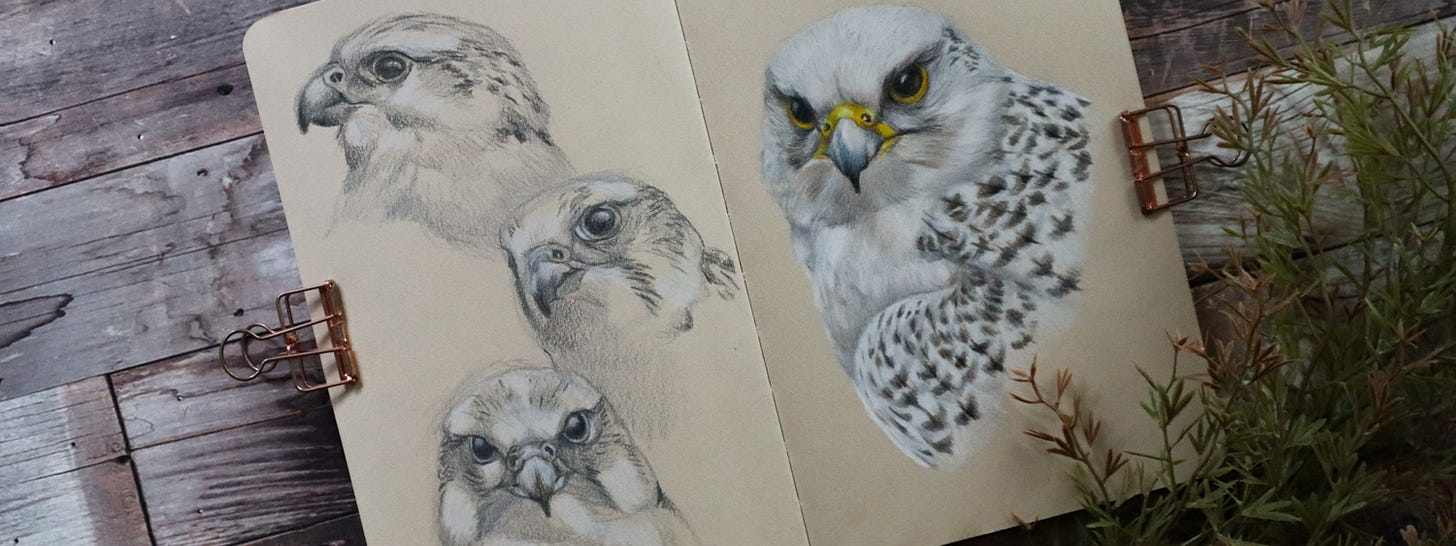
Freya is perhaps the best known of the Norse goddesses, a woman of truly magnificent contradictions, like the rest of us. A fierce warrior and tender lover, mistress of magic and guardian of fertility, she is among the most complex and powerful figures in the Norse pantheon. And yet, like so many female deities, so little remains of her story, and what we do know is often told through a male counterpart’s story, meaning we can only imagine the real impact she had on the societies who worshipped her, and on the women who lived under her magic.
As with most stories passed down orally, there aren’t libraries of concrete written sources for the “true story” of Freya. What we do have comes primarily through the Poetic Edda and the Prose Edda, both written down in 13th-century Iceland by writers who weren’t at all interested in capturing the vibrant, nuanced traditions that once surrounded the female deities. Did they even ask women for their stories? And if they had, would women have given them freely?
With that in mind, I’ve gathered what I could find of Freya and her cloak from the chaotic cauldron that is the internet. It may not strictly represent the original stories, and hey, that’s okay. This is Wild Herstory, remember - we get to create our own herstories from these archetypes and mythical women, embody them in our own unique ways, take from the stories what serves us, and let the rest go. There are no prescriptions, no tests, no wrong or right in this work, other than to let these figures inspire and empower you, and to help you find deeper connection to the wild, and to your own innate wisdom and power.
Freya is the embodiment of divine feminine power in its fullest, wildest expression. As the chief goddess of the Vanir, the group of gods associated with fertility, wisdom, and the ability to see the future, she presides over love, beauty, and sensuality. Her chariot is pulled by two enormous felines, Bygul and Trjegul, who would have been inspired by the Norwegian Forest Cats and Lynxes of the snowy north. Unlike many love goddesses from other traditions, Freya is no passive figure - she is a warrior. She rides into battle to claim her share of the slain, and is equal in martial prowess to the war gods. Her hall in Asgard welcomes not only her chosen fallen warriors but also serves as a place of refuge and renewal.

Valshamr: The Falcon’s Cloak
Among Freya’s most treasured possessions is her magical falcon cloak, known as valshamr. Rather than a disguise or an illusion, the cloak enables complete transformation. When Freya wraps herself in the cloak’s feathers, she doesn’t merely appear as a Falcon, she shape-shifts, becoming Falcon in body, ability, and perception.
This shape-shifting is a sacred ability to access the wisdom and strengths of another being, something humans have wished to be able to do (and who knows, have done?) for time immemorial. Through the falcon’s keen eyes, Freya gains extraordinary vision and perspective, and through her wings, she claims unparalleled freedom of movement.
Think of the falcon cloak as a symbol of her freedom, her ability to transcend boundaries, her refusal to be pinned down, her insistence on seeing the world through her own eyes rather than accepting the perspective of others. When she takes falcon form, we can imagine her claiming the skies as her domain. She observes without being observed, moves without being constrained, and gathers wisdom without filtration or distortion, all of which makes her exceptionally powerful.
There aren’t many classical artistic depictions of Freya, despite mythology being of particular interest from the Renaissance on, that interest apparently extended mostly to Greek and Roman mythology rather than Norse. These days, though, depictions of Freya are everywhere, particularly (and in my opinion, unfortunately) in AI-generated imagery. As is so often the case with this sort of art, she’s represented in ways that are over-sexualised, youthful, and even demure.

I invite you to spend a moment thinking about how Freya would appear to you.
To me, she is of middle age, perhaps because I am too - I can’t imagine goddesses wanting to look youthful forever, but to want to show a life long and well lived. She has lived a full and vibrant life, one that has gathered her a great deal of knowledge and experience, so she probably wouldn’t put up with much nonsense (Loki, I’m looking at you), and she is confident in her own skin. She is strong, wise, and self-assured.
So too is the Falcon.
How would you intuitively describe her?
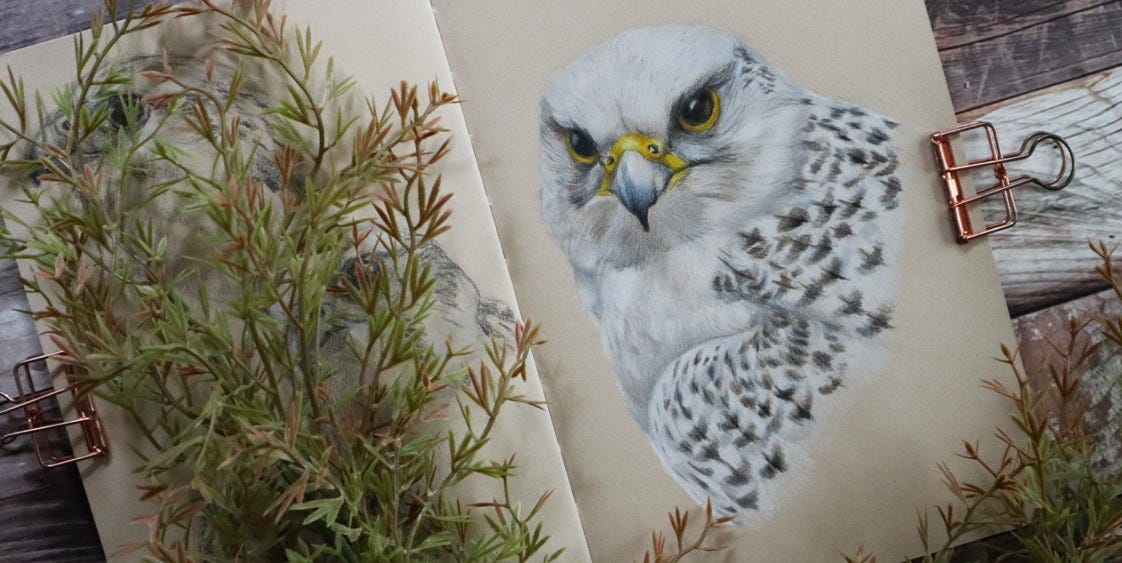
Gyrfalcon (Falco rusticolus)
While it is not specified what sort of Falcon the feathers of Freya’s coat donned, I want to introduce you to Gyrfalcon (pronounced as “JER-falcon”). She is the largest species in the family Falconidae, with females much larger than males.
She is a high-latitude being, breeding on the Arctic coasts and tundra, and across the islands of northern North America and the Eurosiberian region, where she is mainly a resident species who rarely migrates. In her white morph, she is perfect for depicting a Scandinavian goddess who moves between worlds. Her plumage varies with location, ranging from near-white through silver-grey to charcoal, but it’s the white morph, that I’ve long admired in other artists’ paintings, and the one I most associate with Freya’s sovereign story and cloak.
Unlike the smaller Falcons who hunt on the wing, Gyrfalcon hunts low and long, chasing ptarmigan and waterfowl across open tundra, or forcing them to the ground rather than taking them from the sky. Hers is endurance - not the flashy vertical stoop of her Peregrine cousins - the willingness to keep going long after the chase would have broken a lesser hunter.
Gyrfalcon’s qualities might symbolise:
the beautiful part of you that endures rather than dazzles with flashy performance
clarity that comes from the perspective of distance
freedom claimed rather than given
the sovereignty of choosing your own intention and authenticity

🪶 What does the world look like through eyes built for a predator’s flight?
🪶 What does it feel like to shrug on a cloak that changes not just how you appear, but who you are?
🪶 The feathers of Falcon’s carry the story of Freya still - as you honour Falcon with pencil and paper, consider how you can embody her strength and wisdom, her ferocity and tenderness, her passion and protection in your creativity, and in your everyday life.

When I created this Freya and the Falcon for Hedgerow, I did a deep dive into the wonder that is Gyrfalcon, watching video of their flying feats. What incredible beings they are! The way that they can fly straight at speed for such a distance to obtain their slower prey, the endurance and grace and sheer power, is remarkable. Plus, I mean, they are completely stunning. The vibrant yellow of the cere and orbital ring (on some adults, anyway) against the white feathers and dark markings of the white morph - how incredibly lucky we are to live in a world with Gyrfalcon!
Sometimes we have to be reminded of the old stories so we can weave the new ones for where we are now. Through Wild Herstory offerings I hope to give us ways to connect with wildlife, to find wonder and awe in the more-than-human beings we share this world with, and to fall in love with singing their songs through creativity - however that looks for you.
September’s magazine is about wandering and wondering with Wolf, with Skadi (Norse) and Diana (Roman) as our guides. I’d love to have you along for the adventure.

Comments
Nothing yet. Say the first thing.
Sign in to join the conversation.