
Hi friends -
Over the past year, I’ve gone on almost 100 podcasts talking about hormonal health (promoting a book is not for the weak!). Over and over again, I have been asked about what people can start doing right this moment to improve their hormones—and my answer is always the same: focus on your sleep.
The decisions that you make every single day impact your hormone health and fertility by their relationship with insulin resistance and chronic inflammation. Even if we can’t control every single thing inside our body, we do have much more control that we have been told. And sleep is a great example, often considered an afterthought.
To be fair, I’ve been there myself. With medical training, residency and fellowship, young kids, and being on call in my early career, sleep was not at all a priority. And I didn’t really understand the harm it was doing to my body. Even very healthy patients who I see now, working hard to do everything right, are so quick to cut into the time that their body needs most. Putting it simply, I like to explain that sleep is when your body heals itself, clearing inflammation and improving your insulin sensitivity. And getting less sleep that your body needs results in higher levels of inflammation, directly causes insulin resistance, and interferes with gonadotropin release.
We treat sleep like the reward we get after the important things are done. But almost every hormone I care about—cortisol, insulin, estrogen, progesterone, testosterone, and melatonin, is set on a 24-hour clock. Which means that getting better sleep is one thing you can control to improve your hormones now.
This is not about blame or a narrative that you have done something wrong. Actually, this is about understanding your physiology, knowing that sleep and hormones health are deeply connected, and working with your body to improve your own health and feel your best. If your hormones are your body’s communication system, this is something you can start doing right now to improve how they are made.
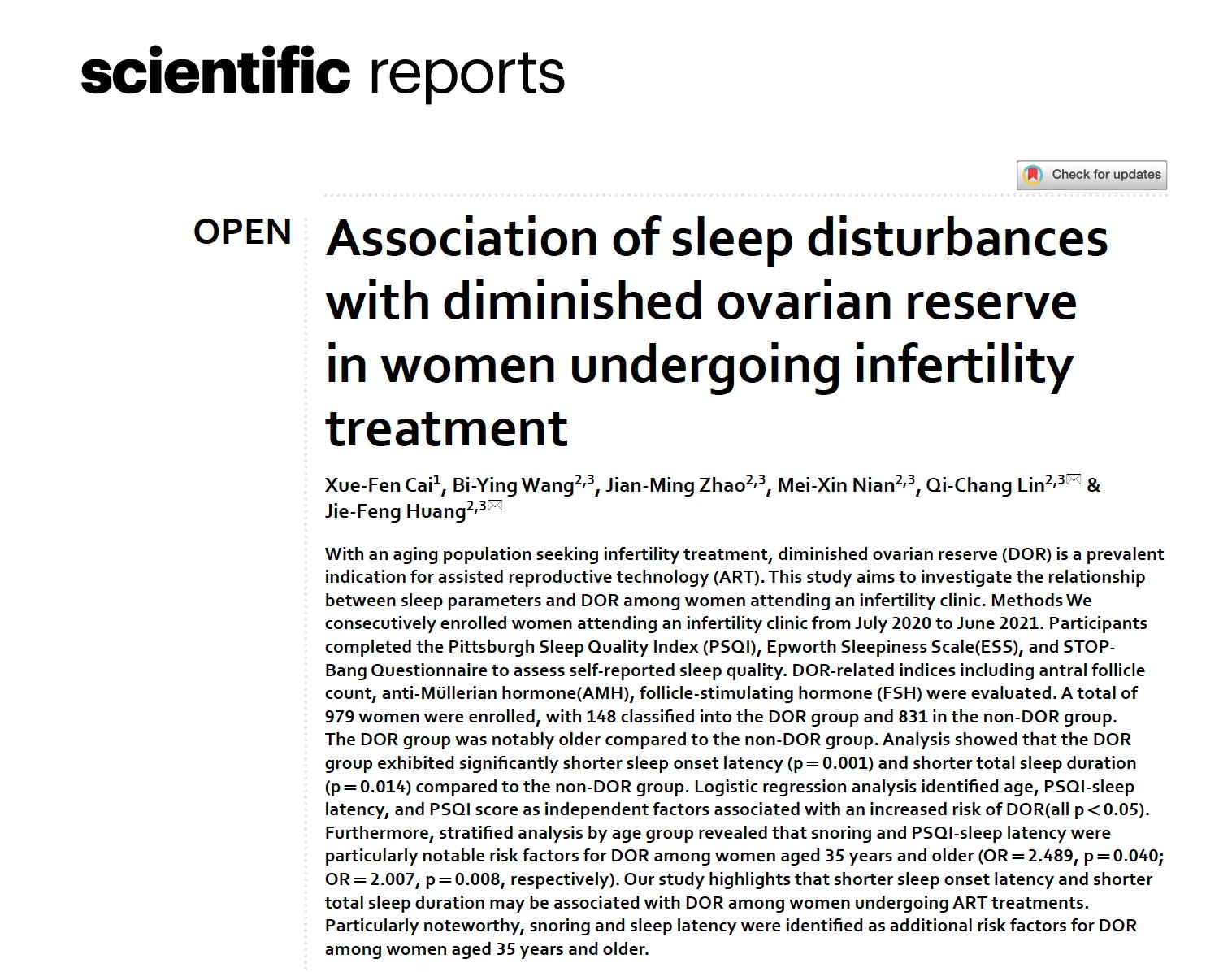
A study published in Nature Scientific Reports looked at nearly 1,000 women going through fertility treatment and asked a simple question: is how you sleep connected to your ovarian reserve (the size of the egg supply you have left)? And the answer was yes.
Happy reading (and get some sleep tonight),
XO, Nat.
Journal: Nature Scientific Reports
Why this study caught my attention:
When we talk about inflammation and lifestyle factors, I have a lot of patients who work hard on being healthy. But I see those same women apologizing for their lack of sleep every day, “I know I should sleep more, but…” They’ll overhaul their diet, add strength training, buy the supplements, track every symptom, but they ignore their sleep. We’ve built an entire culture that rewards exhaustion as evidence of a life well-lived. Being busy has been a badge of honor. I’ve heard more patients say “I only need 5 hours of sleep” than I can count.
But then this study showed that women with poorer sleep had measurably lower ovarian reserve, especially those women over 35. These are the years when the decisions you make have the most leverage over how you age, but you’re told you’re “too young to worry about menopause” and “too old to be fussing about fertility,” and in that gap, women suffer. This is the lost decade of opportunity.
This study doesn’t prove sleep decreases your egg supply, but when you understand why sleep and your hormones are so tangled together, you stop treating sleep as optional.
So today I am reviewing:
The relationship between sleep and reproductive function
A breakdown of this study
What is the connection between sleep and your hormones
What you should do to improve your sleep now and improve your hormones
The single most important thing you can do for your health, hormones, and fertility is improve your sleep quality. If I can inspire you to change one thing, let it be this. Sleep is an essential function that allows your body time to repair and decrease inflammation. It can be much harder to get pregnant if you are not sleeping well.
Unfortunately, over 30% of adults get less than six hours of sleep per night. Women need seven to nine hours to function properly. Sleep deprivation can be due to multiple physical factors, including insomnia and sleep apnea. But the top cause of sleep deprivation is our behavior: use of electronics and TV before bed, alcohol, and poor sleep habits (going to bed late and getting up early). How many times have you stayed up late to finish a project, scroll the internet, or watch Netflix? We live in a constant world where our sympathetic nervous system is always turned “on” and ramping us up.
Regardless of the cause, poor sleep is detrimental to your health in numerous ways. Sleep disturbances significantly affect your hypothalamus, resulting in metabolic changes, abnormal hormone response, and, of course, inflammation. In an attempt to conserve energy, not knowing when you will get proper sleep again, your hypothalamus signals to the adrenal glands that you are “stressed,” and more cortisol is released. At the same time, your brain decides this is not a good time to be pregnant, and the hypothalamic signal to the ovaries (FSH and LH) is suppressed, stopping ovulation and hormone production, resulting in low progesterone and luteal phase defects. In fact, women with poor sleep have double the risk of infertility. In a study of IVF cycles, for every one hour less of sleep a woman got, she had 1.5 fewer eggs retrieved.
Sleep and stress are deeply intertwined, as cortisol and melatonin—the hormone released in response to darkness, signaling your body it’s time to sleep—work in tandem. When you wake, cortisol levels are at their natural highest and decline throughout the day. At night, when cortisol is low, melatonin is released. Think of it as a scale. When one is high, the other is low. If unbalanced, this can lead to a dysfunctional stress-sleep cycle: if you are stressed and have more cortisol, you will have less melatonin and it will be harder to sleep, which will increase your stress and cortisol.
Decreased production of melatonin is not beneficial to our health and fertility. Melatonin is an important regulator of your circadian rhythm, your internal clock that regulates your sleep-wake cycle. Melatonin release varies throughout the menstrual cycle, with an increase around ovulation to decrease oxidative stress to the egg. In fact, supplementation with melatonin during IVF has been shown to improve egg quality. Disruptions to your circadian rhythm are associated with abnormal hormone production, decreased fertility, and poor pregnancy outcomes. Higher day-to-day sleep variability is associated with longer time to pregnancy.
You cannot be your healthiest self if you are not sleeping. In addition to increased inflammation and stress, lack of consistent sleep also leads to an inability to heal and decreased immune function. When you have less time to sleep, you also do not have time to make the hormones your body needs. Your gonadotropins are increased at night, human growth hormone is secreted at night, and melatonin initiates to sleep response pattern. Getting proper sleep allows your body time to make these important hormones.
Comments
Nothing yet. Say the first thing.
Sign in to join the conversation.