
© Natalie Bennett (Gel plate print)
How do we understand the world? Who does the interpreting of relationships between states? Who helps explain their home nation’s place in international hierarchies and the ways in which its internal structures impact on global actions? Having had extensive exposure over the past year to a range of the academic field broadly called International Relations (IR), it has been striking how traditionalist, how narrow, how limited its understanding, and practitioners, largely remain. Which was why Oxford professor’s Patricia Owen’s text Erased: A History of International Thought Without Men, leapt out at me on the library shelves.
A work of what Owen describes as “recovery history”, in tracing a century of academic politics, manouevring and intellectual endeavour (all too often down dead-ends), it is more than a lively account of ivory tower conflict. It helps us see why so much thinking – which still guides international policy - has failed to engage with 20th-century realities, let alone 21st, has sought to maintain failed, broken models of relationships between states. And why, in many years of exposure to history, sociology and political economy, I’ve encountered few texts and writers labelled as IR scholars who seem to have made an impact outside their field. Owen explains:
“This book is both a recovery history and a critical history of a scholarly field. It turns out that much of the history of ‘British IR’ is a story of men who hated women, and the intellectual and institutional legacies of misogyny and racism in its earliest institutions, including Chatham House, the British Coordinating Committee for international Studies (BCCIS), founded in 1928, the Department of International Studies (later Relations) at the London School of Economics (LSE), founded in 1927, and the British Committee on the Theory of International Politics, founded in 1959… Not all the men were mediocrities, misogynists and racists. However, one figures stands out as all three. He also happened to do more than anyone to shape 20th-century British IR. Charles Manning (1894-1978) was a white supremacist South African legal scholar who held the most senior position in Britain’s largest IR department for 32 years, the Montague Burton Professorship of IR at LSE. … published little but devoted himself to establishing international relations as a separate university subject. Under his influence an interdisciplinary field that included disciplined and trained historians, lawyers, anthropologists, classicists and others was transformed into a field with no specialist methodological training at all. He conceived the new IR specialist as a ‘Superman’, meaning an expert in no one scholarly method or discipline, rather an amateur in all of them. British IR’s intellectual standing and even legitimacy never recovered, and its relation to its two closest disciplines, political science and history, never settled. Some of Manning’s modes of thought are still present in the norms of the field today.” (pp. 11-12)
Of course British IR has its own origin and development story:
“One of the most widespread and now obsolete claims about IR’s intellectual history: that the main story of the field is progression through a series of ‘great debates’ beginning in the 1920s between so-called ‘Wilsonian idealists’ who sought to reform great power politics through international institutions and hard-headed ‘realists’ more ‘directed towards building up an empirical or causal science’ to study the relations between great powers. This was followed by a debate between social science behaviourists and more historical traditionalists in the 1950s and 1960s; an ‘inter-paradigm debate between realists, liberals and Marxists in the 1970s and 1980s; and between rationalists/positivists in the 1990s and 2000s.”
Despite the misogyny and prejudice, many white middle-class women were the prominent figures in IR, many of them shaping it in ways now little acknowledged. Although sometimes they were expelled, or stepped out.
Owen takes us to Aberystwyth in 1919, where French music scholar Lucie Barbier, a “trailing spouse”, of French scholar Andre (arrived in 1909) had taken control of musical affairs as part of a cultural and geopolitical mission to grow international understanding and peace.
“Long before the world’s first IR professorship was founded through the Davies’ patronage, Barbier persuaded the sisters to donate £75,000 to fund a new Department for Instrumental Music… later, in 1951, she told an interviewer that music and world politics were ‘her life’ and ‘closely allied’. ‘Both Arts of movement – they are meditation put into movement, and are almost always truthful.” (p. 24)
Those who think universities now are unusually riven with infighting and conflict might want to read this chapter, to encounter the extremely rhetorically violent conflict when Barbier broke off with her husband and married holder of the Wilson Chair in IR Alfred Zimmern (already divorced) “in the conservative and Methodist town”. “Matters were ‘raised to a high pitch’ when the Zimmerns, now married, took rooms in the Queen’s Hotel on the seafront and met with students. … One anxious local wrote to [David, college vice-president] Davies that ‘there would not be the same objection if Prof Zimmerman came alone’.. Yet, replied Davies, Zimmern had just as much right as anyone to stay at the hotel. ‘I am not a Trade Union leader. I cannot suggest any means of prevention as I presume that picketing would hardly be dignified.” (p. 25)
Yet the couple were eventually driven out, and moved to found the Geneva School of International Studies, often referred to as the Zimmern School, in 1923. It continued until 1939. Yet, “in contemporary IR historiography… if referred to at all, Lucie Zimmern is usually only mentioned as the cause of Alfred’s resignation from the Wilson Chair… IR historiography has scarcely moved on beyond centring the singular white male canonical thinker.” (p. 27)
“One of the numerous internationalist educational initiatives of the 1920s, the Zimmern School was the most influential during its time. The Zimmerns attracted numerous high profile figures to lecture, including John Maynard Keynes, Jane Addams, Halford Mackinder, Arthur Salter, Rachel Crowdy and Lewis Mumford. They also invited junior academics associated with the new IR field including Lilian Wranek, nee Friedlander, assistant lecturer at Zimmern’s erstwhile department in Aberystwyth and Agnew Headlam-Morley, later Alfred’s successor as Oxford’s Montague Burton Chair. … The school’s Executive Committee was based in New York, with a large proportion of women members, including Virginia Gildersleeve, co-founder of the International Federation of University Women, with her partner, Caroline Spurgeon…. The deputy director was Yale Professor Nicholas Spykman, a ‘decisive’ figure in the dominant realist approach to American IR after World War II.” (pp. 28-9)
“While students were taught ‘the technical aspects of international relations, including international economics, law and organisation, the school was also ‘devoted to the culture and institutions of the various nations”. In Lucie’s classroom, this incorporated gender, race, class, religion, history and culture. Students were expected to examine their own prejudices, asking how their ‘qualities of thought’ were ‘traceable’ to their national histories and cultures… attended evening lectures on ‘Eastern thought’, focusing on Chinese and Indian intellectual traditions.” (p. 31)
It was ahead of its time from our perspective (although perhaps rather standard in its own), but still had the prejudices of its time. “Cultural, not political Zionism was Alfred’s model for imperial reform and a new world order led by the English-speaking peoples.” (p. 39)
Owen then moves on to what is now Chatham House, which has, Owens reports, its origins in the Second Boer War (1899-1902)
“Britain’s elites grew increasingly anxious about the quality of what was perceived as Britain’s racial stock, continual rebellion in the colonies, and increasing geopolitical competition from Germany, Japan and the United States… Imperial frontiers were closing; colonial administration and inter-imperial relations had to be managed on a worldwide scale…Lionel Curtis famously proposed a series of affiliated institutes for the scientific study of ‘international relations’ at the sidelines of the Paris Peace negotiations in 1919. .. the new intellectual field was obviously and intimately connected to the management of empire.” (p. 25-6)
This was all, of course, heavily male-dominated in the historiography, yet as Owen reports, often taught by women.
“The leading white British thinker on empire from the 1930s to the 1970s, is Margaret Perham. She first made her name and reputation as a respected interlocutor and gentle critic of the Edwardian generation of imperial men … By the late 1940s and 1950s, when Perham’s ideas on imperial government had superseded that of the Round Table generation, she became mentor and patron to one of the most revered international theorists of post-war Britain, Martin Wight, influencing his ideas on trusteeship and international society…. The Australian Mary Bull, another ‘IR wife’ was Perham’s longterm researcher, collaborator and later expert on the historical figure of Perham herself, as she followed her husband Hedley Bull from Sydney to Oxford in 1953. Mary Bull’s personal copy of the catalogue of Perham’s voluminous papers was advertised and sold (to me) from the ‘library of Hedley Bull’.” (p. 47)
You can still listen to Perham’s Reith lecture from 1961.
“Perham was official Britain’s enlightened and knowledgeable conscience on empire. As postcolonial scolar Priyamvada Gopal has recently observed, in this role she actively engaged with anticolonial critique, all the better to reform the empire, to increase its virtue and longevity. In no sense was Perham a model white interlocutor. Yet her erasure from IR … also indirectly delayed IR’s reckoning with Black internationalism and anticolonial thought.” (p. 47)
Her academic power and influence was considerable.
“By 1939, Perham had dispensed entirely with undergraduate tutoring, becoming the first Official Fellow of Nuffield, a graduate-only college in Oxford which ‘was built around her’. During the war, the British information service tasked Perham with shifting opinion on the empire in the United States. She duly toured the US speaking at universities and luncheon clubs and writing for Foreign Affairs. Perham played on white America’s racial anxieties to explain and justify Britain’s predicament in Africa. She evoked white stetler fears that if Britain removed its ‘arbitral power’, then this would lead to their ‘utter submergence … under a vast flood of barbarism,’ evoking witchcraft, tribal war, ‘cannibalism and the ritual murder and the pawning of children’”… The British Empire was ‘a setting and a training ground for weak and immature groups’ that would all need to be incorporated into a new world order after the war.” (p. 51)
For her, however, anticolonial demands and calls for immediate self-government came from refusal to grant respect.
“Content enough with British rule for fifty years, Perham claimed, Africans were now told that their status was ‘shameful’. For African nationalists ‘it was not so much that the British had come to rule over the Ibo or the Luo… No, it was white men who had mastered black men all over the Africa and all over the world… The quality of colonial government, lamented the tutor of colonial administrators, ‘seems to make no difference to the violence of the new rejection’. This was Perham’s explanation for why Britain was such a target of reaction. Framce had given educated Africans greater social and political status. More than once, Perham pointed to the transnational Francophone literary amd political movement of the 1930s, negritude, and its notion of a special African personality, suggesting there was nothing comparable in the Anglophone anticolonial tradition.” (p. 200)
Back at Chatham House, the Royal Institute refused all government finance “though it received funding from banks, corporations, and philanthropic organisations like the Rockefeller Foundation and Carnegie Endowment.” Its claim to being “non-ideological” – always beware such claims! – rested on its assertion that what it was doing was gathering and disseminating reliable factual information on which others could make judgement. So, Owen says, Margaret Cleeve, head of its Information Department, was a key, arguably THE key, figure.
Owen says she has to talk about the men, and she does. Bluntly.
“It was not very clear what a ‘separate’ IR had to offer intellectually… three leading advocates for IR as a separate subject in 1950s Britain, all based in London. The most influential was Charles Manning… assisted by another LSE man, his successor as Montague Burton Chair, the British economist and Foreign Office mandarin Geoffrey Goodwin. German Georg Schwarzenberger, professor of international law and relations at University College London, was the third, another outlier in reaching IR with no historical training… these men, two lawyers and an economist, became obsessed with distinguishing IR from history, with disastrous intellectual, gendered and racialising effects…. Manning envisaged a field filled not with supermen but covetous dabblers… fetishised the norms and rules of the white ‘society of states’, erased the history and politics of imperial domination, and authorised empathy for racial apartheid.” (p. 103-5)
But next in the impressive array of women assembled by Owen is Eileen Power.
“She was Britain’s best-known medieval historian in the interwar period, as well known during her lifetime as her contemporaries RH Tawney and Marc Bloch…. Pioneering in the fields of economic and social history, founding the Economic History Review and co-founding the Economic History Society. She was also at the forefront of establishing women’s history as a core university subject and in collaborations across historical and social science… a public historian and intellectual, committed to writing internationalist textbooks for children and broadcasting regularly for the BBC. .. Social and economic history as practiced by Power was international and world history, crossing countries, civilisations and periods… a world-historical vision that – unlike her contemporaries HG Wells and GP Gooch – was not rooted in a view of universal progress towards ‘Western’ modernity.”
And that lack of theory had a distinctly gendered perspective.
“Did not identify with any theoretical ‘school,’ nor did she seek to found one… nonetheless… comparable to the first generation of the Annales School in France, particularly the work of Marc Bloch and Lucien Febvre. … The ‘new’ historical writing of the 1920s and 1930s, of which Power was one of the leading practitioners, reflected a conscious shift away from the political and constitutional history privileged by new scientific historians in the academy during the 19th century. As historian Bonnie Smith has shown, … established in opposition to so-called amateurism. This was a gendered opposition defined against and considered superior to the historical work of ‘amateur’ women historians.” (p. 125)
Yet another prominent woman now appears: Agnes Headley-Morley, Oxford University’s first woman professor (appointed 1948) and longest holder of British IR’s most prestigious chair, the Montague Burton Professorship. Her appointment:
“Is said to have sent shockwaves in certain circles, taken as evidence of a ‘disastrous decline’ not only of IR as a scholarly enterprise, but the fate of the Anglosphere itself.” Unmarried, her academic and teaching interests were assumed to have been inherited from her father, “famed diplomatic historian, Foreign Office advisor and propagandist Sir James Headlam-Morley.”
Deputy director of studies at Chatham House, Roger Morgan, claimed that Oxford’s ‘purely historical approach’ was ‘notorious’… in 1988 Susan Strange repeated the claim that international relations at Oxford consisted of the history of the League of Nations and the diplomatic history of the inter-war period and it is only only recently that this has changed’.”
Owen’s defence:
“Like most mid-century international relations scholars in Britain, Headlam-Morley counted herself among the historians rather than a pioneer for a new ‘discipline’ without a method. After three years in the Montague Burton Chair, historian EW Woodward did not create a separate IR graduate degree either… She had no shortage of students writing on international relations, Merze Tate among them, and she taught and wrote far more widely than her critics suggest… for most IR scholars the contemporary alternative to diplomatic and contemporary history was to import theories and methods from the functionalist sociology, behavioural social science, and/or so-called ‘realist’ theory from the United States.” (pp. 161-2)
Owen adds:
“Agnes Headlam-Morley is in now way deserving of hagiography. But when read properly she emerges as far more interesting; and certainly no more flawed than contemporary men and women of similar racial and class position: author of right-wing counterpoint to Eileen Power and F. Melian Stawell’s left and liberal pro-League writings for wider publics and schoolchildren; an experienced political campaigner, party activist and would-be Tory MP; a lifelong supporter of Chamberlain’s policy of appeasement, with ‘no secret shame in being half German’, nor in arguing for Germany’s fair treatment after both world wars; a figure who strategically deployed her position as daughter of an intluential diplomat, but whose politics was more influenced by her mother, Else Sonntag, than her father; a shaper of post-war Anglo-German relations; translator of Bertolt Brecht, and author of a novella that prefigured attempts to represent German civilian suffering during World War II; a famed salon hostess, considered one of the ‘best known social and academic figures in Oxford’.” (p. 165)
Neither the British Committee on the Theory of International Politics, founded in 1959, nor, outside Oxford, IR, including at the LSE and Aberystwyth, was empire considered a core subject. “By 1972 and the publication of The Aberystwyth Papers, the discussion of empire was transmuted into an essay on the “Problems of the Developing World’ written by economist and journalist Barbara Ward.” (p. 186)
“Consider what some regard as an ‘iconic’ text of mid-century British IR, Herbert Butterfield and Martin Wight’s 1966 edited volume Diplomatic Investigations… assembled at the height of decolonisation, there is nothing on the British Empire, its history, current form, and legacies. Yet numerous essays use secondary sources to generalise about the medieval ‘universal empire’, the Holy Roman Empire, the empires of Alexander the Great, the Ts’in, the Moguls, the Swedes, the Ottomans, the Hapsburgs, Napoleon, and Imperial Germany, the Krupp empire, and Lenin’s theory of imperialism … only a constitutive erasure could sideline something of such historical and political importance for the context and supposed content of this ‘seminal’ piece of work.” (p. 188)
Yet at the same time, Owen identifies Claudia Jones as one of the most influential international thinkers of the 1950s and 1960s. “If CLR James is ‘the magisterial, world historical intellectual of the 20th century anglophone Caribbean,’; then Jones is the even more impressive ‘female political and intellectual equivalent’. As a Black Marxist feminist woman from a British colony who worked through journalism, political essays, organising and campaigning, Claudia Jones’s absence from British IR’s intellectual history is entirely over-determined… She was internationally renown during her lifetime, received by Chairman Mao on her last international trip to China. Diplomatic delegations from Africa, Asia and Latin America attended her funeral in 1965, which was ‘the first really big Black funeral that London ever saw’. .. She was laid to rest at Highgate Cemetery in the plot immediately to the left of Karl Marx, which, her biographer notes, literally and figuratively represents Jones’s historical place in the development of radical left thought in the 20th century.” (p. 210)
She founded, edited and wrote for “Britain’s most important organ of Black journalism”, the West Indian Gazette. And was key to the foundation of the West Indian (later Notting Hill) carnival. “Jones rekindled ‘an indigenous black British political leadership’ at a time of anti-Black riots across England and pervasive discrimination in employment, housing and everyday life.” (p. 210)
While traditional analysis of West Indian migration focuses on Britain’s need for labour,
“For Claudia Jones, the most relevant context for mass migration was the continued economic subordination of the West Indies. Despite living in territories rich in natural and mineral resources, Britain’s looting and deliberate under-development of colonial territories meant that most Caribbean people lived in poverty. The entire regional economy, Jones wrote, was “distorted to serve the interests of an accumulation of super-profits” by the “big imperial combines and trusts”. In addition to the 1950 McCarran Internal Security Act that restricted Caribbean migration to the United States, Jones argued that the demise of the West Indian Federation also forced people to migrate… Jones vigorously supported the attempt to establish a new postcolonial political federation across the Caribbean islands ‘ in which freedom of movement would have absorbed swome of our disinherited, disillusioned and un-filled people…. With ‘illusions’ about the ‘mother country’, Jones thought many West Indians were shocked at their treatment. They had been taught in Caribbean schools that they too were citizens of the Crown. But the only British workers allowed to enjoy the new welfare state, employment and spoils of empire were the so-called ‘white working class’. ” (pp. 218-19)
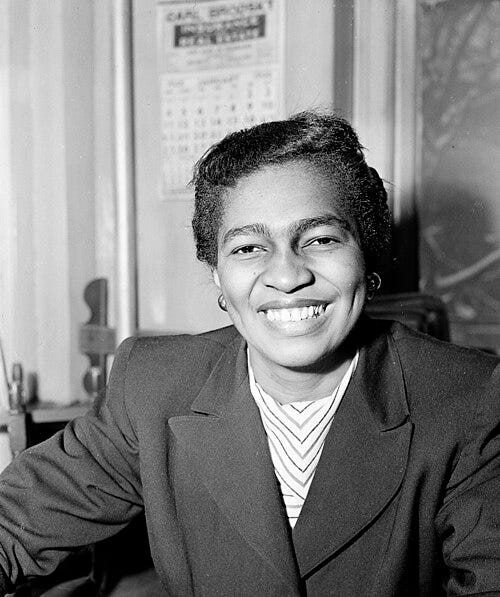
Back at Chatham House after the War, Owen focuses on Australian Coral Bell, preparing The Survey of International Affairs under the hands-off overview of Arnold Toynbee.
“Though she became quite the intellectual insider herself, Bell claimed to have shocked some of the ‘old hands’ at Chatham House by placing ‘two non-European issues’ at the centre of the Survey. She wrote about the significance of the battle of Dien Bien Phu in the Vietnam War… and included a section ‘Atoms and Strategy’ on the implications of nuclear weapons for international relations. The profound intellectual and political conservatism of Chatham House … Bell could pose at least as ‘very radical and daring’ for suggesting in the mid-1950s that nuclear weapons would be central to the superpower relationship and ‘most of the sources of trouble might be in the Third World’.” (p. 239-240)
Perhaps one of the biggest figures Owen covers is Susan Strange, celebrated today by LSE as “easily the most influential figure in the academic field International Relations (IR) in late twentieth-century Britain”. Owen notes she “derided the attempt to establish an intellectual geneaology for IR ‘spanning allegedly from Thucydides to Machiaevlli, Hobbes, Rouseau and Morgenthau.’”(p. 281)
She thought “the study of international (that is intergovernmental) relations was only a branch of international political economy, as diplomatic history had been a branch of international political economy… her legacy of an intellectually open and ‘eclectic ‘IPE’ faltered, especially in the United States, ignored in the contemporary fad for hypothesis testing.” (p. 282)
She “mocked Britain’s pretensions after the end of empire and had little time for the Commonwealth (‘a kind of methadone to the heroin addict’) yet she loved the United States, supporting its leadership role in world politics…. She was not outside the ‘Establishment’, but, like Perham, she was helping to reform it. Perham most successfully reconcited British popular and intellectual opinion to the realities of the loss of empire. She took the anticolonial claims at the Afro-Asian Bandung Conference of 1955 and the Tricontinental Conference of 1966 seriously, all the better to counter them. Susan Strange was writing at a time when these movements were largely defeated. However, she was the Perham of Britain’s international economic decline, the acceptable dissenter, a figure representing reformist improvement of the international economic and financial architecture against the radical transformative demands of those calling for a New International Economic Order…In distancing herself from feminism, the mother of six also became the perfect alibi for others in the field who were resistant to analysing or radically changing the gendered hierarchies of IR.” (p. 289)
So while there’s lots of interesting, important women’s intellectual history here, there is not, beyond Claudia James, much of an offering of alternatives. For that, looking elsewhere is clearly essential. I’m open to suggestions in the comments!
Understanding and recovering tragedy: Important work on the smallpox epidemic that the First Fleet invaders brought to indigenous people in Australia.
“Elders, children and pregnant women were especially vulnerable, meaning that knowledge, language and culture suffered deep harm alongside population loss. Even survivors were severely compromised and could often not care for the country in the same way as before the infection.”
What did you think?
You can also find me on Bluesky, Instagram, Facebook, LinkedIn, TikTok and X.
Comments
Nothing yet. Say the first thing.
Sign in to join the conversation.