
Earlier this year, we published a note to our portfolio arguing that the user group operating your software will not be human within a few years. That was a fundraising piece. This is a product piece. A specific manifestation of that prediction, playing out right now in tools that millions of developers use every day.
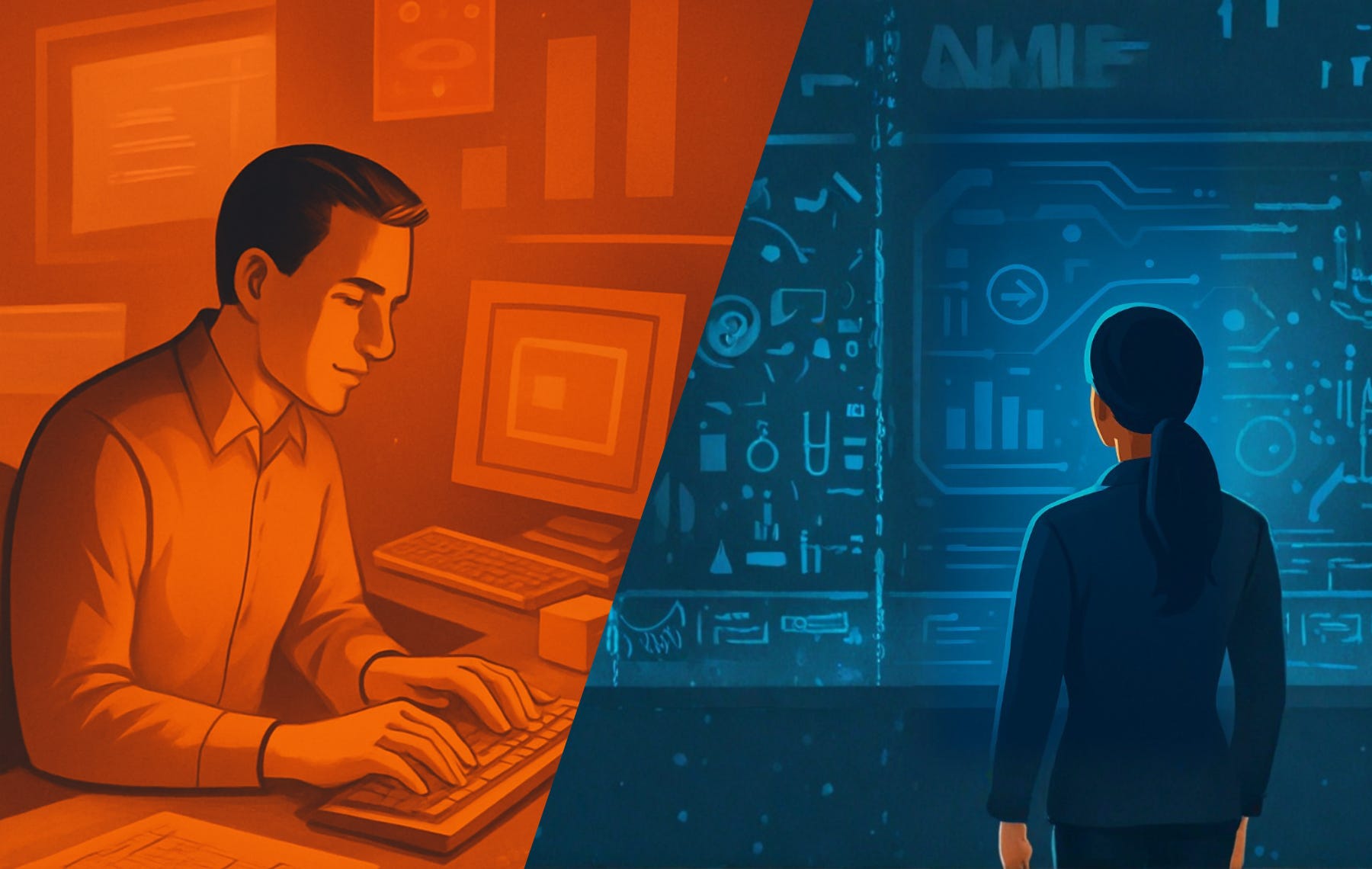
The thesis is simple: the interfaces we rely on to understand what is happening inside our organizations were designed for human cognitive speed. Agents don’t operate at human speed. So the interfaces break. Not because they crash, but because they stop being useful.
In December 1968, Douglas Engelbart gave what became known as “The Mother of All Demos” at the Fall Joint Computer Conference in San Francisco. Over 90 minutes, he showed the world windows, hypertext, a mouse, collaborative editing, and video conferencing. The audience gave him a standing ovation. They had just witnessed the future of computing.
Engelbart’s ideas flowed directly into Xerox PARC, where Alan Kay and his team built the Alto in 1973, the first computer with a graphical user interface. Apple saw it, built the Macintosh, and the rest is well-documented history. Every operating system, every SaaS product, every mobile app we use today traces its lineage back to that same set of ideas.
In 1983, Ben Shneiderman formalized the core principle underlying all of this in his seminal IEEE paper, “Direct Manipulation: A Step Beyond Programming Languages.” His insight was that great interfaces provide continuous representation of objects of interest, together with rapid, reversible, incremental actions and feedback. The key word is incremental. Everything about this model assumes a human in the loop. A person who looks at the screen, thinks, decides, acts, and then looks again. A person who updates maybe a handful of things per hour. A person who needs spatial cues, color, and layout to maintain a mental model of what is going on.
This was an extraordinary breakthrough. But it was, implicitly, a contract: software will change at the speed of the humans operating it. For sixty years, that contract held.
It no longer does.
Let’s make this concrete. Take Jira or Linear, the kind of project management tools that most product and engineering teams use daily. A Kanban board works because it gives you a spatial snapshot of where work stands. When you glance at it, you see four cards in “In Progress,” two in “Review,” one in “Done.” You check back in a few hours and cards have moved. You develop an intuition for the pace and health of a project.
Now imagine that AI agents are implementing features around the clock. Cards don’t move every few hours. They move every few minutes. Or seconds. The board becomes a blur, not a snapshot. You open it and have no idea what you’re looking at, because the state has changed dozens of times since you last checked. The spatial metaphor collapses. The board is not broken in a technical sense. It is broken in a cognitive sense: it was designed for a cadence that no longer exists.
GitHub is the same story, only more advanced. One could argue that pull requests create a paper trail, making agent work trackable and auditable. In theory, yes. In practice, the numbers tell a different story. The 2025 GitHub Octoverse report showed that merged pull requests increased 29% year-over-year, driven largely by AI coding assistants. An academic study presented at the MSR 2026 conference analyzed a dataset containing over 930,000 agent-created pull requests across more than 116,000 repositories. The sheer volume is staggering. GitHub’s own 2026 outlook acknowledged this, drawing an analogy to a denial-of-service attack on human attention. The review burden has grown faster than the reviewer pool.
This is not a theoretical problem. It is happening now, in the tools your engineering team uses every day. Every CRM timeline flooded with agent-logged activities. Every project tracker updates faster than anyone can parse. Every dashboard where the numbers shift before you’ve finished reading them.
The fundamental contract of direct manipulation, that interfaces change at human speed, is being violated by the very tools we depend on.
So what does this mean if you are building software today?
When agents do the work, the human UX can no longer be about doing. It needs to be about understanding. Think of it as the difference between a workbench and a cockpit. A carpenter’s workbench is designed for hands-on manipulation. An airline cockpit is designed for monitoring complex systems, setting parameters, and intervening when something goes wrong. Most SaaS products today are workbenches. They need to become cockpits.
This is not just a design refresh. It is a fundamental rethinking of what the product even is. A tool like Linear, for example, would need to answer a very different question: not “where should I drag this card?” but “what did the agents do last night, and should I be worried about any of it?” The human interface becomes a summarization, exception-handling, and decision layer sitting on top of an agent-driven execution layer.
This is also where it gets interesting for founders. Incumbents in enterprise software built their moats around workflow complexity: intricate UIs, deep integrations, steep learning curves, and high switching costs. All of these assume a human operator who has invested time in learning the system.
Agents don’t care about any of that. They don’t need an intuitive drag-and-drop interface. They don’t suffer from switching costs. They work through APIs and structured data. Which means the very complexity that protected incumbents becomes dead weight. Entrenched players will have an extraordinarily hard time rearchitecting products that were built, over many years, around the assumption that a person is clicking buttons. For founders willing to build from scratch, this turns red oceans into greenfield opportunities.
And it forces existing vendors into an uncomfortable fork. Companies like Atlassian, Linear, or Salesforce need an agent-facing surface (APIs, structured protocols, machine-readable state) and a human-facing surface (summaries, alerts, strategic dashboards). These are not two themes of the same product. They are, increasingly, two different products. And trying to serve both from a single interface designed in 2015 is a losing proposition.
We are at an inflection point that resembles the command-line-to-GUI transition of the 1980s, but in reverse. Back then, we moved from abstract text commands to visual, spatial, directly manipulable interfaces because humans needed them. Now, we may need to move from those visual interfaces toward something more abstract again, because the primary operator is no longer human.
The irony is sharp. Sixty years of painstaking work to make computers intuitive for people, and now we need a new paradigm because the “user” increasingly isn’t one. Every software company building tools for knowledge work needs to confront this. Not next year. Now.
The user is gone. The UI should follow.
No posts
Comments
Nothing yet. Say the first thing.
Sign in to join the conversation.