
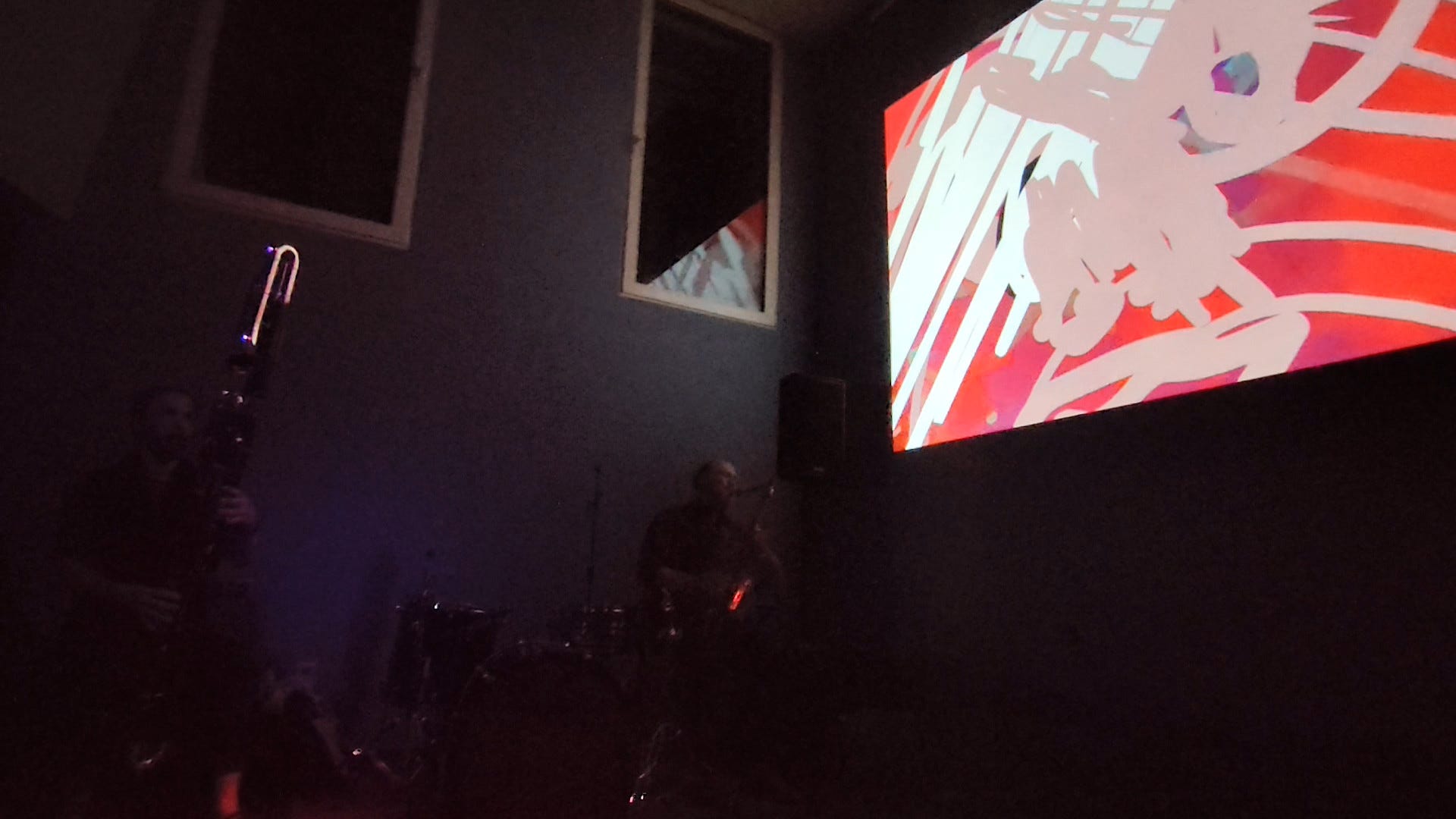
I’m writing this as I’m taking a day recovering from a performance the previous night at Ausland Berlin, a recording of which you can find on my Performances page. I’ve been slowly picking up my third semi-professional field of playing my contrabassoon, and last night I was part of the opening act in a “blind date” setting with a couple other improvisers, followed by a rapid-fire set of small groups put together from the people attending the show.
The whole thing went really well, and I had a great time; but as there were a lot of different ways of improvising showcased, and as I’ve been spending the last few months attending performances in Berlin’s lively “Echtzeitmusik” scene as an audience-member myself, it’s gotten me thinking about how people improvise, and to speculate on why they do it that way.
I come from a very different background as an improviser than most of the people active in the scene: I’m classically trained, and playing probably the most niche and elitist instrument in any setting. On top of that, my more recent background as a scholar of graphic scores has put me in a frame of thinking that is decidedly different from that of most (if not all) of my colleagues, so I thought I’d spend some time here making the case (in characteristically objective fashion, of course) for why the way I do things is inherently superior to whatever those other people are doing.
I’m going to start by laying out one of two general categories of what I consider bad improvisation, and do my best to explain why it’s bad for more than some simple reason of personal taste.1
I characterize it as a situation involving a collection of soloists who happen to find themselves on the same stage and are all waiting their turn to speak. Each person has a bunch of material (or textures, or figures, etc.) that they want to send out into the space, and they’re only listening to the extent that they’re waiting for an opening to do so. I’d describe this kind of improv as largely ego-driven, and furthermore æsthetically uninteresting as it lacks any real depth or complexity. The possibility for collaborative processes is extremely limited, and the possibility of spontaneity only exists to the extent that the individual musicians are not planning in advance which of their internalized habits they’re going to bring out at any given moment.
This is the kind of improvisation that theorists were complaining about already back in the 50s, as playing under these conditions only really allows for the musicians to reproduce previously learned clichés and patterns. It depends to a great extent on faculties as Frankfurt philosopher Christoph Menke defines them: previously learned abilities that belong to that individual, acquired through targeted and goal-directed exercise. They are, in short, almost an entirely unfettered and individualistic expression of personal autonomy.
What I keep thinking about on this is a conversation I had in early 2025 with composer Mathias Spahlinger, as part of my research project into his teacher, Erhard Karkoschka. We were talking about graphic scores as a social phenomenon among the postwar students in West Germany, and he—with an extensive background in jazz and improvisation—said the following:
… also der Ursprung von der Zustimmung für improvisierte Musik kam aus einem anti-autoritären Bedürfnis.
(Die freie Demokratie, in der jeder für sich selbst entscheiden darf.)
Also mit allem Für und Wider und allen Einschränkungen und praktikablen oder weniger praktikablen Lösungen und die ganzen Grundsatzfragen.
My translation:
… and so the origin of the endorsement of improvised music stemmed from an anti-authoritarian impulse.
(free democracy, in which each can decide for themselves)
… with all the pros and cons, all the limitations, and all the solutions—some practical, some less so—and all the fundamental questions.
I think a great deal of postwar Europe’s embrace of American jazz, and free improvisation in general, arose from a need to reinvent the structures of music-making to combat the frankly authoritarian social structures that pervaded music organizations at the time. The cliché of tyrannical orchestra conductors was very firmly grounded in real experience (not least because quite a number of famous postwar conductors in West Germany were whitewashed collaborators), and the same structures existed in music schools as well.
And so it’s not difficult to understand why young musicians would gravitate toward forms of music that were explicitly built around individuals, each with an equal right to say what they wanted, without the straitjacket of conventions, rules, or authorities telling them no. I’m reminded of John Lennon in the mid-60s, visiting an exhibition of Yoko Ono’s work, and how liberating he said it was to read, on a small white card, the simple instruction, “yes.” For a young, restless hippie, surrounded by suffocating limits and rules and authorities telling him “no,” it was liberation.
There is something deeply affirming in this kind of autonomy, and it’s not at all difficult to see why so many improvisers attach a strong political value to this form of music-making.
But here is where I am going to have to go very deep into the weeds: because I fundamentally believe, after years of working not only with musicians operating under this mindset, but from talking to so many people in general life who share it, that while unfettered individualistic autonomy might seem like the counter to authoritarianism, as Spahlinger described it, it is actually the opposite side of the same coin. To counter authoritarianism, a social practice must be capable of actually countering authoritarian systems, and everything about my experience of the recent world has led me to believe that this particular approach does the opposite, and that this is, in fact, one of the major social failures of the 20th century.
Let me take a step back and indulge in some pedantry out of my casual interest in studying espionage, particularly as practiced by the Russian state. Here in Germany, in the most recent federal elections the traditional strong-left party, Die Linke (which literally means “the left [ones]”) found themselves sitting next to a new party made up almost entirely of their former members. This new party, the BSW (for “Bündnis Sahra Wagenknecht,” named after its leader) held a number of positions that are not remotely “leftist” in the usual sense: anti-immigrant, anti-Ukraine, anti-EU, and pro-Russia. By all reasonable observation, they appear to be a Russian proxy party, not unlike the very obvious Russian proxy party, the AfD (“Alternative für Deutschland”).
But it’s an open secret that the AfD is a neo-nazi party, as hard right as you can get without being openly fascist. The part that one might be inclined to ask here is why the Russian government, presuming it to be a political body concerned with promoting its values in other countries, would support two such diametrically opposed parties. I suppose you could imagine that all those former Linke members were never really leftists in the first place, but you’d be forced to acknowledge that for much of the twentieth century, a leftist party is where a bunch of tankies would usually end up.
The reason why the Russian government is apparently supporting two parties at opposite ends of the traditional political spectrum is because the Russian government is not pursuing its interests in the manner of a western democracy. Rather, a lot of Russia’s foreign activities are driven by Chekism (named for the Cheka, predecessor to the KGB and where the techniques were perfected). The goal is not to persuade other countries to share your values, but rather to paralyze those countries from within so they are unable to act. Russia does not want a strong left-aligned or right-aligned party in Germany in order to have a political advocate; rather, Russia wants two parties screaming at each other constantly, each living in mutually exclusive versions of reality, so that no political reality exists, and so that most of the population gives up trying to make decisions, and the country collapses.
It is the same reason why Russia funded the UK’s Brexit campaign through local proxies: not because they want an anti-immigrant nationalist government in the UK, but to split off one of NATO and Europe’s strongest members, weakening both and tying them up in endless squabbles as they argue over tariffs, taxes, and the legal quagmire that Brexit has caused. It is the same reason why the current US administration is probably the single greatest asset the Russians have: if you look at the US right now, a country that was once the beacon of democracy and freedom for decades after WWII (even though mostly a fiction) is plummeting with dizzying speed into a failed-state internal collapse. There are effectively three factions in the United States: 30% are democrats mostly aligned with reality, 30% are MAGA and live in a bizarre fascist fever-dream, and 40% are so disgusted from decades of watching the other two groups trying to destroy each other that they’ve thrown up their hands, declared they “don’t follow politics,” and have checked out. The most powerful military on Earth is, as I write this, being brought to its knees by the Iranian regime, of all things, mocking them on twitter while occasionally demonstrating their resolve by lobbing a missile or two across the Persian Gulf, largely because its mechanisms of governance have ground to a halt.
And so we find ourselves, or at least we do in the very small, very niche community of experimental music, engaging in practices of music-making that were supposed to undermine and oppose fascism. But if we look out into nearly any other domain of human affairs, where those practices have been taking hold as the dominant ethical paradigm of social practice, we witness the societies built atop them sliding into fascism nonetheless.
I fundamentally believe that ethics and morals are inseparable from æsthetics: that good art is a moral good, and that its exercise is conducive to a social good as it serves to propagate those practices into society through culture. I also believe, to borrow a currently popular phrase, that the purpose of a system is its outcome, and thus a system should be judged by the outcomes it produces.
And so I return to explaining why bad art is morally bad, and not merely subjectively bad. Stated plainly, I believe that improvisation based on the principle of unfettered individual autonomy is ethically bad: because isolated individuals, each insisting on their own reality, planting their own individual flag and claiming their space, insisting that nobody gets to tell them no, do not have any means at their disposal to oppose authoritarianism. To the contrary, they will find themselves arrayed mostly against one another, leaving the authoritarian structures of society at large mostly intact, and leaving those in power free to act as they please. That kind of individualism might be anti-authority, but it is not (pace Spahlinger) anti-authoritarian.
What would be an anti-authoritarian form of music-making would be one conducive to the social structures best able to oppose authoritarianism. Those are structures built around community, collaboration, difference, on embracing the other, on selflessness, generosity, empathy, solidarity. They are anti-hierarchical, but they also depend on embracing the unknown, and (crucially) giving oneself to it, rather than imposing oneself on it. They are receptive, built around seeing oneself as part of others, and others as part of oneself. They are built around the idea that nothing of my mind originated there, but is something given to me by somebody else: it depends, in a way, in hearing the voices of one’s mentors as still theirs, even though they might now be part of your own thoughts.
As a musician, it means that I create sounds to be part of a fabric that is not me, and that by doing so, in a way, I become diffuse, no longer certain that what I am doing is being directed by my own impulses, or is some as-yet-unacknowledged manifestation of somebody else’s impulses that my conscious mind hasn’t yet processed. To borrow Christoph Menke’s opposing term to faculties, it is the operation of force: the propensity to do things that you (as you were in the past) were unable to do, but through the interaction with the unknown are expanding yourself to incorporate. In this process you become somebody you were not previously, somebody by necessity unknown to your prior self. It is inherently anti-ego, as you deliberately make yourself into not-you, in the expectation that this will become you in the future.
Doing this, as a musician and as a social agent, is hard. It takes work, and is terrifying and time-consuming and requires a willingness to set aside the version of yourself that you know, to become someone as-yet unknowable.
But doing this as a musician propagates a social practice where we see others in ourselves, and ourselves in others, and where giving one to the other is part of what we do as a culture. Those practices do build the social cohesion to oppose fascism, and to resist hierarchy, and they have the benefit of also creating good art. The most exciting musical experiences for me as a performer is when I have no idea why I’m doing what I’m doing, but upon later reflection understand the context that was invisible in the moment.
I come again and again to a passage from a lecture John Cage gave, in the late 1950s, where he was reflecting on the experience of discovering his own body’s sound in an anechoic chamber, and realizing the possibility of hearing music in everything, not just what the ego intended to be music:
Until I die there will be sounds. And they will continue following my death. One need not fear about the future of music.
But this fearlessness only follows if, at the parting of the ways, where it is realized that sounds occur whether intended or not, one turns in the direction of those he does not intend. This turning is psychological and seems at first to be a giving up of everything that belongs to humanity—for a musician, the giving up of music. This psychological turning leads to the world of nature, where, gradually or suddenly, one sees that humanity and nature, not separate, are in this world together; that nothing was lost when everything was given away. In fact, everything is gained.
The connection to graphic scores is not difficult to see, but it’s not necessary to have them for this kind of practice, either (though at my performance last night I did have the benefit of one of the artists being a digital painter animating material in real-time). What is necessary, as with turning toward indeterminacy in the first place, is a psychological orientation that embraces the external, capable (to borrow another of Cage’s favorite phrases) of interpenetration without obstruction: a mindset capable of allowing each part able to exist within and through and around every other, with none insisting that this is their space, but rather that each is part of something greater than the sum.
I should also be very clear here that none of the rumination that follows is occasioned by any performance or player from the previous night’s event, nor a response to anything in specific. This is not, as they say, a “call-out post.”
No posts
Comments
Nothing yet. Say the first thing.
Sign in to join the conversation.