
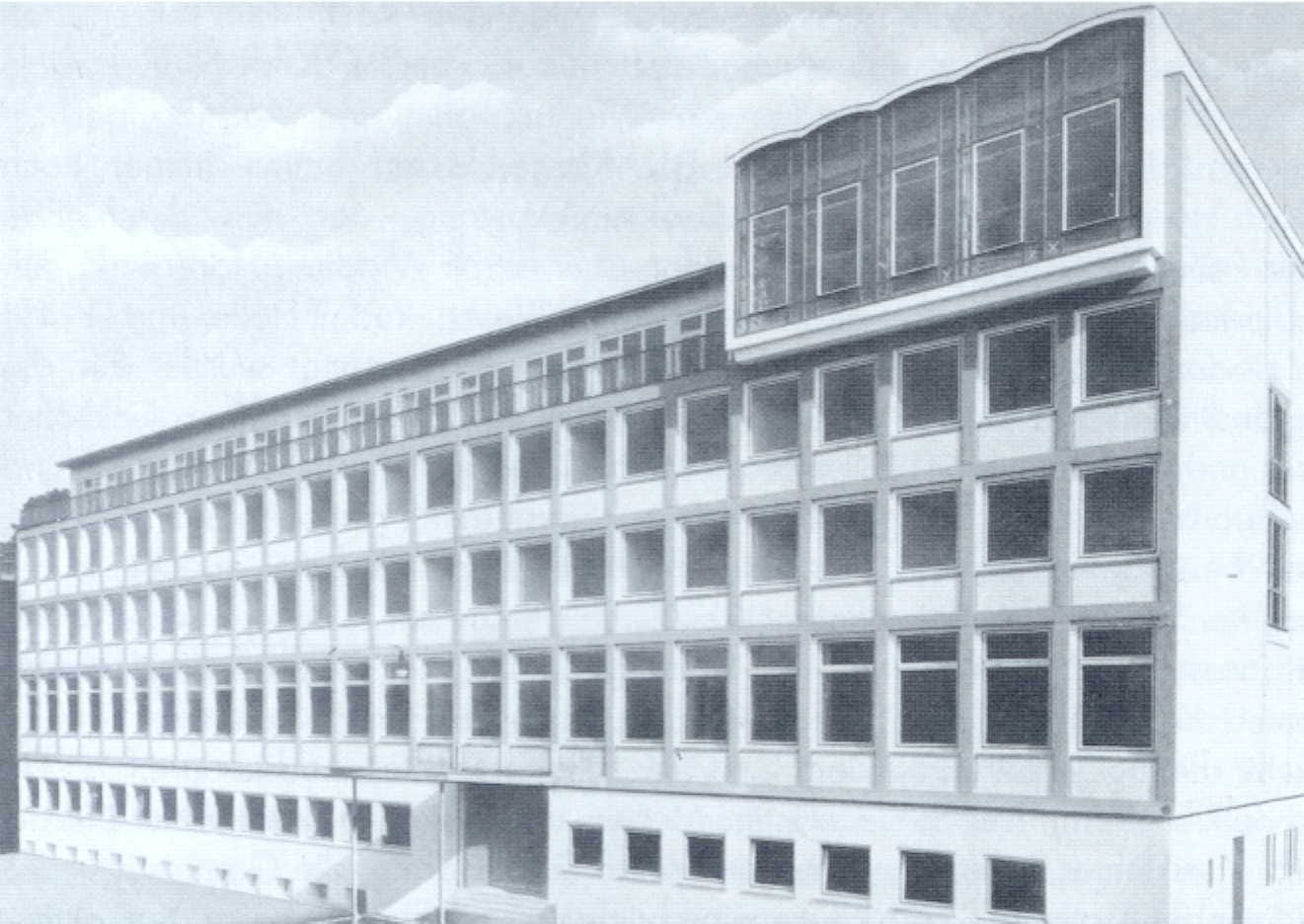
This last summer I was fortunate to receive a three-month research fellowship at the State Institute for Musical Research. The objective of the fellowship was a research project on the performance history of graphic scores, specifically the first generation of students in Germany and Austria to study with teachers who specialized in them. In Germany, it was the State Conservatory of Music and Performing Arts in Stuttgart in the studio of Erhard Karkoschka; in Austria it was the State Conservatory of Music in Vienna in the studio of Roman Haubenstock-Ramati.
Both of these teachers were fascinating personalities in their own right, so I might end up writing more about each of them in the future. But what is particularly interesting to me in the present case is the question of what it was like for a student in the late 1960s or early 1970s to arrive in these schools, in an academic landscape almost exclusively devoted to conventional classical music, and encounter the works of the postwar avant-garde.
My research project was built around conducting interviews with some of the people who studied at these two schools, asking them about both the more documentary matters (what pieces they studied; why they went to Stuttgart/Vienna) as well as sociological questions (their own impressions of their experience; how they remember the public, colleagues, the press responding; what meaning those experience might still have for them). I would have imagined that being involved with composing or performing music that is, even in the present day, poorly understood would be a unique experience, and I wanted to hear first-hand what it was like.
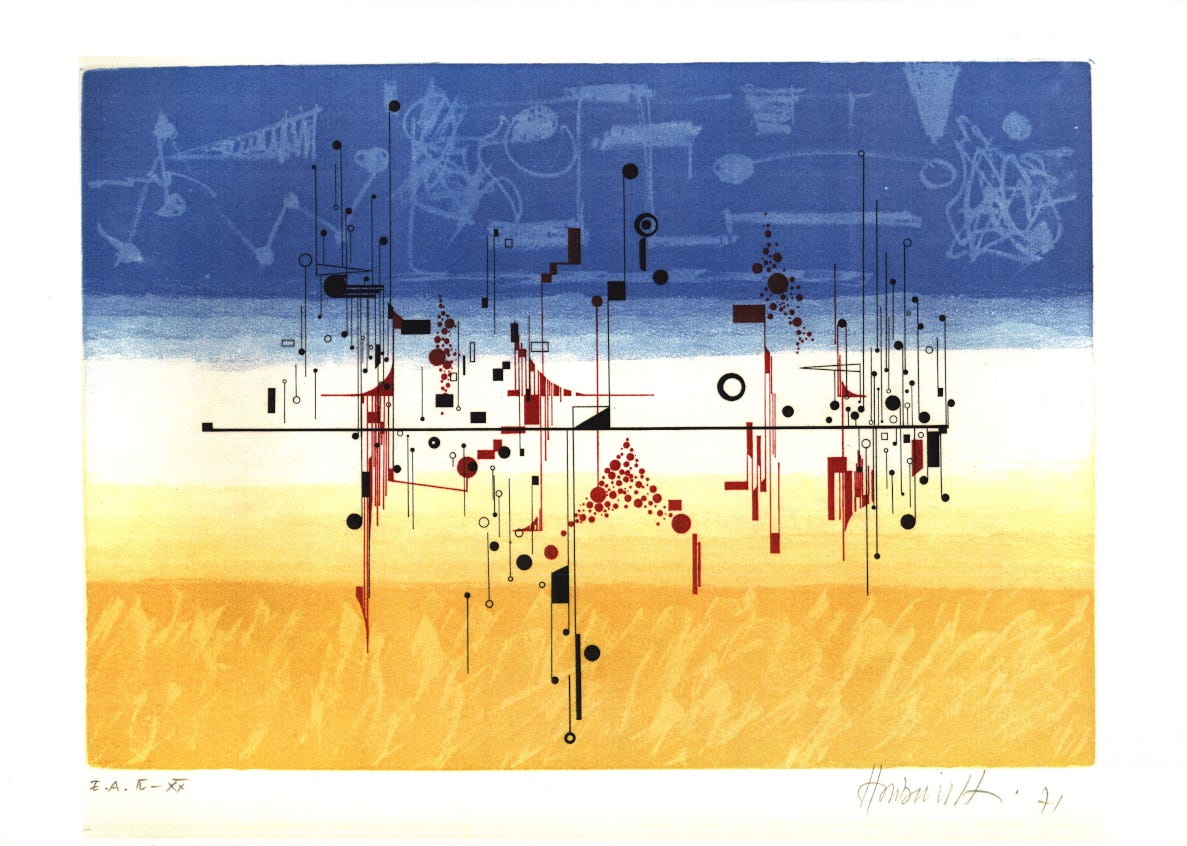
As I’ve written previously, I’m not interested in those musical scores that simply innovate on the kind of symbols they use but are otherwise conventionally written. Instead, I wanted to know how these interviewees, as students, dealt with scores that gave them no real guidance as to how they should sound in performance. An excellent example of this, one of my favorite of the genre, is Haubenstock-Ramati’s “Konstellationen” reproduced above. There’s no “key” or legend explaining how to realize any of the boxes, circles, or lines, or what the color is supposed to mean, or anything else beyond general advice about possible ways of interpreting all these things.
A common mistake in studying these scores is to imagine that they’re just a modified notation, and learning them (and thus the pertinent object of research on their performance) is only the question of how to translate these symbols into those sounds. It seems to be an underlying premise of music-culture that its education rests on teaching this translation process, and yet here we have scores for which no such process is really possible. The teaching methods, by necessity, have to be something else.
Through simply asking around, and a little bit of research, I was able to put together a list of about a dozen former students and collaborators of Karkoschka or Haubenstock-Ramati. Among them were Mathias Spahlinger, Bernd Konrad, Mayako Kubo, Carol Morgan, Dietburg Spohr, and Hans-Peter Jahn-Bossert.
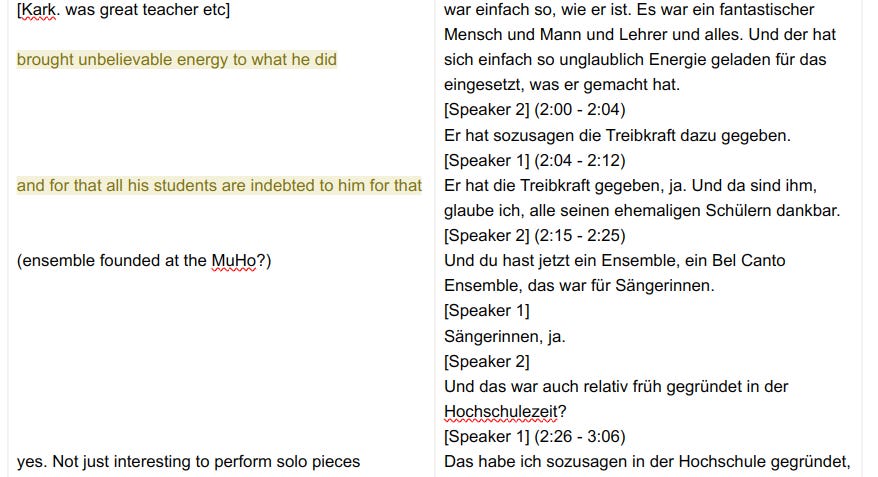
Each interviewee was kind enough to give me a few hours of their time, and I recorded and transcribed everything. Taking the transcribed interviews as a source text, I analysed them using a technique from the social sciences called “grounded theory.” It’s a fairly straightforward process, and I’m by no means a trained sociologist or ethnographer, but it’s extremely helpful to sort long subjective texts into something manageable for qualitative analysis.
The image above is a sample: the color of the highlighting eventually was changed to color-code the interesting parts into categories, which then form the basis of more general statements about what topics seemed relevant among all the interviewees. The prevalence of various topics then suggests general theoretical statements about the subjects’ experiences, which then become the “theory” of my research, grounded in the source material (I’m not going to go into all the details of how analysis works in Grounded Theory; it’s a whole process you can read about in books). What I arrive at, in the end, is a set of statements about this particular phenomenon, which suggest for me a lot of interesting avenues for further research. I want to touch on a couple here.
The most notable finding about both Karkoschka and Haubenstock-Ramati was that they both had extraordinary impact and influence on the students who worked closely with them, as well as through their extensive professional activities. Karkoschka, aside from teaching in Stuttgart, was also on the Board of Directors for the Institute for New Music and Music Education in Darmstadt, as well as a brief period as president of the German section of the International Society for New Music. Haubenstock-Ramati was editor for notation standards at Universal Edition and is almost singularly responsible for the visual appearance of their scores, even conventionally notated ones. Karkoschka also had an extensive schedule of touring and lecturing (“anywhere there were lectures on graphic scores, he was presenting, which is how he drew students to the school,” as Mathias Spahlinger put it). Karkoschka also founded the Ensemble for New Music, which toured extensively in both Western Europe and the Eastern Bloc, and beyond.
All of this points to extensive social networks connecting students and teachers, publishers, academics, and other actors sustaining and cultivating interest in graphic scores and disseminating knowledge. Some of these networks are known, but I suspect there is a lot of fascinating research that could be done studying all the different ways this material, largely unknown outside of specialist circles, was shared.
While there was a lot of grassroots activity cultivating graphic scores, within the confines of the state institutions of higher learning it was quite different. All of my interviewees described the Hochschule in Stuttgart as “extremely conventional,” and Karkoschka as strikingly radical (“forget everything you know” was how Dietburg Spohr recalled him starting his first class on music history). Both Karkoschka and Haubenstock-Ramati faced considerable rejection from their colleagues (Haubenstock-Ramati’s graphic scores, according to Mayako Kubo, were seen as “abwegig” [“absurd”] by the other professors, and his works were almost never performed).
In this environment, I think it’s reasonable to describe the Conservatories as facing what Arthur Levine described as a specific form of “innovation,” and their rejection following the model of “out-of-bounds” identity preservation. That is, the Conservatories viewed themselves as curators of a specific identity defined by a certain approach to music, and graphic scores fell outside of it. But that process is complex and evolves over time. A longer, more in-depth study of both institutions (including researching internal records, more interviews, etc.) would be extremely interesting as a sociological and institutional study.
Lastly, almost all of my interviewees involved in performing these scores described a process where they initially improvised freely, but that this unfettered approach eventually proved unsatisfying (Carol Morgan: “wir haben einfach geblödelt, aber dann war es zu blöd” [“we simply fooled around, but then it was too foolish”]). Over time, they all developed a process of reflection, discussion, and iteration for their performances (one that, for example, Dietburg Spohr still uses in her own ensemble to the present day). After an initial experimental phase, the performers listen to their improvisation, discuss it, and form opinions about what they did, and then play the score again. Over time, simply communicating together and hearing oneself exerts a subtle influence, creating a sort of feedback loop that leads to performances that, while not repeated the same each time, acquired a unique identity that distinguishes one score from another.
This approach to performance is very different, though decidedly methodical, compared to the usual way of performing conventional scores. I would be extremely interested to study such an approach more in depth, working together with an ensemble, documenting rehearsals and performances, interviewing the musicians, etc., to make a proper long-term sociological study of it. As a method of artistic research, it would be a really interesting approach to performance of indeterminate scores in general, and I’d really like to test it as a working method.
There remains an enormous amount of work to be done, but the one final aspect of these interviews, which profoundly affected me, was seeing how much these experiences meant to the people who lived through them. Many of my interviewees were deeply emotional as they recalled what it was like discovering the avant-garde in their youth (some on the verge of tears as they thought about how much their teachers had meant to them, and what sympathetic characters they were), and emphatically implored me to keep working on it (Dietburg Spohr: “Und so etwas wie du machst, das muss sein. Da darf man nicht aufhören. Nein, ganz im Ernst … wenn du es nicht machst, wer macht es dann?” [“And what you’re doing, it simply has to be. You can’t stop. No, really, seriously … if you don’t do it, then who does?”]). It is a project of no minor urgency: my interviewees are all around 80 years old, and there’s no guarantee that I’ll be able to conduct interviews with them for much longer (in fact, one of the former students, one of Karkoschka’s closest collaborators recommended to me by several interviewees, was Ulrich Süße, who died in November of 2024, just before I started preparations for this project).
I still firmly believe that the flourishing of the postwar avant-garde was a uniquely consequential moment in the history of the arts, and that much of what made that era so captivating, the reason why we still often paint it in such heroic tones, was a spirit of the times that has, in the intervening years, drifted into neglect. The aura of joyful experiment, of making everything anew, of charting an undiscovered country, is something almost wholly lost in the present age of brutal capitalist economism, of inward-gazing ironicisation and apathy, of what the Germans call Ratlosigkeit, which means both “helplessness” and “perplexity,” of not knowing what to do but compelled out of habit to continue going through the motions of doing … something.
I believe that the spirit of the postwar avant-garde is an antidote to this, and the intervening years have blessed us with a plenitude of literature and æsthetic standpoints to bring to bear on what were, for the people who first confronted them, insoluble difficulties of artistic creation. We have all the tools at hand to create new and meaningful things; we need only recall the spirit of experiment to use them.
No posts
Comments
Nothing yet. Say the first thing.
Sign in to join the conversation.