
One of the key terms I’ve adopted from literary theory for my study of graphic scores is the concept of the “non-reproducible artwork.” In literature, this refers to texts that are objectively, mechanically different each time they’re read: going beyond the concept of reader-response theory (in which “meaning” is created by the reader and projected onto the text, thereby rescuing the role of the author while still acknowledging the subjective nature of reading), in a non-reproducible text the words, marks, inscriptions, &c. of the literary work are themselves different. This posed a number of problem for literary theorists, addressed elsewhere and not needing much elaboration here.1
In music, graphic scores function similarly: although the repository of visual information contained in the score might be fixed, what subset of it is “read” and the manner of its realization is not; and neither is the experience of that realization by any other participants. I don’t believe the number of possible realizations is infinite (because if it is, it’s the same infinity of possibilities for every such score), but finite numbers can still be so large that no performance is ever reproduced.
I also don’t believe that Pierre Boulez or Karlheinz Stockhausen’s misuse of the term “aleatory” is any productive implementation.2 As Cage noted already in the 1950s, merely rearranging a set of otherwise fully composed and notated musical fragments is superficial and ultimately meaningless.
A truly non-reproducible musical work is one in which not only the structure, but the content of the music is different in every performance. I’ve already talked elsewhere about how this distinguishes “musical graphics” from “graphic scores,” and that only the latter were truly innovative on the fundamental level of their æsthetic and artistic conception.
But this presents significant problems for implementing those concepts in the much more technically and logistically complex domain of music-theater. It’s one thing to have a single group of performers all occupying the same stage space and able to communicate with one another in real time as the performance unfolds; it’s entirely another challenge when the performance also involves the extremely complex apparatus of music-theater: including lighting, stage sets, segregated performance spaces (such as the orchestra pit vs. stage in a conventional opera-house), and all the rest.
(I should pause here to note that I have almost no expertise in theater or performance studies. What follows is mostly my own speculation on how it could be done, but I don’t make any claim of informed competence)
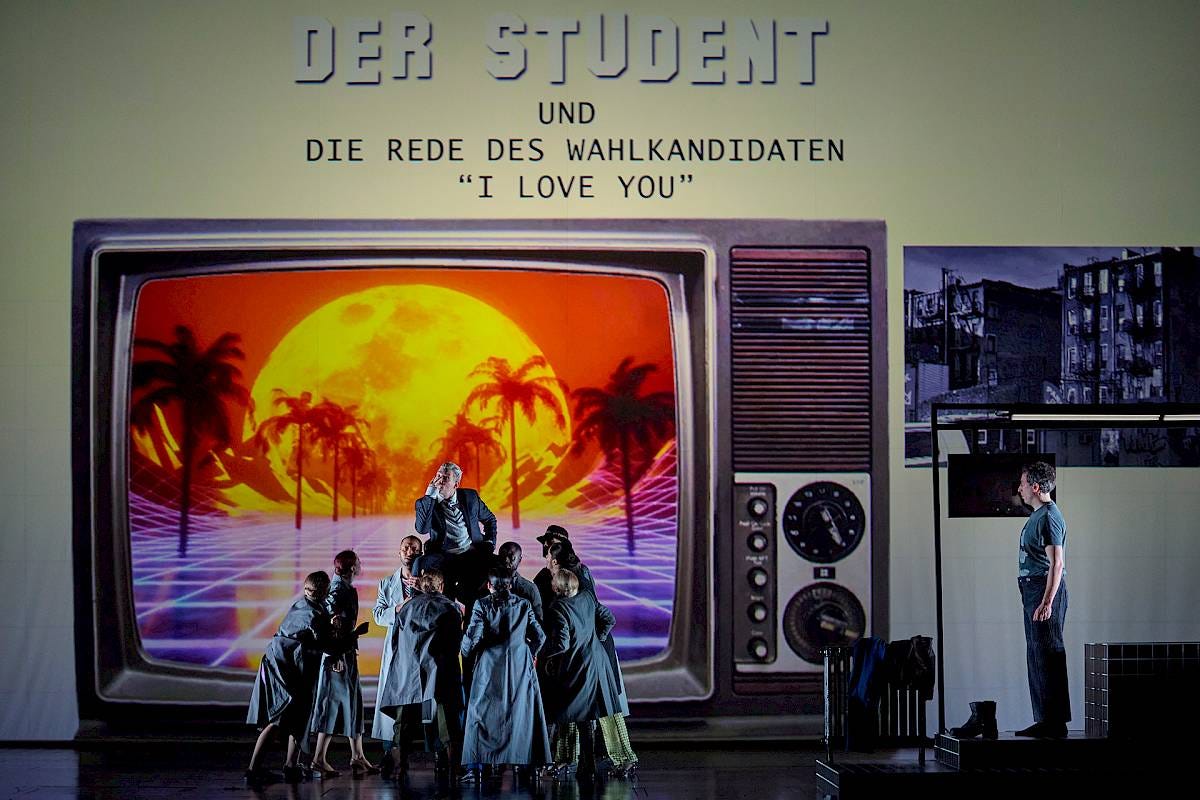
A good example of how difficult these issues can prove to be in their practical implementation is Roman Haubenstock-Ramati’s opera “Amerika.” Based on the novel of the same name by Franz Kafka, the opera was withdrawn from the program of the 1964 Berliner Festspiele after only two performances and decried in the press as “the greatest scandal of 20th-century opera” (a title it may arguably still hold, as nobody was scandalized by anything in opera after the 60s).
Haubenstock-Ramati was particularly interested in the idea of “mobile form,” arising from his experience in Pierre Schaeffer’s studio researching musique concrète, and later working with musique sérielle. His work with graphic scores was originally an effort to develop forms of notation that reflected the modular rearrangements possible with tape music, or the reconfigurations and combinatorics of serialism. But when confronted with the logistic demands of an opera production, his pursuit of these techniques was confined largely to using pre-recorded material as an added layer to the live performance, which itself unfolded in a conventional, linear fashion.
But if I’m going to argue that non-reproducible performance practice is the best tool we have to progress artistically, should that not be a valid claim for all forms of musical expression, including opera? If that’s the case, how would such an opera work? How would you implement it?
I think it may be helpful at this point to return to the concept of aleatory, because it would provide us a means to design a production that conforms to the dramatic and narrative demands of opera, while still leaving open the possibility of the performance itself being indeterminate (in the Cagean sense) and non-reproducible. This is the original definition:
Aleatorisch (von alea = Würfel) nennt man Vorgänge, deren Verlauf im groben festliegt, im einzelnen aber vom Zufall abhängt.3
(“A process is said to be aleatoric (from Lat. alea = dice) if its course is determined in general but depends on chance in detail.”)
As I noted previously, this is almost the exact opposite of how Boulez and Stockhausen used the term when composing their “aleatoric” scores, so it’s important to specify that I’m using “aleatory” in its original sense. When I read “in detail” here, for me that would mean the moment-to-moment musical material (i.e., the specific sounds you hear at any given moment) is indeterminate, while the larger-scale dramatic trajectory of the piece remains (at least in its rough outlines) along the course of a definite arc.
I think a good (and more familiar) example of something like this would be the genre of computer games called “open-world.” Larger game titles in recent years (think Elden Ring, or Red Dead Redemption 2, or [my personal favorite] Horizon: Forbidden West) present the player with a large map, with many different activities that the player may choose to explore in any order. Even the scripted set-pieces of the “main quest” episodes are still game-like in structure, which means that the player may choose to engage with them differently each time. The enemies might behave differently, or the player might choose to use a different playstyle: thus each player, and each playthrough, ends up as a unique experience.
However, the game itself still has an underlying story; and while the player might choose to play the game differently each time, the story as a whole still follows the same general narrative arc. They are, in short, exactly what I think Meyer-Eppler meant with “aleatory,” so I think that might serve as a good model for how to construct an opera with graphic scores. In this sense, only the most general narrative trajectory is determined, and it must account for the fact that its individual components may appear in (almost) any order, and that their specific realization might also be different each time.
Of course, an opera is not a computer game, nor should it be made as one. This is merely a useful metaphor to guide us. So what would such an opera look like?
One of the strategies game developers often use to keep the game’s narrative manageable is to partition off the game’s world into smaller regions, with each new region only becoming “unlocked” after certain essential parts of the story have been completed. This saves the designers from having to account for every possible sequence of events (for example, the king of the next kingdom over might mention having heard from his ministers that you defeated the local dragon, or alternately ask you to do so if you haven’t yet; partitioning the game keeps the variations under control), and I think it’s a useful analogue to how an opera is partitioned into acts.
Within each act, the exact sequence of scenes and how each scene would unfold thus remains indeterminate. This could be accomplished on the level of the physical organization of the score: each “act” is a folio of score materials, with conditions set for when an act is considered “complete” and the next act becomes available, but which parts of the score to play in what sequence, and how specifically to realize them, remains open.
This presents some difficult organizational and genre-specific challenges. A “scene” in an opera is the same for the musicians, singers, lighting team, costumes, stage design, etc.; how would you design an opera where this isn’t necessarily the case? Or where some parts of the production crew have to respond in real time to decisions made by, say, the orchestra? Opera singers usually perform their roles from memory, requiring strict choreography to aid them; what would they memorize here, if we don’t want a Boulez-style reshuffling of predetermined materials?
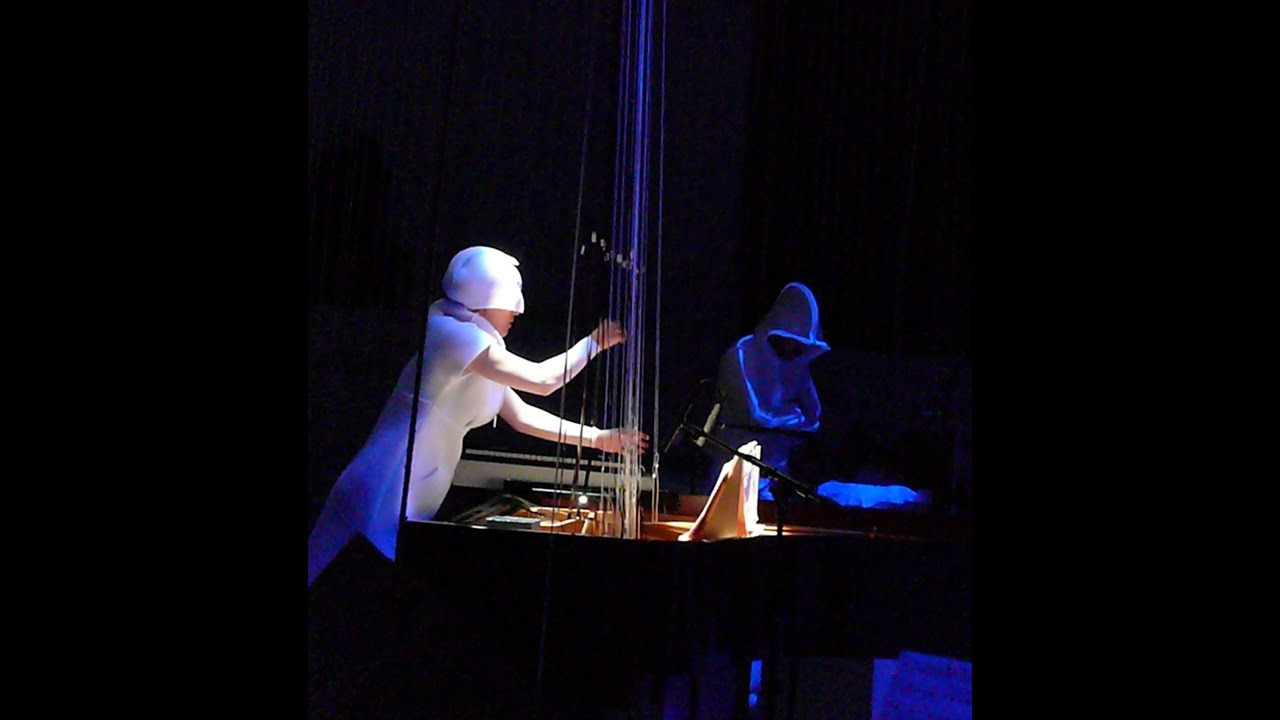
Perhaps one solution is to treat the production more holistically, something like what Carola Bauckholt’s opera Hellhörig does by composing some sounds such that they require movement across the stage to perform (in this case, dragging metal washtubs). The movement itself becomes theatrical, and changes the physical arrangement of the stage as well.4 But what I have in mind is something more comprehensive: the idea that the stage crew, lighting team, sound designers, and all the rest of the production are also treated as a part of the composition, and have parts written for them just as the musicians and other performers do. And that all of these are fundamentally game-like in their unfolding, with each role, whatever it is, traversing through their score materials indeterminately, with their decisions having ripple effects on all the others.
I once got a lot of criticism from the organizer of an opera workshop for putting staging and lighting directions into my score, out of the belief that I was usurping the roles of the director and lighting designer, respectively. But if I’m going to take my own arguments about the artistic necessity of indeterminate performance practice (i.e., graphic scores) seriously, then I think there’s no real alternative. All those added layers on top of the musical score in an opera production can only work as added layers (produced by other parties after the fact) if the score is fixed, if it can provide some linear scaffold on which to hang all the rest of the production.
Put these two ideas together, and the task of the “composer” becomes immense. I’d not only have to account for the action of over a hundred musicians and singers, but also dozens of other participants. It brings to mind a production I saw about a decade ago in the Stuttgart Staatsoper, of Strauss’s Der Rosenkavalier. It was an incredible spectacle, with technicians moving parts of the stage set around while the scene was unfolding, with all the singers also moving around and performing on stage. Here, the rest of the production team would be challenged to perform artistically, to interact with a graphic score with the same rigor as the musicians and singers. And at the same time, I’d have to account for all the different ways the “plot” might unfold, the different ways all the various participants might choose, in the moment, to act. And on the very basic practical level, I’d have to figure out a way to ensure that the score (in whatever form it might take) is still present, so that the participants can interact with it in real time, and that what it ultimately produces is, in some sense, still music.
I’m not sure a creative task of that scale is even possible for a single person. I’d be composing a hours-long totalizing æsthetic experience for dozens, maybe hundreds of people, with the expectation that each of them, in each performance event, would be making different choices and doing different things. All while still following some overarching æsthetic vision, some general narrative arc with its course (even in the most general sense) still determined. On an even more basic level, I’m not sure there exists any source text that I might use for such a story. Juan Rulfo’s Pedro Paramo comes to mind for its dream-like, nonlinear narrative; but this is partly why I think the novel, despite a number of attempts, is fundamentally impossible to present in a visual medium like opera or film. What would a story that could function for an opera like this even be “about”?
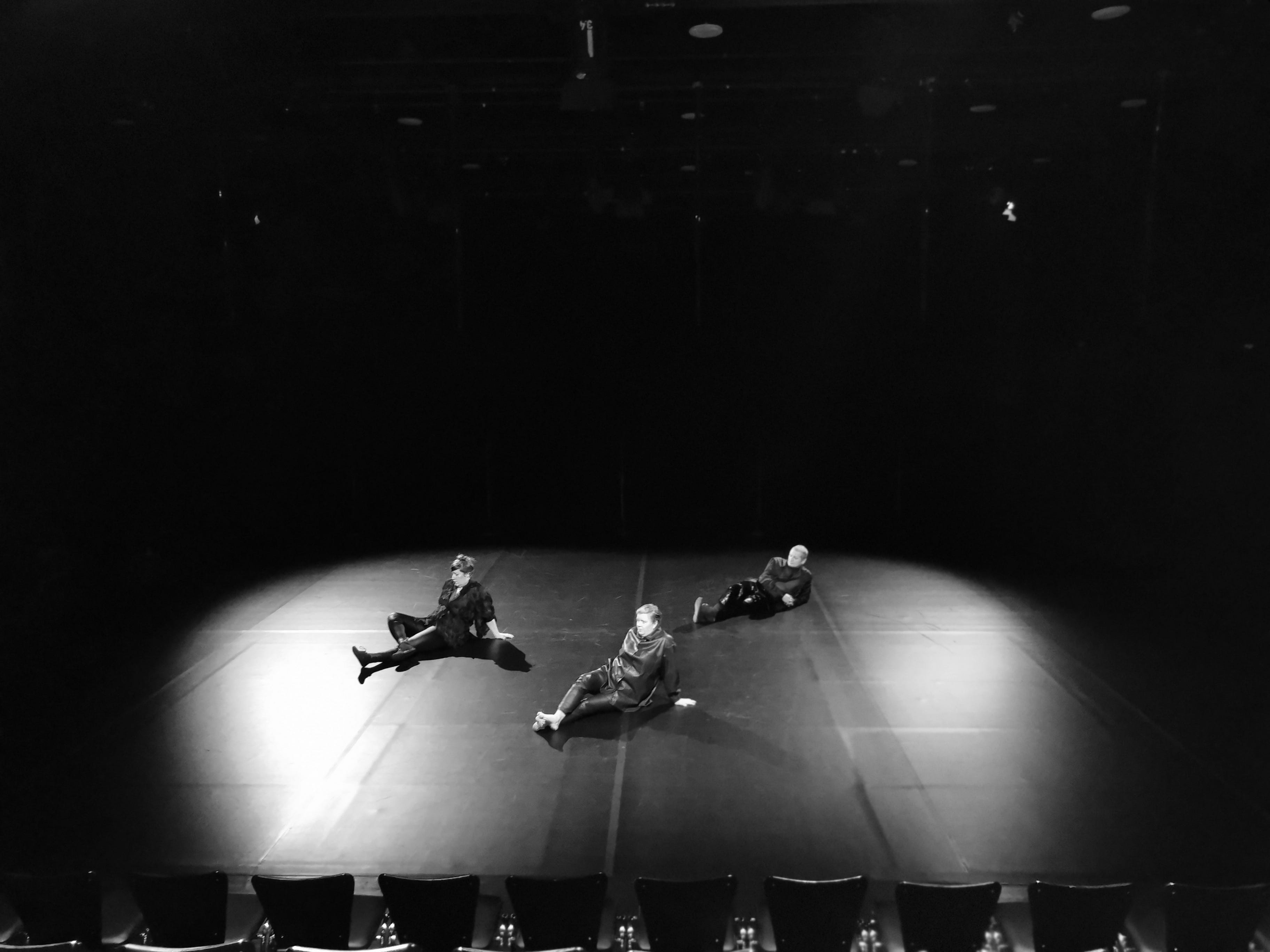
Maybe Oblivia (a Finnish theater collective with whom I’ve worked in the past, pictured at the top of this article), with their unique working method (based on repeated cycles of imitation and improvisation) would be the kind of group that could develop and perform such an opera, and there are most certainly other experimental theater collectives out there with the necessary skillset (I’ve also learned that percussionists are generally more open to physical performance). Certainly, it would require a group familiar with physical performance, something along the lines of Jennifer Walshe’s (no relation) recent discussion of “the new discipline.” But to find an entire opera company willing to work so far outside the institution’s usual working methods? I’m doubtful any such company exists. The stakes are simply too high: the nature of such an aleatoric opera is so far outside the conventions of the institution, that I doubt any established company would be willing to take the risk.
But now that I’ve spent some time thinking about how it might be done, I’m starting to imagine how it could be done, and thence the creative process doesn’t have far to go before exploring how it would be done, and making some first attempts at actually doing it. It’s an entire unexplored world of creative potential, and I suspect I’m going to be venturing out into it more in the future.
See Landow, George P., “What's a Critic to Do?” in Landow, G. P. (Ed.), Hyper/Text/Theory, Johns Hopkins University Press, 1994, 1-48.
In fairness to Boulez and Stockhausen, “aleatory” (as originally presented by Werner Meyer-Eppler in a lecture at Darmstadt) was misunderstood by everybody except Xenakis.
See Meyer-Eppler, W., “Statistische und Psychologische Klangprobleme”. Die Reihe, Universal-Edition, 1955. The German “grob” means something more like “coarse” or “rough,” but it’s close enough for our purposes here.
No posts
Comments
Nothing yet. Say the first thing.
Sign in to join the conversation.