
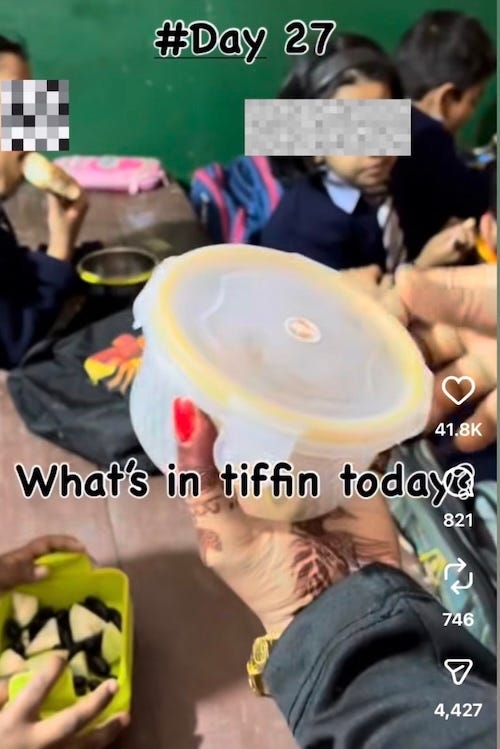
And a teacher (?) goes on to name every kid in her class (possibly 6-7 year olds) and shows the contents of their lunch box. The video I’m talking about has around 14.5 million views at last count. This Instagram content creator is posting one a day, given that this one says ‘Day 27’.
In these reels/videos, most kids’ lunchboxes have some version of ultra-processed food in their tiffin, like biscuits or store-bought cake or Maggi. Some have fruits. And the comments are full of people passing nasty remarks on the parents / mother for sending such a ‘lazy’ lunchbox. “The parents didn’t even try.”
And then there are some sane comments on why such videos are being made, using children with no agency of their own to create content. Videos that indirectly shame them and their parents for the contents of their lunchbox, with a possible intent to ‘correct’ or improve the nutritional value of their lunch box.
I feel strongly about children’s privacy online, and I am also troubled about the food young children are eating. But these kind of videos trouble me even more. Posting videos of young students calling out their names and the contents of their lunchbox to entertain the internet at large is terrible on so many levels.
In times where parents use their kids as content material without a second thought, often to promote their own account or business with increasing engagement levels, how can we expect others to be mindful of children’s privacy online? That said, I do expect schools and teachers to do better.
Some schools share awards and achievements of their students on social media and hopefully after taking consent from parents. Some schools ask concerned parents to opt out of using media involving their kids on their social platforms. While I appreciate that, it should be more of an opt-in feature than an opt-out, and the school should not get rights by default to make content featuring the kids.
Beyond the immediate public shaming (which can erode a child’s self-esteem and make them anxious about what’s in their tiffin), the bigger danger is the permanent digital footprint created without the child’s consent. When videos show faces, names, schools, and even lunch details, it hands over personally identifiable information to strangers worldwide. Research from sources like the American Educational Research Association and privacy experts highlights real risks: predators or stalkers could use this to identify and target children; facial recognition tools scrape public posts to build profiles; images can be misused for deepfakes, identity theft, grooming, or even child exploitation networks.
Reports from child safety organizations, including insights from Australia’s eSafety Commissioner back in 2015, have shown that a significant number of innocently shared family and social-media photos (sometimes estimated as high as half on certain examined sites) have ended up being collected and shared on inappropriate forums. While the exact numbers have evolved since then and are hard to pin down precisely today, the core risk remains: once images and personal details are online forever, they can be misused in ways no one intends, from unwanted attention to more serious privacy breaches, even more so in the times of generative AI we live in.
In India and globally, “sharenting” (and here, “school-sharing”) robs children of agency over their own image and data—information that persists forever, potentially affecting future job prospects, relationships, or safety. Even if the teacher’s intent is “helpful,” the platform amplifies harm without safeguards.
You might have seen the hard-hitting ‘Pause Before You Post’ campaign from Ireland’s Data Protection Commission. It powerfully illustrates how everyday shares can create lasting risks. If you haven’t, I urge you to watch it.”
Time poverty for working parents is a real thing. Instead of judgment, let’s focus on gentle, practical support for families. Ultra-processed foods in lunchboxes (high in added sugars, salts, unhealthy fats, and low in nutrients) are linked to higher risks of childhood obesity, insulin resistance, type 2 diabetes, poor gut health, and even mental health concerns in growing kids—issues that compound over time when they displace whole foods.
Parents can make small, realistic shifts using the examples given below.
Involve kids in choices: Let them pick 2-3 healthy options (e.g., “apple slices or grapes?”) so they feel ownership and are more likely to eat it.
Prep simple swaps ahead: Batch-prep veggie sticks with hummus, prepare veggie-protein patties to make quick sandwiches/rolls, energy balls with millets, dates, some seeds and nuts (modernised laddoos) for a sweet treat, homemade granolas with grains, seeds, nuts, dried fruit for a snack box
Add colour and variety: Aim for half the box in fruits/veggies (carrot coins, cucumber stars, berries), a protein (boiled egg, paneer cubes, nuts), and a whole grain (roti bites or rice balls), add veggie purees like carrot/beet/ pumpkin/spinach to rice and rotis for added colour and nutrition. Pack a fruit instead of a chocolate or packaged dessert.
Start small: Replace one ultra-processed item per week (e.g., biscuits → homemade energy balls or fruit) to build habits without stress.
Have a talk with the parents who are consistently sending biscuits or Maggi in the lunch box and give them some easy-to-make healthier options, even make-ahead options.
Conduct a nutrition session for parents and kids together so everyone is made aware of what the current lunches lack and how it can be improved in simple steps.
For a small extra fee, school can provide a healthy meal cooked on site to all the kids so that one of their meals in the day is balanced and healthy. Younger kids also eat better when they see their classmates eating the same healthy meals, in a way inspiring each other.
Ultimately, improving children’s nutrition starts with empathy, not exposure. Schools and teachers should never use their students as unwitting props for social media content - especially when the framing publicly critiques or shames what kids bring in their lunchboxes, all to boost the school’s own online profile or go viral. This is exploitation in the guise of concern.
Let’s protect their privacy first—because once a child’s name, face, school, and daily habits are out there forever, the risks (from digital footprints to potential misuse) far outweigh any short-term “teaching moment.” Then, and only then, can we guide families with genuine concern that includes practical support and non-judgmental resources.
What are your thoughts on these viral lunchbox videos? Have you encountered them, or do they make you uneasy too? Share below. I’d love to hear your perspective.
If you enjoyed this free newsletter, here are some of the ways you can support me.
❤️ Buy my books - check out my latest book No Gods, No Gurus - A Radical Guide to your Wellbeing on Amazon.
❤️ Join my Instagram and X family
❤️ Share my newsletter with a friend
If you know someone who would like to read this post, feel free to share it.
No posts
Comments
Nothing yet. Say the first thing.
Sign in to join the conversation.