
(A reminder that you’re subscribed to journalist Nancy Scola’s monthly newsletter, and that she appreciates it.)
Hi there, I hope this finds you well and having enjoyed October. Here in Washington D.C., the northern mockingbirds have seemed especially vocal of late, singing their wackadoodle songs. (Thanks, Merlin app!)
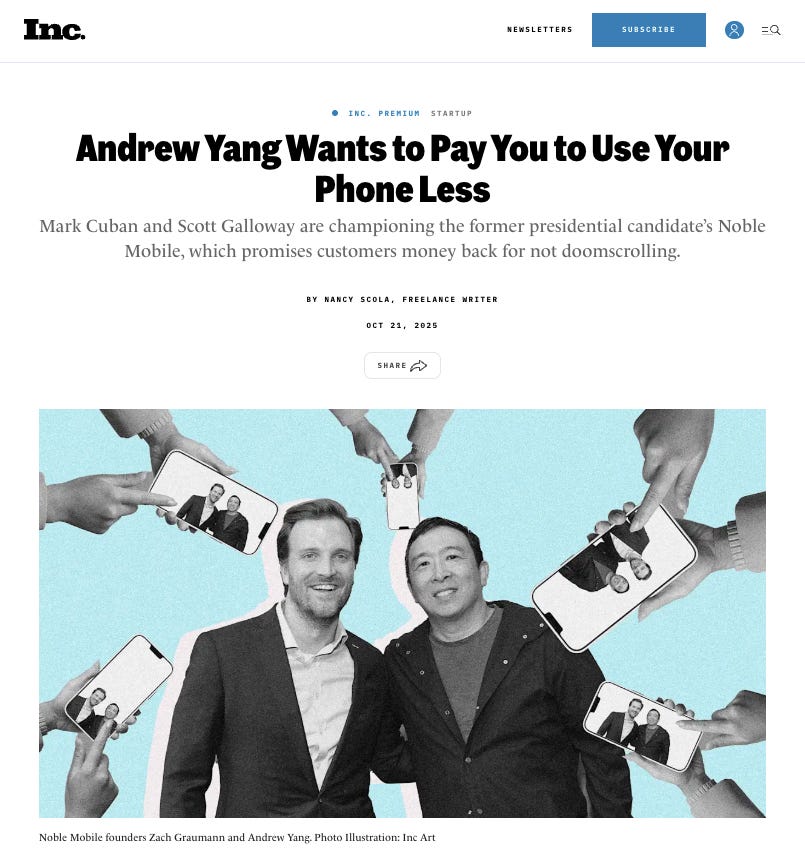
Before we get into “Clearing the Cache,” our last-Friday-of-the-month collection of things I’ve read or otherwise consumed and am eager to share, I want to highlight a piece I have out now for Inc. Magazine, a look at one-time presidential candidate Andrew Yang’s brand-new bid to start a mobile phone company called Noble Mobile. In addition to potentially being a very good business, Yang says he sees the startup as a chance to combat two modern ills: the amount over what’s technologically dictated that Americans pay for cellphone data and how mindless consumption of that data feeds into their phone addictions. Noble’s twist: charge customers less to start, and then pay them back for data they manage to resist using. The story is in Inc.’s premium section, but you can use all the money you save on your phone bill to subscribe.
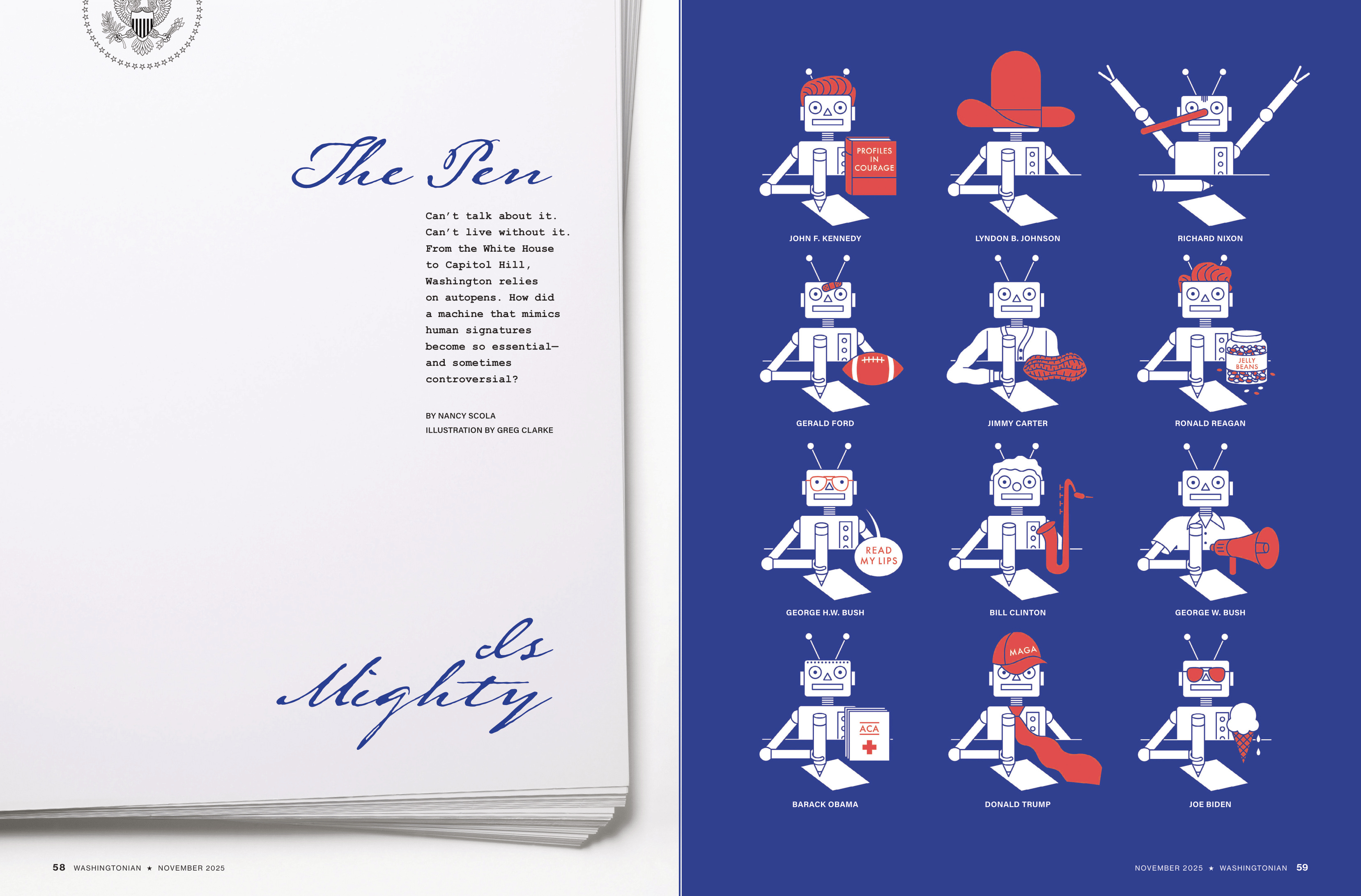
I’ve also got a story in the November issue of Washingtonian Magazine now out on newsstands but not yet online, exploring the role of the autopen in American government. The piece takes a particular look at the controversies surrounding the autopen’s use dating nearly back to the time of its invention amid World War II; what was then sometimes called the “robot pen” took hold in the days of FDR’s “arsonal of democracy” push, as an innovative tool designed to help the Navy keep up with the paperwork of increased war production.
The Washingtonian creative team did, I think, great work on the piece, as is their practice. (See above.) A bit of backstory: as part of the reporting process, the research librarians at the Library of Congress dug out from the archives for me a rare 1965 book from the philographer Charles Hamilton called The Robot that Helped to Make a President: A Reconnaissance into the Mysteries of John F. Kennedy’s Signature. As soon as I retrieved the book from the holding alcove in the Thomas Jefferson Reading Room, I was in love. One cover corner featured a small embossed drawing of a robot President Kennedy:
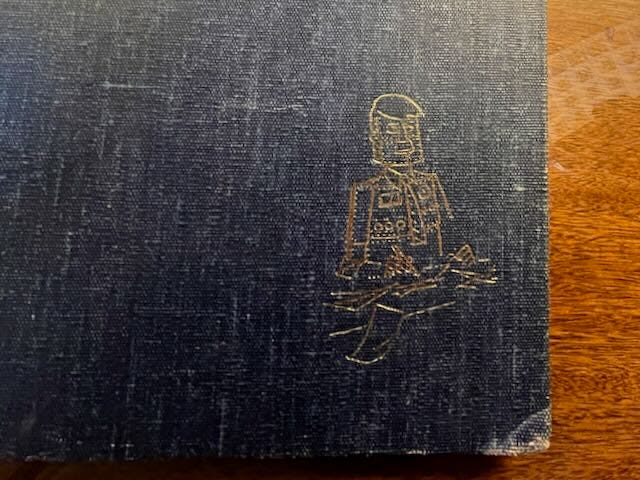
It had technology! It had politics! I mean, come on. I joked with my editor that I was thinking of getting a tattoo of it. He ran with it, as did the creative team and illustrator Greg Clarke. They came up with art that both is fun—I think the giant-hatted LBJ might be my favorite—and conveys the historical truth that the autopen has long been a part of White House operations. (It’s possible that I now have it framed on my office wall.) I don’t convey many opinions in public, but I’m willing to say that libraries are neat. Keep an eye out for the piece on the Washingtonian website.
With that…
Clearing the Cache, October edition:
Like many federal entities, the Library of Congress is closed at the moment. Unlike many of them, the shutdown notice on its website doesn’t blame Democrats. Public Citizen is suing a collection of those whose do for allegedly violating the Hatch Act, including the U.S. Department of Agriculture, which went with this on the taxpayer-funded USDA.gov: “Senate Democrats…can continue to hold out for healthcare for illegal aliens and gender mutilation procedures or reopen the government so mothers, babies, and the most vulnerable among us can receive critical nutrition assistance.”
Oh, also on the Library of Congress front, President Trump is asking the Supreme Court to let him remove the director of the U.S. Copyright Office, which is housed inside the Library through the maneuverings of a Civil War-era Librarian of Congress named Ainsworth Rand Spofford. It’s not Trump’s first attempt to put this stamp on the Library of Congress: recall that this past spring he fired the sitting Librarian of Congress and replaced her with the Deputy Attorney General.
And back to phone rates for just a second, the Federal Communications Commission has voted to raise the cap on what prison inmates can pay for phone calls. Chairman Brendan Carr says that too-low rates pose safety risks. Critics say the more salient concern is shrinking kickbacks.
“How Vance helped Trump get his TikTok deal, despite political risks.” Labeling it a deal, though, might be overcharitable: “Beijing will work with Washington to ‘properly resolve’ issues around the divestiture of the U.S. operations of TikTok, China’s Commerce Ministry said in a statement Thursday.”
The CEO of Oura, maker of rings that know how you feel, says in a selfie video that worries over the company’s engagement with the Defense Department are misplaced.
It turns out that running nearly all of the Internet—including everything from coursework platforms that entire universities run on to ‘smart’ mattress covers—on one cloud platform can be problematic.
Here’s a look back at how the eruption of the volcano Hunga Tonga-Hunga Ha‘apai caused the island nation of Tonga to lose its Internet connectivity, and “with it, all its means of reaching the world beyond the wide, silent water.” (Never mind, presumably, its smart mattress pads!)
“In the beginning, the internet was without form,” writes the New Yorker’s Julian Lucas. Then came Tim Berners-Lee, who is out with a new memoir called This Is for Everyone: The Unfinished Story of the World Wide Web.
Sen. Ted Cruz has set his sights on Wikipedia, riffing off Wikipedia co-founder Larry Sanger’s conclusion that “Wikipedia’s ‘NPOV’ is dead.” Other co-founder Jimmy Wales ain’t buying it. Elon Musk, meanwhile, thinks he can do better.
Kamala Harris says it was a “big mistake” not to invite Musk to a Biden White House event on electric vehicles in the summer of 2021—one of the affronts that seemingly paved the way towards the Tesla CEO trying to invent his own encyclopedia. (Recall that the thinking at the time was that Team Biden didn’t want to offend the United Auto Workers.)
Alvaro Bedoya, a privacy expert who served on the Federal Trade Commission until the White House dismissed him this past spring, says that all that the sense of powerlessness among Americans that he witnessed while in office turned him into a committed populist: “The despair in this country is far deeper than most of us understand. It’s worse than that, actually: It’s so pervasive that we don’t even see it. It’s become normal.”
In Andreessen Horowitz general partner and “American dynamism” promoter Katherine Boyle, “The Tech Right Gets Its Own Phyllis Schlafly,” reports the New York Times, in a story by Julia Black. (One has to admire the assumption that in 2025 a headline-scanning general reader knows reflexively who Phyllis Schlafly is.)
That attempt to mainstream prediction markets seems to be working. Major player Kalshi is partnering with the NHL and Trump Media is getting into the business.
In response to Trump’s pardon of Binance co-founder and former CEO Changpeng Zhao, California Democratic Congressman Ro Khanna has introduced the Ban Crypto Corruption Act. Among other provisions, it blocks a president of the United States from issuing meme coins. Meanwhile, Reuters goes “inside the Trump family’s global crypto cash machine.”
Columbia law professor Tim Wu argues that “an entire generation has grown up thinking that extraction, as opposed to building, is the path to riches.”
Thanks, as always, for reading.
-Nancy
Comments
Nothing yet. Say the first thing.
Sign in to join the conversation.