
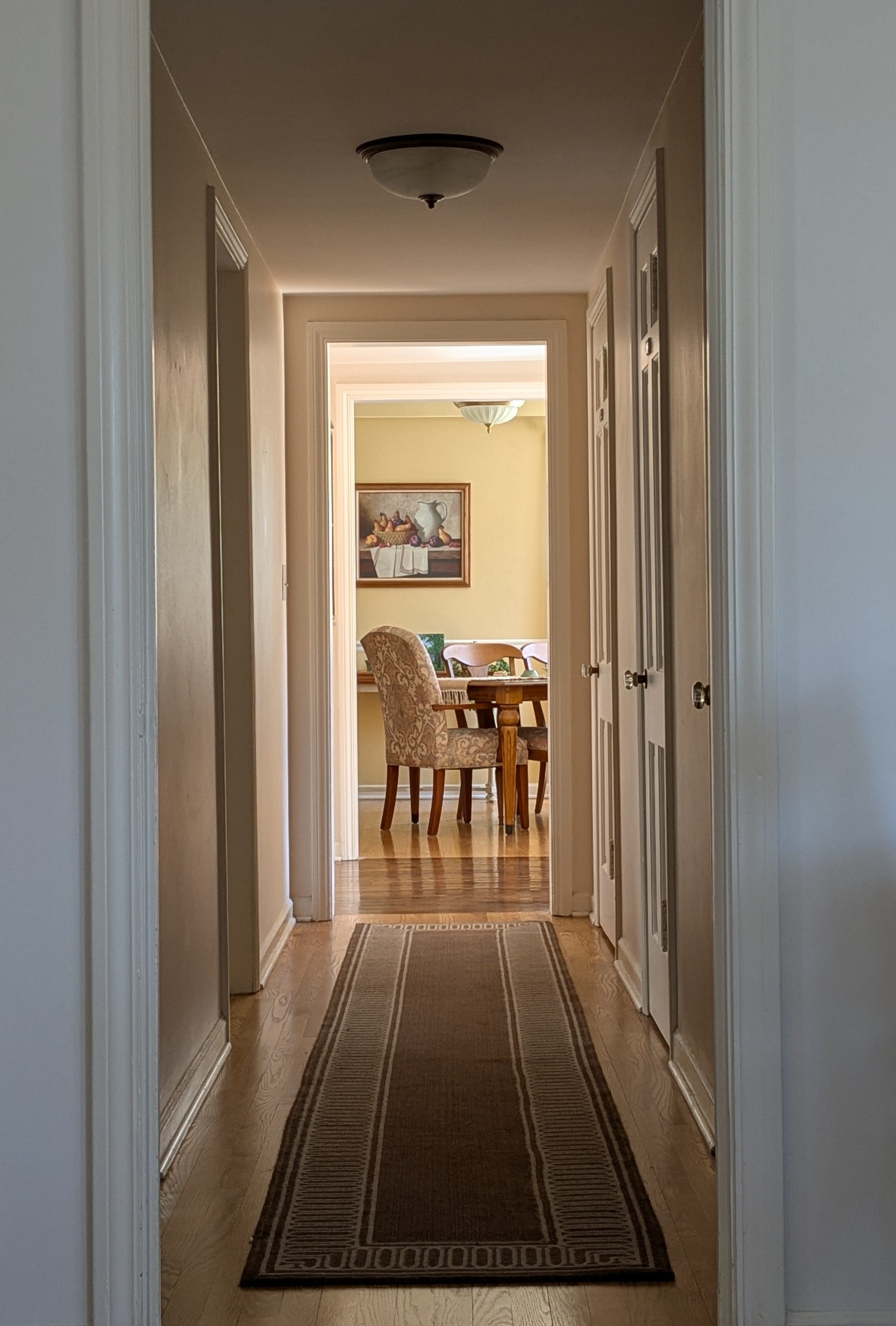
The dining room in our house is a pass-through room. You have to go through it to get to the kitchen. It’s also a corner room with windows that permit the warmth and strength of the sun to settle in from the east, as it moves around the corner to the south. One has a full view of the front yard from it, with the fat trunks of old trees and the dotting of flower beds keeping the eye moving in discovery. I like this room, and so do my houseplants!
There’s more to my affection for this room than for its sunny appearance, a splendid view, and its ability to nurture plants. No longer a space defined by dining and gathering, the room has a new place in the house.
When I sat at the table for dinner on Easter Sunday, I noticed the chair’s once firm seating had softened, with only its framing felt. The fabric on the outside, in a pattern of cream, tan, and celadon, was still in good shape, but the interior had aged.
I couldn’t help but look around the room. I was caught in a loop of the present—an informal place setting for my husband and I, the absence of wine glasses, candle holders, or a vase of flowers—and past years when the table was accessorized, a showcase of formality and vitality. In anticipation of entertaining with a full table, the hutch doors would swing open to grab tablecloths, placemats, and napkins. Wine glasses would gently be removed from the glass shelves, washed, polished, and set on the table. A crystal vase would be placed in the middle of the table. A pair of silver candle holders from Gump’s San Francisco would be polished and held side by side the flower vase.
I thought about what brought me to the table over the years: holiday dinners, birthdays, brunches, and the family and friends who sat around the rectangular shape. It was a place for attention to one another and for moments that mattered. I felt as if I were peering into a keyhole from the narrowed outside to see what was once a larger landscape on the inside.

In the 17th and 18th centuries, a dining room was a distinct space, private and refined, for wealthier households that separated eating from other activities. By the 19th century, the dining room had become a symbol of status. Formal dinners, courses, and elaborate etiquette were all about performance and show. Think of the Victorian era: heavy tables, upholstered chairs, sideboards, and rituals that reinforced social order.
In Virginia Woolf’s To the Lighthouse, the dinner scene is famous: a simple meal becomes almost sacred, holding together fragile human connections.
In In Search of Lost Time, by Proust, dining rooms are central to memory. Meals are not just nourishment; they are portals. A dining room is not really a room but a vessel that holds scent, taste, and time.
One of my favorite writers, Jhumpa Lahiri in her book, Interpreter of Maladies says dining rooms are often where cultural identity and distance are quietly revealed—through meals, silence, and what is left unsaid.
Over the years, our dining structures have changed. Generations who once came to the table have gone their separate ways; friends have moved on. Perhaps a dining room is absent in your house. And if it exists, perhaps it has become a pass-through room.
A dining room, once known for formality and distinction, has now softened its use. Like a showroom, items are displayed and go untouched. It’s a space for viewing rather than for everyday use.
The China cabinet from the early 1900s is filled with Fostoria glassware in every imaginable glass, bowl, and platter, handed down from my mother-in-law. On the glass shelves in the hutch are valuable collectibles from my mother, including a limited edition of demitasse cups and saucers from Bonwit Teller, and from my married years, souvenirs—dinner plates, cups, and candle holders from Ireland, wine glasses from Sonoma, Napa, and Mendocino, and tablecloths and placemats from the South of France.
The items in the room have been left untouched, dormant, allowing for their time to stand still and their memories to keep them active.
Once filled with energetic bodies and conversation, the room was quiet and contemplative on that Easter Sunday with only my husband and I. It was a time to feel the softness beneath me, recalling the relationships that once encircled the table in ritual.
The sun shone bright; the daffodils in the front yard pushed through their muddy footing, and the ghosts of lives we’ve lived filled my thoughts while sitting at the dining room table.
Comments
Nothing yet. Say the first thing.
Sign in to join the conversation.