
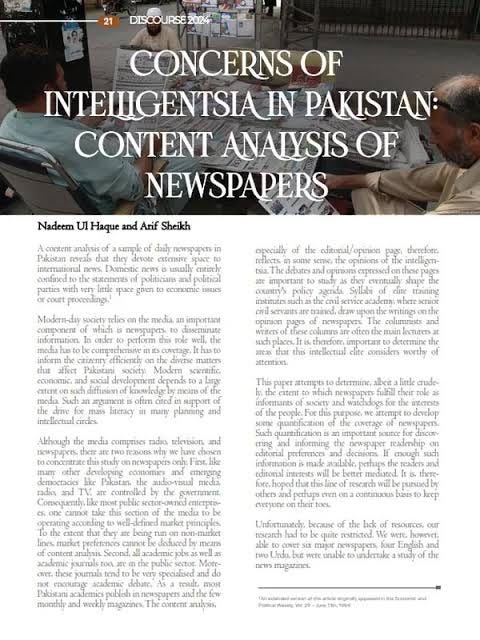
Every week this column finds the same two diseases. The news pages practise stenography: officials speak, reporters transcribe. The opinion pages write in silos: each op-ed diagnoses one fragment, cites no local research, and waits for a donor report to set the agenda. This week supplied textbook cases of both — and, as always, the question neither side asks: what are Pakistan’s real economic issues?
The week in news
The data was plentiful. Textile exports stagnated at $17.9bn, up just 0.26 per cent, with the national export target missed by $4.87bn (Dawn). FDI fell 34 per cent; Bahrain pulled $30m from government securities, adding to over half a billion dollars of foreign outflows from domestic bonds in FY26 (Dawn). Record remittances of $41.6bn still left a $139m current-account deficit as imports rose 8.5 per cent (BR). SBP reserves fell to $17.228bn on external debt servicing (Dawn). LSM grew 5.77 per cent despite a May slump (Dawn). IT exports hit $4.6bn. The IMF’s WEO Update put FY27 growth at 3.5 per cent, cut from 4.1, with inflation raised to 8.4 per cent and the projected current-account deficit doubled (BR).
The institutional items were quieter but telling. The maritime minister claimed record fish exports of $568m; PBS showed $482m — an $86m gap nobody reconciled (Dawn). The Privatisation Commission appointed the ADB as financial adviser for a transaction (BR). Drug price revisions for 105 medicines have sat unimplemented for over two years (BR). A committee was formed to review 24 tax tribunal appointees on Rs2.6m salaries; another to assess GM maize. A GSP+ compliance report warned that trade success has not been matched by progress on 27 convention commitments (BR). A Senate panel demanded scrutiny of foreign-funded projects. The prime minister announced, again, that agriculture can revive the economy quickly (Dawn).
The week in opinion
Dawn ran “Doomed tax initiative”, “Barren reforms”, “GSP-Plus renewal”, and a strong Business and Finance Weekly set: “Financing consumption through SMEs”, “Retail investments in debt”, “Unprepared for artificial intelligence”, “Mangoes in distress”, and the reported-analysis piece “Conventional banks favour Islamic lending”. Business Recorder carried “Beyond Rs13 trillion tax collection!”, “Record remittances: but no room for over-celebration”, “The cost of insecurity”, editorials on the IMF projection and medicine pricing, and op-eds on the PSDP mandate problem, the single-variable habit in economic debate, the seed-company paradox, the education-revolution ritual, and the Strait of Hormuz. On fiscal federalism, Kaiser Bengali’s “World Bank and fiscal distribution” (Dawn) and Shahid Kardar’s “World Bank’s ‘magical discovery’” (Dawn) gave opposite verdicts on the same donor report — the week’s most revealing pairing.
Disease one: stenography
The news pages did not report the economy this week; they took its dictation. The prime minister said agriculture can revive the economy quickly — printed as news, with no return to the last agricultural package, the last seed initiative, the last livestock scheme, or what any of them achieved. The SBP governor said digital transactions hit 12bn — printed, with no question about who controls the infrastructure, what banks charge, or why fintech entry stays restricted. The Prime Minister’s Office described its own preparedness for renewed conflict — printed. When the source of the story and the interpreter of the story are the same official, journalism has not occurred. A press release has.
Stenography is worst when the numbers contradict the dictation — and the press prints both without noticing. Ministers announce facilitation councils and Gulf billions; FDI fell by a third and foreign holders exited domestic debt. A minister claimed fish exports of $568m; PBS said $482m — an 18 per cent gap between a cabinet member and the state’s own statistics bureau, in the same news cycle, unreconciled and unpunished. When official numbers can diverge without consequence, they stop being measurement and become announcement. The press taught officials that lesson by staying silent.
Stenography also means no memory. Textiles is the most subsidised, protected and lobbied industry in Pakistan’s history; decades of packages, cheap credit and energy concessions produced 0.26 per cent growth. That is a verdict on an entire policy architecture — but delivering the verdict requires a ledger of past promises, and no desk keeps one. Reserves fell “due to debt servicing”, and that was the whole sentence: no calendar of what falls due, to whom, on what rollover terms. Treasury-bill inflows are still called “investment” when they are sovereign financing rented at some of the world’s highest yields. The one story that rose above transcription — Dawn’s piece on conventional banks routing credit through profitable Islamic windows — asked why once, got an answer (higher margins, lower depositor returns), and stopped one question short of the thesis: Pakistan’s banks are a sovereign-financing industry with a deposit franchise attached, and the SBP presides over it.
Disease two: silo op-eds, tailing donors
The opinion pages were sharper — and just as fragmented. “Doomed tax initiative” remembered the lineage of failed trader schemes. “Beyond Rs13 trillion” separated nominal collection from fiscal performance. “Barren reforms” refused the fantasy of agriculture-by-command. The remittance editorial said plainly that $41.6bn measures labour export, not strength. The PSDP mandate piece asked why Islamabad runs provincial projects while failing at the macroeconomy only it can manage. Each piece is good. Together they are a pile of fragments. Tax, banks, remittances, agriculture, PSDP — five op-eds, five silos, no one connecting them, and not one citing the local research that already connects them. Pakistan has two decades of domestic scholarship on regulatory sludge, the footprint of the state, banking’s sovereign exposure and the political economy of protection. The op-ed pages write as if it does not exist. Commentary that cites no research cannot cumulate; every columnist starts from zero, every week.??
Then there is the tale of two grade sheets — and what it says about tailing donors. Dawn delivered two verdicts on the World Bank’s fiscal federalism report, a week apart, from two men who have run the system being diagnosed. Kaiser Bengali — a member of the 7th NFC — awarded it “an A+ for technical standard” while faulting its political naivete. Shahid Kardar — former Punjab finance minister and SBP governor — called it a “magical discovery”: a report presenting itself as fresh diagnosis when there is little in it that is new or thought-provoking. Kardar is right. The A+ reflex — receiving foreign restatement of local knowledge as technical excellence — is precisely how donor authority reproduces itself, and how a national debate ends up scheduled around Washington’s publication calendar rather than local inquiry. Kardar’s deeper question deserved the week’s headlines: why have the World Bank and the donors quietly turned their backs on decentralisation? The report tinkers with the NFC formula while the real unfinished business of the 18th Amendment — empowered, elected, fiscally resourced local government — goes unmentioned by the Bank, unpushed by the press, and undemanded by the op-eds. Both the commentariat and the donor stop exactly where the political equilibrium wants them to stop: redistributing between Islamabad and four provincial capitals, never devolving to the citizen.
What are Pakistan’s real economic issues?
Since neither the news pages nor the op-eds will assemble the picture, this column will. Pakistan’s problem is not a missing lever — not credit, not seeds, not digitisation, not a better NFC formula. It is a self-reproducing institutional equilibrium with five load-bearing walls.
First, the permission economy. Every transaction — building, importing, opening, expanding — passes through a wall of licences, NOCs and inspections. This week’s exhibit: drug prices recommended for revision two years ago, still frozen. A state that claims every power and exercises none is not a regulator; it is a toll collector.
Second, a protected insider economy. Textiles’ 0.26 per cent after decades of subsidy is what happens when policy serves incumbents — the Seth firm — rather than competition. Protection without exit produces neither productivity nor exports; it produces lobbying.
Third, a financial system that funds the state, not enterprise. Banks earn risk-free returns on government paper; the Islamic-window story shows them optimising margins within that game, not escaping it. Investment cannot recover while the sovereign is the best borrower in the country.
Fourth, a state that consumes itself. Committees, tribunals at Rs2.6m a seat, PSDP projects in provincial mandates, perks and plots absorbing what transfers deliver — the World Bank found NFC money went to wages and pensions and called it a discovery. The civil service’s own privileges are the budget’s first charge and reform’s first casualty.
Fifth, an exported workforce and an undeveloped citizen. Record remittances are the mirror image of failed job creation; schools that don’t teach and cities run as permission regimes push people out. Labour is now Pakistan’s leading export, and the press celebrates the proceeds.
Binding all five: the knowledge system itself. Research is donor-funded and non-cumulative; journalism is stenographic; commentary is siloed. A country that outsources its self-understanding cannot reform itself — it can only await the next report and grade it A+.
The remedy: memory and integration
Every economic desk should keep six public trackers: targets versus outcomes; donor and PSDP projects from approval to completion; tax initiatives and realised yields; the debt-servicing calendar against weekly reserves; subsidies and their beneficiaries; reforms promised versus implemented. And every op-ed page should demand one thing of its writers: cite the local work, connect your fragment to the system. Until then, officials will keep supplying both the story and its interpretation, columnists will keep polishing fragments, and donors will keep collecting A-plusses for telling us what we already knew.
Comments
Nothing yet. Say the first thing.
Sign in to join the conversation.