
You know the feeling.
12 VC websites. 6 Crunchbase deep dives. 17 LinkedIn profiles cross-referenced against portfolio pages that haven’t been updated since 2022.
Hours in. Zero emails sent.
This is not a productivity problem but an information problem.
Before a founder sends a single outreach, they’re trying to answer five questions — and none of them have a clean, obvious answer:
Do they actually invest at my stage?
Have they written a check at my size before?
Do they lead rounds, or do they follow someone else’s conviction?
Is my sector something they genuinely back, or just something they listed on their website once?
Are they even actively deploying right now?
So you go hunting. A podcast interview from 2023. A Medium post the partner wrote when they were at their last firm. A Twitter thread that’s now locked. A portfolio page with logos and no dates.
By the time you’ve assembled a half-picture, you’ve spent 2–3 hours per investor — and OpenVC estimates it takes 10–15 minutes just to write one quality personalised email. That’s before you’ve even started writing.
The average seed round requires reaching out to 40–80 thesis-matched investors. Run the math on that research time, and fundraising stops being a part of your week. It becomes your entire week.
Before I dive deeper:
Check out —> The VC Lens
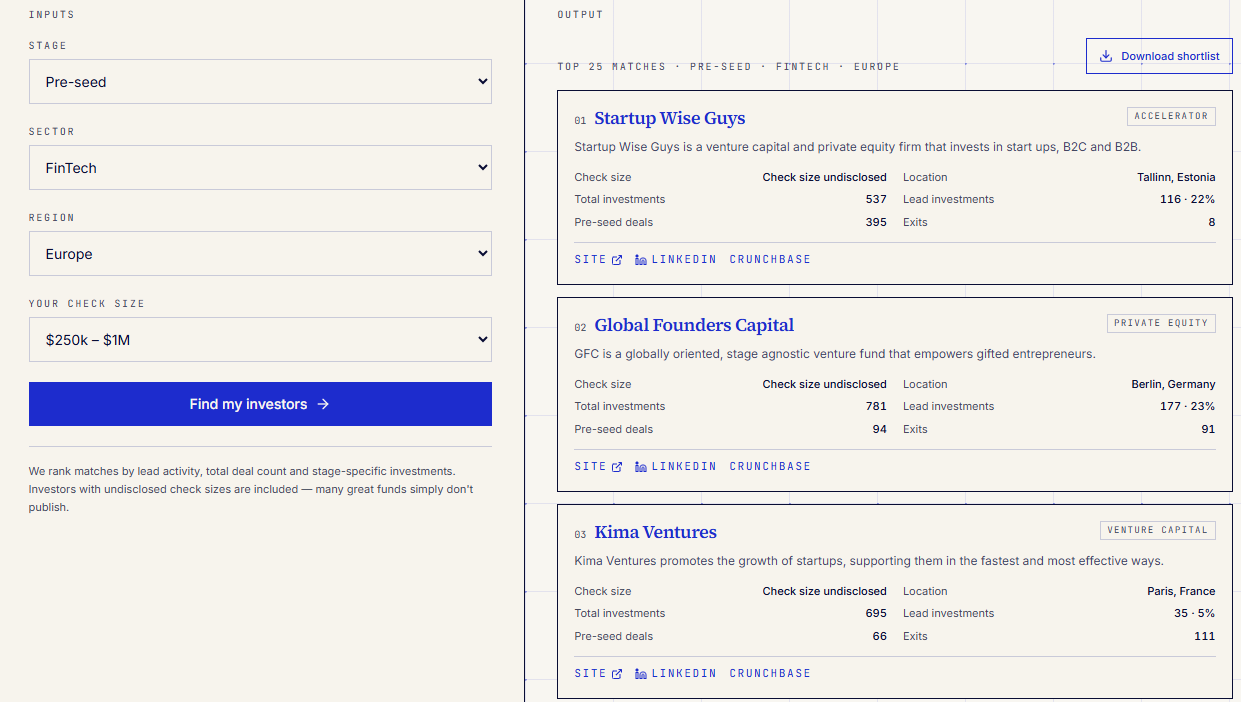
A platform for first-time founders to learn how VCs think & evaluate startups so they can raise faster on better terms
Why investor research breaks down for early-stage founders
The five questions you’re always trying to answer before you reach out
How the Investor X-Ray changes the process
A real example: what a Fit 90 score actually looks like in practice
The detail that changes a pitch conversation before it starts
FAQ
Here’s the core problem.
VCs are not transparent about how they actually behave. They’re transparent about how they’d like to be perceived.
“We’re stage-agnostic.” (They’ve done 3 pre-seed deals and 140 Series A deals.)
“We invest across sectors.” (Their last 12 investments were all SaaS infrastructure.)
“We love to lead.” (Their lead rate is 7%.)
None of this is dishonest. It’s just the gap between a firm’s stated thesis and its revealed behaviour — what they actually write cheques for, at what size, at what stage, and in which geographies.
That gap costs founders enormous amounts of time.
You’re not filtering for who says they invest at your stage. You need to filter for who has invested at your stage, repeatedly, recently, and at your check size.
Before any cold email goes out, a founder is running an internal checklist. Here’s what it actually looks like:
Stage match — “We invest early” appears on almost every fund website. But early can mean pre-seed, seed, or Series A depending on who you ask. A fund that’s done 147 Series A deals and 50 Seed deals is technically an early-stage investor. Whether they’re the right call for your Seed round is a different question.
Check size — If your round is $750K and a fund’s minimum check is $5M, you’re not a fit. Simple. But most funds don’t publish this clearly, and many list a range so wide (”$100K–$10M”) that it tells you almost nothing about where they actually concentrate.
Lead behaviour — There’s a significant difference between a fund that leads 52% of its deals and one that leads 7%. A lead investor anchors your round, sets the terms, and brings the credibility that gets other investors across the line. A follower can’t do any of that — they need someone else to go first. Knowing which category you’re in before you reach out changes the ask entirely.
Sector fit — Declared focus and actual portfolio are often different things. A fund that lists “Software, FinTech, Health, Education” as sectors may have invested 80% of its capital into one of those. Cross-referencing what they say with what they’ve actually backed is time-consuming but essential.
Deployment activity — A fund that closed in 2019 and is now on year 7 of a 10-year life cycle may have limited dry powder left. A fund that closed 18 months ago is likely actively deploying. This isn’t always public — but deal recency gives you a strong signal.
These five questions have clear answers. They just live in 12 different tabs.
The Investor X-Ray on The VC Lens brings all of that into one place.
You answer five questions about your company — stage, sector, geography, check size, whether you have a lead — and the tool surfaces 20+ matched investors, each scored by fit.
Click “Read the X-Ray” on any investor, and you get:
01 — Fit Verdict
A score across five dimensions: Stage, Sector, Check, Geography, and Lead Behaviour.
02 — Stage Fingerprint
The actual distribution of their deals across pre-seed, seed, and Series A. Not what they say on their website. What the data shows. If 74% of their early-stage deals are Series A and you’re raising Seed, you see that immediately.
03 — Sector Focus
Their declared sectors, flagged against your category. At the moment this is self-declared; a portfolio-validated version is in the works.
04 — Check Behaviour
Their disclosed range placed next to your ask. Side by side. If your numbers don’t overlap, you know before you write the email.
05 — Lead Profile
Total deals, lead deals, lead rate. Labelled clearly: Conviction Lead, Opportunistic Lead, or Follow. Knowing this before the first call tells you whether you’re pitching for a lead anchor or a follow-on cheque and your pitch language should be different for each.
06 — Reach
Where they’re based and what geographies they cover. Relevant if you’re building outside the Bay Area and need to know whether a US fund actively backs international companies or just says they do.
07 — Personalised Outreach Openers
Three draft openers grounded in their actual portfolio, not a generic template. The difference between “I admire your work” and a reference to a specific portfolio company that overlaps with what you’re building.
One of the startups in a recent cohort — raising Seed, B2B SaaS, North America — ran the tool and F-Prime Capital came back with a fit score of 90.
Here’s the breakdown:
DimensionScore
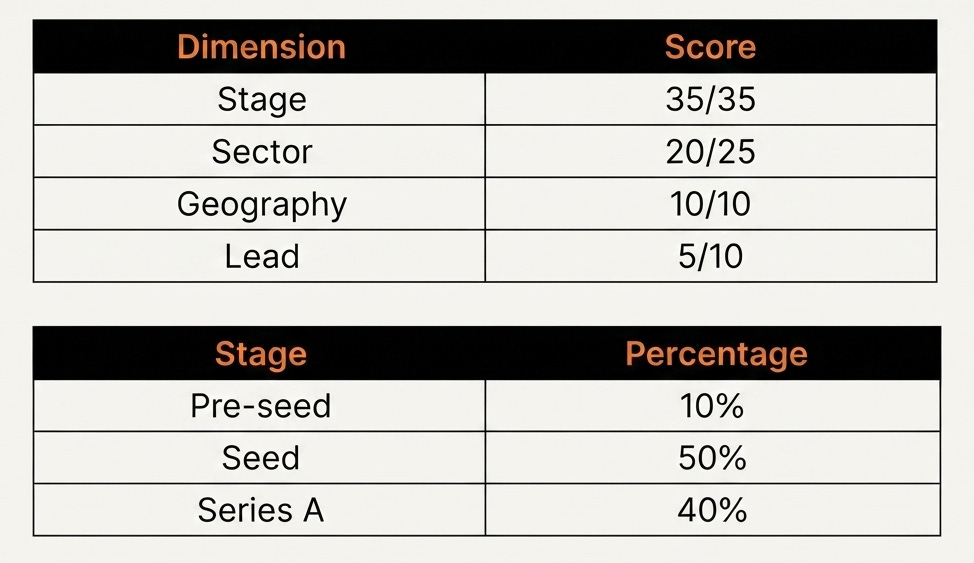
Stage match: full. Check range ($100K–$10M) fits. Geography covered. Sector declared and overlapping.
The lead score is partial — because F-Prime’s lead rate is 21%. They lead opportunistically, not consistently. Worth knowing before you decide how to position the ask.
But there’s a second detail worth flagging.
F-Prime’s Stage Fingerprint:
Pre-seed: 1 deal
Seed: 50 deals
Series A: 147 deals
74% of their early-stage portfolio is Series A.
This doesn’t disqualify them. 50 Seed deals is a real track record. But it means they’re much more frequently writing Seed checks to companies they already know — companies they’ve been watching since pre-seed, or that come via a warm intro from a Series A founder in their portfolio.
A cold email pitching them as a first-time lead is a harder sell. A warm introduction through a founder they’ve already backed is a completely different conversation.
That one piece of context — surfaced in 30 seconds by the X-Ray — changes the outreach strategy entirely. You’re not writing a cold email. You’re mapping a path to a warm intro through their existing portfolio.
That’s the difference between three hours of research leading nowhere, and three hours of research leading to the right meeting.
Q: Is the tool free?
The Investor X-Ray is open access — you can run a search and see your matches without a membership. The personalised outreach openers and some deeper data points are unlocked with a The VC Lens membership.
Q: How are the fit scores calculated?
Each dimension is scored against real deal data — stage history, disclosed check sizes, geographic coverage, and lead/follow behaviour pulled from investment records. It’s not a survey or a self-assessment. It’s based on what investors have actually done.
Q: My sector is niche — will I still get relevant matches?
The tool maps your sector against both declared focus and actual portfolio categories. If a fund has backed three companies that look like yours but calls themselves “agnostic,” they’ll still surface in your results.
Q: The Stage Fingerprint shows mostly Series A deals. Should I skip them?
Not automatically. Look at the absolute number of Seed deals alongside the percentage. A fund with 50 Seed investments has a real track record at your stage — even if most of their volume is Series A. The percentage tells you where their attention lives; the absolute number tells you whether they know how to evaluate a Seed-stage company.
Q: How do I use the outreach openers?
They’re starting points, not finished emails. The tool gives you three angles based on their portfolio — your job is to pick the one that’s most relevant to your specific story and make it yours. A line that references a specific portfolio company they’ve backed will always outperform a generic intro.
My Unicorn Club is a weekly newsletter for early-stage founders navigating the realities of building and raising. If someone forwarded this to you — subscribe here.
Tool referenced: Investor X-Ray by The VC Lens — open access, free to try.
Comments
Nothing yet. Say the first thing.
Sign in to join the conversation.