
3 Things (3Ts): three thoughts. Maybe about one movie; maybe three snippets of my current WIP; maybe totally disconnected thoughts. All I can promise is there will be three of them, and it’ll be short enough to read over a cup of coffee.
Immediately after posting the sentences post, I wanted to write a follow up about the dark horse of sentences, dependent clauses.1
Dependent clauses as standalone sentences are typically rare in literary prose. Why choose to make the clause a standalone sentence, not just part of the same with a semicolon or comma?
My hypothesis boils down to 4 categories: emotional closeness, idea emphasis, genre tone convention, and general poetics.
To test my hypothesis, I’ve been gathering data, highlighting dependent clauses in books since April. My plan is to read at least 4 more books from completely different genres, collect a good sample size of dependent clauses, then report back in a long post.
As I’m reading, I’m asking: when are dependent clauses most impactful? How do writers use this tool from their toolbox, and how can we learn to better utilize this tool?
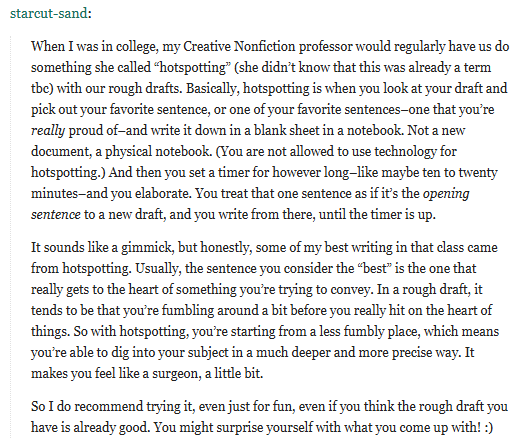
As I’ve been zero-drafting one of my Locust & Lowe books, I’ve been keeping this exercise in mind. During my zero draft process, I write a lot of words. Most of those words won’t make the final cut. Like the post says, you write a lot of bunk to get to those kernels of plot or character insight. This is especially true on the scene/chapter level.
Part of becoming a stronger writer is hotspotting as you go, identifying your strongest sentences as you write them, iterating on those sentences in the writing moment. The stronger this skill is, the better your scenes, the clearer your ideas, the less time you have to spend on editing.2
I’m finding hotspotting useful, especially for newer writers, in a few ways:
inspires confidence in your writing (you have to admit to yourself you’ve written a sentence you like, the worst!)
cuts the chaff from bloated, unruly zero drafts
helps rapidly iterate stronger scenes
If any of those sound like skills you want to work on…
Are you a reader? Help me with dependent clauses: send me the examples you see, and how they’re being used.
Are you a writer? Help me with hotspotting: try the exercise and tell me what surprised you. I plan to write a long post on this one too.
DMs and comments are open. you can also email me at mythoscopes@gmail.com.
Know a writer who wants to strengthen their craft? Share this post with them <3
I actually got into a discussion about dependent clauses at work! Business writing vs. creative writing, and whether dependent clauses are appropriate in business context.
None of us want to fucking edit our own stuff, and if you say you do, well done on tricking yourself with the power of positive thinking.
Comments
Nothing yet. Say the first thing.
Sign in to join the conversation.