
Last I wrote, I was considering how to better write at the sentence level. I was on writing rest, though, so pivoted to reading at the sentence level instead. I set myself a goal to write down one sentence a day I believed exemplified a great sentence. I was to report back around January 5th.
This immediately spiraled. I set myself a goal, and the goal got out of control. I know, I know, who could’ve possibly predicted this.
But lemme tell you, I was not expecting this to become all I think about. That’s what happens when you listen to teachers, smh.
The result? I do have a list of Sentences I Loved. More than that, I have categories. Lock in, nerds.
1. a sentence conveys facts
2. a sentence conveys meta
3. a sentence conveys a full thought or part of a thought
4. a sentence conveys the beauty of language
Facts are your who, what, where, when, why. In literary terms, this is called narrative framing. Narrative framing, or “frames,” are these “facts” that readers usually look for at the beginning of stories, chapters, scenes. They include:
year and time of year
time of day
place
weather outside
room inside
objects in the room
people in the room
other sensory data
your character
appearance, physicality, current state of the body
their internal state
Let’s look at one of my Good Sentences to discuss. It’s the 2nd sentence of an investigative journalism piece from Rolling Stone.
On this sweaty February day in the Southern Hemisphere, he’s speaking above the whir of an oscillating floor fan and the drone of Fox News.
This sentence has a lot of frames:
time of year: February
time of day: “day” time
place: Southern Hemisphere
weather outside: sweaty
room inside: ambient noise
objects in the room: oscillating floor fan and tv
our character: a “he” who speaks
These frames typically count as non-action narration. But notice they’re different than exposition, which is an explanation of plot; they are their own category of framing the story — a literal frame for your piece of art. Each scene needs its own frame, and you have to build one each time you start a new scene, otherwise the reader may get disoriented; they don’t need to know all these things for every scene, but they need at least one or two, as signposts, to understand where you’ve taken them in time and space (has there been a time jump? is the character in a different room now? etc).
Many novels start with the most framing they’ll have all book, sometimes pages of it, these days mostly following their main character doing something mundane (often waking up—try to avoid the cliché of your first page including an alarm clock and a morning routine!). But framing doesn’t have to come first in a scene; in fact, scenes are usually more powerful if they start with action.
Take this example from George Orwell’s 1984, and notice how it starts with action, then leads into framing. Remember, this is the start of a brand new scene.
III.
“There are three stages in your reintegration,” said O’Brien. “There is learning, there is understanding, and there is acceptance. It is time for you to enter upon the second stage.”
As always, Winston was lying flat on his back. But of late his bonds were looser. They still held him to the bed, but he could move his knees a little and could turn his head from side to side and raise his arms from the elbow. The dial, also, had grown to be less of a terror. He could evade its pangs if he was quick-witted enough; it was chiefly when he showed stupidity that O’Brien pulled the lever. Sometimes they got through a whole session without use of the dial. He could not remember how many sessions there had been. The whole process seemed to stretch out over a long, indefinite time—weeks, possibly—and the intervals between the sessions might sometimes have been days, sometimes only an hour or two.
Instead of starting from a very far narrative distance from the action, which is how it would feel if we started with paragraph two, we start with dialogue (which is neither exposition nor framing, but action) and with just three simple sentences gives the scene more pep and urgency. Only then do we jump into framing, but notice how very little meta is being included here; it’s mostly sensory data and descriptive fact:
year and time of year - unknown
time of day - unknown
weather outside - unknown
room inside - we don’t get a description of the room per-se, but we do get…
objects in the room - a bed, the bonds, a dial, a lever
people in the room - O’Brien, no description
your character - Winston
appearance, physicality, current state of the body - this is the majority of the framing. “lying flat on his back.” “he could move his knees a little and could turn his head from side to side and raise his arms from the elbow.” Orwell wants us to pay attention to Winston’s body.
their internal state - I’ll leave that up to you. There’s certainly no very clear “Winston was feeling scared.”
other sensory things - I almost put time dilation here, but on reflection, that’s actually the meta of the scene. I’ll explain more in the next section.
With these framing sentences, Orwell draws our attention to two things: Winston’s physical state, and the objects in the room. Not the room’s walls or ceilings or dimensions, the objects. He also draws our attention to the lack of time framing: Winston doesn’t get time framing, and neither do we. Orwell doesn’t use every single frame; it doesn’t matter what time of year it is or what the weather is outside, here; he picks the important ones and gives us sensory details that make those specific frames matter.
The clever reader then asks themselves: why is Orwell focusing us on objects and physical state? What does that mean?
And the intentional writer knows that clever readers will pick up on these things.
Notice, too, that framing sentences are the perfect way to show, not tell. Neither one of these examples uses strong emotive words; it’s giving us barely any meta information. But there are undercurrents and moods, just from what Orwell has chosen to focus his framing on.
Now, these are just the first two paragraphs of the scene. We could easily get more framing in the next few paragraphs—framing does not have to be bunched all together. When you get really good at sentences that convey frames, you use framing to serve your action by using setting to manipulate mood.
If you want to practice writing framing sentences, I recommend this assignment from poet Marie Howe:
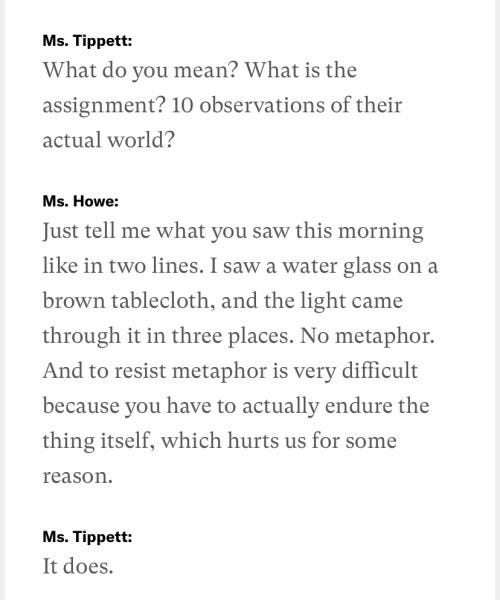
Meta consists of:
psychic distance - how emotionally close are we to the character?
narrative distance - how close are we to the action?
I learned about these concepts from Scott Driscoll at Hugo House. Scott taught us how to manipulate voice and distance to better serve our story. He taught us five levels of psychic distance and five levels of narrative distance, and each level of distance is a tool that can be used in a myriad of ways. For example, you could use the closest level of psychic distance during an emotional peak to get the reader to endure the difficulty of the moment. Or an author could use the furthest narrative distance, a panoramic view, to world-build.
But I can’t get into all that in this post. For our purposes, here’s the meta info we want to look for:
to whom do the words belong? (the author or the character)
how close to an event/deed/action does this sentence make us feel? (narrative)
how emotionally close to the character does this sentence make us feel? (psychic)
Let’s take this sentence:
Nobody ever said it was always going to be a goddamn delight.
This sentence, taken completely out of context, could be one of two things:
flaneur, which is an author’s insertion of a pithy opinion or observation
free indirect discourse, which is the voice inside the character’s head (what some call an internal monologue)
To make this emotionally further away, you’d say “Nobody ever said it was always going to be a goddamn delight, he thought.” See how the addition of “he thought” makes us feel further away from the character?
To know if these words belong to the author or character, you need context.
In class, Scott used an example that sticks in my head to this day.
“Hotels were different in those days.” vs. “I liked hotels better in those days.”
The latter is, arguably, the weaker sentence; we don’t need that insertion of the character with “I liked.” The latter is an example of boilerplate narrative and psychic distance; very safe. Pretty boring. The former, though. Flaneur is that slightly ironic, slightly detached voice, making observations about politics, humanity, always dipping in to offer an opinion then disappearing again. Hotels were different in those days is the sentence of an opinionated person, daring you to take a stance, daring you to have a reaction. The flaneur is the loafer, and he’s one of the most interesting voices to employ, but he never stays long in a novel; otherwise, you have a substack essay instead of a narrative.
There’s a lot more to say about this, but if you’re interested in this section, I recommend seeking out Scott’s classes.
When pondering which sentences were going to make my final list, I discovered: I prefer sentences to stand alone. To be a contained thought, one that you, my reader, could read without any context and still get some sense of frame, meta, action, and beauty. This was a subjective preference I didn’t know about myself before, a learning I’m taking away from this experiment.
I don’t think stand-aloneness is what makes a sentence good, but it does help writers to study how we express an idea on the sentence level. What I found was that authors from older eras had a 1:1 idea to sentence ratio. This led to much longer sentences. These days, publishers want writers to have short sentences. That necessitates spreading an idea out over a few sentences.
Here’s a contained idea from The Scarlet Letter by Nathaniel Hawthorne (1850):
Over the entrance hovers an enormous specimen of the American eagle, with outspread wings, a shield before her breast, and, if I recollect aright, a bunch of intermingled thunder-bolts and barbed arrows in each claw. With the customary infirmity of temper that characterizes this unhappy fowl, she appears by the fierceness of her beak and eye, and the general truculency of her attitude, to threaten mischief to the inoffensive community; and especially to warn all citizens careful of their safety against intruding on the premises which she overshadows with her wings. Nevertheless, vixenly as she looks, many people are seeking at this very moment to shelter themselves under the wing of the federal eagle; imagining, I presume, that her bosom has all the softness and snugness of an eiderdown pillow. But she has no great tenderness even in her best of moods, and, sooner or later — oftener soon than late — is apt to fling off her nestlings with a scratch of her claw, a dab of her beak, or a rankling wound from her barbed arrows.
(The Scarlet fucking Letter. Yes, all those weird words and spellings are directly from the book, not typos. It’s overwrought prose, but man. She has no great tenderness even in her best of moods, and sooner or later…. why is America still living up to this description?)
Anyway. Sentences. You really can’t extract one of these sentences and have it stand alone. You need the whole string of sentences to capture the entire sentiment. It makes “sentence that stands alone” a rare commodity, and it made me realize novelists don’t typically write that way. It doesn’t make sense, most of the time, unless you’re a… well, we’ll get there. But most of us are writing at the paragraph level, if we’re thinking of that at all.
Here’s a contained idea from Prentice Alvin by Orson Scott Card (1989):
As her mother had been called Goody Guester all these years, and other women Goody this or Goody that, any woman could have the name. But few deserved it. Few there were who inspired others to call her by the name in full: Goodwife, not just Goody; the way that Mistress Moody was never called Missus. It would demean her name to be touched by a diminished, a common title.
Shorter sentences, we’re getting to the point quicker now. Take all these sentences individually, most but not all of them stand alone. “But few deserved it” is a particularly dependent clause, that makes little sense as, say, the first sentence of a story (the place where your story has the least context). “It would demean her name to be touched by a diminished, a common title.” That could stand alone. It would be a tease of a sentence, though, because it’s only part of a thought. You need all four of these sentences, together, to encapsulate the full thought.
So, while reading, knowing that these sentences would one day be read in a list, by you, I began looking mostly for sentences that could truly stand alone — that the author wrote to stand more alone.
Here’s another example: “Knowledge that he used to break into Dan’s house.” I enjoyed this sentence because it’s punchy, it’s a good character beat. Then it got cut from my list. Not just because it would be stronger if it read “Knowledge he used to break into Dan’s house,” but because the sentence simply doesn’t have the legs. Here’s the context:
In some ways prison was a kind of college for learning unusual skills, and one of the unusual skills Herbert had learned while there was how to pick a lock. Knowledge that he used to break into Dan’s house.
The sentence works better with its fellow, because the full thought is expressed through two sentences. The punch only lands if you have the previous sentence’s wind-up.
Let’s talk, then, about how a sentence can encapsulate a full thought, even in the context of a longer paragraph and larger story. Here are a few I pulled in the last two months:
He meant to be reasonable, he surely did.
Jean Daspry—that delightful heedless Daspry who, six months later, was killed in such a tragic manner on the frontier of Morocco—Jean Daspry and I returned on foot through the dark, warm night.
“That is horrifying and I want to go home,” I said, although I pronounced it, “Ah. I see.”
Sentence One: Now, that first example might’ve made you raise your eyebrows. How does that sentence stand alone? It barely tells us anything. Try this: read it out loud to yourself. Read it out loud again. He meant to be reasonable, he surely did. It gives us one single frame (our character), and not a lot of action. But what this sentence has in spades is meta information. We’ve got fairly close psychic distance, with a lot of internal insight on our character’s feelings, and also makes us feel psychically close by using the phrase “he surely did,” which sounds like a verbal tic or dialogue, so that it feels like we’re hearing internal thoughts, or perhaps the character himself telling the story (how easily this could be “I meant to be reasonable, I surely did”). That makes us feel closer to being truly inside the character’s head.1 We’re also fairly close to the action, because “meant” implies he’s not going to be reasonable. An escalation of some sort is about to occur. The sentence primes us, it makes us sit up and pay attention. Anyway, I love this little sentence. It would be fun to start a story this way.
Sentence Two & Three are, in my opinion, perfect examples of sentences that stand fully alone. Do you know the context? No. But the sentence is a delightful little canapé regardless. They convey a full thought and don’t feel incomplete on their own.
Compare these again to: “It would demean her name to be touched by a diminished, a common title.” To me, there’s a subtle difference in completeness that makes the latter need its paragraph to be a truly good sentence; it just doesn’t have the components to stand on its own. And that’s okay! Because we’re novelists, we’re writing in paragraphs. But this taught me not to be overly reliant on paragraphs to express full thoughts, when a single sentence could do instead.
While all the other categories are interesting, the most important lesson I learned during this experience was one about beauty.
Usually I read for plot. Or, if it’s fanfic, I’m reading for emotion. Both encourage skimming. I rarely stop to notice sentence structure.
I’m not supposed to. The stuff I’m reading wasn’t meant to be read at the sentence level. Lots of care might have been taken to craft amazing characters, give them good arcs, make the plot intriguing and page-turning, but… sentence level?
As I read on the sentence level, I found myself impatient with poor construction. Repetitive paragraphs. Slogs. In the last post, I think I mentioned Bourdain’s mountain of dung story, and that kept coming back to me. It threw into stark relief that: 1) I read for plot, and when I do, I’m skimming; 2) part of the reason I’m skimming is that a lot of these sentences aren’t supposed to be read closely; 3) if I want to read on the sentence level, I have to choose different books to do that with; 4) the books that can stand up to a Sentence Level Read are fucking life-changing pieces of literature and I can’t just read, like, 5 in a month.
I knew this experiment was going to be difficult for my typical reading habits. It would’ve been like picking apart a chalupa with tweezers. You’re not supposed to do that to a chalupa. A chalupa’s there to make you feel good.
But I couldn’t stop thinking about this quest for Good Sentences, so I ended up abandoning the books I’d been reading at the time, and picking up a bunch of books I knew would fit this prompt. Books I’d been avoiding because they would take a lot of attention and care. Books I knew would probably scramble my brain and change how I felt about writing. The opposite of a chalupa.
When you start reading on the sentence level, your priorities change.
One of the most important things a sentence can do is be beautiful. Below, you can read examples of sentences I found beautiful, but beauty is unquantifiable and unique to each individual, so I’ll really only be able to talk in abstracts here.
But the beauty of the craft in these books! It reminds me of going on the Chicago Art Deco architecture tour and marveling, mouth agape, at the craftsmanship, the artistry, the scope. Not just that the novel is compelling, but that they built it with a beautiful sentence, and then another beautiful sentence, and then another one, that make up small beautiful paragraphs, that stack into perfectly portioned beautiful scenes, that string into a narrative that, at every. single. level., has beautiful construction, until it’s a soaring monument to art — that is crazy.
I said we’d get to something later, and that’s Colson Whitehead, winner of the Pulitzer and a million other awards and fellowships and a living legend and an author you read to remember what writing can do to a soul ready to listen, like going to church penitent. Here’s one of Colson Whitehead’s paragraphs:
The people of bygone days had pulled dark wood in wagons to panel the hotel walls, and now it was scraped and splitting. They had ordered red-and-orange carpet from the big city catalogs and laid it on the floor for a hundred years of feet, and now it was gauze. The armchairs, tables, and writing desk had been moved so often that the furniture legs had scraped fuzzy white halos into the floor. If he put the three lamps together, he could partially reconstruct the sylvan idyll described on their round bodies—alone, they were too chipped and defaced to relate anything more than ruin. Brittle brown spots mottled the lamp shades where the bulbs had smoldered, mishap after mishap. The previous guests had left their mark. The only thing unscathed through these accumulated misadventures was a painting that hung on one wall. Closer inspection revealed it to be a portrait of one of the Winthrop elders. Winthrop stood in a field with some hunting dogs, preserved in his kingdom. Guests came and went, guests registered, retired, and checked out, but this man remained. He never blinked.
This paragraph makes me feel crazy. Like. What are you talking about, every sentence is perfect? How long did it take to craft this? It reminds me of poetry: every word precise, deliberate. Pull any one of these sentences and it flickers as a little candle of beauty. You feel the craftsman’s hands on every single one of these sentences. And then they all stack together to build something bigger and even more beautiful. And later, this sentiment will matter. This framing, this flaneur, this exposition about Winthrop, this all matters. We’re setting up here, in big ways. But even if we weren’t, just reading these sentences alone is art enough. The previous guests had left their mark. Phew.
The whole book is like this, by the way. That’s what being a Pulitzer-level author looks like. Go read Colson Whitehead. What the fuck.
Anyway, this is what I must continue to learn. I don’t think I’ll ever get to cathedral levels of novel construction, but studying these master craftspeople at their most fundamental level, the sentence level, will help me build better.
It starts with that first small stone.
Before we get to my list of sentences…
This was a difficult one to publish. I almost didn’t. If you shared it with just one of your friends, it’d feel worth it. Thanks <3
“That is horrifying and I want to go home,” I said, although I pronounced it, “Ah. I see.”2
The bird man is at his desk, vaping and working the phone.3
On this sweaty February day in the Southern Hemisphere, he’s speaking above the whir of an oscillating floor fan and the drone of Fox News.
“If you need to be famous,” he says, “you need to have something strange.”
He was a soldier, legislator, judge; he was a ruler in the Church; he had all the Puritanic traits, both good and evil.4
It was pleasant in the summer forenoons — when the fervent heat, that almost liquefied the rest of the human family, merely communicated a genial warmth to their half torpid systems — it was pleasant to hear them chatting in the back entry, a row of them all tipped against the wall, as usual; while the frozen witticisms of past generations were thawed out, and came bubbling with laughter from their lips.
It was a bright cold day in April, and the clocks were striking thirteen.5
He was only the door, the open door.6
All the anguish, all the grief spilled out of him, while above him Lolla-Wossiky, called Tenskwa-Tawa, called the Prophet, sang to him a song of melancholy, a song about the death of bees.
Jean Daspry—that delightful heedless Daspry who, six months later, was killed in such a tragic manner on the frontier of Morocco—Jean Daspry and I returned on foot through the dark, warm night.7
He meant to be reasonable, he surely did.8
It was chance that put me in his way.9
The first time Alex noticed himself in a mirror, he cocked his head and said, “What’s that?”10
“I lied,” she says, and laughs so hard that the heels of her platform boots nearly leave the floor.11
Not one person has eyes to see that Lolla-Wossiky isn’t drunk at all.12
Lying there with death seeping through his bone, he began to feel like his body was just a kind of lean-to, a shelter he lived in during bad weather till his house was built.
Johnny watched Henry’s eyes instead of his hands.13
Nobody ever said it was always going to be a goddamn delight.
“This kind of trouble you don’t need,” Whit said earnestly, and Johnny thought that maybe his dark eyes looked so big because of the smudgy circles underneath them.
With warmth and sunshine and months of brilliant, fine weather, life of course is instantly changed; it is transacted out of doors, with the result, known to all who visit Italy, that small incidents are debated in the street, not in the sitting-room, and become dramatic; make people voluble; inspire in them that sneering, laughing, nimbleness of wit and tongue peculiar to the Southern races, which has nothing in common with the slow reserve, the low half-tones, the brooding introspective melancholy of people accustomed to live more than half the year indoors.14
Knowledge that he used to break into Dan’s house.15
And Europe’s faithful masses paid the price, and carried the stone.16
If we then wanted to pull out and distance ourselves psychically, we could retreat to something more objective, such as a piece of framing or authorial observation: “He sneered and that was it.” By making that observation, we’re no longer in the character’s head; we’ve moved the camera back. If we wanted to pull in, we could start using sentences that imply we’re hearing the character’s actual thoughts: “Reasonable. Yeah. That was a dream.” That’s free indirect discourse and it’s a very powerful way to yank your reader deep into the psyche of your character’s most tumultuous moments.
T. Kingfisher, What Stalks the Deep. This is cheating, as it’s technically two sentences, but you could cut out the “I see” and it would still work.
Nathaniel Hawthorne, The Scarlet Letter
George Orwell, 1984. Sorry. But it’s iconic for a reason.
Orson Scott Card, Red Prophet
Maurice Leblanc, “The Seven of Hearts” (an Arsène Lupin story)
Maurice Leblanc, “The Seven of Hearts”
Rene Ebersole, Inside the Black Market Fueling TikTok’s Grey Parrot Craze
Orson Scott Card, Red Prophet
Dorinda, What Wouldn’t I Do For That Man
Virginia Woolf, “On Not Knowing Greek”
Comments
Nothing yet. Say the first thing.
Sign in to join the conversation.