
Wolves have gone from fairy-tale villains to guardians, goddesses, and ecological heroes. In this fascinating guest essay, Melinda Reidinger traces the surprising rise of modern wolf mythology from forgotten old traditions to viral internet legends and asks why we need these new stories today. If you like this article, you should subscribe to Regina Dentata and check out her other posts.
Biologists and wildlife educators1 have done a lot to rehabilitate the image of the wolf over the last few decades—and so have storytellers.
Wolves’ charisma continues to inspire new legends, myths, and rituals; however, now—thank goodness—the folklore is a lot more wolf-positive than in the Grimm Brothers’ tales where wolves were big, bad, and hungry to devour livestock and children.
The opening story of Clarissa Pinkola Estés’ 1992 Women Who Run With the Wolves offers the powerful image of a woman gathering up bones, relics of former life that had been scattered and forgotten, and resurrecting them into resplendent vitality.
Wolf Woman, La Loba sings over animals’ bones, which is ultimately a liberation not only of the animal, which she saves from oblivion, but also an act of healing the world where it lives:
She collects and preserves especially that which is in danger of being lost to the world. Her cave is filled with all manner of desert creatures: the deer, the rattlesnake, the crow. But her specialty is wolves.
She creeps through the mountains and the dry riverbeds, looking for wolf bones, and when she has assembled an entire skeleton, she sits by the fire and thinks about what song she will sing. Then she stands over the criatura, raises her arms over it, and sings out. Hence the rib bones and leg bones of the wolf begin to flesh out and the creature becomes furred, La Loba sings some more, and more of the creature comes into being.”
— Clarissa Pinkola Estés
La Loba sings so deeply that the floor of the desert shakes, and as she sings, the wolf opens its eyes, leaps up, and runs away down the canyon.
Then, whether by the speed of its running, or by splashing its way into a river, or by way of a ray of sunlight or moonlight hitting it right in the side, the wolf is suddenly transformed into a laughing woman who runs free toward the horizon.
Pinkola Estés did not just retell the story of La Loba: she also did some creative work in bringing the folktale to modern readers. She adapted original stories collected from Northern Mexico and the American Southwest, such as La Huesera (The Bone Woman) and La Trapera (The Gatherer). The older tales did not focus so powerfully on wolves: they were simpler local fables about a desert witch who gathered animal bones (deer, snakes, wolves, etc.) to preserve and ressurect the desert’s animals so life could go on. The bone gatherer was not liberating herself or other women: she was a supernatural mother of Life and Death.
The psychologist focused her La Loba’s attention specifically on wolves because she knew that wolves and healthy women share the traits of keen sensing, playful spirits, deep intuition, intense devotion, and fierce protectiveness of their young and their pack.
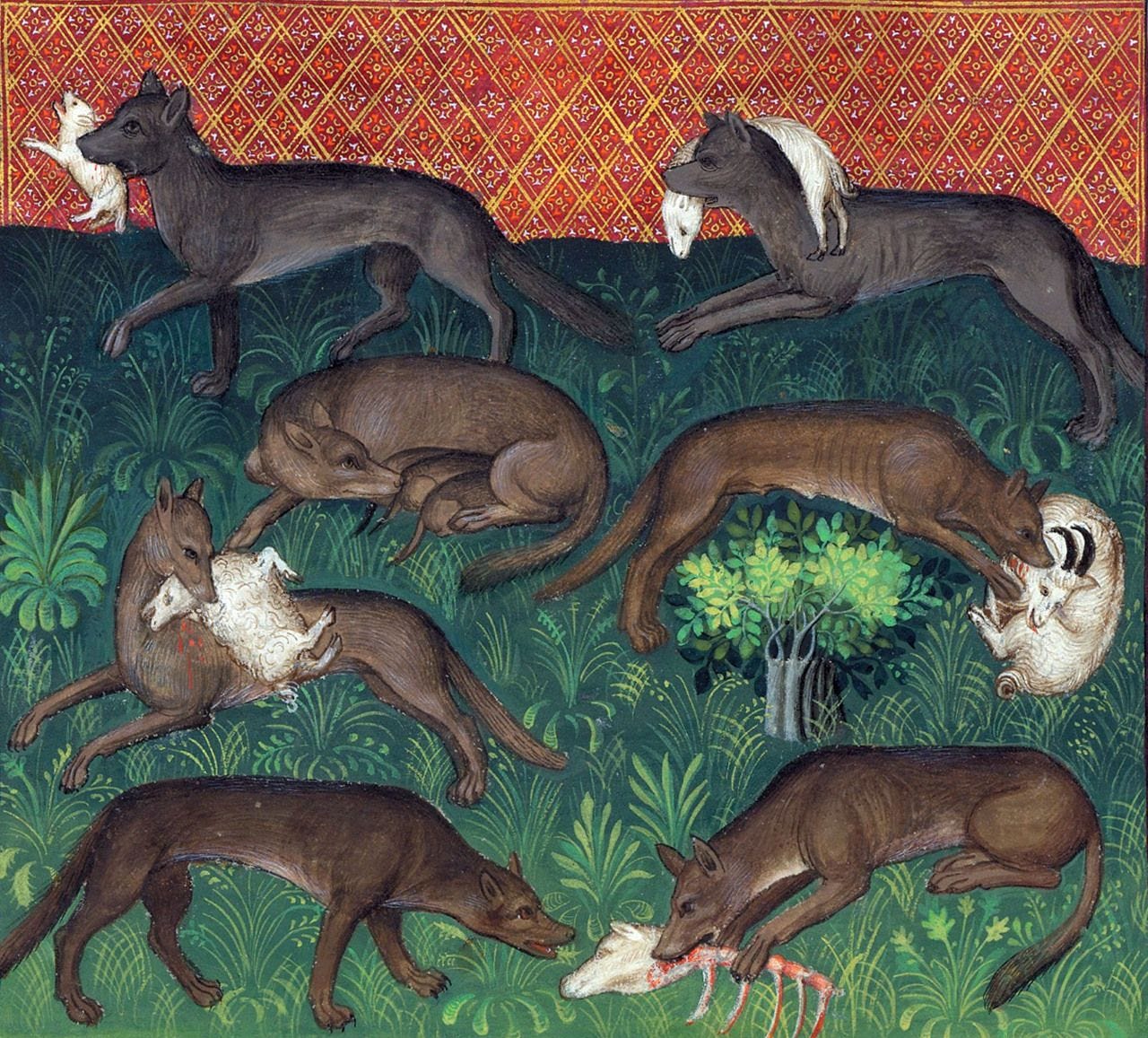
In this spirit of gathering up bones and relics, let us now examine modern folklore that rehabilitates wolves as an image of virtue and nobility, and an object of compassion.
Wulvers are all over the internet these days; these furry fae from Scottish, or, more precisely Shetland culture, have quickly become beloved cryptids. However, the scant trace of evidence for wulvers all leads back to Jessie Saxby’s 1932 Shetland Traditional Lore, where she depicts a sympathetic character who looks like a man with a body covered in short brown hair and a wolf’s head.
Unlike werewolves, the wulver does not shapeshift—it looks like this for all its life. According to Saxby, wulvers are reclusive and live in caves, whiling away their quiet days in days in fishing, contemplation and philanthropy.
It is possible she took her inspiration from myths of cynocephali, a fictitious race of dog-headed human cryptids who variously lived in India or Africa—until these areas were more thoroughly explored by Europeans, and the native human populations were classified as such.
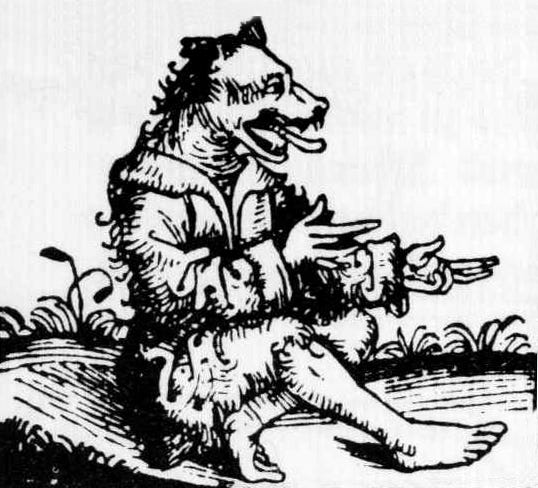
Above: an illustration of a cynocephalus (dog-headed man) from the Nuremburg Chronicle (1493). Images like this are often used to illustrate werewolves, wulvers, and other fantastical hybrids.
Cynocephali were variously described as wise and benevolent, vicious, or even—in the example of Saint Christopher—saintly.
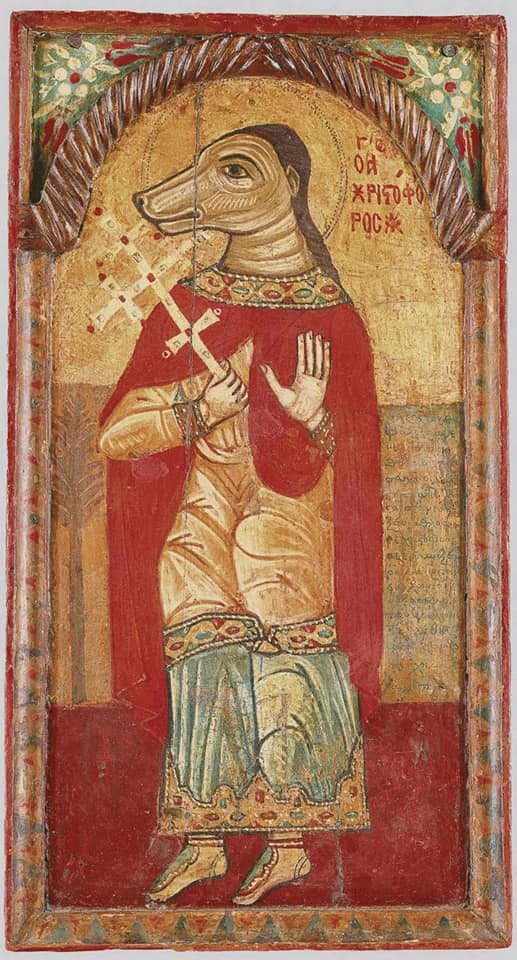
Wulvers are benevolent, though not saintly in a religious sense. These good neighbors are especially kind to those who are needy or in distress. According to Saxby, sometimes they placed fish on poor families’ windowsills,2 they guided lost or distressed travelers back to their path, and they helped children find their homes. (We will see this wilderness guide motif repeat in contemporary stories about lost autistic children guided by wolves.)
What’s not to love about Wulvers? They’re utterly delightful—so wonderful that if they didn’t already exist in folklore, someone would have to make them up. So Saxby did: mentions of “wulvers” are entirely absent in academic werewolf studies. No primary sources exist: there is no monk’s account, trial record, or folk tale; nor are they to be found in paintings, engravings, or woodcuts—or even in fantastical bestiaries.
Did anyone in the Shetland Islands believe in wulvers? It’s impossible to prove a negative (that no one ever believed in them), but no responsible folklorists are vouching for them. Source.
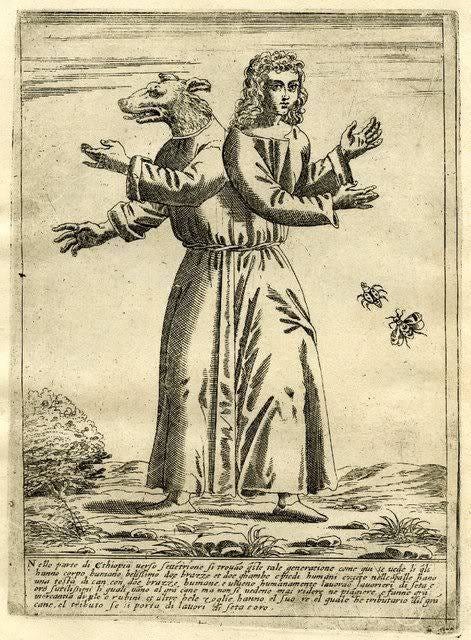
Saxby constructed their mythos on the basis of sloppy, fanciful, or fraudulent etymology.3 It appears that she misused legitimate place-name research by the Faroese scholar Jakob Jakobsen, who collected thousands of place names in Shetland in the late 19th century, and dressed it up to her whimsical liking.4
The idea to hold in mind is that in 1932 an author was combining wolflike traits and a peaceful, kindly disposition in her character, which sets her story apart from the usual “Big Bad” tales AND from the rest of Scottish wolf lore, which never painted them in a positive light.5 In this sense, Saxby was decades ahead of most other people who wrote about wolves.
Wolf truces are a genre of folklore within pop military history. The stories, which describe a pause in hostilities between troops, have viral appeal, but they cannot be corroborated with verifiable historical sources.
Here is an abridged version of a Facebook post sharing a collection of these (apocryphal) tales from the Western Front at Verdun.
There is a document in the archives of the Imperial German Army, catalogued under Section XIV of the Verdun Campaign records at the Bundesarchiv in Freiburg, that was classified for thirty years after the war and declassified in 1948 without fanfare. It is a field report from Oberleutnant Klaus Brenner of the 5th Reserve Infantry Regiment, dated March 3, 1917. It is four pages long. The first three pages are a routine accounting of trench condition, ammunition status, and casualty figures for the preceding week. The fourth page begins:
‘I must record an event that I cannot account for and that I believe should be recorded regardless, as it was witnessed by all men currently in the forward position and will be spoken of whether I write it or not. On the night of March 1-2, 1917, a pack of wolves entered no man’s land from the eastern side of the valley. They numbered, by my estimate and the estimates of the men who observed them, between fourteen and twenty individuals. They remained in no man’s land for approximately four hours. During this time, no French fire was directed at the German position and no German fire was directed at the French position. I do not know whether this restraint was ordered on the French side. It was not ordered on ours. The men simply did not fire. I did not order them not to fire. The wolves simply—and I cannot find a better word for this—made firing seem wrong.’”
[…]
What happened on the night of March 1-2, 1917, is documented in at least four sources, which agree on the following:
Between approximately 11 PM on March 1 and 3 AM on March 2, a large pack of wolves—estimates range from twelve to twenty-three individuals—entered no man’s land from the eastern side. They worked systematically across the ground. They were not running. They were not panicking. They moved through the craters and the debris with the deliberate, methodical movement of animals that had been there before and knew the terrain. They worked throughout the night.
Both sides watched.
Neither side fired.
[ …]
The field report, the letter, the diary, and the testimony were correlated by a French military historian named Jean-Pierre Verdoux in a 1971 monograph on non-combat incidents at Verdun. Verdoux noted that the accounts were consistent in their description of the wolves’ behavior and the cessation of fire, and inconsistent only in their estimates of the pack size—which he attributed to visibility conditions and observer angle. He concluded: “The event as described is historically credible. Its meaning is not for the historian to determine.”
There is a small stone monument outside the village of Fleury-devant-Douaumont, near Verdun. It was placed in 1923 by a local veterans’ association. The inscription, in French, reads: “Aux loups qui sont venus.” To the wolves who came. It is not on any official map of Verdun memorials. It is not mentioned in any guidebook. Visitors sometimes find it by accident. They almost always photograph it.
The monument is approximately forty centimeters tall. It weighs perhaps twelve kilograms. It has been weathered by a hundred winters. The lettering is still legible.
To the wolves who came.
It is the smallest memorial at Verdun. It commemorates the only thing at Verdun that both sides, simultaneously, chose not to fight.
Reality check: this story is entirely fictional, and there are no newly-discovered historical‑ceasefire accounts.
None of the author’s pseudo-archival details can be verified:
There are no traces in peer-reviewed historiography or archives that document the existence of any of the alleged sources or their accounts.
Nor is there any known French military historian named Jean-Pierre Verdoux who published a monograph on non-combat incidents at Verdun.
The Bundesarchiv in Freiburg has no catalogue entry titled “Section XIV of the Verdun Campaign records” with a report of wolves in No Man’s Land.
Neither is there any known monument among those in Verdun’s memorial inventory or regional heritage databases.
All the inventive flourishes give the story a veneer of plausibility, which helps credulous readers overcome their skepticism that war-weary soldiers would admire the animals and spare them the bullets they sprayed at their fellow men.
The premise that wolves scavenged the battlefield at Verdun, where 300,000 soldiers died on the battlefield (as they have done in wars through the ages), is not unbelievable. There are numerous recorded cases of dogs or wolves appearing at battlefields because their usual hunting grounds had been disrupted: they entered the quieter zones, such as No Man’s Land, that were strewn with fresh and decaying corpses, and they scavenged the carrion— behavior euphemistically described as “working” in the tale cited above.
But beyond this plausible baseline, the rest of the 1917 wolf truce tale is contemporary folklore that upgrades the wolf symbol of noble savagery: an animal follows its instincts: it hunts and kills to feed itself and its family; it does not succumb to nationalist propaganda, or understand boundary lines. The explicit lesson is that no matter how furious and violent the scene (the killing fields at Verdun), it is always possible to stop, reflect, and try to do better in the future—and we should also be so noble!
Yet, despite the falsity and even cheesiness of this tale, it still gave me a chill up my spine. Not from the Kipling-esque motifs transposed onto the Western front, but because these wolf-positive tales spreading all over social media and YouTube are doing valuable work to rehabilite the animal’s reputation. The cheesy clickbait wins hearts and minds for wolves in ways no dry analysis of ungulate populations or livestock deaths by predation vs illness ever could.
What’s extraordinary is these fables set in Verdun rewrite an older stratum of tales that were the opposite of wolf-positive. The original WWI wolf truce stories published in 1917 periodicals (The New York Times, an Associated Press dispatch, and a number of small, regional US newspapers, as well as French and Italian publications) represented the wolf in the more familiar role of Big Bad uber-enemy.
The original stories that actually circulated during the Great War did not take place Verdun, but on the Eastern Front. The claim, repeated in slightly different retellings, is that in 1916, German and Russian troops stopped shooting at each other and joined forces to fight off a “plague” of vicious wolf packs, killing hundreds of the animals over the 10 months of military hostilities.
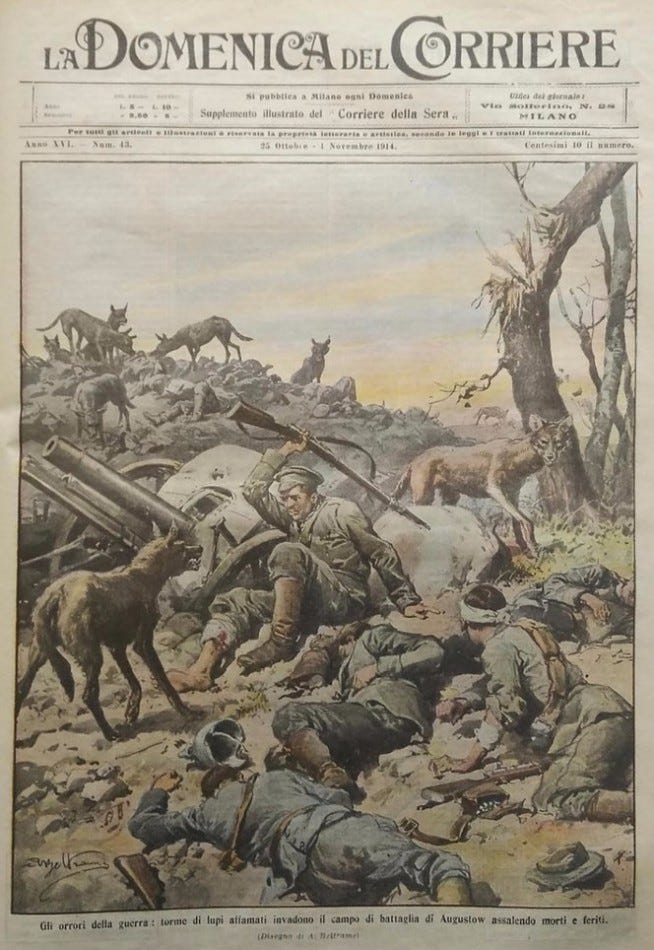
Readers of that era required little persuasion that making sure no one was going to be killed by a wolf was more important than whatever the soldiers were fighting over. Dying with a bayonet in your side or a bullet in your gut was better than with fangs clamping down on your windpipe.
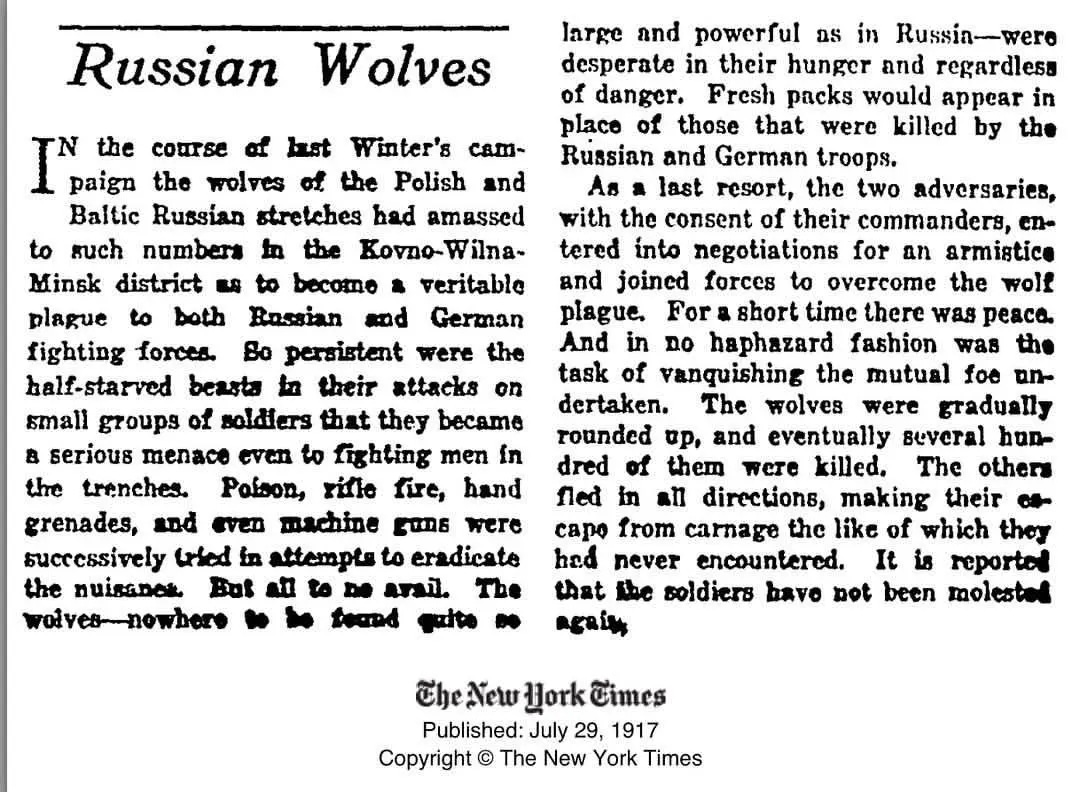
But, as with the Verdun tales, here, too, we must put our credence that the events actually happened on a leash. While the Eastern Front wolf truce stories really were published during the Great War, they are apocryphal. They have never been authenticated by any outside reports, such as Russian archives. What is authentic about these early 20th-century legends is they reflect early twentieth-century views of wolves and human beings.
It was not until the early 21st century that the “plague of wolves” could glow up into reminders of numinously sublime dark nature “working.”
Several generations had to pass away who did not remember the stench of bodies and the horror of witnessing actual scavenging by man and beast alike.
The choice of Verdun for the setting of this reconceived wolf story is fortuitous, as the former killing fields, mostly left unmolested since the war’s end, have evolved into a thriving, diverse ecosystem. Perhaps this is foreshadowed.
Misha: A Mémoire of the Holocaust Years is a literary hoax written by a ghostwriter and published in French in 1997 by Misha Defonseca. During a period of financial difficulty, Defonseca invented a story from her childhood that she was encouraged to publish. The faux autobiography relates how, when she was six years old her parents were deported in 1941 and she wandered across Europe. She describes being sheltered by kindly packs of wolves, killing a German soldier, sneaking in and out of the Warsaw Ghetto, and ultimately finding her way home.
In 2008, Defonseca’s legal defense team admitted that this was not a genuine work of autobiography, as she had led her publisher and her readers to believe, and she was made to pay her U.S. publisher $22 million in damages; money which she had been awarded in an earlier legal suit against them.6
Nevertheless, for our purposes it is significant that the wolves were presented as friendly and nurturing, and safer company than people for the young protagonist.
It also represents a step away from the old genre of stories of “feral chlidren” where the arc bent toward their rehabilitation, which meant correcting wolfish influences and behaviors.7
Modern ecologists’ lament that all traditional stories about wolves portray them as monsters simply isn’t true. From the ancient Roman myth of Romulus, Remus and the She-Wolf, to the widely-believed nonsense about Our Lady of Guadalupe,8 to clan names and heraldry, there have been positive characterizations alongside the negative ones. In more recent fiction, Akela and the wolf pack in Kipling’s The Jungle Book, there are wise and benevolent wolf characters. Jack London also wrote sympathetic, but brutal characterizations of the lives of wolves and wolfdogs in his expressionist realist tales, BUT they were set in places that are so exotic for most readers that they might as well be mythic.
Since they were unlikely to meet these wolves, and London made sure they would not want to, readers experienced a disconnect between their sympathy for the four-legged, white-fanged characters and their support for or indifference toward real policies of wolf “control” or extermination in places near where they live. The takeaway was: the tundra was a world away, and things work much differently there. But surely, wolves shouldn’t be allowed to roam anywhere near their kids, pets, or livestock!
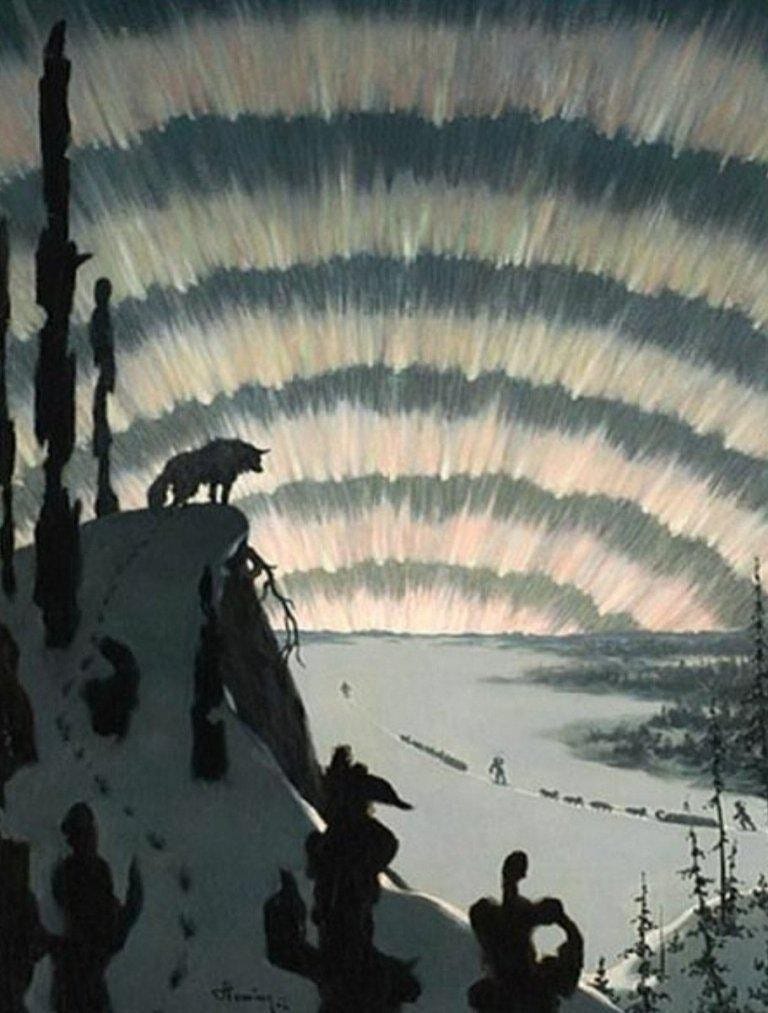
It took eight decades of efforts by pioneering nature writers, such as Ernest Thompson Seton, who published the short story Lobo the King of Currumpaw (part of Wild Animals I Have Known, in 1898), Aldo Leopold, who wrote of wolves as the spirit of the mountain in his 1949 A Sand County Almanac, and Barry Lopez (Of Wolves and Men, 1978) to convince average people that wolves living closer to home were not dangerou vermin desperate to sink their fangs into the nearest child. Their efforts, and the outreach by environmental educators convinced a growing part of the public that wolves were neither exotic monsters nor a threat to people and livestock under most circumstances, and they were integral to the holistic health of the land.
Once their educational mission was at least partially accomplished (outside of ranching and hunting communities where the animals are still vilified), the pendulum swung in the other direction: wolves became not only tolerated and even admired as the magnificent beasts they are, but they were also appropriated through a kind of symbolic domestication that conforms to basic psychological mechanisms in which the wolf is not just an animal.Through a psychoanalytic lens, fantasies about befriending wild animals represent the ego’s attempt to master and domesticate the primal, untamed impulses of the id. Sublimation allows the mind to transform unconscious fears or aggressive drives into safe, affectionate relationships. Fantasies about wild animal friends allow people to safely connect with their own untamed instincts by converting an internal threat into a loyal companion—and, if they share the story, it gives them ecological “cred” by appropriating the once-demonized and now patronized animals.
Wolves were once feared because people in agricultural and industrial societies saw them as emblems of the laws of brute nature: eat or be eaten; dominate or be subjugated. Wolves are powerful, and they feared by many other creatures: if one could capture some of that power, the animal might be a reliable guide through physical and psychological peril. Yet wolves’ gentle side is also highlighted: the creatures’ appropriation as a wise and benevolent mascot in fantasies and stories involves the belief that all their potential viciousness would only be directed toward one’s rivals or other external threats, and that their nurturing, family-oriented side would be directed toward oneself.
Suddenly, people suddenly wanted encounters with wolves, very badly. This explains wholesome learning experiences, such as wilderness trips led by experienced guides who keep the campers at a safe distance to hear the wolves’ singing at night, to bogus works such Misha—and to new genres of viral internet content.
Contemporary internet folklore now features heartwarming, fake stories of lost and found children who are guided and protected by wolves. Overtly mythic elements and ideas about the “state of nature” explored in Kipling’s and London’s tales are stripped away, and the wolf is presented in loco parentis.
The arc of the stories suggests we should have more respect for and trust in nature, for it has a gentleness and goodness that surpasses our understanding, and it will protect us. (Stories like this directly parallel religious parables that illustrate that those who are simple and trusting will benefit from faith in ways that more “sophisticated” people will never understand.)
One recent version features an autistic child, who is understood to be especially vulnerable, and the wolves are described as “angels.”
Wolves save kid with autism. During a family hike, a young boy who adored wolves slipped off the trail and vanished. Panic set in, search teams scoured the woods all night, but there was no sign of him. At sunrise, he emerged from an overgrown game trail, exhausted but unharmed. When asked what happened, he simply said: “The wolves guided me.”
At first, no one believed him. But a week later, a hunter’s game camera proved he was telling the truth, wolves had stayed by his side, leading him safely through the forest. When asked about it, his mom said:
“My son has always had a connection to animals. I believed him the whole time.”
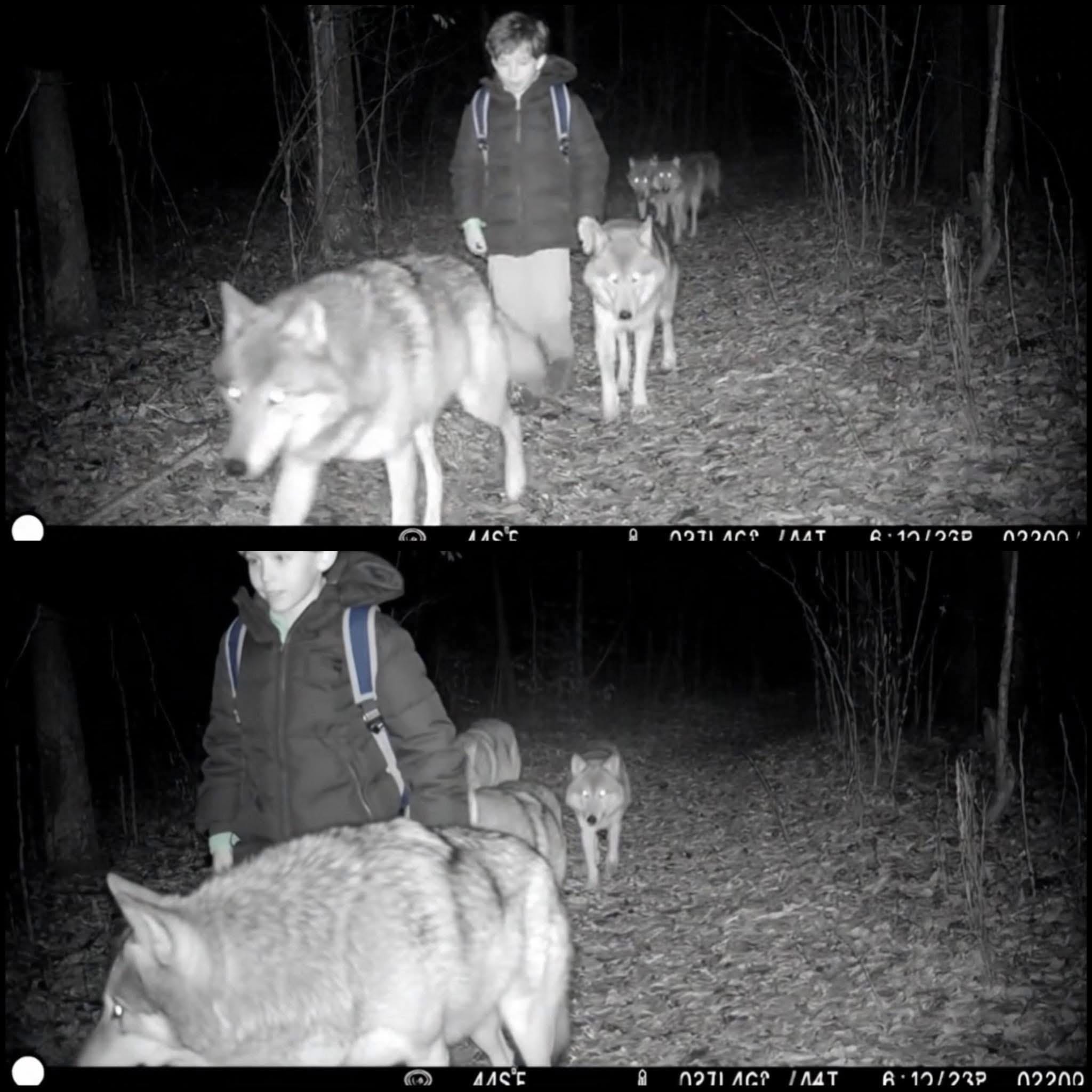
Don’t read this online shaggy-dog story larded with ads after every other brief sentence unless you are currently hospitalized or serving a very long prison sentence. Unlike the viral post above, it isn’t even trying to pretend to be true.
Everyone knows dogs are domesticated wolves, and now that many people want to experience contact with wolves themselves, they also wish for their four-legged best friends to meet their wild cousins. These imaginary associations with wolves upgrades the status of dogs, and also their owners, and the arc of the story inevitably returns to the blissful domesticity of a human/dog household that is blessed with a little sparkle of wilderness
Below is an account from a woman named Pamela Rodger, who described the howling of her “dominant” standard poodle as wolflike. Perhaps it is all true—I don’t know—regrettably, I haven’t yet had the opportunity to hear her poodle belting out popular wolf tunes.
What is relevant to this discussion is her pride in the dogs’ atavism, and the anti-civilizational attitude that poses are rebellious by refusing millennia of culturally dominant pro-civ propaganda.
We raise large standard poodles. When hearing the word POODLE, public sentament would define them as Fluffy, up town personalies. We lived in the foothills of the Rocky Mountains for years. While they were similar to all regular barking dogs, the poodles would change their sound dramatically when bears or cougars came into¹ the area. The dominant female poodle would howl like a wolf. Probably only seasoned outdoors people could tell the difference between a poodle howling and a wolf howling. And i did have that experience as i had lived in the back country of one of the National Parks where the re-entry of wolves was a successful program. I often had the grand treat of the wolves, announceing their presence behind me on the hiking trail. A bit later in time, they’d announce that they had circled around me off the trail and through the trees. They would also announce when theyvwere in front of me. Such specific respect and fine manners.
Our alpha female Standard Poodle was also a mom that we breed once a year. Each year, she would dig a new den under the roots of a large tree for her pups to live. WELL! We had a place inside, but always knew the den would be a great hideing place for the pups once they were old enough to play in the fenced back yard. And it provided a hideing place when they were smaller and could hide if the owl was hanging around.
This living characteristics of the wolf in our modern day poodle, was simply clear indication that many of us also probably feel the Neanderthal of Europe or the Paleo native of the Americas, resting in the hollow below our heart..... alive and beating on its original log drum.
Source: Facebook comments (a great resource for analyzing emerging folklore)
The tale below comes from an account called Cameux:
A man was at work when his phone sent a motion alert from the security cameras inside his house. At first, he assumed his husky was probably running around causing trouble or tearing up the furniture while nobody was home.
But when he opened the live camera feed, he nearly fell out of his chair.
There were wolves inside his living room.
Several of them wandered through the house calmly, moving around as if they belonged there. Meanwhile, his husky looked completely relaxed, wagging his tail happily like he had invited friends over to visit.
Panicked, the man called a neighbor and asked them to check on the dog. But after seeing the camera footage, the neighbor refused to go anywhere near the house.
So the man contacted the police while continuing to watch the scene unfold through the cameras.
Then things became even stranger.
His husky began carrying over chew toys and dropping them in front of the wolves one at a time, seemingly convinced the unexpected visitors were there to play.
By the time officers arrived, the wolves had already disappeared. The house was quiet again, and the only evidence left behind was a disappointed husky missing several of his favorite toys.
The man had been terrified when he first saw the footage, but once he realized his dog was unharmed, he could not stop laughing.
To the husky, it had not been a dangerous encounter at all.
He thought he had just made some new friends.
The wolves, meanwhile, left looking like they had raided a toy store on their way out.
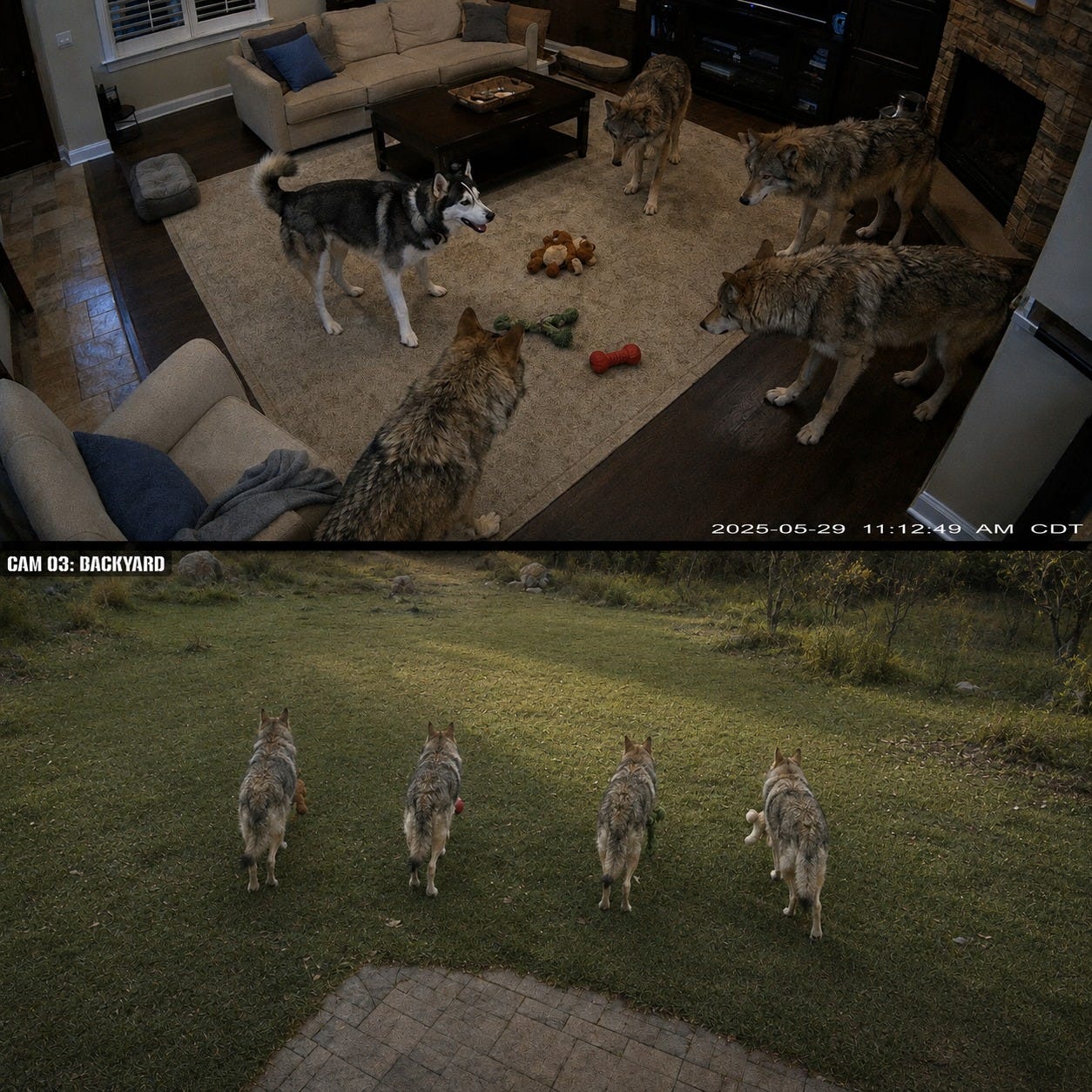
Cute, adorable. Obviously never happened. It’s easier than ever to cook up illustrations for fake wolf/dog stories now. Gods bless the internet, amirite?
Yet as far-fetched as the husky story seems, there are also tales about Chihuahuas:
In Ely, Minnesota, locals were used to a scrappy stray chihuahua roaming the streets. Despite his size, he carried himself like he owned the town— friendly, but fearless. Then one day, after more than a year of sightings, he suddenly disappeared. With wolves moving closer to town, many assumed he’d been eaten.
But a month later, a farmer’s trail camera revealed the truth. The missing chihuahua wasn’t gone— he was trotting confidently with a wolf pack When a wolf expert was asked how this was possible, he laughed and said, “l’ve met many wolves and a few Chihuahuas, and I was always more scared of the Chihuahuas.”
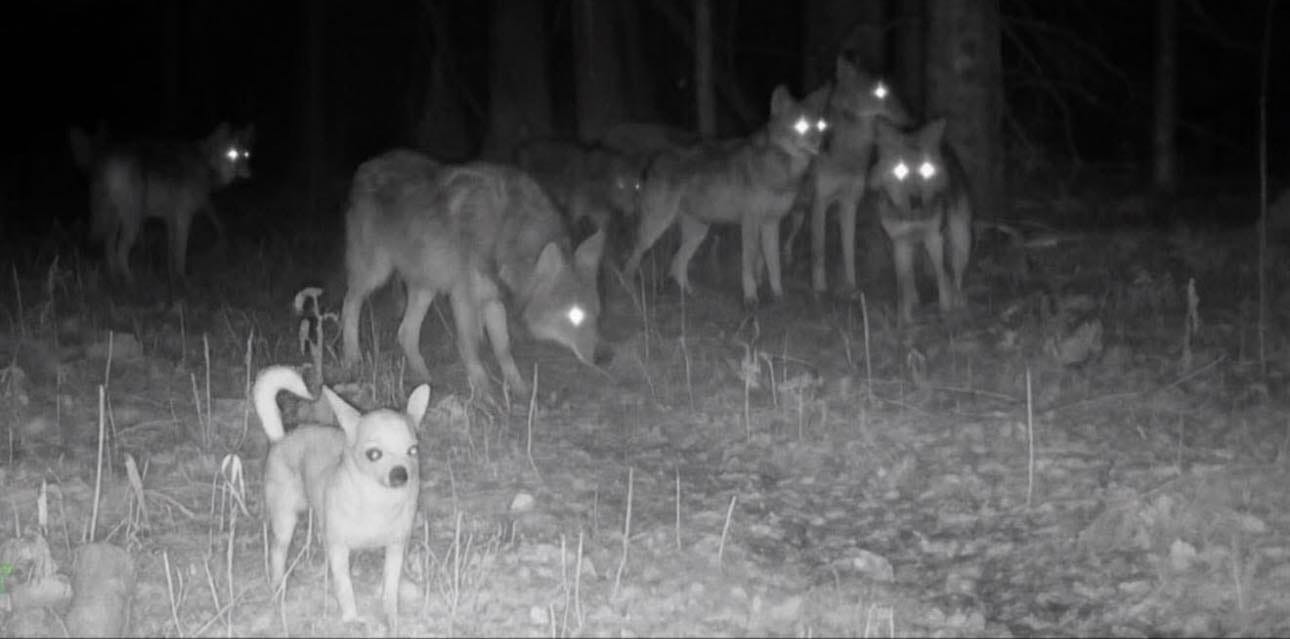
This photo was taken from one source out of many. The image was identified by Snopes as a trail cam shot made by the Voyageurs Wolf Project, a scientific research institute that studies wolves. The Chihuahua was edited in.
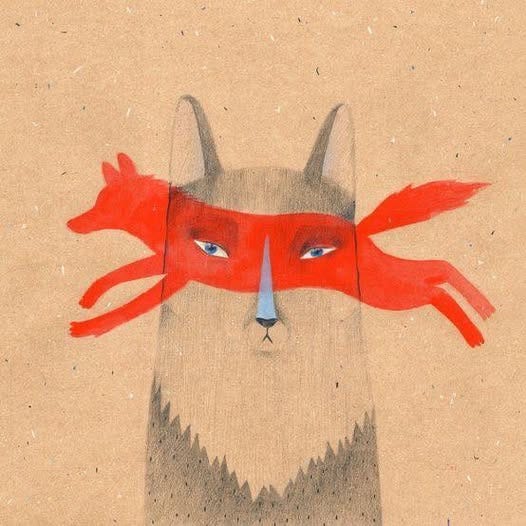
Hukkatar is an ephemeral neo-deity9 who, like the Wulver, wears a skin of fanciful etymology.10 The bones underneath Hukkatar’s exterior are a longing to give wolves and the wild a positive valence, and to connect it with women’s empowerment, but it is much harder to create fakelore now than 90 years ago, and there was less similarity with older layers of folklore than was the case with La Loba.
Finnish has several words for wolf. The most standard term is susi: this contemporary zoological term remains burdened with negative connotations: when wolves were considered varmints, people would go out to hunt susi. Folklore also reflects this; for example: Hiisi-susi and näkki-susi (demonic, and evil spirit-wolf).
Hukka is a noa word that refuses to name the wolf, speaking only of its effects on humans and their economic interests: it literally means “destruction/ruin/waste.” Thus, as was the case with bears, evil spirits, and devils, people were afraid to summon the susi by speaking its name, so they spoke of hukka instead.11
Romantic sensibilities triggered a semantic reversal: pages promoting Hukkatar claim that susi is a word that associates the wolf with negative forces and is the label on the animal in a zoo or a taxidermy exhibit, while hukka is the “poetic, natural, neutral-to-positive” name. Moreover, they claim, hukka is a term that comes from the misty past and is associated with something feminine and even with shamanism. Next, they added the feminine suffix -tar / -tär to make sure this would be a feminine figure.
In Finnish myths, animal species had an emuu—a divine progenitor or protective “founding mother” spirit. For example, Hongatar was the emuu of the bear, and Mielikki was the mistress of the forest. Historically, the wolf did not have a benevolent, neutral, or healing goddess. The emuu of wolves was Loviatar (or Louhi), the blind daughter of the god of death. In traditional spells (loitsut), wolves were explicitly called the “dogs of death” or demonic creatures born from the underworld. This was rectified for Hukkatar by connecting her with an opposite class of deities.
Finnish mythology personifies celestial bodies as pure, beautiful, benevolent spirits. The assimilation of Hukkatar to Tähti (star) shifts the wolf (hukka) from a forest-dwelling creature into a majestic figure on the cosmogony. The earthbound, blood-drinking predator is uplifted into a cosmic, majestic being when Hukkatar is connected with Tähti (the Star), an avatar of celestial purity.
It is an attempt at rehabilitating wolves in recognition of humans’ need to repair their fractured relationship with nature.
Here is the original source text: her birth chart, if you will:
Hukkatar the Divine She-Wolf
The Finnish goddess Hukkatar (literally “Wolf Star”) has the titles “the Divine She-wolf” or “Lady of Wolves.” When taking the appearance of a human woman, she is usually clad in green and has with her a silver dagger. Her hair is blonde and grows longer with each season, shorn short each winter. She sometimes has two faces, one that shows by day, the other by night.
She is a virgin sworn never to bear children. She is a healer, warrior, and defender of all that runs free. She is an assistant to Mielikki the Bear-goddess and Lady of the Forest, and to Akka the Earthmother.
As a figure of medieval epic or nationalist poetry, whether or not Hukkatar was worshipped in greater antiquity is debated. She may be the same as, or overlaps with, the Lapland goddess Louhi (Louhetar, Laviatar, Lowyatar, Louhetar, etc), a name alluding to shamanistic trance. She is a Moon- and Wolf-goddess with authority over shamanism, and a warrior-protectress of the dead. She withdraws to the underworld by day, where she is Queen of Desolation and Decay.
Louhetar is villainous in the Kalevala. She is a blind swordswoman of great strength and power. Though she did not wish to bear children, she was secretly impregnated by the wind, and gave birth to nine sons as to a litter of wolves; they were demons of nine terrible diseases. The name of Louhetar is recited in spells to cast out these demons of sickness, obedient as they are to their mother. Her granddaughter is Syöjätär the Devourer, Ogress of Sea Serpents.
Source: Jorma Jyrkkanen’s blog.
Many gods and goddesses from various traditions are already associated with wolves, so why did someone need to invent another? Maybe someone wanted a wolf-positive figure that was Finnish, or maybe it was just another personification of a guardian of wild places and animals that also represents women’s wild nature.
The attempting to weave a dry handful of etymology into eco-feminist-wolf-positive gold was noble, but Hukkatar is too easily debunked. This is why she has the tricksterish habit of popping up, getting a lot of attention, and then vanishing as soon as more skeptical commenters point out that she is not attested in any credible Finnish source and embarrassed page admins delete her. She will remain ephemeral unless she is made into a popular film or perhaps a comics franchise.
However, if Hukkatar is forgotten, I’m sure we’ll see similar spirits and deities appearing in different wrappings: perhaps instead of Finnish, they will be Siberian, or Nepalese, or Kazakh.
Eventually, one of them will capture enough people’s imagination that it starts taking on a life of its own outside the scope of its creator’s influence.
Thus far, no neo-deity has achieved this, but a kid named Jack who loves dogs and wolves managed what the amateur and academic folklorists could not: he turned his fellow feeling for these creatures into a worldwide phenomenon that transcends his own personal influence: the holiday called Wolfenoot.
Unlike Hukkatar, which is a noble effort that isn’t bearing much fruit, Wolfenoot is a new tradition that is genuine, vital, and spreading.
Here is the official page of Wolfenoot: a holiday of canines and kindness.
Wolfenoot was invented by a New Zealand boy named Jack who was 7 years old at the time.
His mother posted on Facebook that her son had a “cool idea.” The mom’s friends urged her to make the post public, after which it “exploded.” The mother created an online event, tweeted about it, and then “everything went crazy.”
Here is what she wrote:
My son has invented a holiday called Wolfenoot.
It is when the Spirit of the Wolf brings and hides small gifts around the house for everyone. People who have, have had, or are kind to dogs get better gifts than anyone else.
You eat roast meat (because wolves eat meat) and cake decorated like a full moon.
A holiday to the spirit of wolves that celebrates people who are kind to dogs? I can 100% get behind this. So we will be celebrating Wolfenoot. It’s on the 23rd November if anyone else is moved to celebrate it. If you do, please post pics, so he can see how his idea has spread.
Jack invites everyone to participate, and—unlike some of the viral slop stories—his tradition does not bring special honor onto those who believe their dogs are blessed with wolf-spirit (the poodle breeder) or the fabulists who write about how their chihuahua has given up terrorizing mail carriers and is now leading a wolf pack.
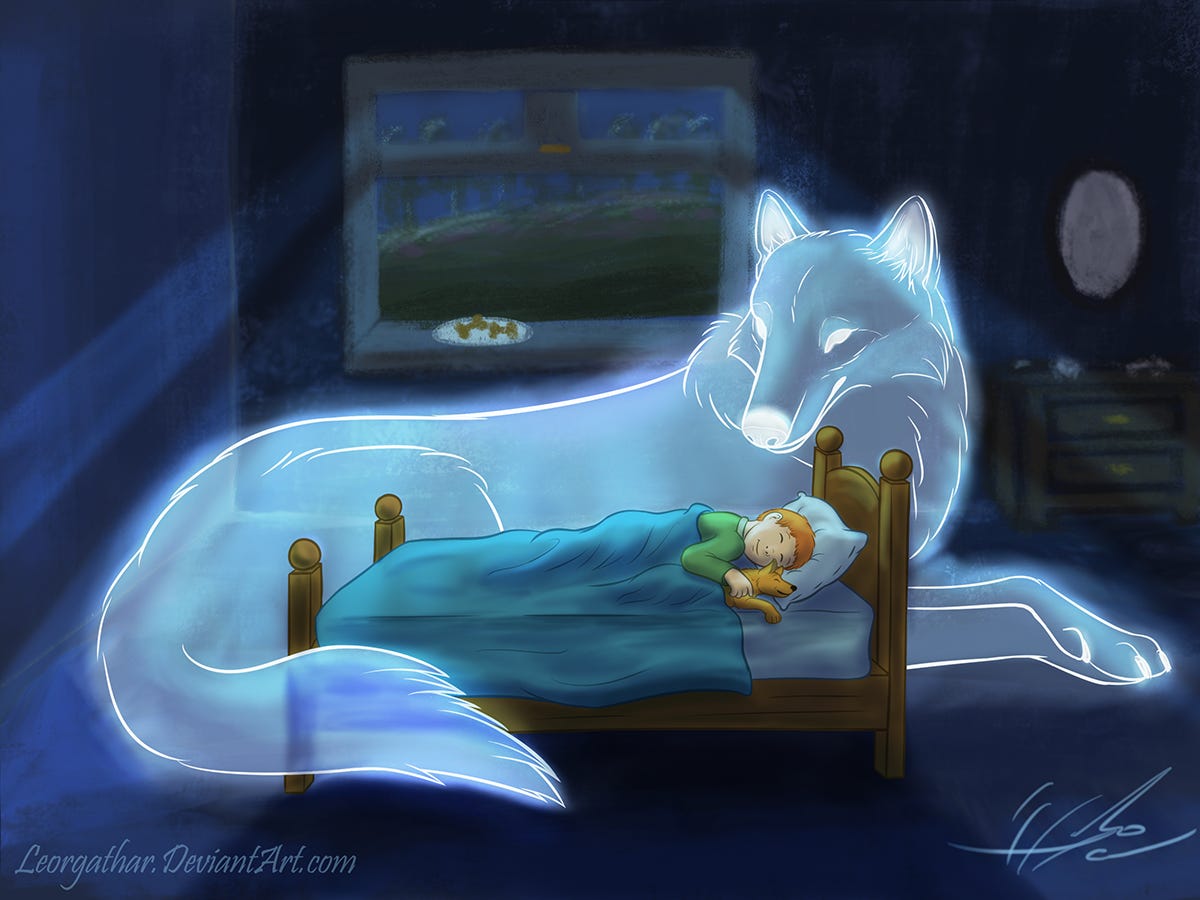
Howly Wolfenoot by Leorgathar on DeviantArt; an artist who has made other images depicting wolves positively.12 The artist writes: May the Spirit of the Wolf protect you tonight, and reward you, your family, and your pets with the gift of love (and snoot boops!)In Wolfenoot artwork like the image above, wolves are domesticated and assimilated as kind, benevolent spirits or ancestors watching over dogs and children alike. Notice that the child here has either a small dog or a plushie, which shows his parallel role as a protector. Booping the snoot of a real wolf is definitely not recommended.
However, there are numerous illustrations on the theme of Wolfenoot that verge into furry or “anthro” human/animal comics) content that is often sexualized.
(Imagine my surprise as an anthropologist when I first looked up “anthro” images online, expecting to see memes promotiting the discpline and found NSFW cartoons!)
The original concept of Wolfenoot is based in a pure love for animals, with no sexual subtext or commercial motivations. Those who celebrate should practice kindness to dogs and wolves, and should, as Jack suggests, contribute to charities that benefit them.
While enjoying the fantasy that wolves are just badass dogs, and our pets are just as badass underneath their clipped poodle coats and sparkly collars, we need to remember that wild wolves still need our protection, our voices, our votes, and money donated to reputable research organizations like the Voyageurs Wolf Project and the Wolf Conservation Center in New York State.
Not just for ourselves, not for our “liberation” from social scripts that keep us small and facilitate abuse, which is often a catalytst to the psychological breakdown that drives a search for renewal. We can start there, but the reason to rehabilitate and support wolves is much larger than our personal stories.
The 20th century America ecologist Aldo Leopold said the wolf is the “painter of the mountains,” which was a way to appeal to readers aesthetic sensibilities. He was suggesting that the beast participates in beauty, but he shifted this from a hyperrefined art gallery context to one where an ecosystem is beautiful when all its species live in balance. For an ecologist, beauty is harmony. Beauty is functionality. Beauty surpasses our understanding, but not in the personal way related in tales of wolves guiding lost children. Ecological beauty is not sentimental; it is sublime: we don’t say “ awww” and melt a little inside. We yield when beholding it because, subconsciously, we know it is part of what sustains us and it is part of how we sustain everything around us, and this erases us a little as individuals.
Yet, before Leopold came to see wolves this way, he hunted them. In A Sand County Almanac, the ecologist retells the moment when he finally understood that they were. His unforgettably evocative account describes the moment he realized what he had destroyed.
We reached the old wolf in time to watch a fierce green fire dying in her eyes. I realized then, and have known ever since, that there was something new to me in those eyes–something known only to her and to the mountain. I was young then, and full of trigger-itch; I thought that because fewer wolves meant more deer, that no wolves would mean hunters’ paradise. But after seeing the green fire die, I sensed that neither the wolf nor the mountain agreed with such a view.
Yet what has been stilled is not erased forever:
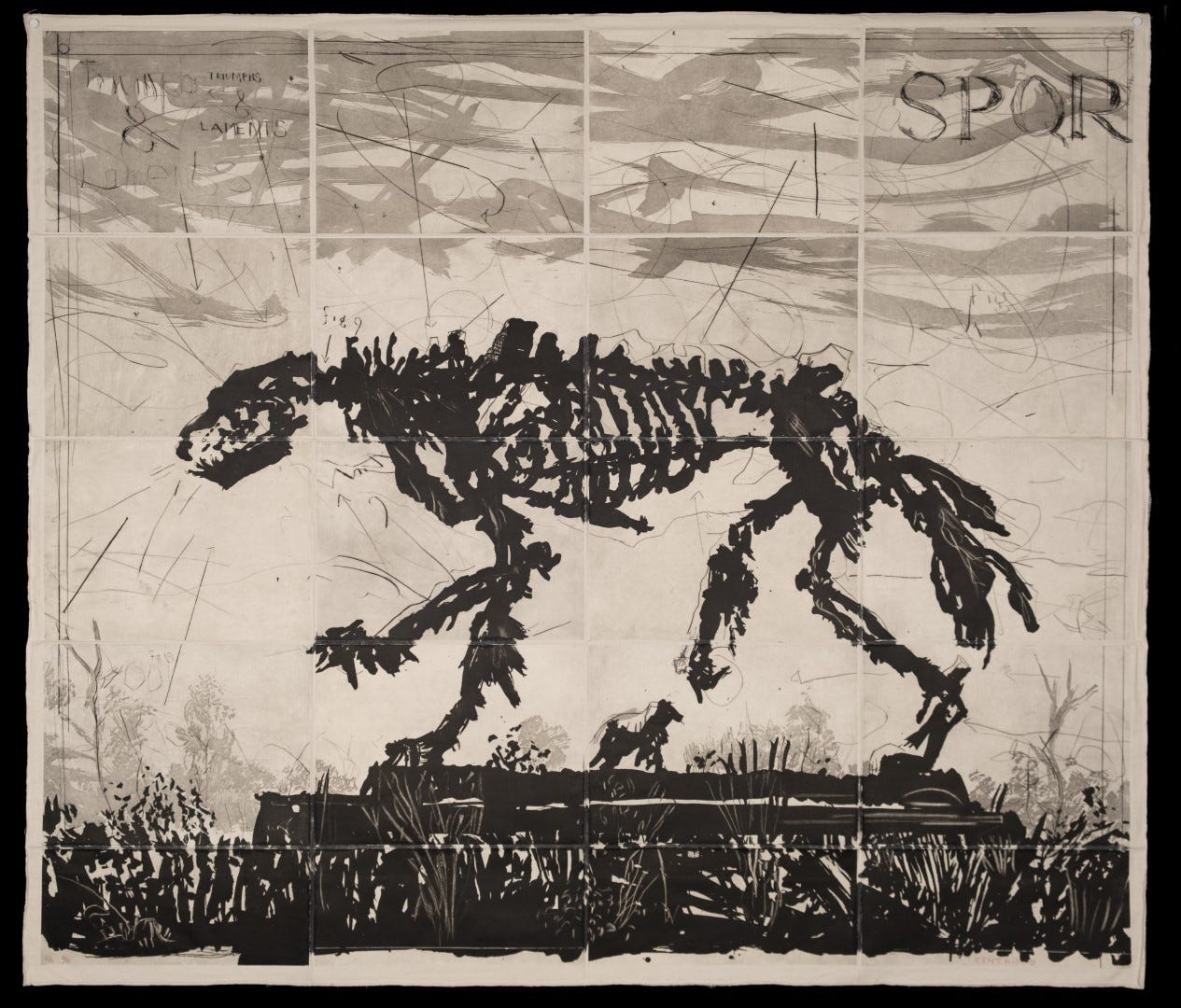
This is where the myth of La Loba helps us take the next steps.
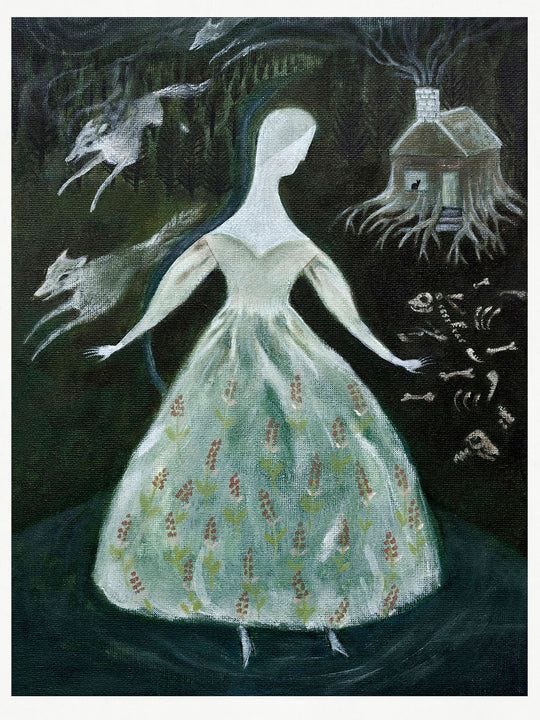
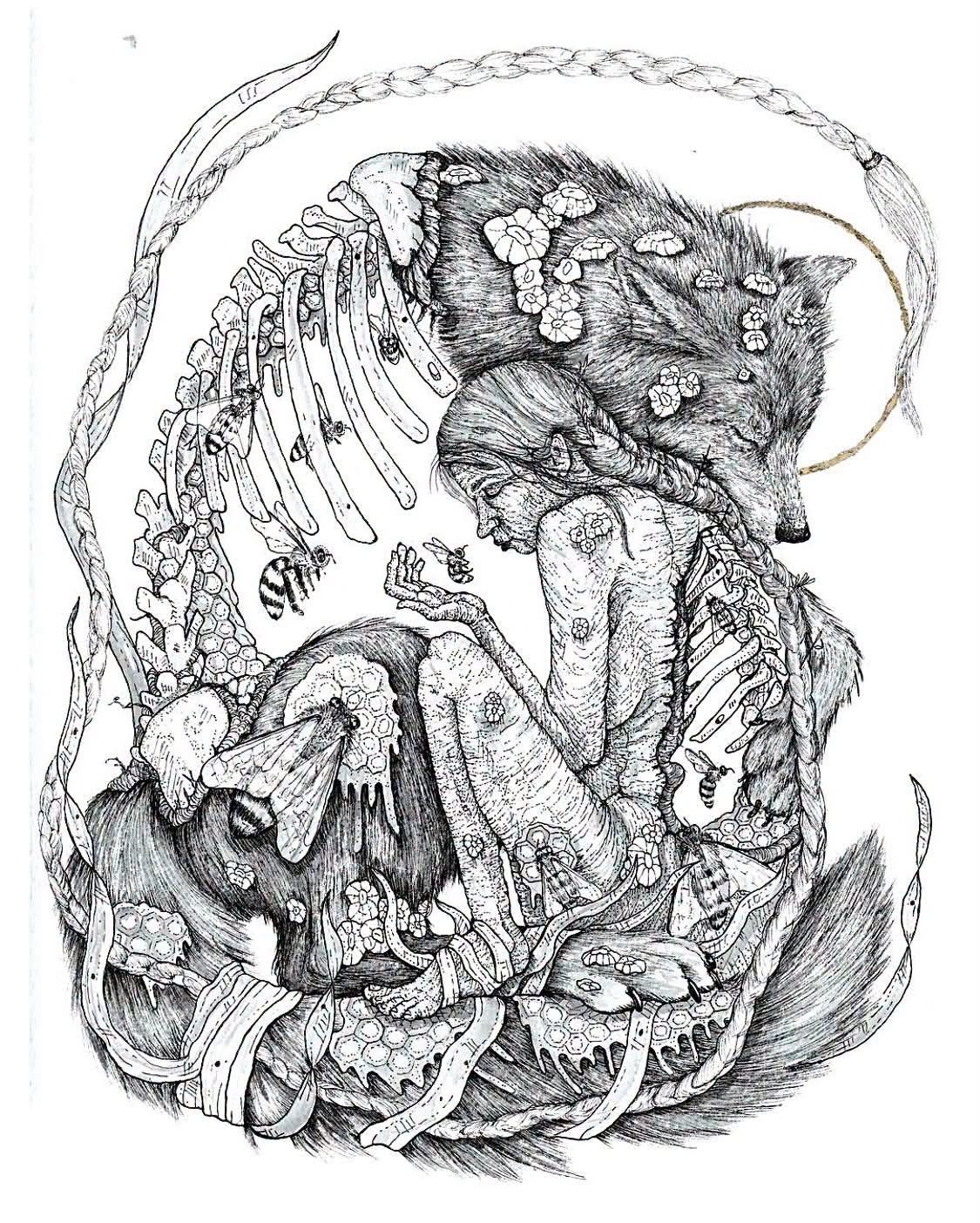
When we sing the bones of the wolf back to life, we must sing to the mountain, the forest, the deer, and ourselves, and our song forms an unbroken circle of shared vitality.
Thanks for reading Regina Dentata! Subscribe for free to receive new posts and support my work.
The release of George Monbiot’s video How Wolves Change Rivers was a watershed moment for wolf appreciation. An article published in 2024 claims that it has been viewed over 43 million times on YouTube, but the real number is likely higher because it is also accessed on other platforms.
In four and a half minutes, Monbiot illustrates how predation by the reintroduction of wolves awakened a whole web of revitalized connections in the web of life, a “dynamic symphonywhere each species plays a crucial role, moving beyond the traditional view of isolated species to a holistic vision of an interconnected ecosystem.”
La Loba would approve; however …
Researchers still debate the extent and mechanisms of wolves’ ecosystem effects in Yellowstone and elsewhere, and critics have pointed out a number of inaccuracies in Monbiot’s video, but the story’s cultural power lies in how it recasts wolves as agents of renewal and as stewards rather than threats to other species. That broader point is well supported and not seriously in dispute, and the video, as well as other scientific outreach, helped make the public aware of trophic cascades and keystone species— topics which, a generation ago, were only understood by specialists.
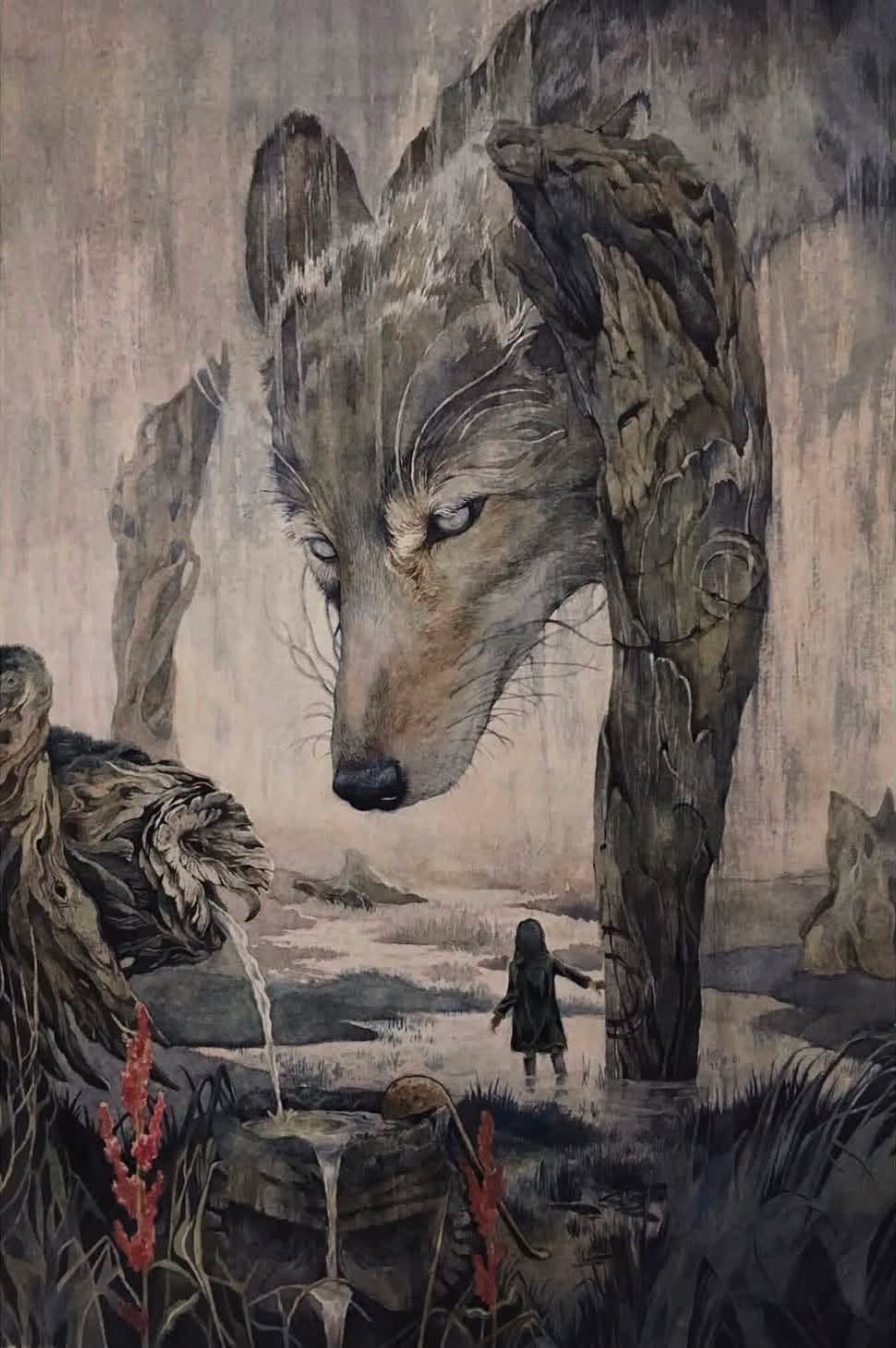
Above: Hydrus (2018), by Lily Seika Jones.
Attempts have been made at retroactively justifying Saxby’s hoax with claims that the wulver was a human being with a rare medical condition, or that the acts of charity were a form of mutual aid among islanders. Neither clain stands up to the most casual scrutiny. Some of the “charity” interpretations even go so far as to say “all the fish in the sea belonged to the Crown and taking them without a permit was illegal,” which is obvious bullshit. But even if this were true, laying a fish out on a neighbor’s windowsill is a) much too obvious for a clandestine act of food charity, and b) likely to lead to theft by cats, or c) to cause the fish to begin rotting and making a terrible stink.
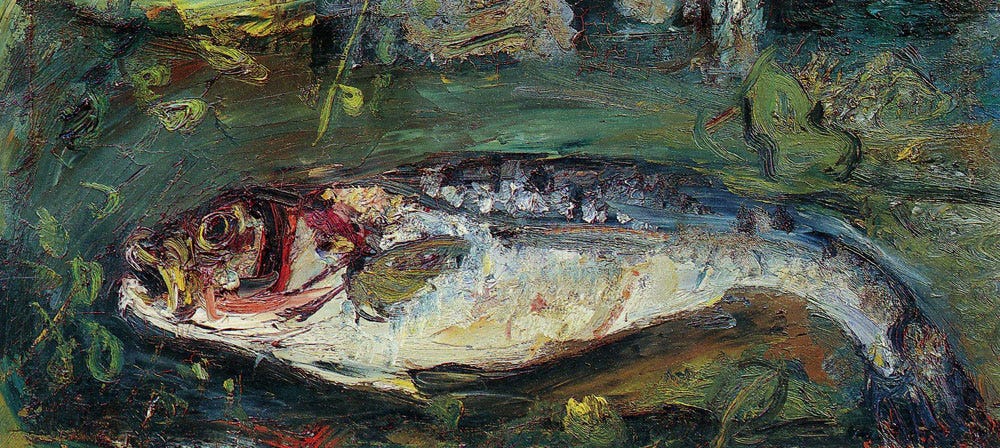
The Fish, Chaim Soutine, 1933. Source. This eccentric painter famously kept carcasses in his studio until they began to liquefy and reeked so badly that the neighbors called the police.
In Jacobsen’s discussion of names derived from Old Norse hóll, hill, he mentioned a category of group of “Wol-” names: they included Wolvhul and Wolwul in Delting (also, he said, called Da Wolwul Knowe); Wolewul in Weisdale; Wolhul in Fladdabister; and Wolver(s)hul in Mid Yell.
The folklorist claimed they were derived from Old Norse álf, fairy; thus, these places’ names means “fairy hill.” In Shetland names, the vowel ‘á’ often turns into ‘wo,’ so Jakobsen compared the place called Wolver(s)hul in Yell with the Faroese noun álvarhús, fairy house. Saxby, however, found the derivation of Wulver’s Hool from álf [fairy] too mundane, so she invented the fictitious wulver and named her own house Wulvershool after it. Source / Another source
Canis lupus never reached the Shetland Islands, but the Scottish mainland had plenty of them, and they were never viewed through a romantic lens. As early as the 2nd Century BCE, King Dorvadilla decreed that anyone who killed a wolf would be rewarded with an ox. In the twelfth century the monks of the newly founded Abbey at Melrose were trapping wolves and in 1283 an allowance was paid to ane hunter of wolves in Stirling. In 1427, James I ordered wolves to be eradicated, and his parliament then passed an act requiring lairds to hunt and kill them. Source / Another source.
However, the Scots’ enmity was not caused by wolves’ livestock predation as much as by the fact that they scavenged human corpses. Because graves in the Highlands were often robbed by wolves, certain islands, such as Handa Island and Inishail (in Loch Awe) became burial grounds. The deep water surrounding them worked as a natural barrier: families that rowed their dead loved ones over island burials knew their bodies would not be dug up and consumed. And, in a Christian context, that meant they would be ready for physical resurrection on Judgment Day.
It was partly—though not only—for this reason that the church associated them with the devil, further inflaming people’s hatred and fear of the animals.
Even without the aspects of predation and grave robbing, churches have traditionally preached against forests while appropriating the peaceful, sanctuary atmosphere they provide in architectural simulacra. Read more about it here:
Is the forest my church, or is the church a forest?
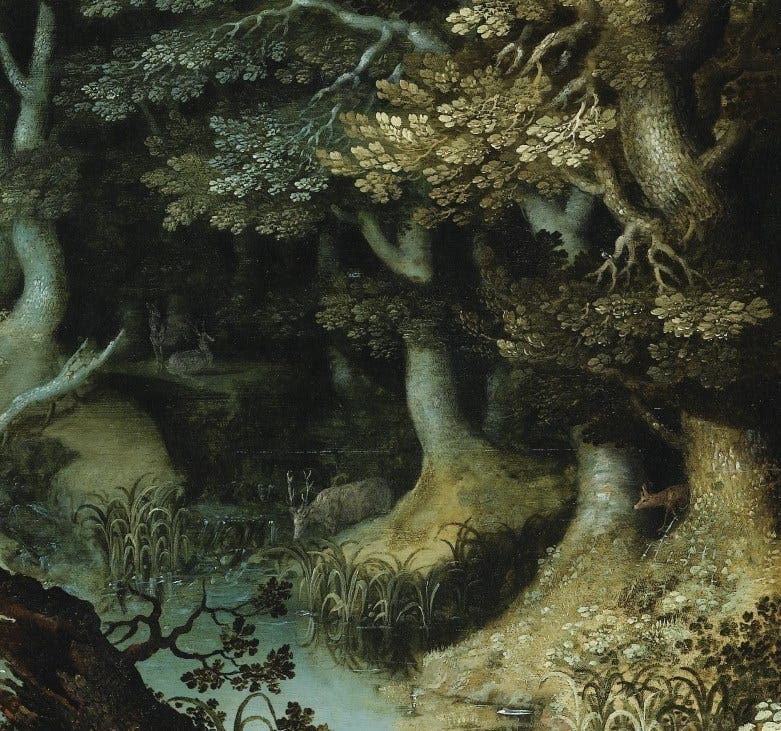
Rich in trees, shadow-spreading …
This is also part of the reason why Scotland’s native coniferous rainforest of Scotland, the Caledonian Forest—once a vast primeval wilderness of birch, rowan, aspen, juniper and Scots pines—was gradually reduced by humans, for a variety of reasons, but parts of it were not even harvested; they were burnt deliberately to eliminate habitat for wolves and other “vermin.”
More than a hundred years after the last wolf in Scotland was killed (according to a popular legend), they were still feared:
He climeth the guarding dyke,
He leapeth the hurdle bars,
He steals the sheep from the pen,
And the fish from the boat-house spars,
And the digs the dead from out of the sod,
And gnaws them under the stars.
Thus every grave we dug
The hungry wolf uptore,
And every morn the sod
Was strewn with bones and gore:
Our mother-earth had denied us rest
On Ederchaillis’ shore
The Book of Highland Minstrelsy, 1846
Source.
Scotland has many local “last wolf” legends that celebrate their eradication, but supposedly the very last wolf in Scotland was dispatched in 1743 by a certain MacQueen of Pall-a-chrocain. Allegedly, it was a terrifying, huge, black beast that was killing children as well as sheep. MacQueen managed to decapitate it, stuffed the animal’s head under his plaid, cried Sine e dhùibh! [There it is for you!] and threw it onto the grass before the feet of his laird.
Today, only one percent of the original Caledonian forest still remains—once the humans destroyed most of it the rest has been savaged by deer. However, ecologists have hope for at least a partial renewal, and wolves have been reintroduced to bring the ecosystem back into balance.
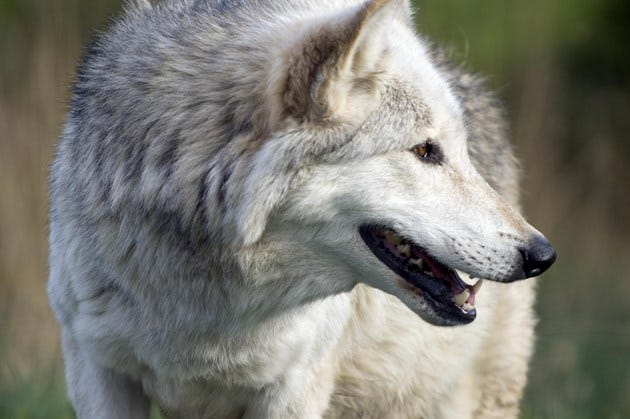
A wolf at the Highland Wildlife Park near Kincraig. Source.
Scottish folk stories, such as tales collected in the Morayshire lowlands, portray wolves as preying on children herding cattle or working on the edges of peat bogs. The wolves do not represent some kind of abstract or human danger, as modern researchers believe the wolf in Little Red Riding Hood does. The tales were intended as public safety information that would help children avoid predators. Source.
Source 1; Source 2. Defonseca’s false claim to be the daughter of Holocaust victims is an excellent example of Wilkomirski Syndrome,
Wilkomirski Syndrome is a public phenomenon when non-Jewish people falsely claim Jewish identity or pretend to be Holocaust survivors or to suffer from Holocaust trauma. This form of literary fraud can be highly profitable on the “Holocaust memoir circuit,” but it not only undermines legitimate memoirists’ work, but also supports Holocaust denial, because deniers can say “You see? They’re making this stuff up!”
The connection between the Virgin of Guadalupe and wolves is based in a “folk” or “false” etymology. This bogus/poetic derivation claims that the -lupe part of her name comes from the Latin lupus; however, Guadalupe is not originally a Latin name. It comes from the Arabic Wadi-l-lubb [hidden river]. During the Moorish period in Spain, many towns near rivers were given Arabic names that begin with Guada, such as Guadalajara, Guadalquivir— and Guadalupe. Now, apparently, the wolf is being syncretized to her cult:
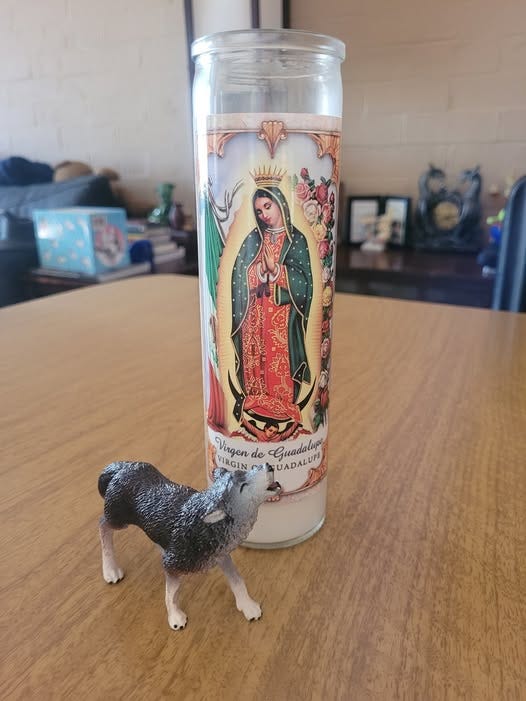
Then, when the Spaniards invaded the Americas, they took this naming tradition with them. There is a Virgen de Guadalupe in Spain (classified as one of the “Black Madonnas”), which dates to at least the 8th century. Fatefully, it was at her monastery that queen Isabel and king Fernando signed the charter authorizing Columbus’ first voyage. Moreover, Hernán Cortés, the conqueror of México, was a devotee of the (Spanish) Virgen de Guadalupe, so her cult was present in Mexico long before the Mexican version of the Virgen appeared, though this latter version is what most people in our part of the world are familiar with.
(Credit to Andras Corban-Arthen for the information.)
Naturally, the creation of new deities is not only a recent pursuit. Undoubtedly, our Neanderthal ancestors did it, and probably Homo erectus did as well. We will never stop doing it, no matter what religion, priestly caste, or theologists forbid it.
The scholarly term for the creation of a new deity is theogenesis, and the entity is a “theogonic construction.” This process happens all the time. Sometimes, the new theogonic constructions are just a bright flash that quickly disappears; sometimes the deity stays around for millennia.
Some amateur philologists try to link Hukkatar to Hekate due to phonetic similarity, but this is obviously spurious.
No posts
Comments
Nothing yet. Say the first thing.
Sign in to join the conversation.