
If you’ve ever dipped into the comments section of this newsletter, there’s a good chance you’ve run into Hannah Iris.
Hannah almost always leaves a comment on My Sweet Dumb Brain posts, and those comments reveal a lot about the person she is. She’s thoughtful and conscientious, self-reflective and funny, and genuinely cares about other people’s well-being. She’s also gotten really good at noticing the bright spots in her own life. Every month, when I share my personal glimmers, I know Hannah will soon show up in the comments sharing her own recent moments of joy too.
But this wasn’t always the case. As you’ll read below, Hannah initially struggled with the practice. It’s only in the past several months that she’s begun documenting her glimmers with real anticipation and ease.
Here’s something else you might not know about Hannah Iris: that’s not her real name. Because she’s a therapist — and because this space is important to her — she keeps her identity private. We’ve never met in real life, but we’ve connected over Zoom and exchanged handwritten notes, and I can confirm she’s just as wonderful as she seems in the comments.
Today, I thought it’d be fun for you to get to know her a little better too.
Hello! Thanks so much for agreeing to this Q&A. You’ve been a longtime reader (and regular commenter) of My Sweet Dumb Brain. How did you first discover this newsletter? What made you want to stick around?
I can answer the former question with remarkable specificity: I discovered what quickly became one of my favorite corners of the internet on October 9, 2022. That was the day your own Q&A was published in the Culture Study newsletter. I’ve experienced my own fair share of palpable grief, but — and this is so funny to reflect back on now — because I’m also a therapist in private practice whose work centers on grief, my interest in reading your Q&A was initially piqued because I thought your writing might serve as an additional resource to share with clients.
As I began to dig into the MSDB archives, though, it immediately became clear to me that I wanted to preserve this space as one for me. I have incredible working relationships with my clients and I am not at all a stereotypical blank-slate therapist, but, to use the language of Amanda Litman, I am skilled at discerning between my real self and my full self: clients get my real self, but it doesn’t do them — or me — any good to give them my full self. And your writing — replete with thoughtfulness about what it is to make a meaningful life out of what’s often a devastating world — resonated on a deep full-self level for my own tender heart and sweet, dumb brain. I knew I wanted to keep reading, and I wanted to engage in the community you’d built.
You’re such a thoughtful, engaged presence in the comments — the kind of reader newsletter writers hope for. I have to admit, I tend toward being a lurker online, but your comments have inspired me to leave more encouragement when I read something I love. Has that always come naturally to you, or is it something you’ve grown into?
Oh, wow, that is such a generous compliment; thank you. Receiving that feedback is especially meaningful to me because how I show up in online community spaces is actually really important to me.
Don’t get me wrong, I lurk plenty. Also, part of my engagement is purely (albeit wisely) selfish: I’m an elder millennial who’s long known that online spaces can offer rich opportunities for connection, all while honoring, in my case, a deeply introverted and homebody self.
In the spirit of both/and, though, it’s also true that I really value being kind, and letting people know that they, and their work, are appreciated feels like a meaningfully kind thing to do. Expressing that appreciation to writers is especially important to me, because I am a reader.
It comes naturally in the sense that it’s springing from one of my core identities and directly from one of my values: expressing kindness and gratitude through engagement. That said, I’ve also intentionally cultivated it over the years. Just last month, I sent off a quick email to a local journalist telling her how much I appreciated a recent (incredible!) article of hers in my city’s newspaper. That’s not the first time I’ve done that, but that’s a consciously made values-based decision that takes more intentionality on my part than, say, engaging with my favorite newsletters.
Let’s talk about glimmers. I started a monthly practice of documenting bright spots back in April 2024 and invited readers to do the same. I went back to that first post and you commented: “As soon as I read your invitation to share our own, I realized I was at a loss. Which I know is less an indication that I didn’t experience glimmers and more an invitation to start paying more attention to them.”
Now, two years later, you consistently share moments — big and small, global and personal — that have brought you joy. What shifted for you?
Oof. I’m actually emotional right now, because I remember writing that in response to your first glimmers post. And I remember being at that loss and thinking to myself, this is so sad! I was going through a wild ride of a time personally back then; I was in the midst of a giant midlife reckoning, and there was a lot that was heavy and hard. But, even so, I knew I didn’t want to be at an immediate loss for a single darn glimmer over the course of an entire month!
Here’s what I DIDN’T remember though, not until going back through your glimmers archives just now: You started documenting glimmers in April 2024, but I didn’t actually start sharing my own glimmers, in the comments of those posts, until October 2024 — and then only inconsistently so. It wasn’t until February 2025 that I started consistently sharing them (and adding in all the corresponding emojis that continue to decorate my lists to this day). But, even then, there were some pitifully anemic glimmer lists happening: short in length, generic in content. Fall 2025 was when I (finally!) really got cooking with the practice. So: SIX MONTHS to get started and then A YEAR to really find my rhythm.
In my mind, I’d jumped right in and voila! Clearly, it was a more plodding process than that.
Ultimately, I think these (sloooow) shifts unfolded because, well, I am quite stubborn. I’m quick to let something go (euphemism for giving up) in all kinds of cases, and at my core am incredibly impatient, but when I really want something, I am persistent and unyielding.
What does noticing glimmers look like in your day-to-day life now?
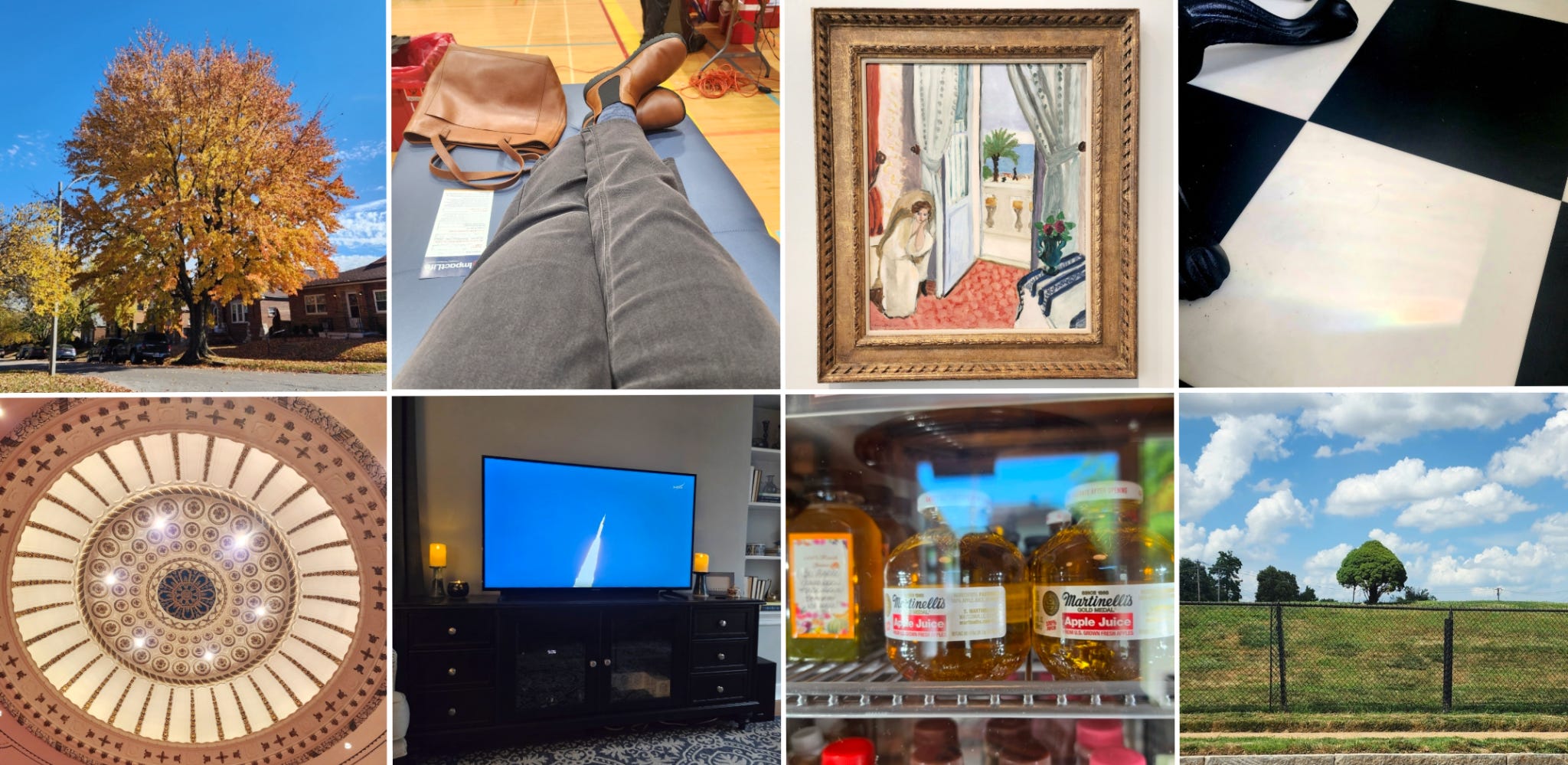
Honestly, it’s so simple: the whole thing looks like 1) noticing, and 2) (often) taking a photograph. My noticing skill, just like any other, of course strengthened the more I practiced it. And the photography aspect instinctively happened, in large part I think as a natural extension of a previous commitment I’d made to myself to begin documenting my life more.
While taking photos of things can for sure take us out of the moment (by looking at the image of the thing on our screen rather than the thing itself), I’ve found that taking glimmer photos actually allows me to really savor the glimmer. Also, by photographing a glimmer, I’m marking the moment as special; I’m marking it as worthy of remembrance; I’m marking it as something I can return to (and I do!). I think all of that has helped boost my glimmer-noticing skills even more.
What this glimmer photography often means in reality is that I, well, have a bunch of photos on my phone that would be utterly confusing to anyone else and that are otherwise just absolutely absurd. (The sheer number of photos I have OF MY TELEVISION — from the Olympics; of the livestream of the Big Bear Valley eagle nest; throughout the Artemis II mission — is truly wild.)
Then, when I make my glimmers list in your comments at the end of each month, it’s an opportunity to revisit my memories, my calendar, and my photos from the month. I find that to be an absolutely lovely reflective practice. I take a screenshot of that glimmers list, crop it, and save it as a monthly marker in time in my photo gallery. Revisiting these lists is often a glimmer itself!
I’ll also just quickly note that this practice, from the start, has felt far more impactful than a standard gratitude-journal kind of exercise. That, to me, always felt just like another chore to do, another thing for my brain to think about. For me, my glimmer practice has always been rooted in pleasure, which is surely why I’ve kept with it.
I love that! I’ve noticed real benefits from keeping track of glimmers myself. What started as a whim has become central to how I see the world.
You’re a therapist. From your perspective, why does this work? What’s happening when we start paying attention in this way? Have you ever suggested something like a glimmers practice to your clients?
It all comes back to the wisdom of your own language, Katie; it’s because we all have sweet, dumb brains. In this case, that our sweet, dumb brains need glimmer-like practices can be connected to (at least) three things:
1) Evolution and our ancient ancestors: Human beings’ brains evolved to have a negativity bias, which serves to prioritize paying attention to, focusing on, and remembering the RISKS, the BAD, the SCARY, the WHAT IFS, the THINGS THAT HAVE EVER GONE, OR COULD EVER GO, WRONG. This is true even for people without anxiety disorders, because this isn’t about anxiety at all; it’s about a brain adaptation that evolved to help ensure the survival of the species.
That negativity bias is why we’re here, in the present day, to begin with! Our ancient ancestors who were more focused on remembering that THOSE BERRIES KILLED KEVIN and then DIDN’T EAT THOSE BERRIES THEMSELVES were more likely to survive (and pass along their killer-berry-remembering brain) than those ancient-ancestor losers (ahem, Kevin) who were primarily focused on those oh-so-beautiful-looking ripe berries that they just had to pop straight into their mouth to savor. RIP Kevin.
2) Our dominant culture: I’m a licensed clinical social worker, and my therapist self is deeply informed by the social work profession’s value of looking at systems, not just individuals. I end up ranting quite a bit in my work with clients about patriarchy, white supremacy, and capitalism, because these systems have a profound impact on how we experience our individual lives, both externally and internally.
As pertains to this discussion, we are immersed in a dominant culture that glorifies — and moralizes — achievement, attainment, and striving. Always focusing on what could be better and then trying to make it better, only to rinse and repeat, is our cultural default. And so, because of this dominant culture, our experiences of contentment, satisfaction, and pleasure are perceived, on a subconscious level, as existential threats to our goodness, value, and worthiness.
3) Our own unique selves: I’ll use myself as a quick example here. My temperament tends more toward seriousness than silliness. My mood skews toward a melancholic baseline. I’ve experienced traumas. I’ve had three major depressive episodes, and I also have a chronic anxiety disorder. There’s shit in my family lineage that I only have a slight grasp on. I grew up in a Catholic-school environment that capitalized on all my vulnerabilities toward rule-following, people-pleasing, and perfectionism. I’m white; a first-generation college grad; middle class; a cis-gender woman; straight; neurodivergent. I could go on. All of these things contribute to how I experience my life, and many of them throw up obstacles to experiencing my life in an unencumbered, lighthearted, pleasure-focused way.
To recap: Our brains evolved to prioritize survival, which has no use for thriving; our dominant culture is focused on upholding cruel systems, which are all threatened by individuals’ liberatory practices (both big and bite-sized); and we, as individuals, hold countless parts of our own history and identities which can impede our well-being and enjoyment of our lives.
NO WONDER WE NEED PRACTICES LIKE GLIMMERS.
My clients and I are constantly exploring these practices, because we as humans are essentially compelled to practice pleasure and enjoyment — through the mindfulness of slowing down, savoring moments of gratitude, and connection to art, community, and the natural world — as an antidote to all these forces and as a way to live a life, even amid horrors, that feels full and meaningful.
If how we spend our days is how we spend our lives, then it can also be argued that how we spend our days is what we pay attention to. (I highly recommend Chris Hayes’s recent book, The Sirens’ Call, for a compelling argument about the vitality of attention.) Mindfulness, gratitude, and noting glimmers are all about attention. Our minds can help us identify our values, orient (and reorient) our attention in ways that align with those values, and make values-based active choices — like a glimmers practice — that can support a more radically empowered way of living.
Wow. That was so helpful. And thoughtful. And funny. (Poor Kevin!)
Thank you for being so generous with your answers. Is there anything else you’d like to add? Maybe a bit of advice for readers who are curious about glimmers but haven’t yet started their own practice yet?
I’m going to give the answer that I admittedly would hate to hear myself: don’t be too serious about it! Just jump in, play around, see what happens. There are no rules to follow, and there is no right or wrong way to do it. (God, I mean it, I would SO hate hearing that.)
Beyond that:
1) I never could have had my current practice as my initial practice (my current practice is a natural outgrowth of the practice evolving over time; process matters; yadda yadda);
2) if I had known it would take me SIX months to start and then A YEAR to find my groove, I never would have freaking begun.
So especially for you fellow recovering perfectionists who feel daunted by starting what’ll likely be an imperfect, evolving process: maybe it won’t take you as long as it did me! Or, maybe just try to forget about my timeline entirely! Or maybe remember my timeline as a reassuring boost if you end up feeling like your own practice isn’t immediately clicking into place! Or maybe this whole glimmers practice is just a great exposure therapy to keep dismantling that darn perfectionism! Or maybe you do another practice entirely (I also love, and participate in, Jessica Valenti’s weekly One Good Thing tradition)!
The final thing I want to add is a request: it’s obvious that I love sharing my glimmers in the comments of Katie’s monthly glimmers post, but I also really love reading other people’s glimmers. So PLEASE share yours, too! Sharing in one another’s glimmers is a glimmer itself! ✨
Thank you, Hannah, for showing up so fully. And thank you, readers, for being here. It never ceases to amaze me that there are real people reading these words, week after week.
I hope you take Hannah’s glimmers request to heart. It’s never too late to start noting and documenting the bright spots.
See you next week, friends.
Text within this block will maintain its original spacing when published
xoxo
KHG
Comments
Nothing yet. Say the first thing.
Sign in to join the conversation.