
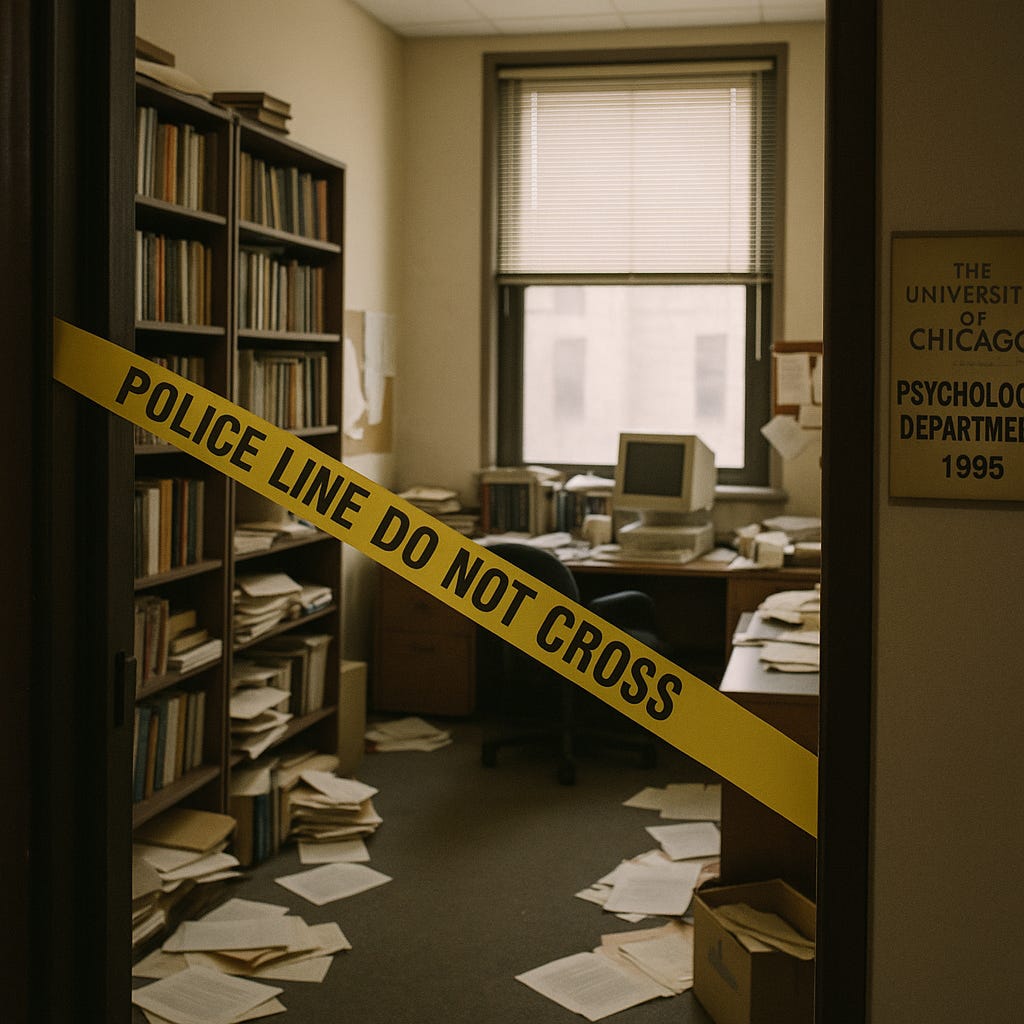
Friday, October 6th, 1995
Evidence Log - University of Chicago Psychology Murder
The call from the coroner's office came at 8:15 AM, just as I was settling in with my coffee and the case files spread across my desk like academic papers I'd never want to grade.
"Detective Rinaldi? Dr. Patricia Santos, Cook County Medical Examiner. I have preliminary results on your professor."
"What'd you find?"
"Cause of death is asphyxiation by ligature strangulation, as expected. But here's what's interesting—Dr. Brennan had significant levels of lorazepam in his system. That's Ativan, a benzodiazepine sedative."
I grabbed my pen. "Enough to knock him out?"
"Enough to make him very drowsy, confused, compliant. Not enough to kill him, but enough to incapacitate someone his size. Based on the concentration, I'd estimate he ingested it thirty to sixty minutes before death."
"Any sign he was a regular user?"
"No indication of tolerance or regular use. This appears to be a single, substantial dose. And Detective? The way it was administered suggests it was dissolved in liquid coffee, tea, or something like that. The stomach contents show traces of coffee along with the drug."
I thought about that coffee mug on Brennan's desk. "World's Greatest Mentor."
"Dr. Santos, how would someone get access to lorazepam?"
"Legally? It's a prescription medication for anxiety disorders. But it's also used in research settings, psychology labs studying stress responses, sleep studies, that sort of thing. Universities with psychology departments often have access for legitimate research purposes."
"Would a graduate student have access?"
"Potentially, yes. Especially someone working on research involving stress, anxiety, or behavioral modification. The dosage and administration suggest someone with knowledge of the drug's effects and timing."
"What about the coffee mug from his office?"
"Already sent it to the lab for testing. Should have results this afternoon, but given what we found in his stomach contents, I expect it'll test positive for lorazepam residue."
After hanging up, I stared at my notes. Someone had drugged Brennan's coffee, waited for him to become helpless, then strangled him with his computer cable. This wasn't a crime of passion—it was planned, methodical, and executed by someone who understood both psychology and pharmacology.
The University of Chicago Psychology Department suddenly felt a lot smaller.
I called the department office and asked to speak with the person who managed research supplies and controlled substances. Twenty minutes later, I was back in Rosenwald Hall, talking to Janet Morrison, the department's research coordinator—a no-nonsense woman in her fifties who looked like she'd been keeping track of academic chaos since the Carter administration.
"Lorazepam?" She consulted a thick binder. "Yes, we maintain a supply for Dr. Patterson's anxiety research and Dr. Kim's sleep studies. It's a carefully controlled—locked cabinet, sign-out sheets, the whole protocol."
"Who has access?"
"Faculty members running approved studies, and their designated research assistants. Everyone who handles controlled substances has to be registered with the university and complete safety training."
She pulled out a folder. "Here's our current authorization list. Twelve people total, five faculty members and seven graduate students."
I scanned the names. Sarah Chen was on the list, authorized to access controlled substances for Dr. Kim's sleep disorder research. So was Michael Henderson, working with Dr. Patterson on anxiety studies. Dr. Sterling had access for her social psychology research on stress responses. Even Dr. Whitman was authorized, though as department chair, he rarely handled substances directly.
"How closely is usage monitored?"
"Sign-out sheets for every withdrawal, co-signed by supervising faculty. Monthly inventory reconciliation. But..." She hesitated.
"But what?"
"Well, if someone took a small amount and falsified the paperwork, it might not be noticed immediately. The reconciliation process isn't foolproof, especially if you know the system."
"Has anyone reported missing lorazepam recently?"
"Not officially. But there have been some minor inventory discrepancies over the past few months. Nothing dramatic—a few milligrams here and there. We assumed clerical errors or measurement inconsistencies."
Dr. Kim's lab was on the second floor. Her research focused on sleep disorders and circadian rhythms, the kind of work that required precise knowledge of sedatives and their effects. Sarah Chen worked as her research assistant, helping with data collection and subject monitoring.
The pieces were starting to form a picture, but it was still incomplete. Someone with access to lorazepam had drugged Brennan's coffee during their evening meeting, waited for the drug to take effect, then killed him when he was helpless to resist.
But here's what bothered me: even drugged, Brennan was a grown man, probably 180 pounds. The strangulation would still require significant physical strength and leverage. Lorazepam might make someone compliant, but dead weight is still dead weight.
The question wasn't just who had access to the drug—it was who had both the pharmaceutical knowledge and the physical capability to overpower a sedated but still substantial man.
As I walked back through the psychology building, I thought about each of the suspects. Michael Henderson was young and athletic, strong enough to be easily. Dr. Sterling worked out regularly, and I'd noticed her gym bag in her office. Even Dr. Whitman, despite his age, was a tall man who'd probably played sports in his Ivy League days.
Sarah Chen, on the other hand, couldn't weigh more than 110 pounds soaking wet.
Key Evidence:
Brennan was drugged with lorazepam 30-60 minutes before death
The drug was dissolved in coffee, administered by someone with pharmaceutical knowledge
The university psychology department maintains lorazepam for legitimate research
Seven graduate students have authorized access to controlled substances
Sarah Chen works in sleep disorder research and understands sedative effects
A recent inventory discrepancy in Dr. Kim's lab suggests missing lorazepam
Next Steps:
Interview Dr. Kim about missing inventory
Review sign-out sheets for recent lorazepam withdrawals
Check alibis for all personnel with controlled substance access
Examine the victim's office coffee setup more carefully
Questions Remaining:
Who had the opportunity to drug Brennan's coffee during the evening meeting?
Which authorized personnel had a motive to kill Brennan?
How did the killer ensure they wouldn't be discovered in the locked office?
The case was becoming clearer, but the most important question remained: In a department full of people with access to the murder weapon, who had been pushed far enough to use it?
Comments
Nothing yet. Say the first thing.
Sign in to join the conversation.