

How much are seven hours of your time worth?
If you’re like most solopreneurs, those hours disappear into brainstorming, researching, or fighting with a blank page.
That’s time you could be landing a client, resting, or focusing on the parts of your business you enjoy.
Here’s the good news: you can reclaim those hours this week using AI tools you already know — ChatGPT, Claude, or Perplexity. No steep learning curve, no expensive software. Just a few clever prompts that do the heavy lifting for you.
Let’s break it down into simple, time-saving wins:
Stuck on what to write about? Your favourite AI can generate fresh angles in seconds.
You are an experienced content creator, specialising in innovative ideas. Read my Substack publication:[PASTE YOUR URL] and suggest 7 article ideas that would resonate with my audience. Provide a headline and a 2-sentence outline for each. I inserted my own Substack URL into ChatGPT. Here are the first two ideas I received:
1. “The 30-Minute Power Reset: How to Reclaim Focus & Flow Midday”
Outline: A concise routine weaving mindfulness, movement, and a quick creative spark to help readers break free from afternoon slumps. Includes optional habit triggers and mini-rituals to recharge even on the busiest schedules seamlessly.
2. “Money Mindset Makeover: Small Inner Shifts That Yield Big Financial Leverage”
Outline: Examine limiting beliefs—like scarcity thinking or imposter syndrome—and offer mini mindset exercises inspired by neuroscience. Bonus: a “weird but effective” journaling prompt from your habit library to shift someone’s financial thinking.
Within minutes, you’ll have a week’s worth of ideas — tailored to your readers — instead of staring at a blinking cursor.
Every great article starts with research, but digging through sources can eat up your day. That’s where these AI tools shine:
Perplexity: Built for research, it gives you concise answers with citations. Free daily queries included.
ChatGPT/Claude: Great for organising insights, comparing perspectives, and explaining complex topics simply.
You are a research & analytics expert. Research the latest statistics, facts, expert opinions and crucial information on [CHOSEN TOPIC]. Use credible sources only. Summarise your findings in bullet points with source links I can verify. 1000 words max, please. I asked Perplexity to research ‘Imposter Syndrome.’ Here’s part of the output I got:
Imposter Syndrome: Latest Statistics, Facts, and Expert Insights (2025)
Below is a summary of the most recent, credible information on imposter syndrome, including statistics, core facts, expert opinions, and proposed solutions. Source links are provided for verification.
Prevalence and Demographics
Global Prevalence: Meta-analysis of 11,483 health service providers from 30 studies found that 62% experience imposter syndrome. Prevalence increases with years of study but tends to decrease slightly with larger sample sizes.pubmed.ncbi.nlm.nih+1
Source: PubMed (May 2025)
(See full research here)
Now your “half a day of Googling” becomes 15 minutes of focused review.
Instead of starting from scratch, let AI map your piece.
You are an experienced content writer, specialising in [YOUR INDUSTRY]. Create a detailed outline for an article on [CHOSEN TOPIC]. Include an engaging intro, 3–5 key sections, and a conclusion with a strong CTA.I asked ChatGPT to outline a psychological article on imposter syndrome. Here’s part of the output:
Outline: Imposter Syndrome — Why High Achievers Feel Like Frauds
Introduction (Hook + Context + Relevance)
Hook: Start with a relatable question or statement — “Ever landed a big win only to feel you didn’t deserve it? That’s not humility. That’s imposter syndrome.”
Context: Define imposter syndrome briefly as the persistent feeling of being a fraud despite clear evidence of success.
Relevance: Explain how it affects people across professions — from students to CEOs, creatives, and entrepreneurs. Mention its psychological and emotional toll (anxiety, self-doubt, burnout).
Preview: Introduce the article’s flow: what imposter syndrome is, where it comes from, how it shows up, and practical strategies to manage it.
Section 1: What Exactly Is Imposter Syndrome?
Definition: Coined in 1978 by psychologists Pauline Clance and Suzanne Imes.
Explain the paradox: High-achieving individuals doubt their abilities more, not less.
Differentiate between normal self-doubt and imposter syndrome (persistent, irrational, and resistant to evidence).
Quick, relatable scenario to illustrate the feeling.
(See complete outline here)
You’ll get a roadmap in seconds. Then it’s just a matter of filling in your expertise.
Even the best article fails without a strong hook. AI can help polish headlines until they click.
You are an expert copywriter. Give me 10 headline variations for this draft: [PASTE WORKING TITLE/ARTICLE DRAFT]. Rank them from most viral to most professional. Now ask me for my favourite two options (ask for their numbers). Once the user answers, for each headline, provide me with: - A short, enticing subtitle which will add value and naturally segway into the article. - A strong, irresistible hook which will capture the reader's attention. I tested this prompt on ChatGPT with the following headline from section #3: Imposter Syndrome — Why High Achievers Feel Like Frauds. Here’s what the AI provided:
1. The Silent Struggle of Success: Why High Achievers Secretly Feel Like Frauds
Subtitle: Behind every polished résumé and outward success, many professionals quietly wrestle with a hidden enemy — the nagging fear they don’t truly deserve their achievements.
Hook: Imagine climbing the mountain you’ve trained for your whole life, only to reach the peak and think, “I don’t belong here.” That’s the exhausting reality of imposter syndrome, even for the most accomplished people.2. Imposter Syndrome: The Hidden Curse of High Performers
Subtitle: From CEOs to creatives, high performers often battle an unseen weight — the belief that their success is just luck, timing, or deception.
Hook: They’re celebrated as the best in their field, yet in private, they’re haunted by a single thought: “One day, everyone will find out I’m a fraud.”
Pair this technique with intro rewrites, and you’ll maximise your chances of pulling readers in.
Words attract, but visuals stop the scroll. You don’t need to be a designer.
Free options: Canva AI/DALL·E (via ChatGPT)/Microsoft Designer for quick visuals.
Advanced: Midjourney (Starting at $10/month) for more polished, branded images. (Watch this space for my Midjourney guide very soon!)
You're a professional AI artist. Generate four professional visuals for an article about [CHOSEN TOPIC]. Keep them modern, clean, and brand-aligned. Please provide four different styles. When you're done generating the images, ask me:
- Is there any image that resonates with you? (Please provide the image number.)
If the answer is NO, create four more visuals.
If the answer is YES > ask whether to upscale that visual or create four variations of it.
When you're done, repeat the same questions as before if needed.
I asked ChatGPT (via DALL·E) to create images about imposter syndrome:
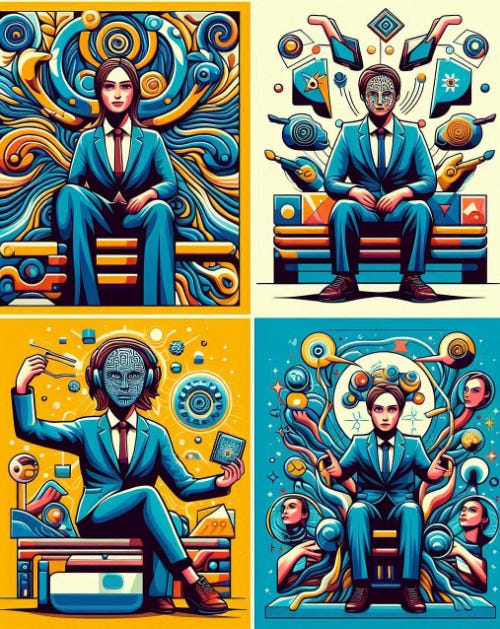
Now you’ve got assets that elevate your content instantly.
AI isn’t about replacing your creativity — it’s about reclaiming your time. Try even one of these quick wins this week, and notice how much lighter your workload feels.
Because the truth is simple: the less time you spend wrestling with the process, the more energy you have for the work that grows your business.
Pick one of these AI quick wins and try it today. Even saving 30 minutes is proof of what’s possible—and those minutes add up to hours you can reclaim every week!I send one helpful email every week. Stay tuned for next week’s article on AI for Content Distribution and subscribe to join our rapidly growing success community!
P.S. - If you liked this article, please consider restacking/sharing it with your followers.
Comments
Nothing yet. Say the first thing.
Sign in to join the conversation.