
Welcome to My Next Electric, where electrification and education meet.
Electrification = Help for people going electric one machine at a time
Education = Help for people curious about the energy transition
This is the second in a series on getting energy transition smart in 2025. Part one’s here.
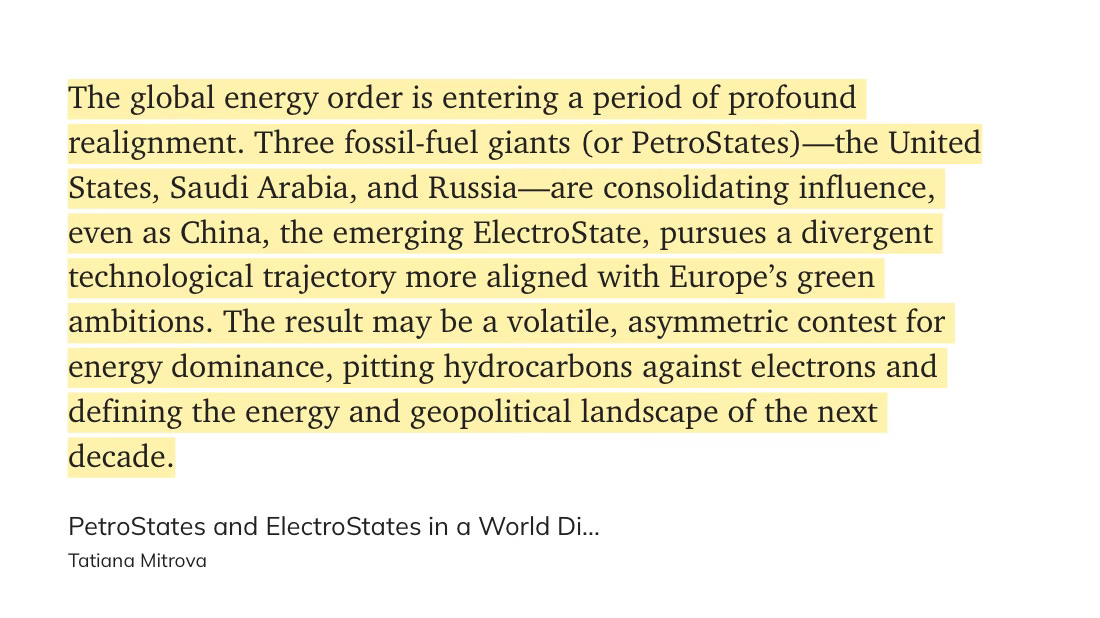
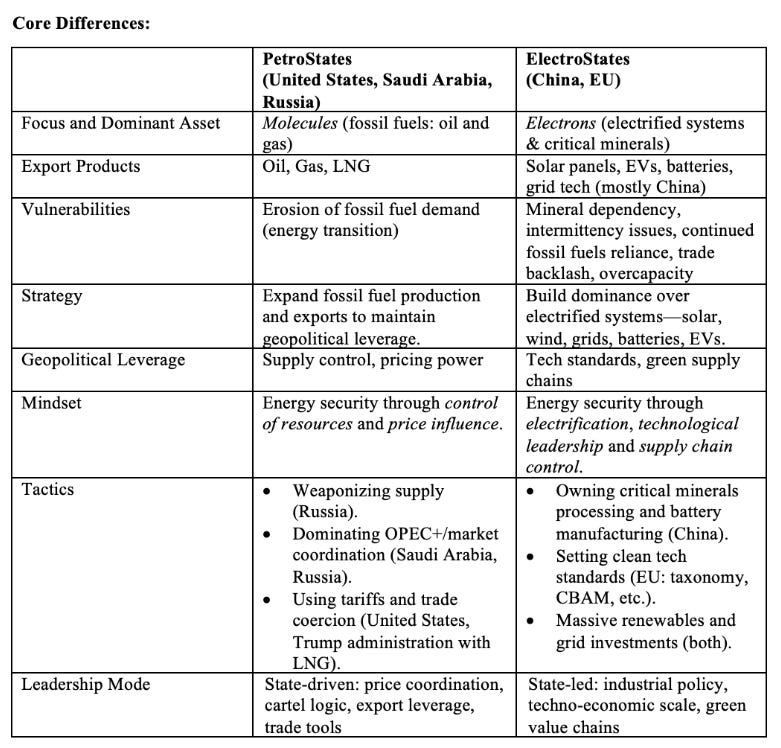
I’m fascinated by what I’ve been reading on PetroStates vs ElectroStates. Two pieces stand out — one on geopolitics, one on the science:
Mitrova and Cobra cover geopolitics; here’s my favorite highlight and a dope chart:
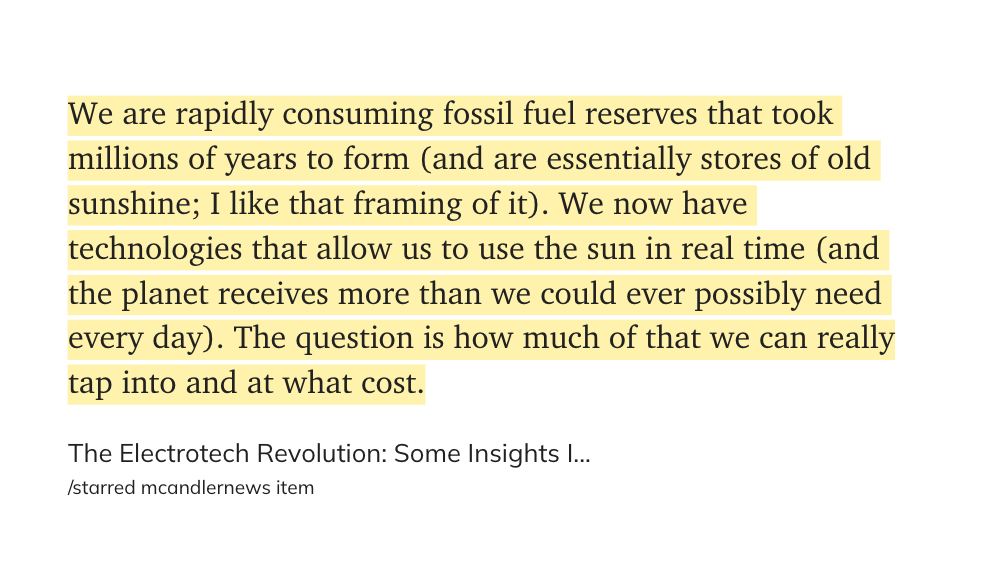
Ritchie has a gift for explaining the science; here’s my top highlight and an awesome chart from Ember, where she’s an advisor:
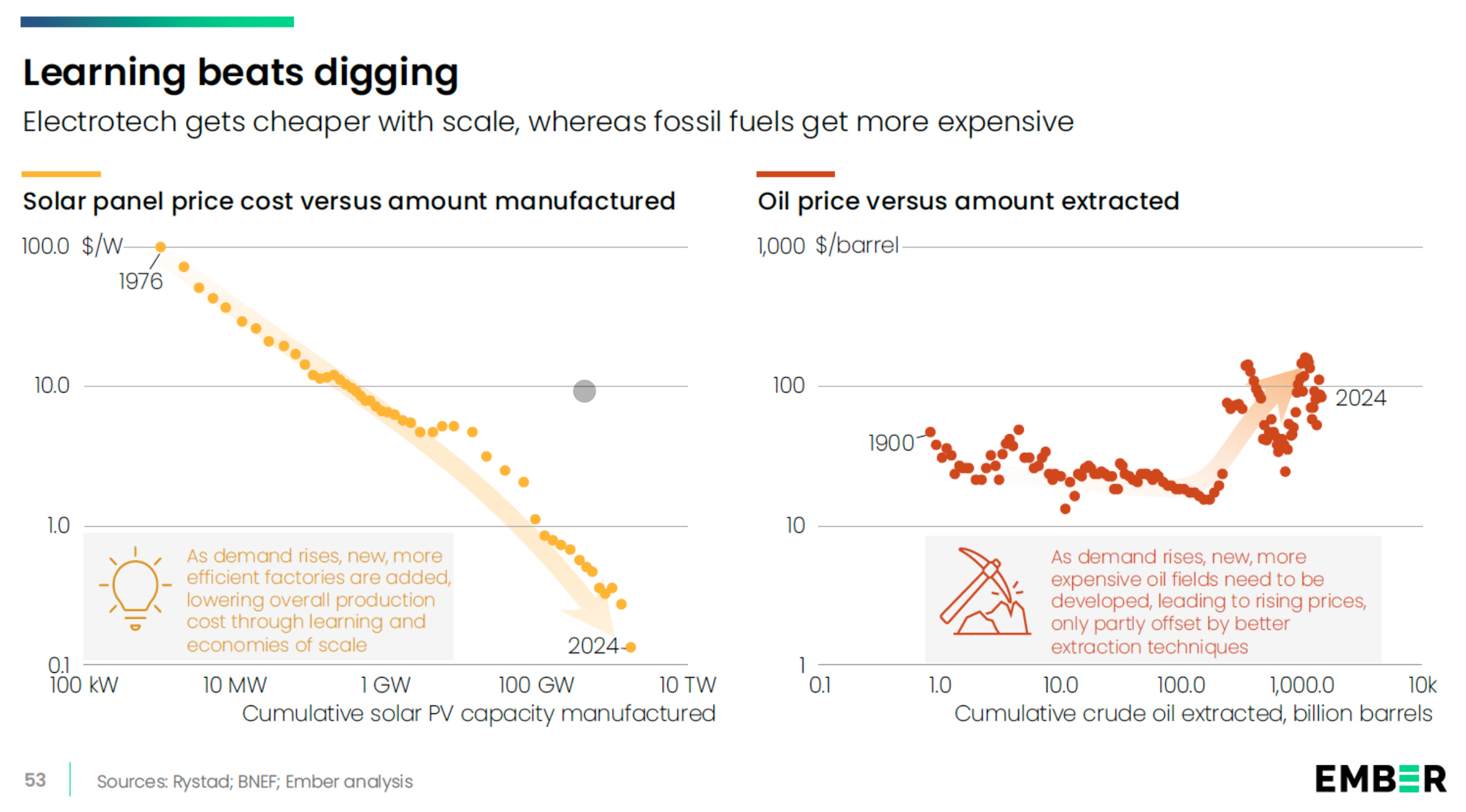
Let’s read that subtitle again; it’s core to my obsession with Christensen’s Innovator’s Dilemma.
Electrotech gets cheaper with scale, whereas fossil fuels get more expensive
Check out the right side of the visual above; oil’s getting more expensive to find. Natural gas will follow a similar path.
Converting these fuels to useful work won’t get any cheaper, either; combustion, whether inside an engine or a power plant, is limited by physics from getting much more efficient than it is today. Indeed, capturing energy from lots of tiny explosions and turning that into motion is complicated.
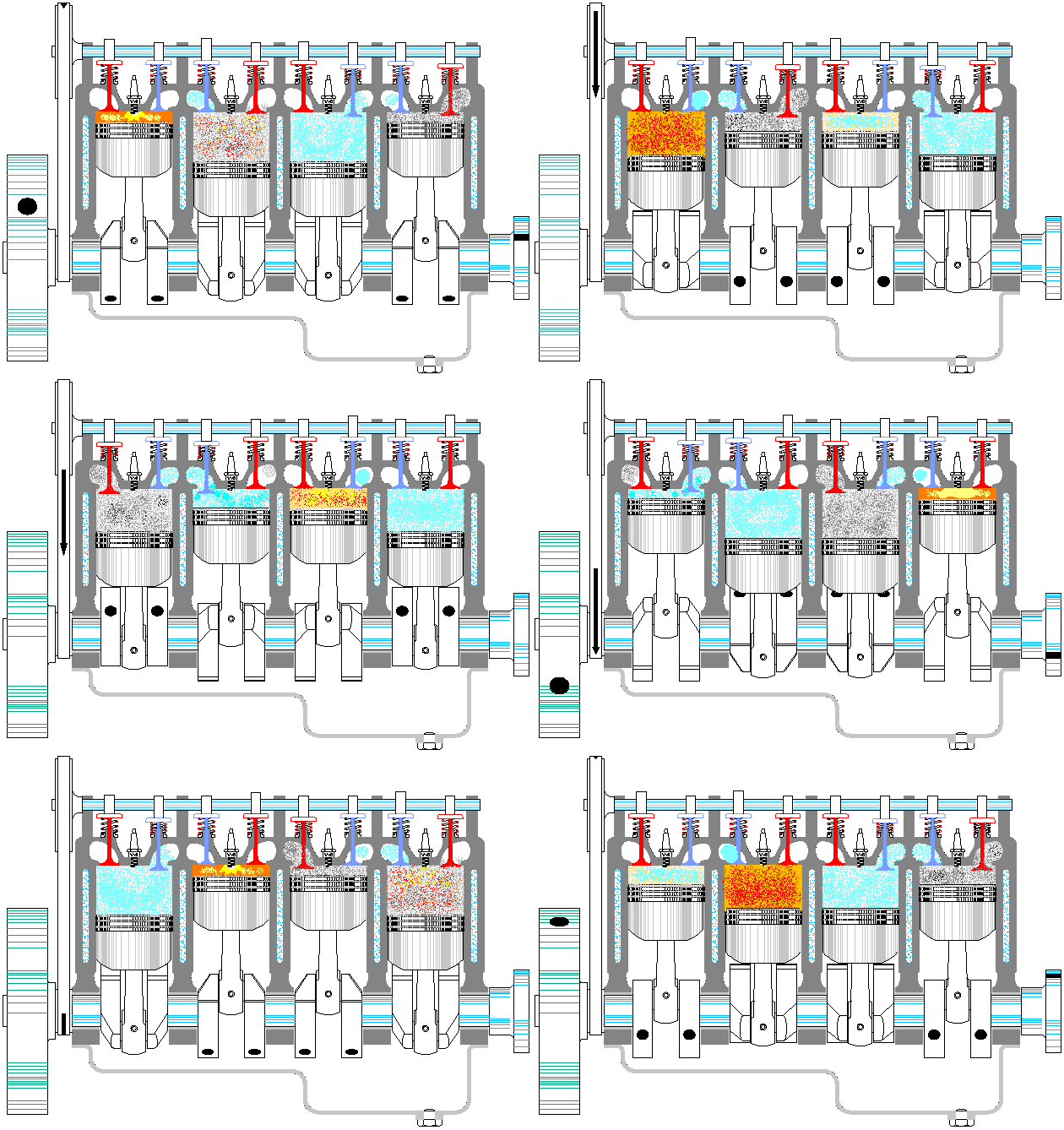
Meanwhile, there are plenty of Electrofuels to “mine.” Check out the subtitle of this next visual:
The sun supplies more energy to Earth every 5 days than all fossil fuel reserves.
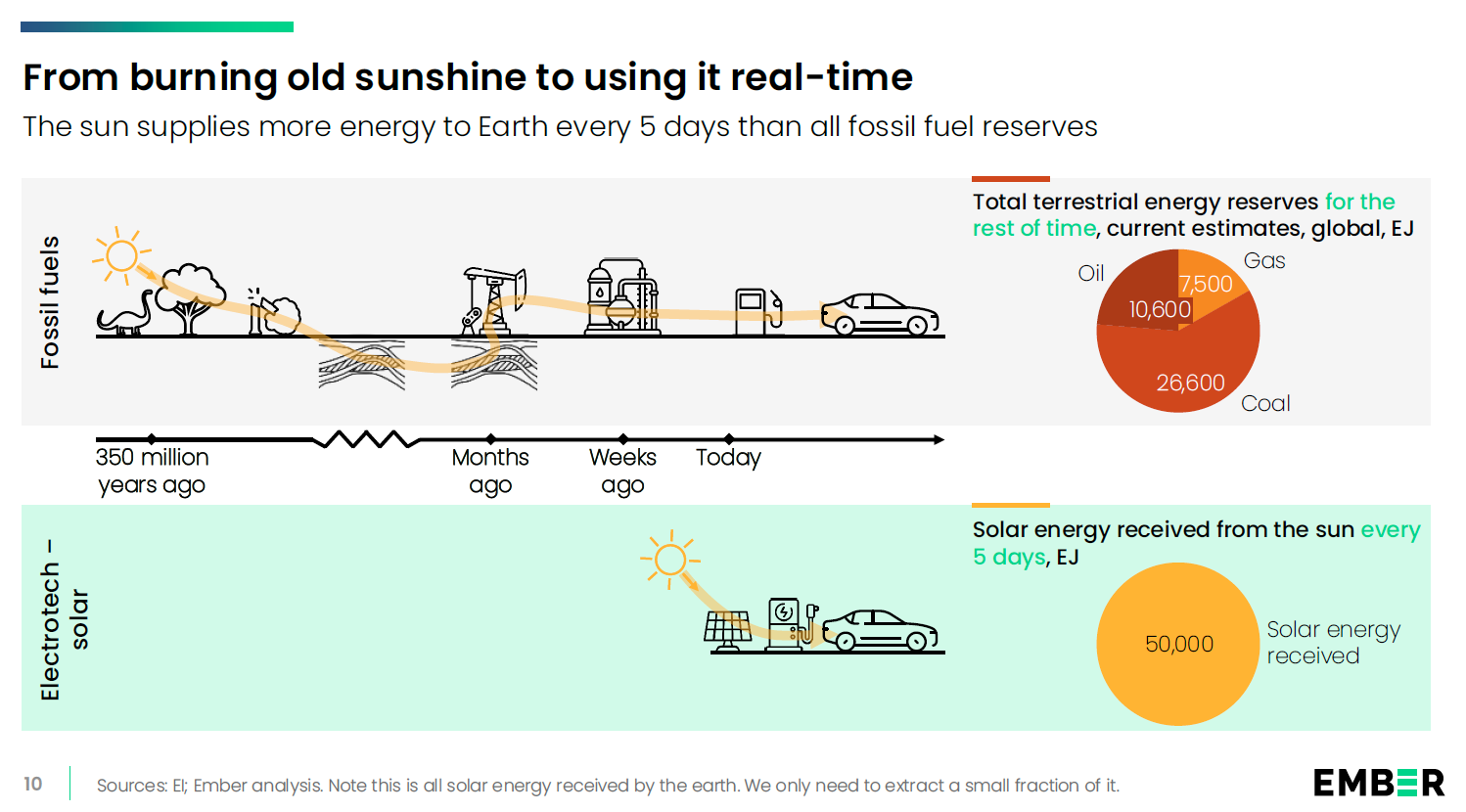
When it comes to converting all that fuel to electricity, we’ve got lots of room left on the learning curve. Check out the left side of the first visual above; solar’s dropped 3 orders of magnitude in cost since 1976.
And once we get the electrons, electric motors and heat pumps crush combustion processes. While there are some super-hot industrial processes left to figure out, we can trade out most of our fossil fuel machines — which top out at 30-40% efficiency — for electric machines that hit efficiencies well above 90%.
Seriously, Ritchie is so good at this stuff. Read her book.

With Mitrova and Cobra covering the geopolitics and Ritchie the science, we begin to grasp the significance of China’s 30-year investment in becoming the first ever ElectroState, and how it stands in sharp contrast to a recent double-down by the US, in a bid to join Russia and Saudi-Arabia as the third modern PetroState.
How cool would it be to get all 3 of these thinkers together and talk shop? I’d take them to St. James Cheese Co. for tinned fish.
And if I had a time machine, I’d ask Clayton Christensen to join us.
Christensen’s 1997 book, The Innovator’s Dilemma — When New Technologies Cause Great Firms to Fail, landed in my first year of business school. It was a big deal; The Economist later named it one of the six most important business books ever. It covers how incumbent firms deal with emerging tech.
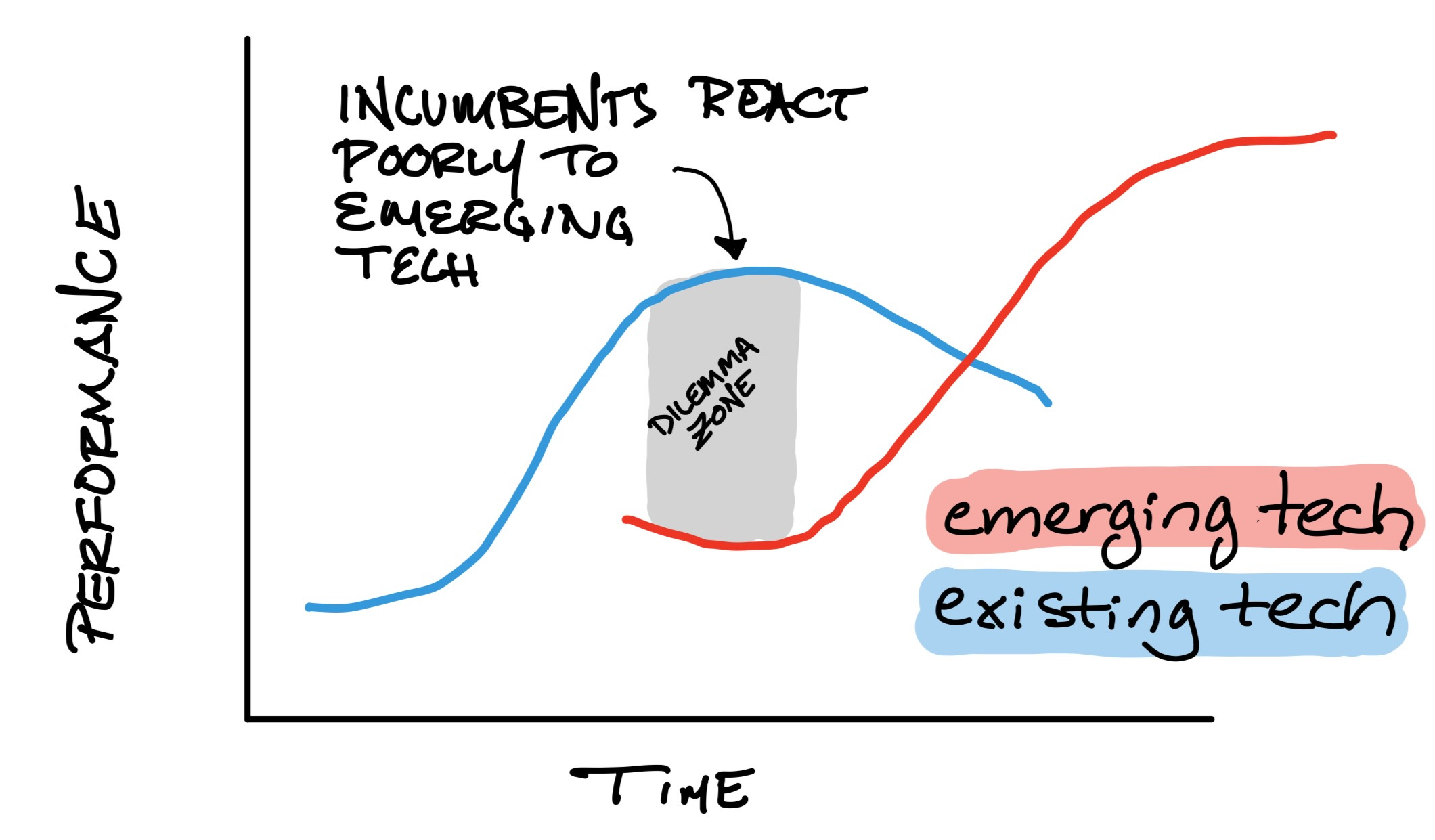
Blue line = existing technology that works, makes money for an incumbent firm
Red line = emerging technology that eventually will be better, cheaper than what’s allowing you to dominate the market now
Grey dilemma zone = the window of time and reduced profits when you can leap from blue to red. Jump too early and you run out of cash while learning. Too late and others iterate their way to an insurmountable competitive advantage.
What on earth does a 30-year old book on disk drives and other consumer tech have to do with geopolitics and the transformation of the global economy? After all, Christensen studied firms, not nation-states. (He passed in 2020.)
And still, I can’t look away. The fundamentals of incumbent petro vs emerging electrotech are too Christensen for me to not go down this rabbit hole: What would the innovator’s dilemma look like for nation-states and the energy transition?
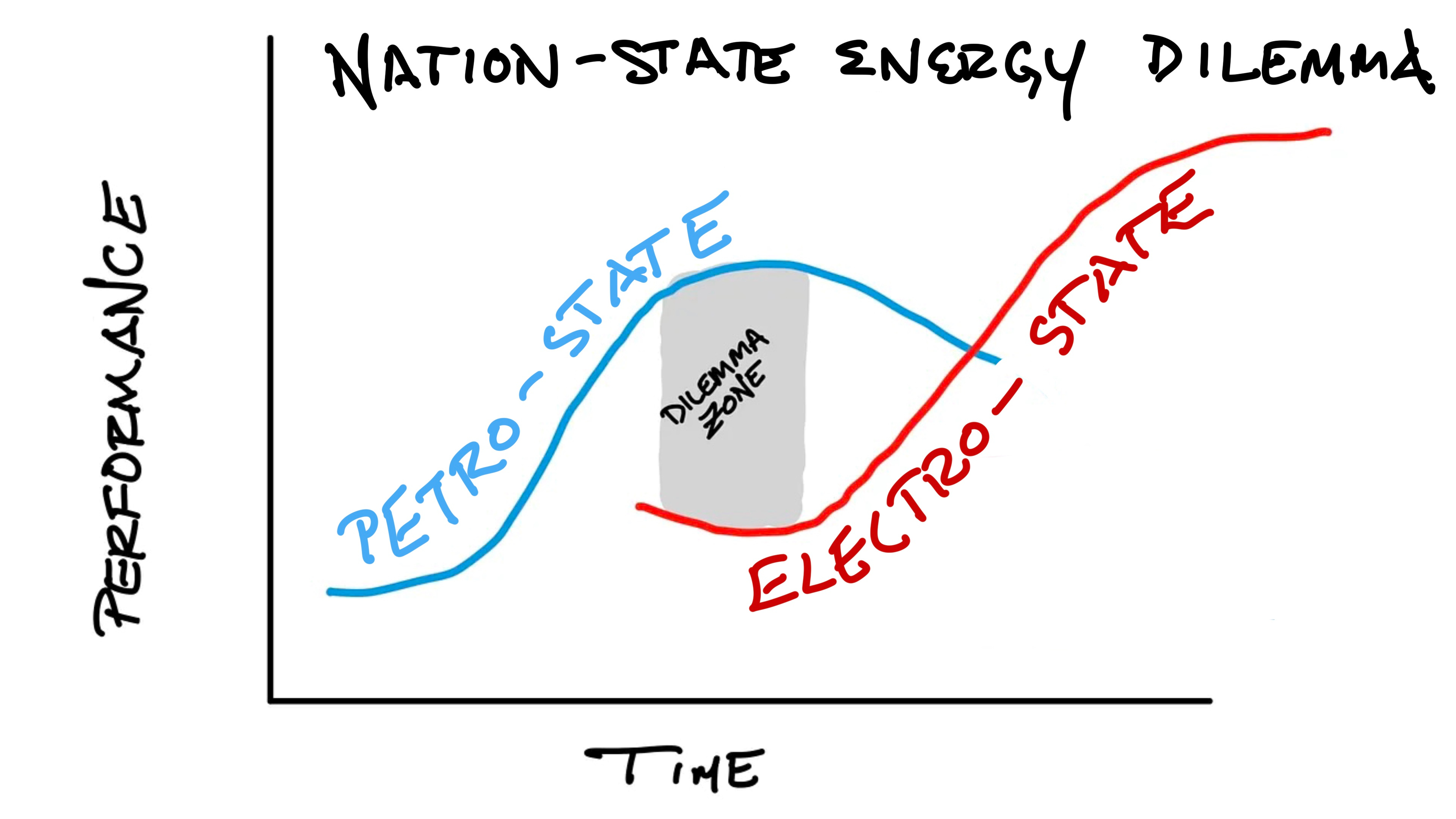
Incumbent PetroState Tech: Petroleum + Combustion (blue line)
Burn petroleum fuels, do work with the heat directly (industry) or with kinetic energy (internal combustion engines)Fuel: Fossil fuels that we dig up, sometimes recycle
Conversion to work: Burn fuel
Move fuel to industrial facilities, burn to make lots of heat
Burn in power plants to heat steam to spin turbines to make electricity
Carry fuel with us inside vehicles, burn as needed
Emerging ElectroState Tech: Renewables + Electrification (red line)
Capture energy in realtime, convert it to electricity there, store it in a battery, send it to a machine that creates electromagnetic fields to do workFuel: solar, geothermal, hydro, wind, nuke + fossil fuel burned in a turbine
Conversion to work: Move electrons to create magnetic fields
Magnetic field spins a motor to move a vehicle
Magnetic field powers compressors and fans in a heat pump or geothermal well
Magnetic field excites iron particles in a cooking vessel
Back to our dinner conversation: I’m sure Clayton wouldn’t let us get past appetizers before asking how different firms nation-states are behaving.
Good question, Dr. Christensen.
When it comes to jumping from blue to red…
We’ve got lots of natural gas, and we’ve figured out how to get to it cheaply.
It’s been profitable for extractors and utilities who sell it, even as it’s lowered prices for users; it’s even lowered carbon emissions by displacing coal.
We still have a lot left, so much that many leaders in DC think we could use extra gas as a strategic asset.
Geography helps us decouple our energy strategy from national defense.
Only two (friendly) neighbors.
Two big oceans to help defend ourselves.
We’ve got lots of non-gas, non-petro options, too.
Good solar generation, good wind to mine when we need to, good geothermal too.
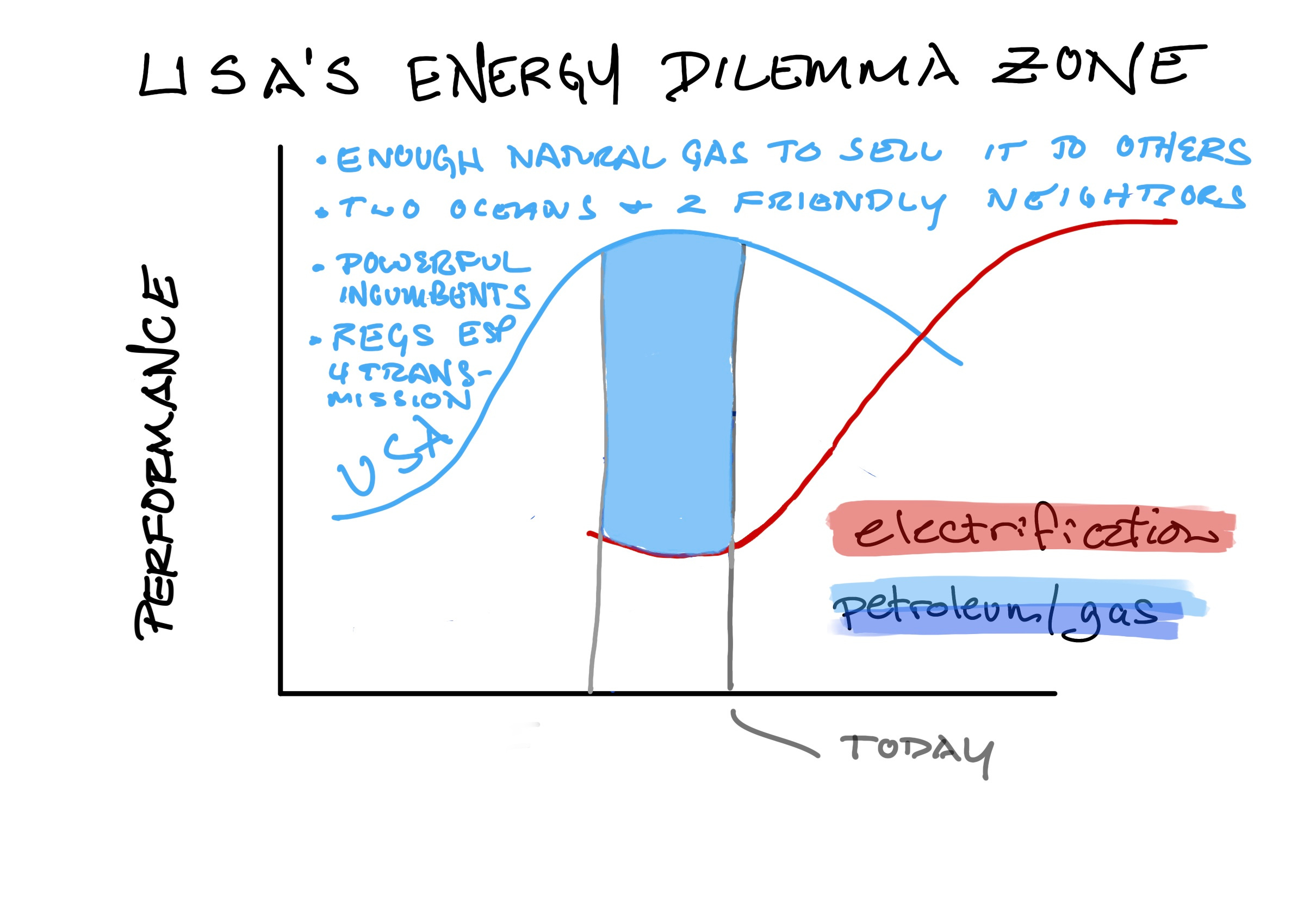
All of this leads to a very why-rush-it attitude about electrification.
We can always go get those renewables later, right?
Let’s put the pedal down on petro til we get way closer to running out, no?
They’ve got:
A lot less domestic oil and gas than we do.
Lots more neighbors to worry about.
Fewer oceans to help with defense than we do.
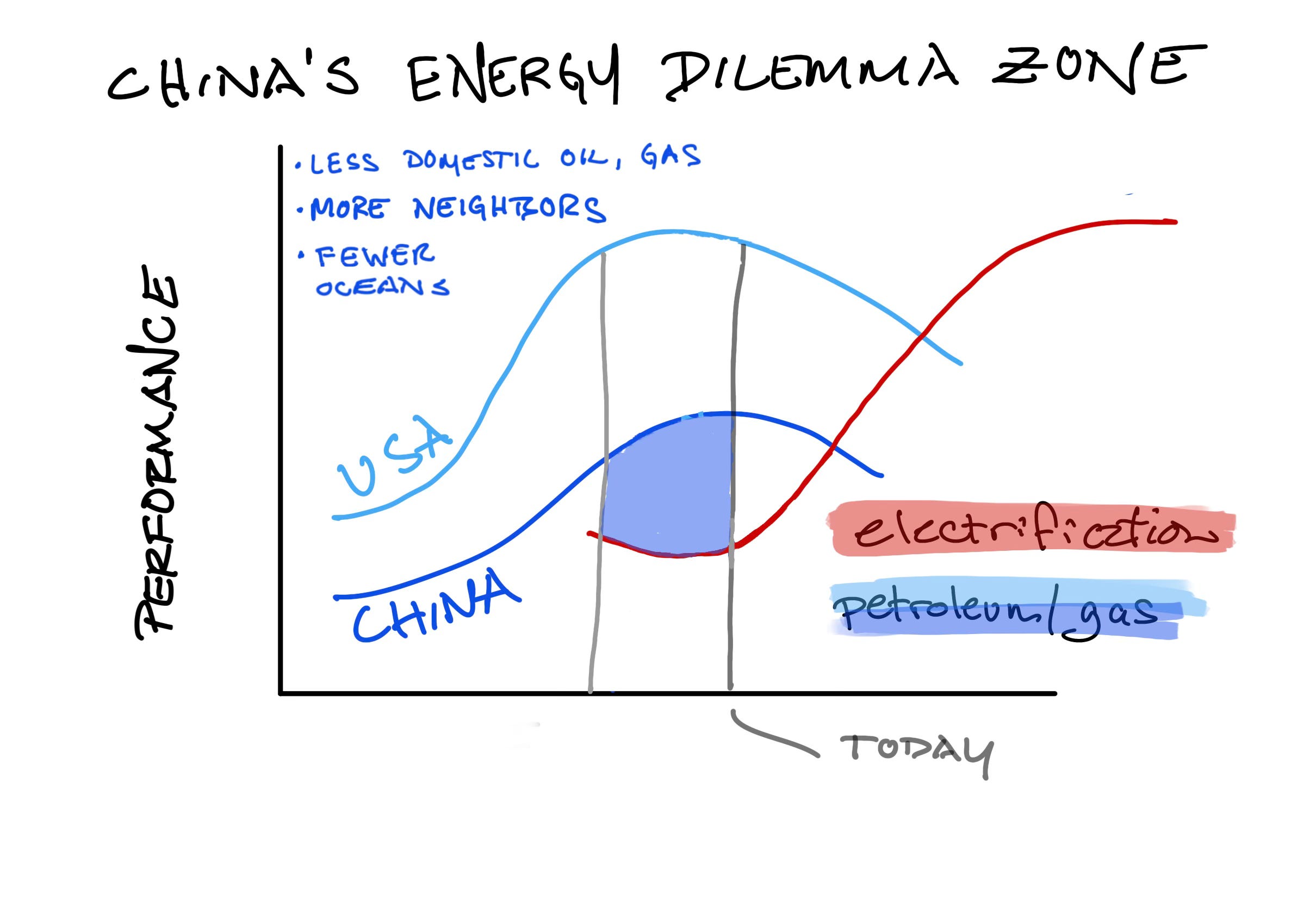
All of this leads to a very why-not-go-for-it attitude about electrification.
If we build the factories, policies and labor pool that can drive renewables and the electrified technologies that convert them to work down steep learning curves, with tech that’s already been designed (in the US) we can:
Create geopolitical leverage for ourselves.
Lower our own costs of doing work.
If this were Olympic diving, the US and China would be jumping from different heights.
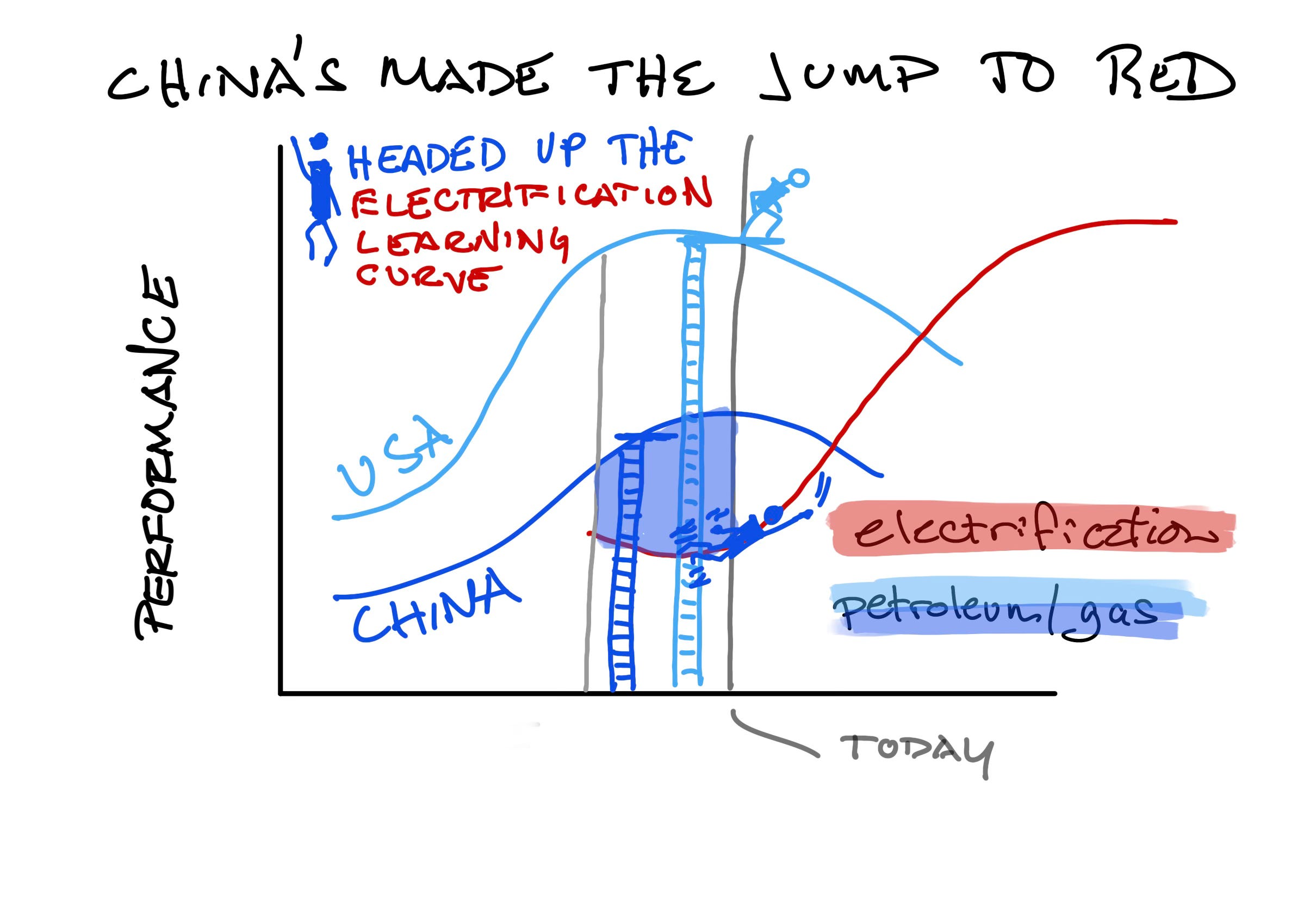
Some examples:
DC fighting to stop Orsted’s 80%-complete wind farm from opening
ICE raids delay the opening of Hyundai/LG’s EV battery plant in Georgia
GM’s building a new, next gen V-8 plant
The LNG export story from above
The end to IRA EV credits and rebates on electric appliances
100% tariffs on EVs from…China
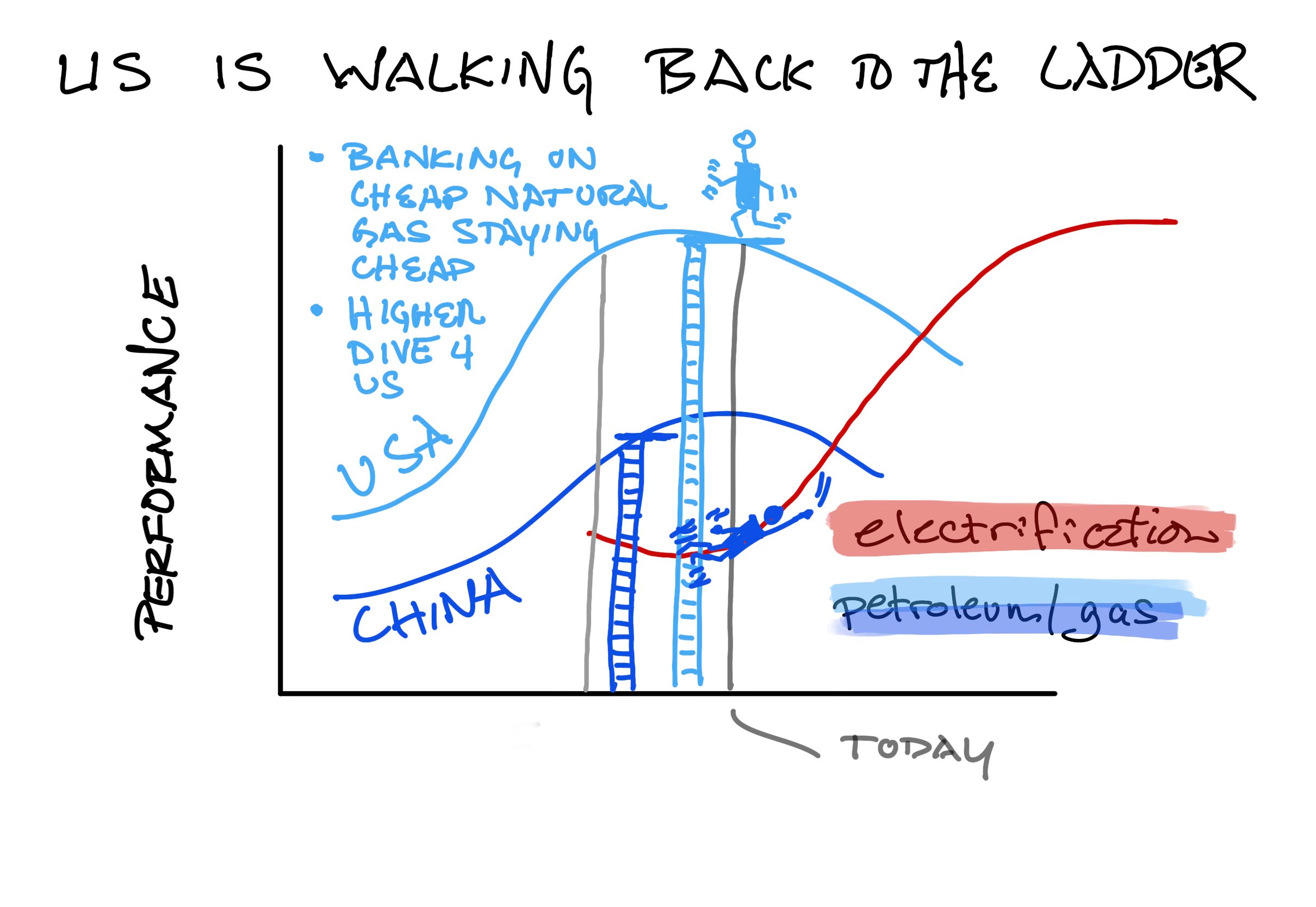
Not likely, says Conrad Bastable in this great take on how far ahead China is on electrification since jumping in the pool around 1995.
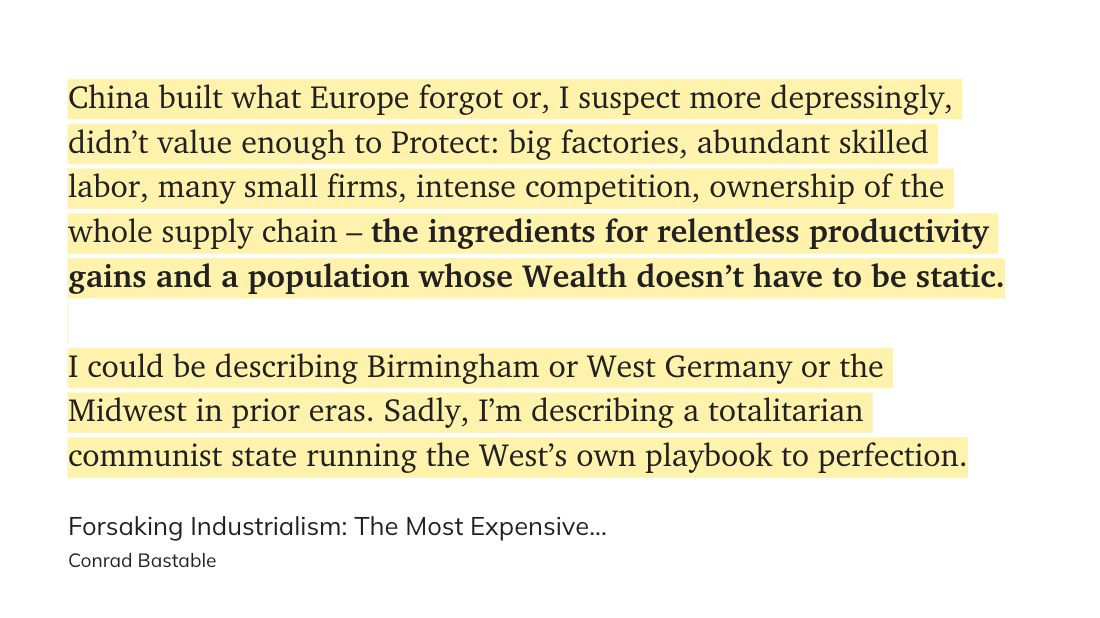
But Conrad’s not China-gushing. Yes, he’s realistic on how hard it’ll be to catch up. But he’s showing us a way forward, too. It’s a slim chance, but it’s there.

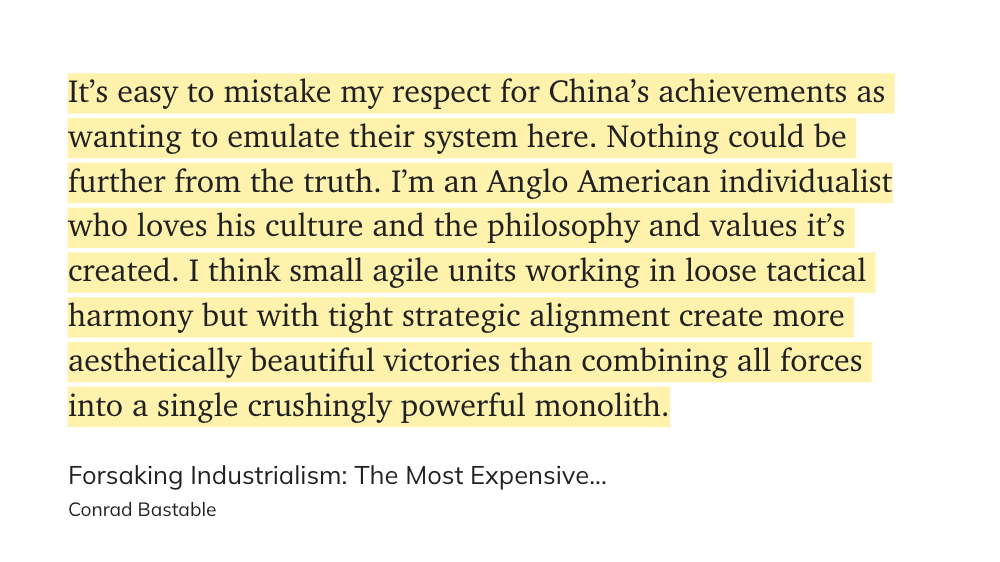
Small, tactical units. In loose tactical harmony. With tight strategic alignment.
I dig that.
That is My Next Electric’s jam. It’s 4.0’s jam. It’s Steven Johnson’s Where Good Ideas Come From jam. It’s Malliron Hodge’s jam. It became Christensen’s jam after the 1997 book.
It’s also Jim Farley’s jam. He’s the CEO at Ford. He’s been daily driving a Chinese EV for a year and a half. He just launched a skunk works in Long Beach. The $30k not-a-truck they’re designing there might save Ford.
I think the baby steps he’s been taking every morning out to his SU7 have a lot to do with the not-a-truck his team announced this week. Or maybe not.
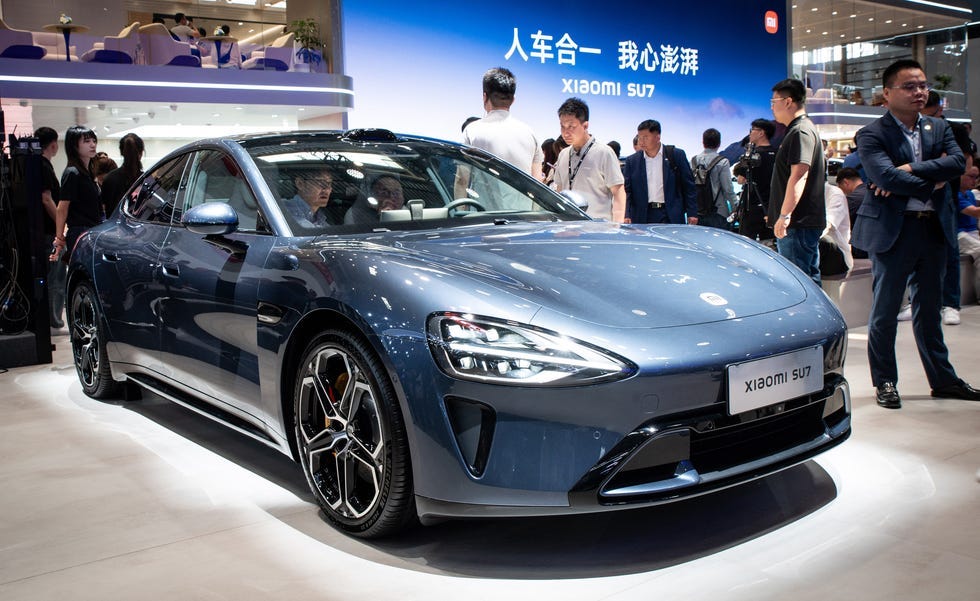
Either way, innovation’s hard. Especially in a PetroState democracy.
Hannah, Conrad and Jim are showing us one way that might work:
Get/stay curious.
Electrify one machine at a time.
Share what you learn.
Repeat.
I say we jump in.
And paddle like hell.
If you made it this far and want to go deeper, I’ve got two recs:
Seriously, read the Ritchie piece and follow her elsewhere. She’s a badass scientist. An urgent optimist. A fab podcast host. And spiritual successor to data visualizer, Hans Rosling.
For an amazing 40,000-words breakdown on the Electrotech stack, you have to read Packy McCormick and Sam D’Amico on The Electric Slide. Wow.
No posts
Comments
Nothing yet. Say the first thing.
Sign in to join the conversation.