
To be clear:
Homer’s Odyssey has been, over the centuries, the subject of innumerable discussions. These are all very interesting, I’m sure, to classicists and philologists. But, as a former English major, I have increasingly little interest as to whether movies hew close to books: the two are different medium, and a film can depart from the book, and still be a faithful interpretation.
As such, I have no stakes in whether Emily Wilson’s translation (the one utilized by Nolan) or some of the older translations (such as my own Robert Fagles editions) are more true to the ancient Greek. I likewise care little as to whether or not it tells a true story about Troy, or Ithaca, or Odysseus.

But as one who only first encountered the Illiad two years ago, and the Odyssey as a high schooler, the questions that the Odyssey raises are of the kind that move through, and beyond, the work itself. Greece, and indeed, the world that Greece birthed, have long forgotten the gods, but it remains haunted by the idea that maybe the gods are right after all.
The Odyssey succeeds as a film in nearly every way that a film can succeed: it instructs, moves, and entertains. Apart from the inscrutable sound design choices that Nolan keeps making, it’s truly a great film that I can’t wait to watch again.
Throughout the film, the xenia—the law of Zeus regarding hospitable treatment of travelers and strangers—is the fulcrum. Odysseus, in turning a gift for Troy into a weapon of its destruction, is the major transgressor of the law. And so, Odysseus’ journey home is littered with examples of how much we miss that law after it’s gone. The Illiad turns pivotally on a companion idea: that honor is due even to your enemies, and that disaster befalls you when it is neglected. And so here, in the Odyssey, we are living in a world after neglect of honor has multiplied out into our cities, our international relations, our world.
Much has been made in online grumbling about how Odysseus is much less the braggadocious trickster than the wounded warrior. To be sure, the film leaves out some of the more clever moments of Odysseus’ trickery. But this makes sense, I think: even in the original, Odysseus’ cleverness is a character trait which is in service to a deeper desire—home.
But herein lies the problem: Odysseus is no longer quite fit for home. Having been gone for nearly twenty years, Odysseus is not the young man any more: cleverness hasn’t gone away, but Odysseus knows he can’t get by purely on that any longer. Here, Matt Damon—no longer the fresh-faced hero but the father of four adult daughters—has the perfect Tired Dad energy for the role. And he’s had practice: Jason Bourne, the tired assassin who wants to be left alone, but now has to get by on his wits rather than brute strength. But while Bourne was only fighting government agents, Odysseus gets to contend with the gods.
And as much as he might like to forget the gods, and to claim that his actions at Troy were a necessity, Odysseus is living in the world of gods, and now he can’t get the thing he desires. For the way home is made possible by the favor of the gods, the law of xenia, and a little help from his friends. All of the things broken in order to win are now the things he can’t call on to cross the sea.
Throughout his journey, Odysseus (no spoilers) is reminded of the ways in which he has ongoing debts to pay for his actions, and subsequently, how the Ithaca he wants to return to cannot be fully reclaimed. In the original (and the film), Ithaca is now two decades into anarchy, a change which cannot be easily undone, even if Odysseus kills all the suitors who are trying to woo his long-suffering wife Penelope. Nolan hammers this home with a subtle change of the ending to remind the viewer: for Odysseus the warrior, the home he left is not possible to return to, and to have a future, he truly must become a man of the sea.
The question I am raising is, after war, what it means morally for there to be a homecoming from war.
Here’s what I mean:
Much of Nolan’s version turns on narrating Odysseus as a man in search a home which can never quite be reclaimed. Since the 1970s, much has been written on PTSD, and the disjointed way in which soldiers find themselves frequently between worlds. But even before Vietnam, this was arguably true, even if only in anecdotes. In most countries, military service is viewed as part of ordinary life, a service rendered to one’s country whether or not there’s a war. But in America, when drafts only occur in the midst of an active war, military service is an in-between time, a break in ordinary life, creating a pronounced break between their life before and everything after.
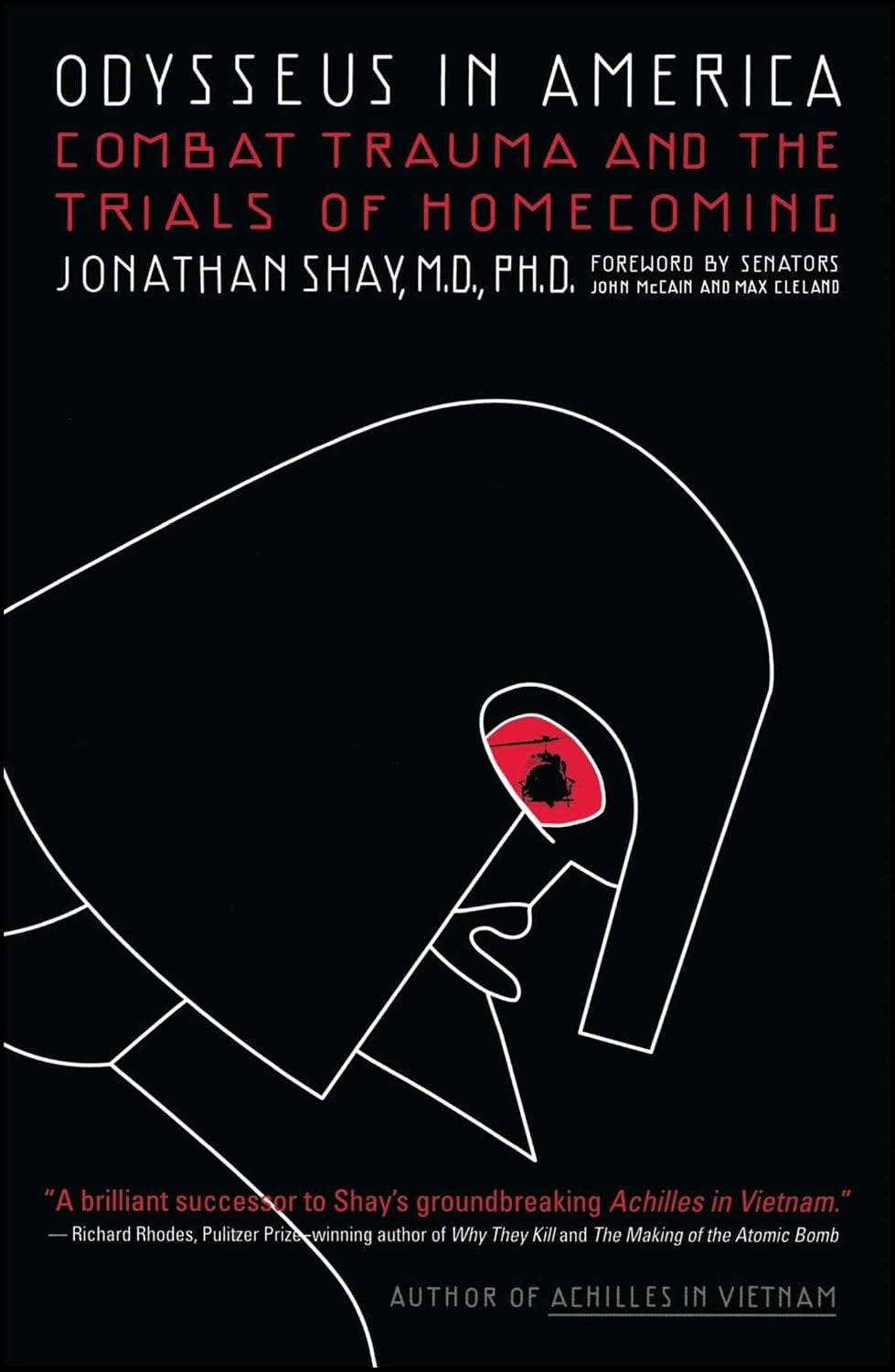
Jonathan Shay, clinical psychologist, in his Odysseus in America, notes the ways in which Odysseus’ experience paralleled the experiences described by his own patients returning from war: the disorientation, the inability to leave behind wartime habits in peacetime, the lack of integration. He chronicled the way in which the experience of war had, like Odysseus, left them adrift on an indifferent ocean they had no control over, or at worst, were under the sway of malevolent gods. The veterans—predominately from the Vietnam era—had never fully come home.
Later research began to give a specific name to this: moral injury, committing acts in war which are deeply at odds with one’s ordinary moral compass. Both in Vietnam, and in the Odyssey, we see this in play: Odysseus, in violating a core law of xenia, which he would never violate in ordinary life, now pays the price in the world and in his life.
So, how can a person come home? How might they begin to knit the world together again?
During Vietnam, many vets either did not come home at all, or having returned, remained in constant limbo because of Vietnam’s deep unpopularity. And so, to fasciliate a homecoming, America began to overcorrect: to honor its homecoming heroes all the time. Projects like the GI Bill—education to acknowledge the labor of veterans—date back to the Second World War. But it was after the lack of recognition that returning vets had in Vietnam that parking spots, discounts, and public commemorations began to appear more regularly. Instead of being only on Flag Day or the Fourth of July, honor of veterans began to appear in cashier lines and travel agencies.
All of this is well-intended1. But this constant celebration creates a situation in which the returning soldier can never simply re-enter the world, as Odysseus does in assuming the guise of a beggar in his return. The soldier—at the checkout, at ballgames, throughout the year—is reminded that they are separate. They are reminded that they are a Purple Heart, a veteran, a warrior, and in that, not just a citizen. Unlike a previous generation, in which a citizen became a solider and could ostensibly come back to being a citizen, professional soldiers now always are seen separately, among us citizens but never truly one of us. In trying to help soldiers to come home, America reminds them ironically on the regular that they are a people apart, that they are “killers”2, that they are—in Nolan’s version— “people of the sea”, who might land here but are no longer really just citizens.
As much as some hate this part of the film, I thought the ammending of the original was genius: Odysseus comes home only for a time, knowing that his place now lies over the horizon, on the sea forever. The homecoming is denied because of what war does to those who engage in it, but also because of how we as citizens celebrate the destruction of war rather than mourn it.
As late as the 4th century, prohibitions existed among churches against immediately readmitting to Communion those who had been in war. The canons (additional instructions) attached to the Council of Nicaea in 325 read as follows:
As many as were called by grace, and displayed the first zeal, having cast aside their military girdles, but afterwards returned, like dogs, to their own vomit, (so that some spent money and by means of gifts regained their military stations); let these, after they have passed the space of three years as hearers, be for ten years prostrators.
But in all these cases it is necessary to examine well into their purpose and what their repentance appears to be like. For as many as give evidence of their conversions by deeds, and not pretence, with fear, and tears, and perseverance, and good works, when they have fulfilled their appointed time as hearers, may properly communicate in prayers; and after that the bishop may determine yet more favourably concerning them. But those who take [the matter] with indifference, and who think the form of [not] entering the Church is sufficient for their conversion, must fulfil the whole time.
This is a hard word. But it was not just because they had shed blood, but because war marks a person, and approaching the Lord’s table apart from giving the returning warrior time to mourn was to put them in peril. They could indeed return to the table, but only after giving time for them to return as Christians, and not as a warrior.
For it was only then that they could come home. The way home was neither in forgetting what war does to people, nor in calibrating our world to violence’s necessity. The way forward is plainly and simply repentance of having done in war that which should never be done. In this way, Nolan’s film falls short: Odysseus has Penelope by his side as he sails into exile, having cleared out Ithaca with the same fire that he brought to Troy.
There can be no forgiveness, no homecoming for Odysseus, but only the eternal sailing out, becoming the “people of the sea” who serve as a warning to all others. Odysseus mourns what has been lost and never be reclaimed. But Nicaea knew a different way: repentance, humility, and with it, return.
Homer actually raises two questions about homecoming: both whether it is possible to come home, but also whether celebrating their return is wise. Odysseus’ story raises the former well: he has to live with his legacy of being a warrior, and with the consequences of his actions long after Troy has fallen. But there is a second homecoming which happens in the Odyssey: that of King Agammenon, the leader of the fight against Troy. As we find out, the King was welcomed home as a conquering hero, only to be murdered in his bed by his wife for the actions he took in order to win the war. One way of reading this is to say that Agamemnon’s victory does not excuse him from the consequences of his actions, but another way to read this is to say that in setting Agamemnon apart as a conquering hero, his sins are put under a microscope even more strenuously, to the point that he is broken by them.
https://thehill.com/policy/defense/5528817-hegseth-changes-military-meeting/
Comments
Nothing yet. Say the first thing.
Sign in to join the conversation.