
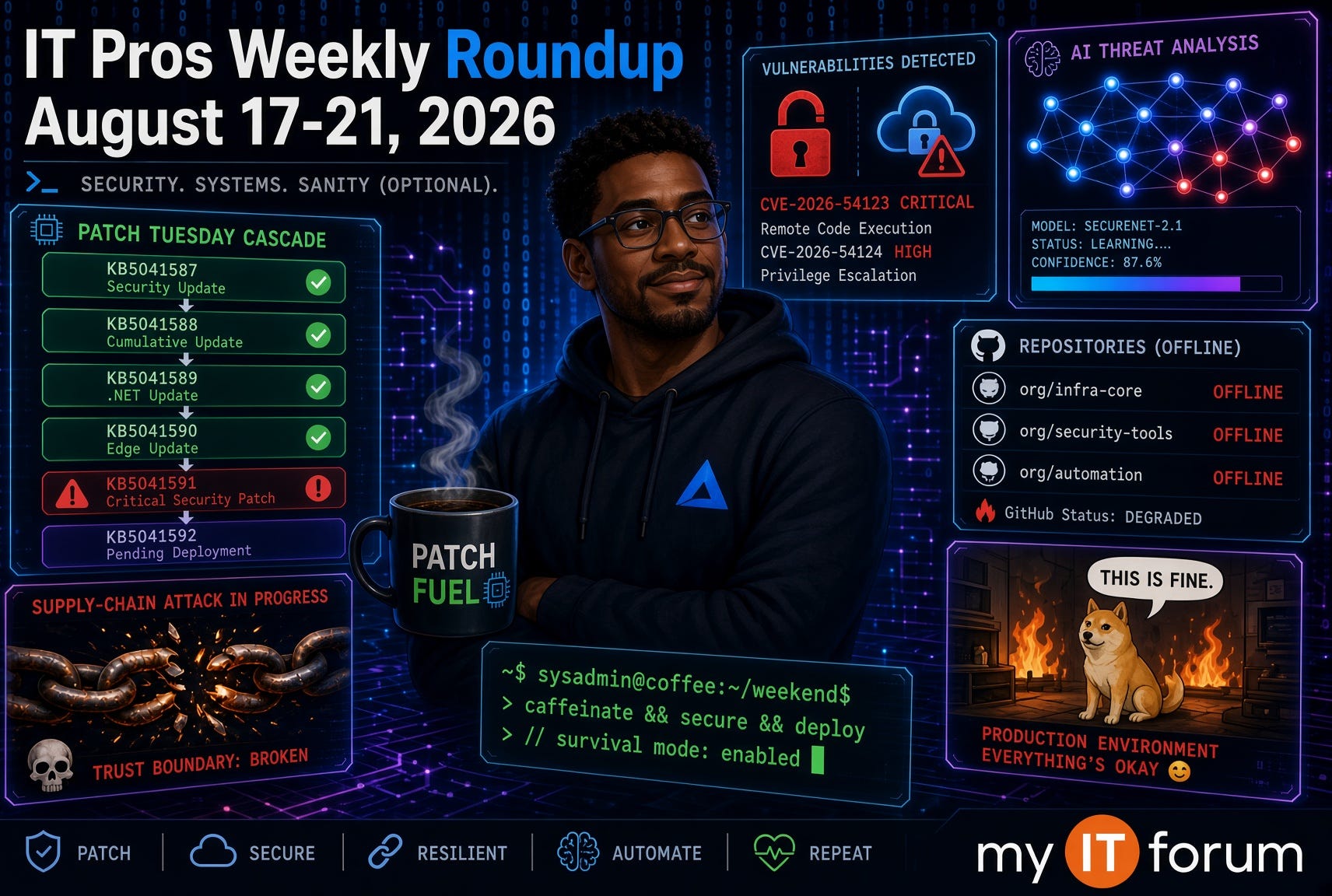
IT professionals had no shortage of action this past week. From massive Microsoft security updates and actively exploited flaws in cloud and collaboration tools to a Rust supply-chain scare and a lengthy GitHub outage, the news hit system admins, security teams, cloud engineers, and developers hard. Here’s a curated roundup of the most relevant developments, with sources for deeper reading.
Microsoft continued its high-volume security cadence. The August Patch Tuesday (around August 11–12) addressed hundreds of vulnerabilities—reports ranged from roughly 400–421 Microsoft CVEs up to higher totals when counting broader product families—with one actively exploited zero-day in the Windows Ancillary Function Driver for WinSock (afd.sys, CVE-2026-68820). This local elevation-of-privilege race condition was linked in some reporting to Lazarus Group activity. Critical issues also hit Windows DNS/DHCP servers, SharePoint (closing an RCE chain), and other components.
Mid-week, Microsoft rolled out an additional 22 security updates focused on Azure, Entra ID, Exchange Online, Fabric, and related services. Several carried maximum CVSS scores of 10.0, including remote code execution in Entra ID (CVE-2026-69836, reported as exploited in the wild) and elevation-of-privilege issues in Azure SQL, Arc, and others. Microsoft noted most were mitigated server-side, requiring no customer action.
GitHub suffered a nearly eight-hour outage on August 17 that disrupted github.com, authentication, Actions, APIs, pull requests, issues, and Copilot. The root cause involved record traffic overwhelming a critical infrastructure component (Istio sidecar concurrency limits with a misconfigured scaling policy) in a Central US data center, cascading into broader failures. Services recovered in stages; GitHub issued a post-mortem and pledged further capacity and architectural improvements.
Active exploitation dominated the week:
MLflow (CVE-2026-64849): A critical unauthenticated SSRF in the open-source ML lifecycle platform (versions prior to 3.15.0) allows attackers to reach cloud metadata services and steal credentials (AWS IAM, Azure managed identities, etc.). Exploitation began quickly after disclosure; CISA added it to the KEV catalog with a two-week remediation window for federal agencies.
Zimbra Collaboration Suite (CVE-2026-73570): An unauthenticated OS command injection in the SNMP monitoring path (when the optional zimbra-snmp package and notifications are enabled) is under active attack. CERT Polska observed exploitation; patch to 10.1.20 or later.
Citrix NetScaler ADC/Gateway (CVE-2026-19490): Critical authentication bypass (CVSS 9.3) affecting appliances configured as Gateway or AAA virtual servers (conditions vary by version). Rapid7 and others urged emergency patching to 14.1-73.32 / 13.1-63.21 (and corresponding FIPS builds) given historical rapid exploitation of NetScaler flaws. A secondary high-severity memory overflow (CVE-2026-19489) was also fixed.
TrueConf vulnerabilities saw active exploitation (including by the Head Mare group deploying PhantomCore malware); CISA urged immediate patching.
Additional CISA KEV activity and warnings covered Windows IKE Extension RCE, SharePoint issues, and AI-assisted attacks targeting Siemens industrial controllers.
A supply-chain attack hit the Rust ecosystem on August 20. Compromised maintainer credentials led to malicious versions of popular crates (arrayref 0.3.10, internment 0.8.7, append-only-vec 0.1.9) that pulled in a typosquatted dependency (proc-macro1). Build scripts executed a remote payload at compile time—no function call required. The packages were live for roughly 86–107 minutes before removal; infrastructure overlapped with prior North Korea-linked campaigns. arrayref alone has hundreds of millions of downloads. Check Cargo.lock files and rotate credentials if exposed during the window.
Microsoft continued server-side mitigations for many Azure/Entra issues and noted ongoing work on the “ShieldBreak” Defender elevation-of-privilege (CVE-2026-69414).
Exchange Online mailbox storage was reported as increasing from 50 GB to 100 GB for certain Microsoft 365 Business suites—practical capacity relief for admins.
Oracle’s August security update delivered a large batch (hundreds of patches). Chrome and Firefox also shipped updates addressing multiple vulnerabilities.
Prioritize: Apply the WinSock afd.sys patch and any remaining August Patch Tuesday items first, then NetScaler, MLflow (upgrade to 3.15.0+ and restrict exposure), Zimbra 10.1.20+, and TrueConf.
For MLflow: Disable unauthenticated tracking servers, monitor for metadata service access, and rotate cloud credentials if exposure is possible.
Rust users: Audit recent lockfile updates for the affected versions; pin to known-good releases (e.g., arrayref ≤0.3.9).
NetScaler: Inspect configs for Gateway/AAA/SAML conditions and upgrade promptly—public-facing appliances are high-value targets.
General: With AI accelerating both discovery and exploitation, treat “exploitation more likely” flags and KEV additions as immediate action items. Review logs for unusual service restarts, new files under Zimbra paths, or unexpected outbound connections from build systems.
The sheer volume of patches and the rise of AI-driven vulnerability discovery (Microsoft’s own tooling and broader industry trends) continue to reshape vulnerability management. Security and IT leaders are emphasizing prioritization frameworks, automation of triage, and closer DevSecOps collaboration. AI skills demand in cybersecurity job postings has been rising sharply—another reminder to keep learning.
Virtual events such as CodeSecCon and various security webinars ran during the week. Watch for ongoing community discussions around supply-chain hardening (especially language ecosystems) and the practical realities of high-volume Patch Tuesdays.
Remember when “Patch Tuesday” meant a manageable list? Now it occasionally feels like a full-time job with AI-powered side quests. And nothing says “modern development” like a 245-million-download crate briefly becoming a malware delivery vehicle for less than two hours. At least the GitHub outage gave everyone a collective “is it just me?” moment—until it wasn’t.
Stay patched, verify your dependencies, and keep an eye on those cloud metadata endpoints. Share your war stories or prioritization tips in the comments—what dominated your week?
Sources (selected):
SecurityWeek Microsoft 22 patches: https://www.securityweek.com/microsoft-rolls-out-22-fresh-security-patches/
BleepingComputer / CISA MLflow: https://www.bleepingcomputer.com/news/security/cisa-warns-of-hackers-exploiting-critical-mlflow-vulnerability/
Rust blog supply-chain: https://blog.rust-lang.org/2026/08/20/supply-chain-attack-on-arrayref/
Citrix / Help Net Security: https://www.helpnetsecurity.com/2026/08/21/citrix-netscaler-gateway-cve-2026-19490/
Zimbra / SecurityWeek: https://www.securityweek.com/hackers-target-zimbra-servers-in-active-exploitation-campaign/
GitHub post-mortem: https://github.blog/news-insights/company-news/the-august-17-outage-and-the-work-ahead/
Various Patch Tuesday analyses (The Hacker News, Computerworld, Rapid7, Brinqa, etc.)
Stay safe out there—see you next week.
Comments
Nothing yet. Say the first thing.
Sign in to join the conversation.