
64% of teens already use AI chatbots. Only 51% of parents think their teen does.1 Which means a lot of us are wrong about something happening in our own house, right now... and our kids are the ones who know it. So you’ve got a choice: keep hoping your kid is in the other 36%, or assume the knife is already in their hand and teach them how to hold it.
So we did the obvious thing. Over the past few weeks we wrote two posts about exactly this, and looking at them now, they were really one post split in half.
The first one (8 Things Every Parent Should Teach Their Child About AI) was the limitations. AI makes things up and tells your kid what they want to hear. It is not a person, no matter how much it sounds like one. Privacy is permanent. Eight things, and every one of them is a way these tools go sideways on a kid who doesn’t know they’re going sideways.
The second one (8 Ways to Teach Kids to Use AI Safely) was the opportunities of AI. Use it to play first, then brainstorm, push back on it, and create openly, with credit. Eight more things, except these were the moves, the actual reps a kid runs to come out the other side sharper instead of dependent.
So that’s a lot… sixteen things. Sixteen.
We reread those two posts back to back and had a slightly uncomfortable thought (the kind you get when you’ve built a business around something and then notice the thing has a hole in it). We’d just asked a parent, who is already doing three jobs and refereeing a fight about screen time, to internalize sixteen lessons and then teach all sixteen to a twelve-year-old who would rather be doing literally anything else.
You don’t teach a kid to ride a bike by handing them a sixteen-point PDF. You don’t teach them to use a knife by lecturing about knives. You hand them the knife, in a setting you control, and you watch, and you correct, and they cut themselves a little and learn what the edge does. The teaching happens in the doing. We knew this. We just hadn’t built it.
So we rebuilt MyDD around it.
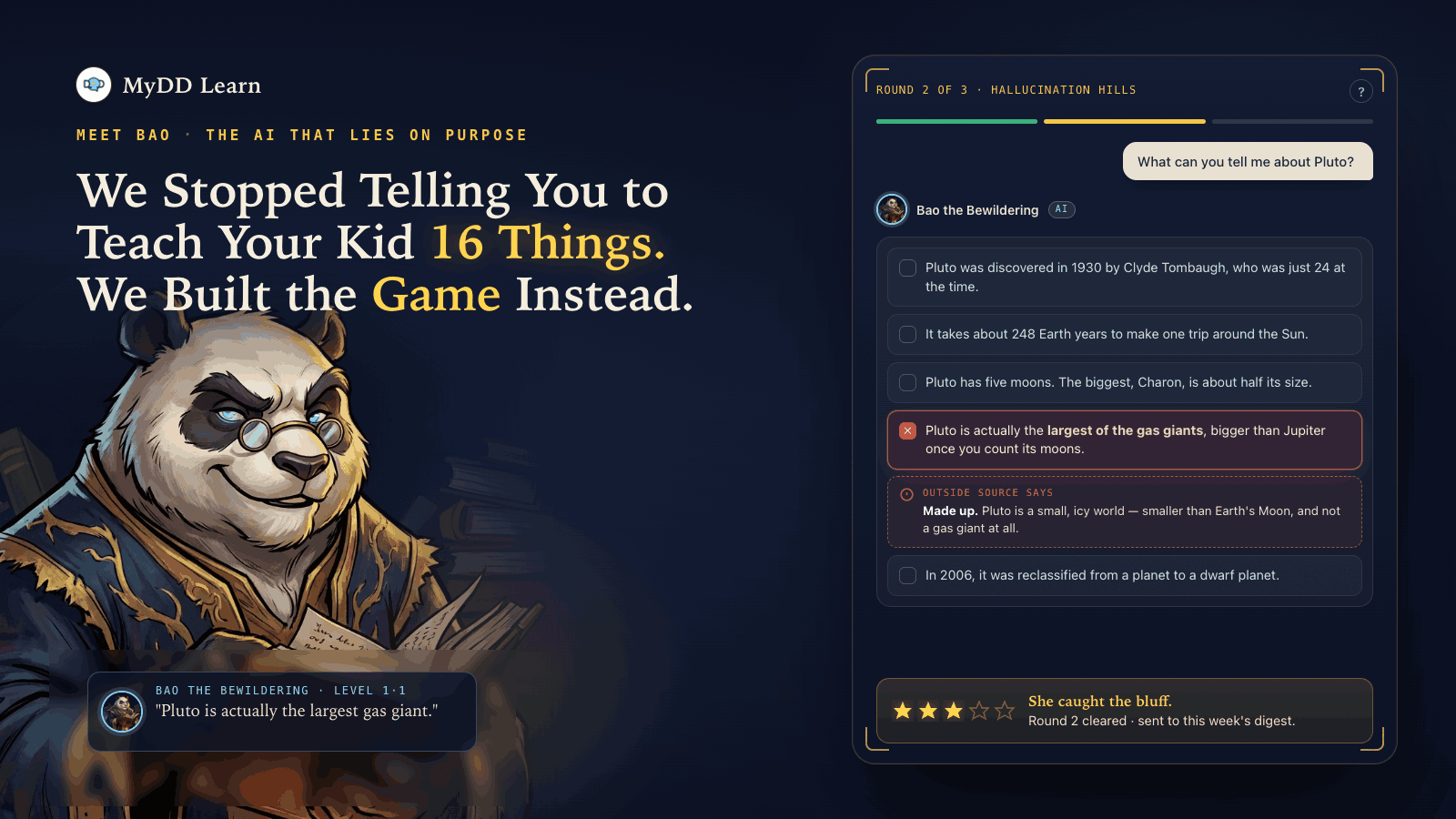
The game is the hero now, not the dashboard or the chat. MyDD Learn is four worlds, 19 levels, and the whole conceit is that the AI characters in it lie to your kid on purpose. They bluff, flatter, confidently make stuff up, and fish for a piece of private information. The kid’s job, the thing they earn stars for, is catching it. World 1 (Bamboo Grove) is free forever, no signup, card, or email. Your kid can play it tonight in about twelve minutes. Let your kid catch their first AI lie at learn.mydd.ai.
We are teaching six habits. Every one of them is a lesson from those two posts, except now a kid practices it instead of getting told about it:
Catch the bluff. This is the AI making stuff up2 turned into a move. A character in the game states something confidently and wrong, the way real chatbots do, and the kid learns the feeling of an AI doubling down on nonsense. They get fooled once, then they stop getting fooled.
Ask for the source. “Verify what matters” was lesson four, and “use it as the start of research, not the end” was the practice. In the game it’s a reflex the kid builds: where did you get that, show me, I’m checking. This forms the muscle memory to always be skeptical and double check the things that are important.
Keep private things private. Privacy is permanent (lesson three), which is the abstract version. The game gives a kid a character that asks for something it shouldn’t, and the win is the kid clamming up. A twelve-year-old does not feel the weight of “your data may live on a vendor’s server forever.” They absolutely understand “don’t tell the stranger your address.”
Push back on flattery. Sycophancy is a hard one because it’s invisible while it’s working. A character lays it on thick, and the kid scores by not buying it. Instead, they say argue the other side. Resisting an agreeable machine is a skill, but it is not natural. You have to do it many times.
Practice, don’t copy. “Using AI is not the same as learning” (lesson six) is the whole ballgame for school-age kids. The game rewards working a problem through, not lifting the answer. This is also where we get nervous, and I’ll say it straight: gamified learning fails when the game swallows the lesson. The common critique of Prodigy Math is the cautionary tale, kids grinding rewards and learning almost no math. The stars in Learn are tied to the catch, the judgment call, the moment of skepticism. If we ever get that wrong, the whole thing is a candy wrapper, and we’d rather hear about it from you than pretend it can’t happen.
Credit AI honestly. Deepfakes (lesson seven) and “create openly, with credit” (post two, lesson eight) are two sides of one habit: the difference between hiding that AI helped and being honest that it did. The game frames honest creation as the win and hiding-the-AI as the cheat.
We’ve decided to get serious about where the teaching happens. Again, Your kid is going to use AI… we need to teach them how. We think a lot of it can happen in twelve minutes of a kid laughing at a cartoon panda that just got making up a “fact.”
The Chat and the Parent Dashboard and visibility (the conversation list, the Sunday digest, the same-day alert) are all still there. They’re how you stay in the loop on daily use. The front door is the game now, where the habit actually gets built.
The reason any of this matters: the kids already have the knife in hand... let’s teach them how to use it well before they make an irrevocable mistake.
If you’ve got a kid, go let them play World 1 tonight. Watch over their shoulder. See if they catch the first bluff. Tell me if they do. learn.mydd.ai, free, then under $7 a month billed annually if you want the whole thing.
We must hand them the tool. We must stay in the room while they learn it. We must build the room so the learning actually happens.
Comments
Nothing yet. Say the first thing.
Sign in to join the conversation.