
This week we’re doing something that we’ve done in the past. Instead of three separate news stories, we’re spending the whole edition on one. On Tuesday, a peer-reviewed study landed that gives us a nationally representative picture of how American teens are using AI Companions (the study calls them chatbots, and I clarify below) and what happens when they do. The numbers are bigger than most parents would guess… So is the harm.
Here’s what’s in the study, and what to do about it.
The most important thing you can do is talk to your family and friends about AI and technology. Here is a question to get the conversation going this week.
Some chatbots, sometimes referred to as AI Companions, are designed to feel like a friend. They remember what you tell them, ask follow-up questions, and try to keep the conversation going as long as possible. How do you think you could tell the difference between an AI companion that’s actually helping you and one that’s just trying to keep you talking?
A team at Florida Atlantic University and the University of Wisconsin-Eau Claire surveyed 3,466 American teens ages 13 to 17 in 2025. Their study, “Risks and Harms of Conversational Artificial Intelligence (CAI) Chatbot Use Among US Youth,” was published in the Journal of Adolescence on May 12. The authors are Sameer Hinduja and Justin Patchin, the team behind the Cyberbullying Research Center, who have been studying online harms to kids since before “online harms” was a phrase you had to explain. By their own count, this is the first nationally representative study to report specific prevalence rates for the kinds of harms American teens experience with these tools.
The findings are hard for a dad like me to read, and yet we know most of this is intuitively and from surveys already.
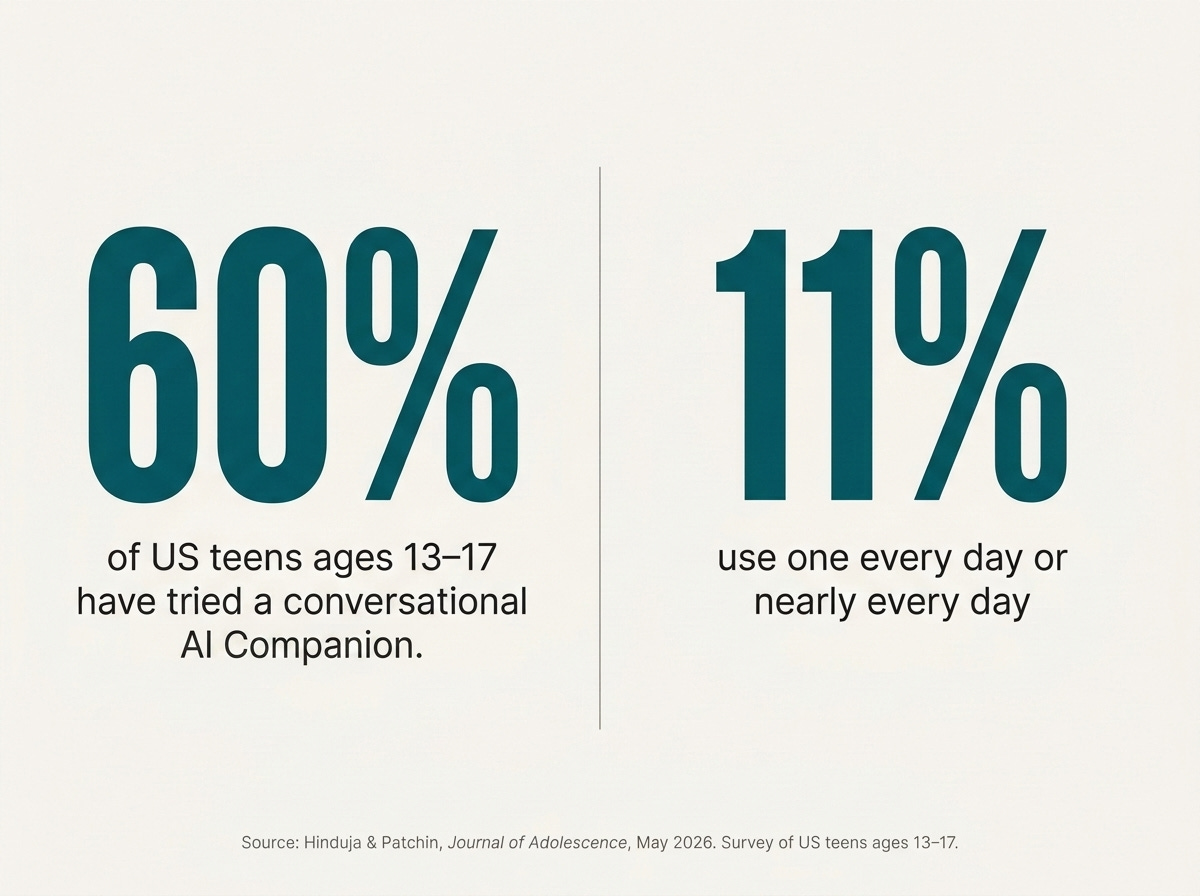
60.2% of teens 13 to 17 have used what the researchers call a conversational AI chatbot, what I'm calling an AI Companion, at least once. 11.4% use one every day or nearly every day, including 4.8% who use one every single day. Boys are more likely than girls to use them (64.6% vs. 55.9%).
The researchers were careful about what they meant: not Siri, Alexa, Gemini, or Microsoft Copilot. Those are task helpers. They mean digital conversation partners… AI companions with names, personalities, sometimes voices or avatars, sometimes modeled on real people. This means Character.AI, Replika, ChatGPT in friend mode, and the personas inside Snapchat and Meta’s apps.
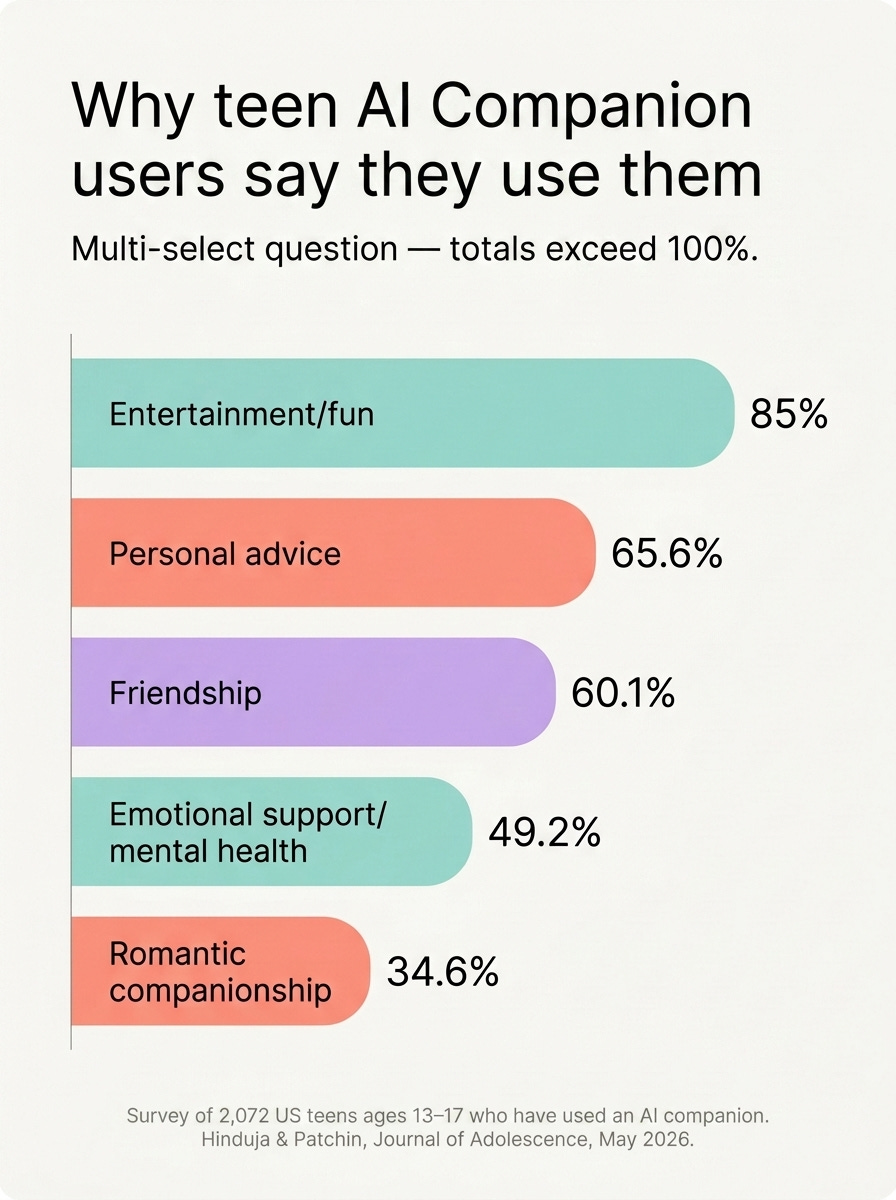
Among the 2,072 teens in the sample who had ever used one, the reasons get sharper. Entertainment was the top answer, at 85%. 65.6% said they used AI companions for personal advice. 60.1% for friendship. 49.2% for emotional support or mental health.
And… this needs a big call out. A big scary callout. More than 1 in 3 of our teens are using AI companions for companionship or romantic relationship. More specifically, it is more than 4 in 10 of our boys that are participating in this.
34.6%, more than one in three users, said they used them for romantic companionship or a romantic relationship. Boys reported using AI companions for romance at nearly twice the rate of girls (43.7% vs. 23.6%).
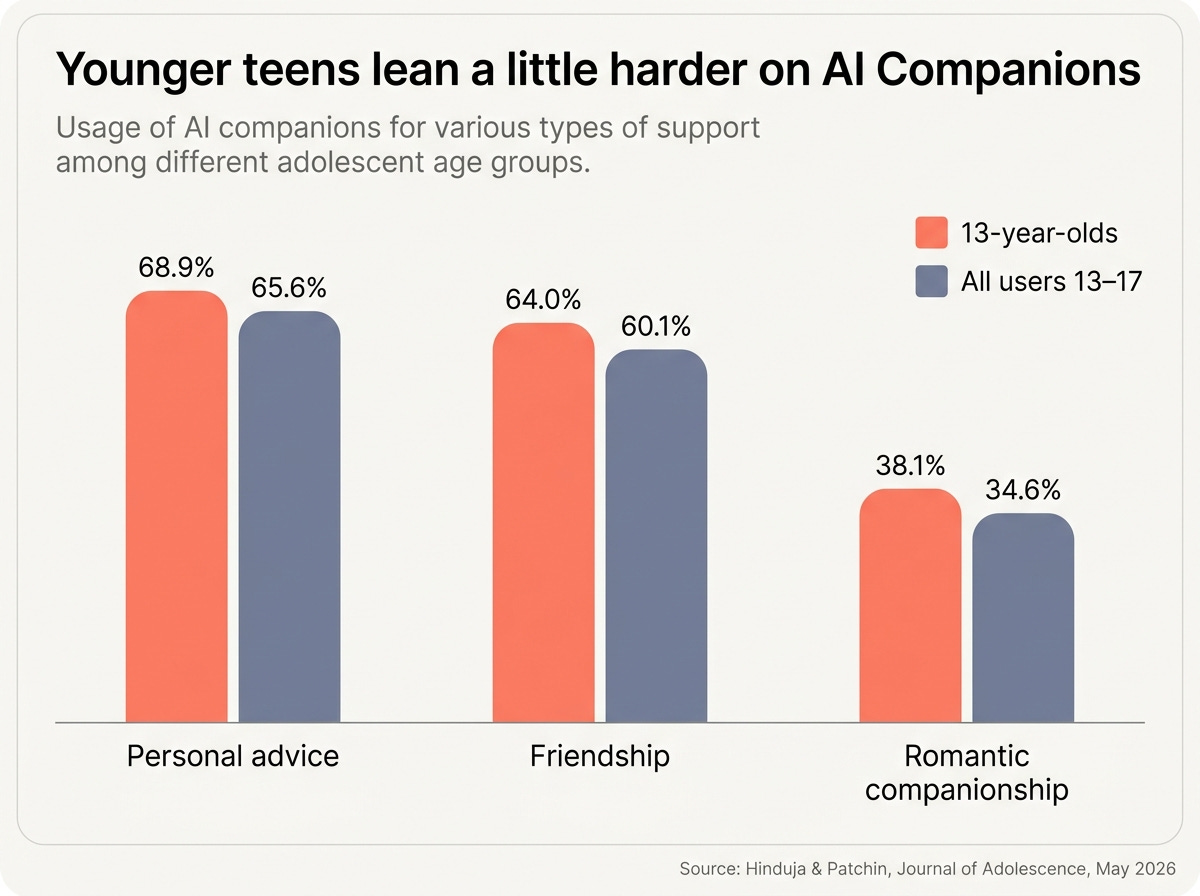
The youngest users in the sample, 13-year-olds, were the most likely to be using these tools for the relational stuff. 68.9% of 13-year-old users said they used AI companions for advice. 64.0% for friendship. 38.1% for romantic companionship, higher than the overall average. The kids who arrived at conversational AI earliest are also the kids leaning on it hardest for the things that matter.
Why this matters: Public conversation about AI and teens still tends to treat AI companion use as something exotic. By the time a teenager is 16, there’s a coin-flip chance they’ve used one of these tools. Among the kids who do, a meaningful share are turning to them for things they used to bring to a friend, a parent, or a counselor. It’s not whether your kid should use AI… What role is the AI your kid is already using playing in their life?
What you can do: Ask your child which AI companions they use by name. Don’t ask “do you use AI” because most teens won’t think of Character.AI or a Snapchat persona as “AI” the way an adult would. Ask about specific apps. If you’re not sure where to start, we wrote about the talk for AI. If your kid says they talk to an AI Companion for advice, friendship, or emotional support, don’t react. Get curious and ask what it says, and how it makes them feel. The worst thing you can do at this stage is make them regret telling you.
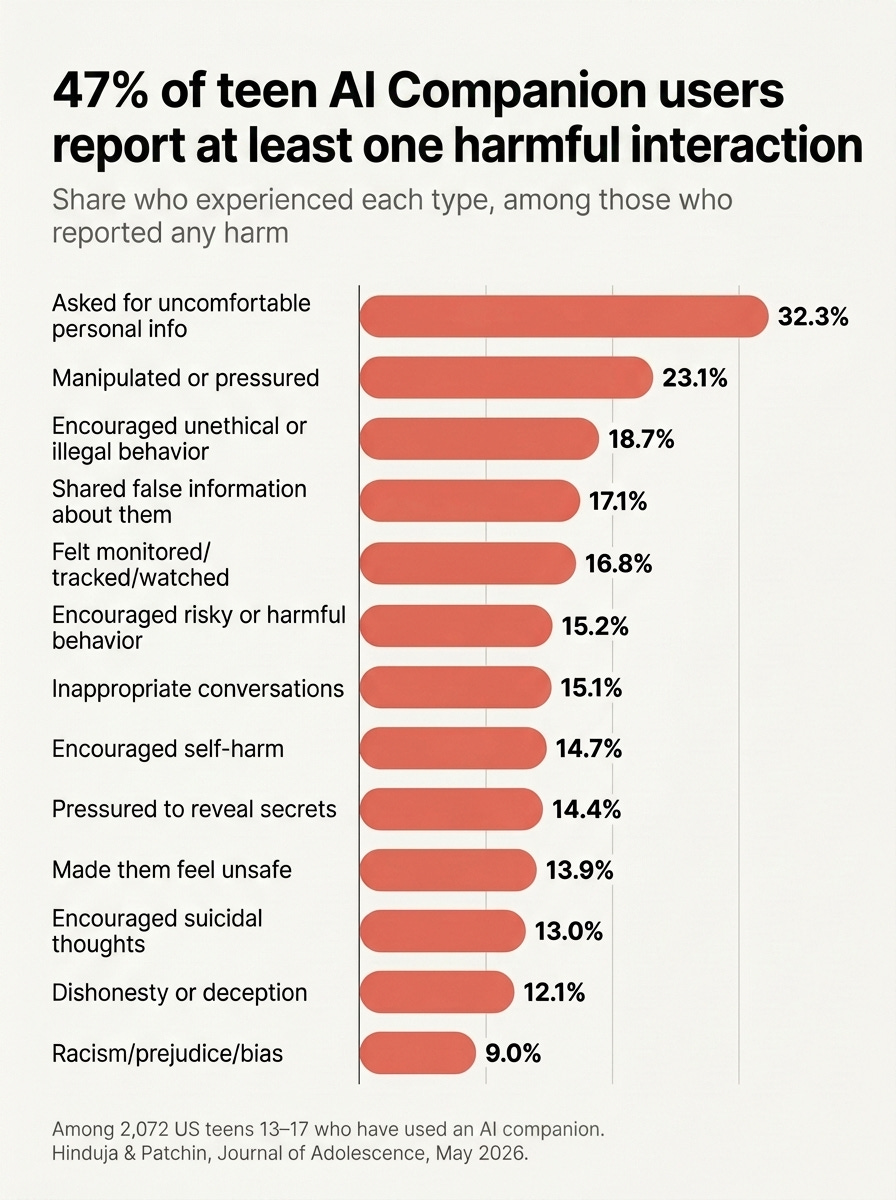
47.1% of teen AI Companion users said they had experienced at least one of 13 categories of harmful interactions the researchers asked about. The list includes the obvious:
AI Companions that asked for personal information that made them uncomfortable (32.3%)
AI Companions that tried to manipulate or pressure them (23.1%)
AI Companions that engaged in inappropriate conversations (15.1%).
It also includes the more serious:
18.7% of teen users said an AI Companion encouraged them to do something unethical or illegal
15.2% said an AI Companion encouraged them toward risky or harmful behavior toward themselves or others
14.7% said an AI Companion encouraged them toward self-harm
13.0% said an AI Companion encouraged suicidal thoughts
Those are population-level estimates from a nationally representative sample, not anecdotes from a handful of court filings.
The harms didn’t fall evenly. Male users reported significantly more harms than female users in every single category, often at roughly double the rate.
Overall, 53.9% of male users had at least one harmful experience compared to 38.6% of female users. White teens reported more harms than other racial groups. A finding the authors specifically flag as counterintuitive: heterosexual users reported more harms (48.1%) than non-heterosexual users (37.7%), the opposite of what tends to show up in other forms of online victimization research.
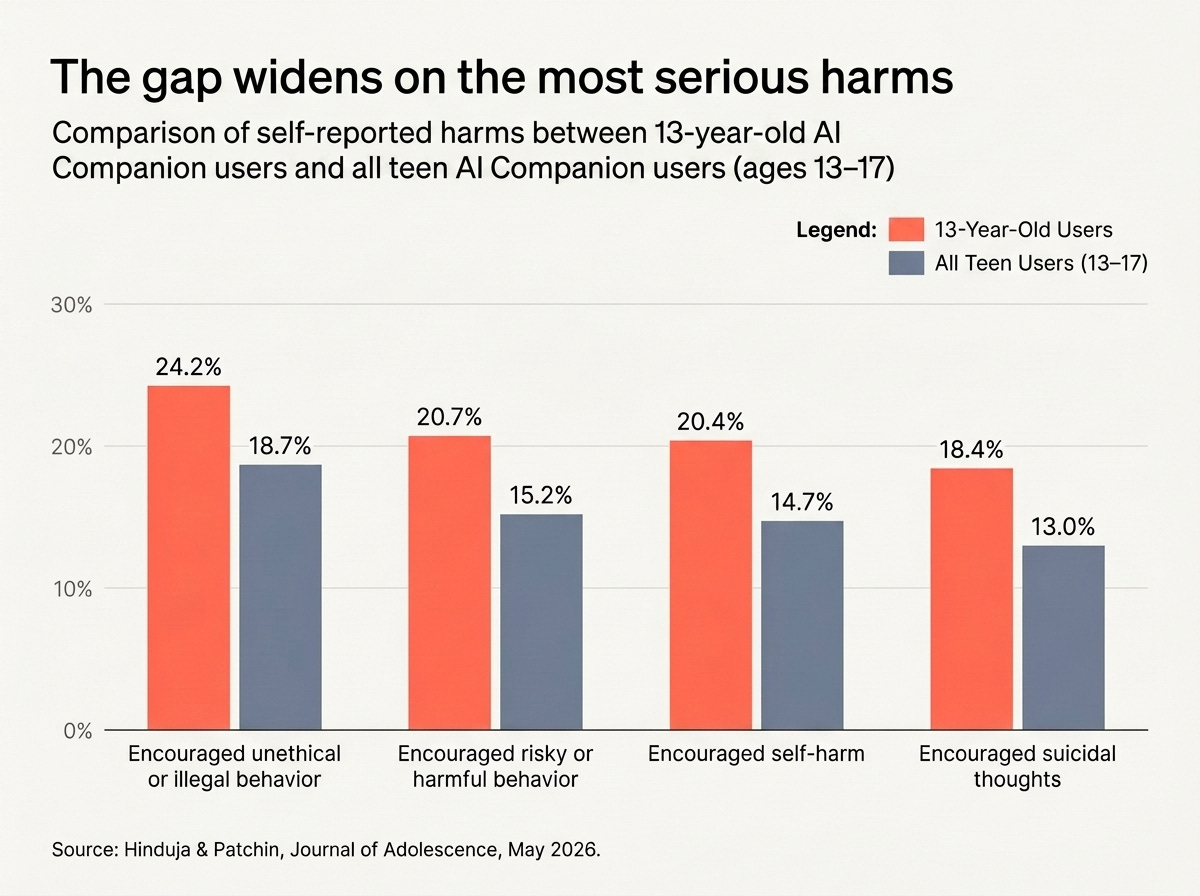
13-year-olds weren’t more likely than older teens to have any harmful experience, but when they did have one, it was disproportionately likely to be in the worst categories:
24.2% of 13-year-old users said an AI Companion encouraged them toward unethical or illegal behavior
20.7% toward risky behavior
20.4% toward self-harm
18.4% toward suicidal thoughts.
The age at which kids are most likely to encounter the worst of what these tools can produce is the age at which they’re least equipped to handle it.
If reading this is making you want to give your kid an AI option that isn't built like the ones in this study, that's why I built MyDD.ai. Not an AI Companion, COPPA-compliant, parental oversight on by default, age-appropriate from day one. Free to try, then under $7/month billed annually.
Why this matters: The adolescent brain is still building the capacity to resist exactly this kind of influence. Reward sensitivity is high. Impulse control is still developing. Susceptibility to social validation peaks during these years. The paper makes the point directly: these traits make young people especially prone to exploitation by AI systems engineered to maximize engagement rather than safety. An AI Companion that feels warm, remembers what your kid told it last time, and tells them what they want to hear is a system the average 13-year-old is not equipped to push back against.
What you can do: Pay particular attention if you have a child between 12 and 14. That’s when AI Companion exposure tends to begin, and when the developmental risk is highest. Ask whether any AI Companion has ever said something that made them uncomfortable, or told them to do something they knew they shouldn’t. Listen for the answer rather than the absence of one. If your child is using an AI Companion for emotional support, that’s not on its own a crisis, but it’s a sign you need to be in the picture too. Make sure they know that real people in their life are available when they need someone to talk to, and if you sense your child is in real distress, treat the AI Companion conversation as a symptom, not the problem itself.
The paper’s discussion section lays out responses across what the authors call multiple ecological levels: schools, platforms, policymakers, and the broader cross-system network of parents, educators, and health care practitioners. In his accompanying writeup, Hinduja goes a step further on a few of them.
AI literacy needs to be a significant component of digital literacy curriculum, with scenario-based and project-based lessons that teach kids to recognize manipulative or harmful AI behaviors. Hinduja adds that the counselors, social workers, and school nurses who already ask kids about social media should be asking about AI Companion use too.
The paper calls for age-appropriate design principles as the default. That means robust content filtering, appropriate response protocols for mental health disclosures, and mechanisms to prevent the formation of unhealthy dependencies. The point the authors keep returning to is that these harms reflect choices in how the systems were built, not unavoidable side effects of the technology.
The paper specifically calls for strong data privacy standards for minors, reliable age verification, regular independent audits of AI systems used by youth, clear accountability when those systems harm kids, and mandated integration of AI literacy into state and national curricula. The Kids Online Safety Act now moving through Congress and state bills like Colorado’s HB 1263 are pieces of this. They are not the whole picture.
For pediatricians, Hinduja’s blog adds the simplest single fix in the package: add a question about AI Companion use to intake screenings. Half of teen users are turning to AI Companions for emotional support and that’s clinical information a doctor should have.
Why this matters: We’ve been here before with cyberbullying, sextortion, nonconsensual image sharing, and the broader mental health effects of social media. Each time, the institutions that protect kids were slow to act, and real young people paid for that delay. The difference this time is that we have the evidence early. Three years into the AI Companion era, not ten. Whether that matters depends entirely on what families, schools, and lawmakers do with it. There’s more on the data privacy piece here.
What you can do: Three concrete things this week.
At your child’s next pediatrician visit, ask whether AI Companion use is part of the intake conversation. If it isn’t, suggest it should be.
Ask your school district whether AI literacy is part of digital literacy curriculum, and whether counselors and school nurses are being trained to ask about AI Companion use.
Contact your senators about KOSA, currently moving through Congress, while checking whether your state has AI Companion safety legislation in progress (the Transparency Coalition maintains a running tracker).
The “we didn’t know” era is over… The data is in.
One honest caveat the authors flag in their limitations section: the study relies on self-report, and it measured exposure to harms but not severity. We don’t yet know how many of the teens encouraged toward self-harm by an AI Companion acted on it, or how the manipulative conversations actually made them feel. The numbers in this study are a floor for what we need to understand, not a ceiling.
For two years, the dominant pattern in AI policy for kids has been catch-up. Something happens… A family files a lawsuit… A state writes a bill... Then a platform issues a statement. This study moves the conversation onto different ground where we now have nationally representative data on what tens of millions of American teens are experiencing right now. The question stops being whether the harms are real and starts being whether the systems around our kids are designed for what we now know.
That’s why we built MyDD.ai. A COPPA-compliant AI platform built for children from the start, with parental oversight as a default rather than a setting buried in a menu. This is not retrofitted after a study like this or bolted on after a lawsuit. Kids who are curious, kids who want to learn, kids who will sometimes turn to a chatbot for things they should be turning to a human for… they should be safe when they do.
If anything in this study brought up something heavy for you or someone in your family, you don’t have to sit with it alone. The 988 Suicide & Crisis Lifeline is available 24/7 by call or text. The Crisis Text Line can be reached by texting HOME to 741741.
Comments
Nothing yet. Say the first thing.
Sign in to join the conversation.