
When Russia’s full-scale invasion began in 2022, Georgia opened its doors — becoming one of the few countries in the region where Ukrainians could find safety without visas or restrictions. For many, it felt like a rare place of stability amid the chaos, a country that welcomed them when few others would. But as Georgia tightens its migration rules in 2025, that sense of safety is giving way to uncertainty — a shift that may foreshadow how other nations, too, will begin to recalibrate their approach to displaced Ukrainians.
Georgia quickly became an accessible refuge for both Ukrainians and Russians fleeing the war — drawn by its proximity, visa-free entry, and shared language. While many saw it as a temporary stop, others stayed, shaping the country into a post-2022 migration crossroads hosting refugees, draft avoiders, and displaced professionals. This open-door policy, however, has quietly expired.
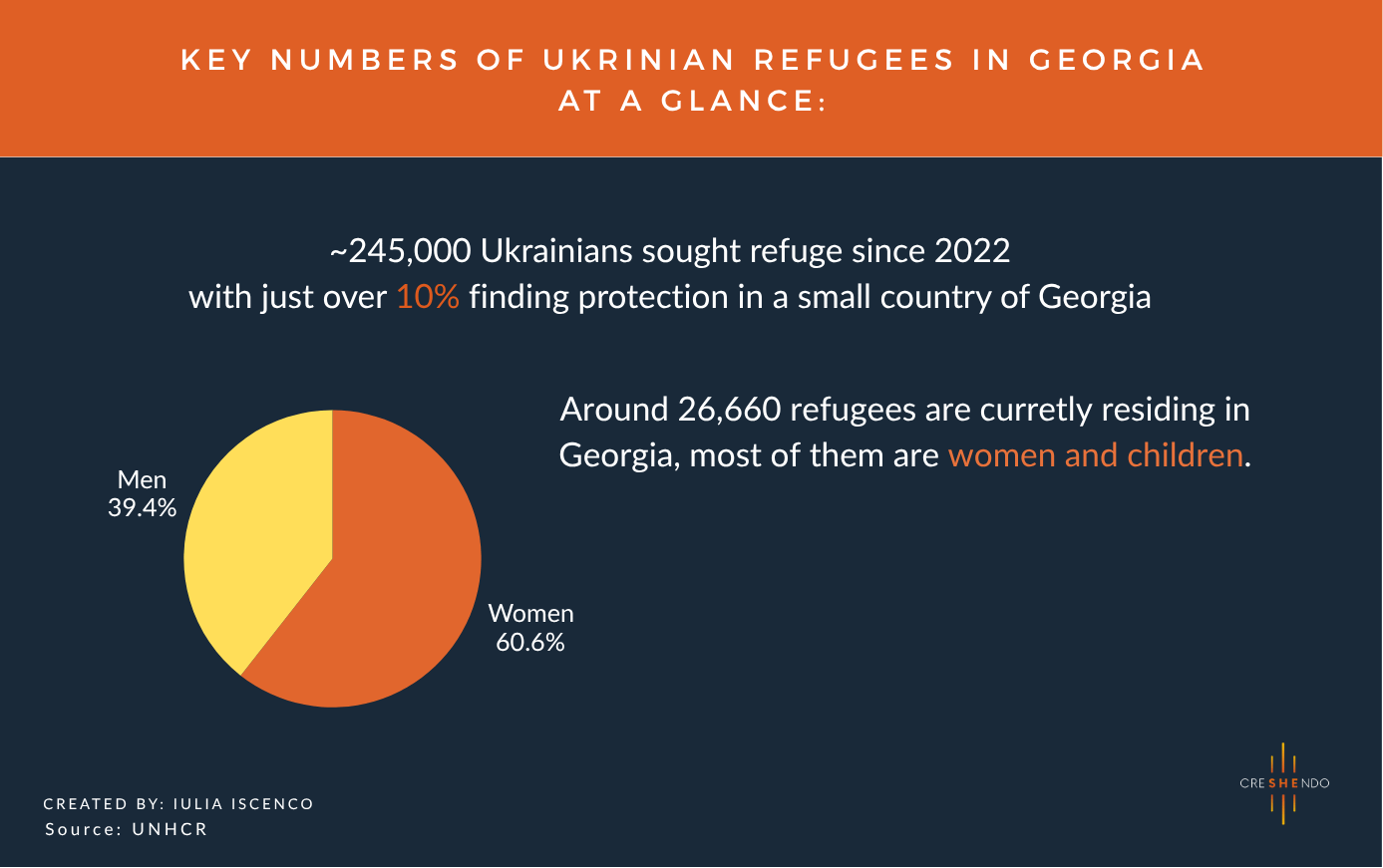
Before 2025, Ukrainian citizens could stay in Georgia for up to three years without a visa, based on a special exemption introduced after the Russian invasion in 2022 (Gov Decree #81). This policy allowed displaced persons to remain in the country without immediate pressure to regularize their status, offering time to stabilize or consider long-term options such as asylum or residence permits. After 2025, however, Georgia significantly revised this approach. This shift introduces legal uncertainty for those who arrived recently or seek to extend their stay, requiring them to apply for residence permits, asylum, or resort to temporary exit-and-reentry strategies. While existing long-term residents may still be eligible for legal stay through humanitarian or residence status, new arrivals now face tighter entry and stay rules, signaling a broader policy change toward more regulated migration management.
Although Ukrainians fleeing the war are entitled to apply for asylum in Georgia, in practice, most do not pursue refugee or humanitarian status. Legal advisors and NGOs in Georgia often encourage this route over asylum, given its greater predictability and faster access to services.
While Georgia has shown humanitarian openness toward Ukrainians, state-provided support remains minimal and unstructured, with no dedicated refugee program or long-term social protection scheme for displaced Ukrainians. Governmental aid has been mostly limited to initial emergency assistance, such as temporary cash support (300 GEL per family, plus 45 GEL per additional member for three months), free access to public transport in cities like Tbilisi and Kutaisi, and limited free healthcare for those who arrived before November 2022.
In contrast, international actors and NGOs have filled critical gaps: a major $1.62 million initiative funded by Germany and implemented by UNDP and CARE Caucasus supports Ukrainian women entrepreneurs and local integration efforts. The Ukrainian House in Tbilisi, also supported by UNDP and the German government, offers psychosocial aid, language classes, and networking. Meanwhile, UNHCR provides cash assistance for the most vulnerable groups, including children, the elderly, and persons with disabilities.
In the absence of a structured state-led response, civil society and private citizens in Georgia have played a vital role in welcoming and supporting Ukrainians. Grassroots Georgian civil society and private donors continue to offer informal aid, including free meals, shelter, and basic services, often without formal recognition. These acts of solidarity are often coordinated through community groups, social media, or word of mouth, creating an informal but highly responsive support system.
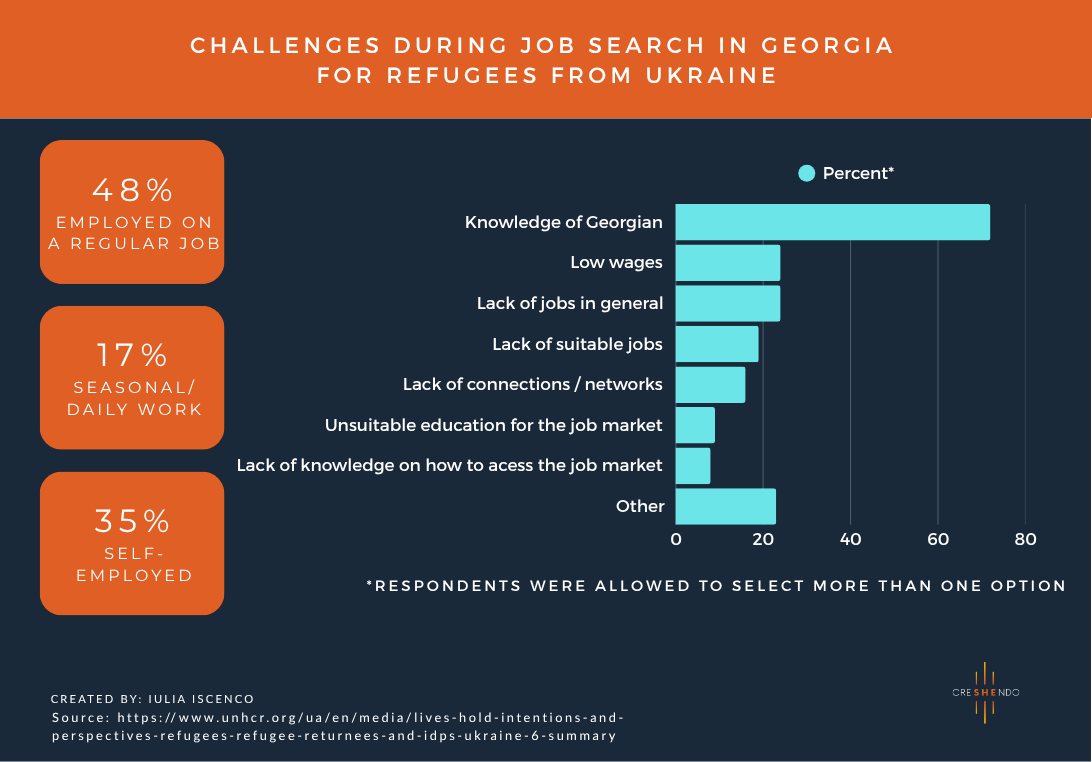
While there are little country aggregated data, available surveys suggest that a large share of displaced Ukrainians in Georgia remain outside formal employment. Many report working only part-time or not at all, often due to limited Georgian-language skills, recognition barriers, or difficulties navigating the local labor market.
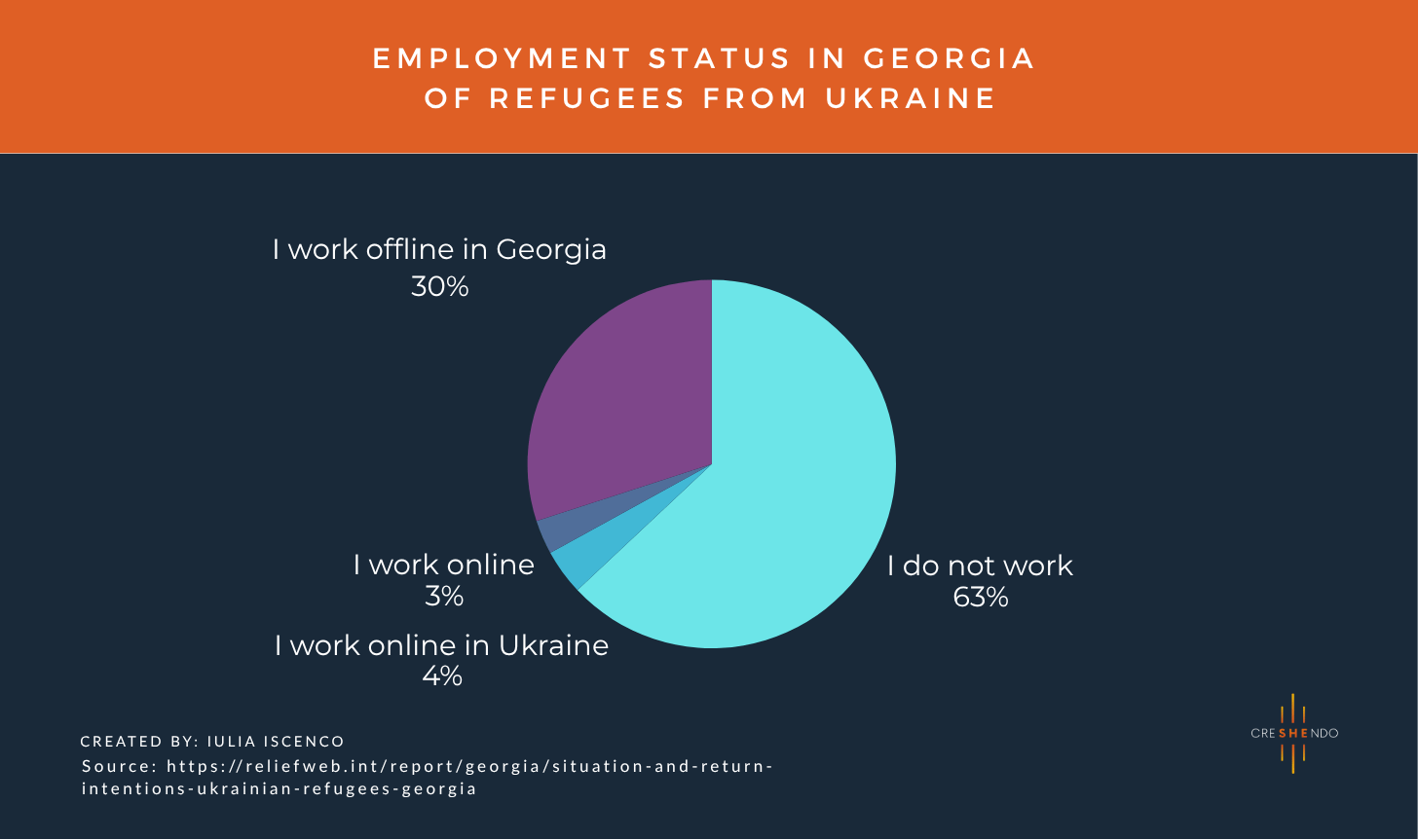
This lack of stable income not only restricts their ability to meet the requirements for residence permits or work-based visas, but also places them in a precarious position as Georgia’s migration rules tighten. For those without formal jobs — including caregivers, elderly individuals, single parents, and people with disabilities — the shrinking number of legal pathways to stay in the country increases the risk of falling into irregular status.
This tightening of rules is likely to deepen existing inequalities among displaced Ukrainians in Georgia. While those who have secured employment or established small businesses may be able to transition into legal residence, many others — particularly the elderly, single parents, and unaccompanied children — risk falling into irregular status. For individuals already in precarious conditions, the new requirements to prove income, housing, or employment may push them into even greater vulnerability, leaving them at risk of losing access to healthcare, education, and basic protection mechanisms.
The shift in Georgia’s approach from an initial stance of open solidarity to a more controlled and politically cautious posture may reflect growing refugee skepticism, domestic concerns over overstays and integration capacity, or a broader reorientation of public attention away from Ukraine as the war drags on. For Ukrainians in Georgia, this evolving landscape creates legal ambiguity, especially for new arrivals unsure of how long they can remain or how to transition into legal residency. Many face barriers accessing stable housing, employment, or healthcare, particularly if they fall outside formal aid networks. There is a growing risk that displaced Ukrainians will find themselves caught between temporary protection and long-term insecurity — dependent on informal support while navigating a legal system that increasingly asks them to choose between short-term stay and uncertain asylum routes.
Despite the growing legal uncertainty, most displaced Ukrainians in Georgia do not plan to apply for international protection. Survey data show that 55% have no intention to apply, 26% remain undecided, and only 9% intend to seek asylum. Several factors help explain this reluctance. Some fear that applying for asylum will restrict their mobility or prevent them from returning to Ukraine when conditions improve. Others associate asylum procedures with stigma, long processing times, or a perception that their stay in Georgia is temporary. For many, the hope of securing employment, obtaining residence permits, or eventually moving elsewhere feels more viable than entering a protection system that offers limited benefits and unclear long-term prospects. As a result, a significant share of Ukrainians remain in Georgia without committing to any formal status — a situation that becomes increasingly risky as migration rules tighten.
As the war enters its fourth year, Georgia’s changing stance illustrates a wider global dilemma: how to sustain protection when displacement becomes protracted. What began as emergency hospitality is evolving into migration management — a shift that may soon echo across other host countries, redefining what “temporary protection” means in practice.
Comments
Nothing yet. Say the first thing.
Sign in to join the conversation.