
Originally published on my Patreon on February 14, 2026.
One of the more dramatic and iconic aspects of being an art student is the public critique: you present your work before professors and classmates and have them tear it apart in front of you and make you cry and piss yourself. Okay, that’s not how it’s supposed to go. The critique is supposed to be constructive: not simply an assessment of the student’s skill or understanding but an intellectual examination of the work that allows the student to see it from new angles, and perhaps mutually, allows the professor to see the student from new angles. And maybe if we’d all been a little more mature, that’s how it would have gone down.
Every class had minor critiques after every project, which were conducted largely by classmates. And then major critiques, toward the end of our junior and senior years, by a panel of professors and visiting artists. When we critiqued each other’s work we were often graded by participation, which meant people felt compelled to make bullshit comments just to make sure they’d said something. Someone on my old forums once said, “Don’t speak unless it raises the level of discourse,” and that stuck with me, but you can’t do that if your grade counts on doing the opposite.
Still, I had to admit, I didn’t have an academic background in art before I went to art school. I didn’t grow up in an environment that fostered it: we liked art, we told ourselves, but I’d grown up in a culture so steeped in reactionary responses to anything made after the ‘50s that I didn’t realize: This conservative contempt for art had pervaded mainstream society so thoroughly that liberals didn’t realize they were perpetuating it. And we were relegated to asking the same questions over and over -- Is this art? Is this good? How does this reflect the artist’s assumed poor moral character? -- Instead of engaging with the art itself. So it took me a while to stop talking shit, and to stop expecting to be shit-talked to. See, I wanted to know if my art was good. I thought I was there to be told whether my art was good. I should have accepted by this point that “good” is a useless metric.
My Junior crit was surreal. I had spent most of the year working on a single gigantic painting. It was the assignment for a class that had become an obsession: making a figurative painting that an abstract expressionist would like. I wanted to impress this man. After being confronted by a friend about misgendering me, which he’d done without malice, he said: You don’t have a gender, you’re a painter. This would have normally been offensive, but from him, it was the highest compliment. He did not throw around the word “painter” lightly.
The painting was stretched on 2x4s because I was afraid thinner wood wouldn’t hold. Another classmate and I walked to Home Depot to pick the lumber up, and carried it back about ten blocks on our shoulders. Along the way we ran into a couple of skaters that he knew. They asked if we would put the wood down so they could jump it. We did, and they did, and we went on.
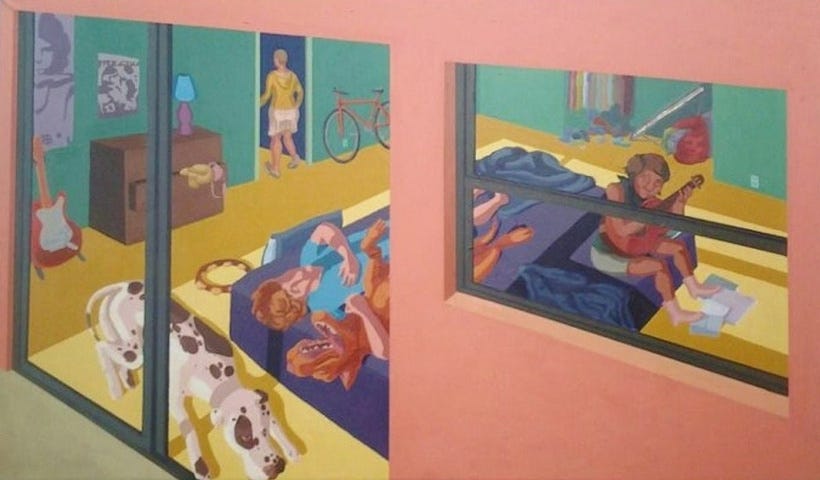
I brought it before the panel of professors, and they fell almost completely silent. One simply pointed at the Doors poster on the wall in the painting and said: “Jim Morrison.” Another called it a failure. It was the most constructive comment I had gotten. I chose her as my professor for the next year. It was a good call.
I was also taking metal shop that year. I loved working with the forge, though I was not strong, so it took a long time to hammer. My professor had various anvils and dies, some of which he made himself, to pound different curves and angles into the hot steel. A few were tree stumps, shaped into bowls for wide curves, and when the steel hit the wood, it would burst into flame. It was important to wear natural fibers or leather because synthetics could melt to the skin and burn: I still prefer them today, though I haven’t touched a forge in over a decade.
Everyone else was making coffee tables, pretty much. My teachers were thrilled to be able to help with something that wasn’t a coffee table. We stored our projects in a vertical rack overnight. One morning I went to get mine down, and a piece of sheet metal lodged above it came down first: the corner hit the back of my left hand and bounced back up. And at first I thought: Huh, glad I’m okay.
Then after a beat, blood started to well from the wound like a bubble fountain, and I rushed to the bathroom inside the metal shop to grab a wad of paper towels to wrap around it. I still wasn’t sure if this was a walk-it-off kind of injury so I waited for my professors to finish introducing the day’s class before saying something like: “Hey my hand is bleeding. What should I do about this?”
They immediately call an ambulance, and my professor goes with me to the hospital. I out myself as trans at the ER and give them a full surgical history, in front of my professor, because I have no idea, at this point in my life, whether I have to do that for a minor wound. They inject it with lidocaine — at this point I haven’t been in any pain until they stick a giant needle into the wound — and stitch it up. After I go home I get hounded for months about the ambulance bill.
I get a call the next day from the school: they say they heard I was in the hospital and want to know if I want to withdraw from all my classes and try again next semester. Which would have cost my family thousands of dollars and required me to retake classes I had nearly completed. There are only two or three weeks left until finals. I panic. I decide to finish all my projects with one hand.
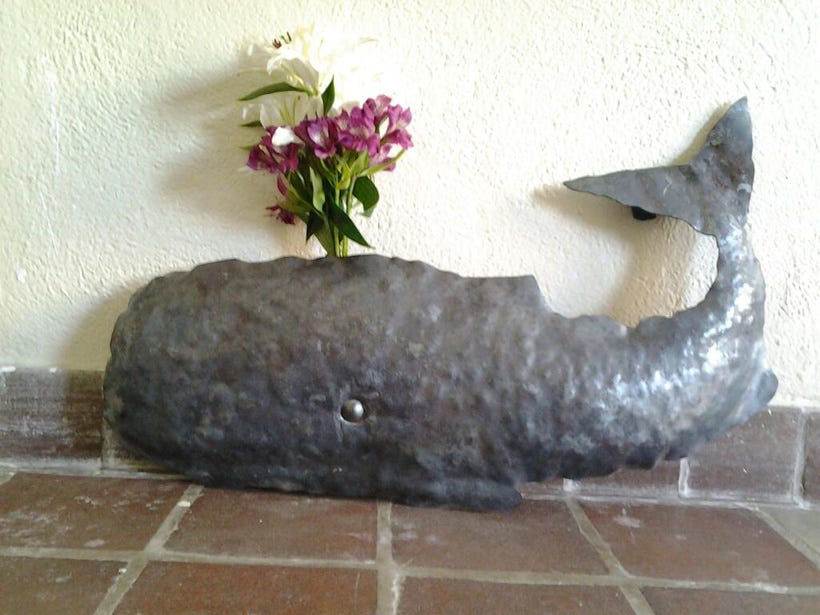
When I get back, my piece is still in the sand pit, a splash of blood across it. I return it directly to the forge and burn the blood off as I work. The professors feel responsible for leaving the rack disorganized; it could have hit my neck. My professor, in addition to holding the metal while I hammer, helps me plan out how to finish the piece: using a piece of metal pipe as a die for the eye, and MIG welding a piece to hold the glass bottle that holds a spray of flowers on the back where the blowhole goes.
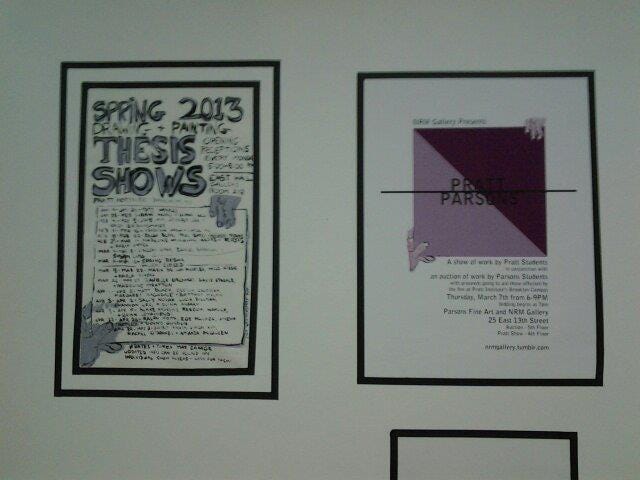
Around this same time, senior crits were coming up, and I had decided to make some posters for it in the letterpress lab and post them around the school. Now at the time I must have thought I was hyping up the students, because Pratt didn’t really advertise these events: if you knew, you knew. I wanted to see more interdisciplinary interaction among students and thought classmates who weren’t in the program might want to watch the fine arts critiques. But it was also pretty clearly satirical. I was moving a little too fast to think about how I was critiquing the institution.
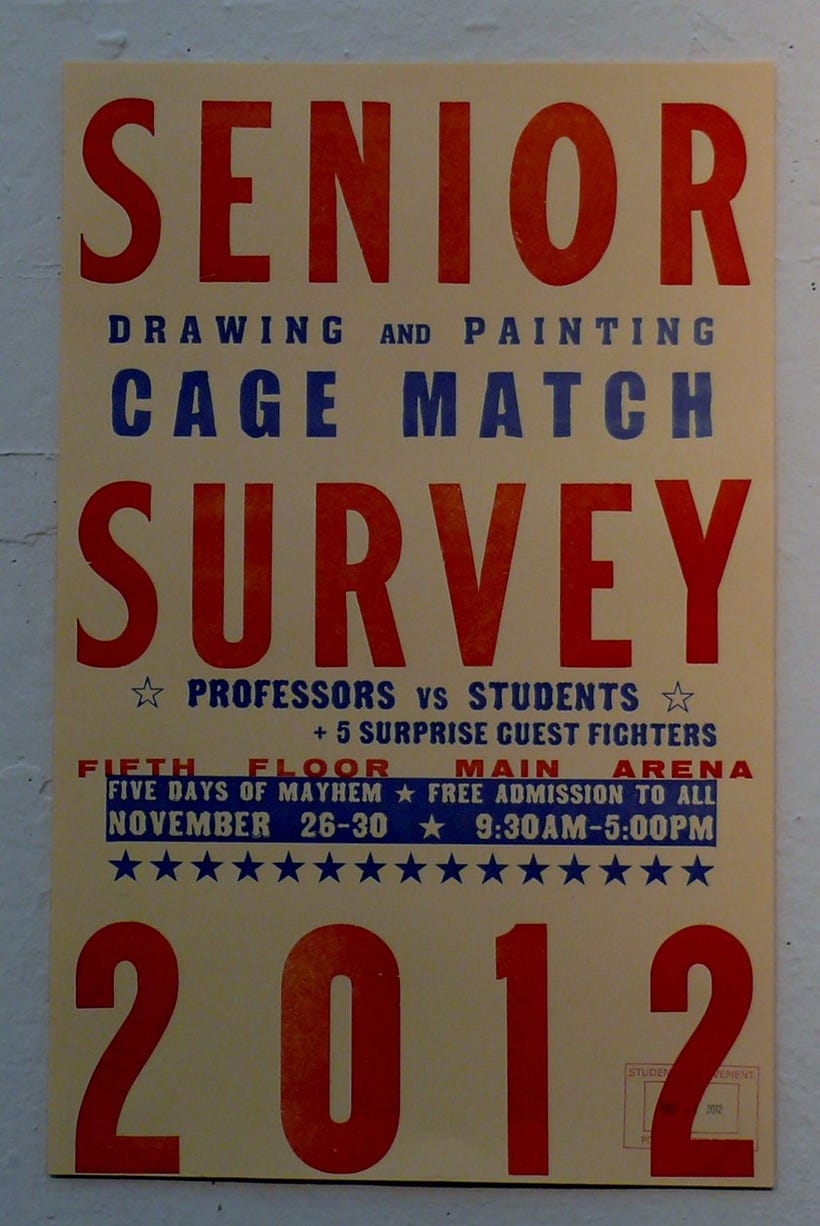
Critiques were valuable, but why were they framed as confrontations? As a student, one of my biggest fears was being the kind of person who couldn’t take criticism. I accepted that I was a beginner in the art world and that my professors must know better than me. But this was the reality: they each knew a lot about art but they often also had a narrow sphere of experience. And they were overworked, underpaid adjuncts with no health insurance, coming in from lunch, maybe a little tipsy and a little surly. Many of us were dealing with subject matter they didn’t know, and they didn’t realize they didn’t know it: race, class, gender, the social impact of technology. They’d say things like, “Identity art died in the ‘90s,” and I’d wonder what that meant for the identities you couldn’t discuss openly, except as stereotype and spectacle, in the ‘90s. We came into these confrontations already defensive, instead of prepared to simply discuss our work.
I had avoided making any work that had to do with being trans for the first few years of school, because, frankly, I wasn’t sure how to go about it. I had spent a lot of time thinking about how trans bodies were represented in art: at the time, an almost universally exploitative, flattened cis gaze. We were meant to be subject, not artist, and as subject nothing but a mugshot, a medical curiosity, a sex object, a before-and-after. There were other trans artists, of course, some of whom I would meet a decade later or so, but at the time I didn’t know their names or how to find them.
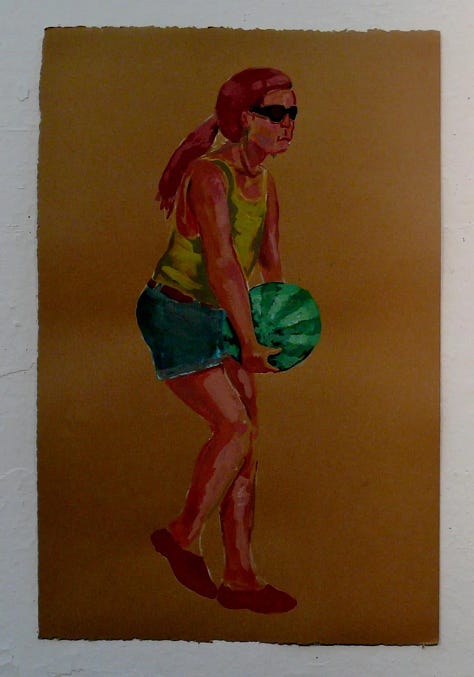
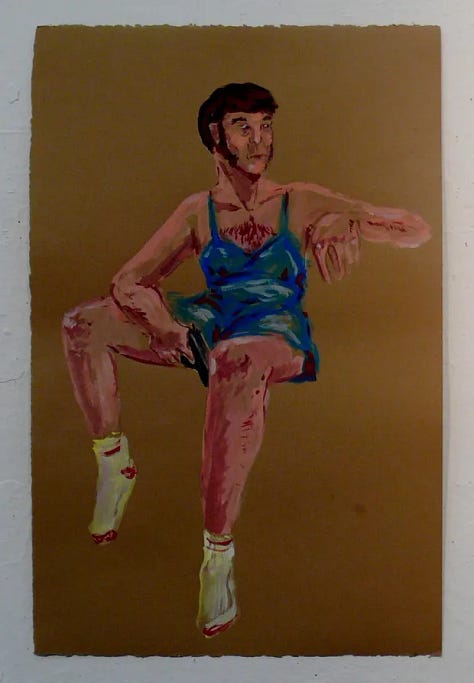
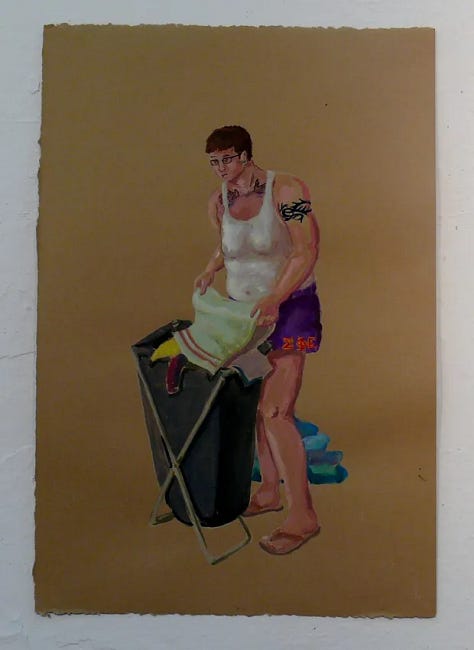
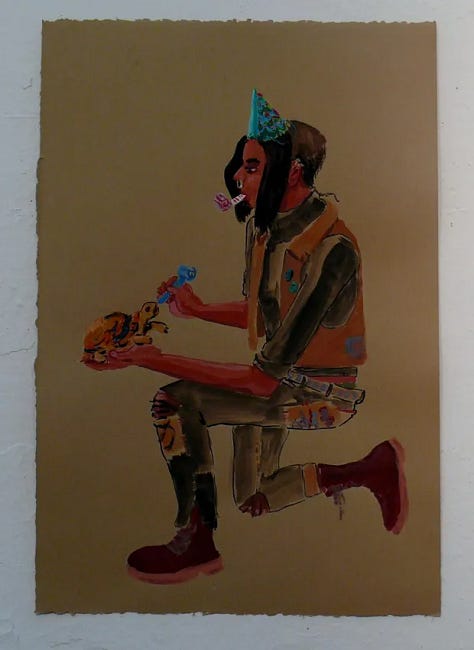
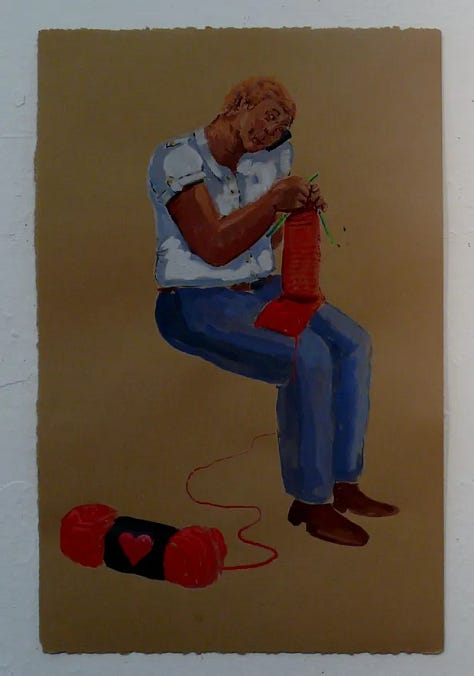
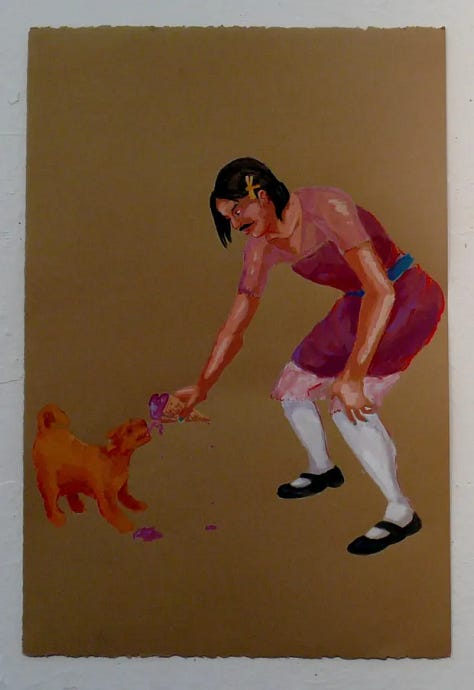
I made a series of works on tan paper. I painted what at the time would have been ambiguity, subtlety: people whose bodies were ambiguously trans or cis, engaged in activity. That was radical at the time: a maybe-trans person, doing something. I actually used my classmates as models, because I didn’t know any other trans people in New York, and scrambled their gender presentations. I had to make sure none of them looked anything like me, or they’d be assumed to be self-portraits. I was personally isolated but I wanted to create the illusion of the community I sought: dozens, hundreds of trans people, all together.
I brought them to my senior critique.
The professors began to refer to the figures in the painting with various pronouns, and eventually picked up on the fact that they didn’t agree which was which. The conversation about the work turned to gender. After some back-and-forth I say something like: “Well these aren’t depictions of real people, I haven’t decided genders for them and as it’s impossible to ask, it remains ambiguous.” This idea, basic to me, struck them as radical. I was not prepared. I had wanted to talk about trans representation in art and now I was not sure if my professors understood what “trans” meant, beyond what they had seen in magazines. But still I hoped they, as my teachers, could give me insight. What I have just said here was the only insight.
Every senior, before graduation, would also participate in a group show with up to three other students. I had hoped to show the paintings I have just described, and began making a second, similar series on blue paper, one involving a three-foot-long model of the Titanic I’d found in the gutter on the way to class and carried on my shoulder for two miles. The senior shows all took place in the same gallery on a weekly basis, and like the critiques, were not advertised by the school proper. We were expected to do that ourselves. Most students made flyers for their own shows and told their friends to come via whatever methods were available.
I took it upon myself to create a single poster advertising every student show at once.
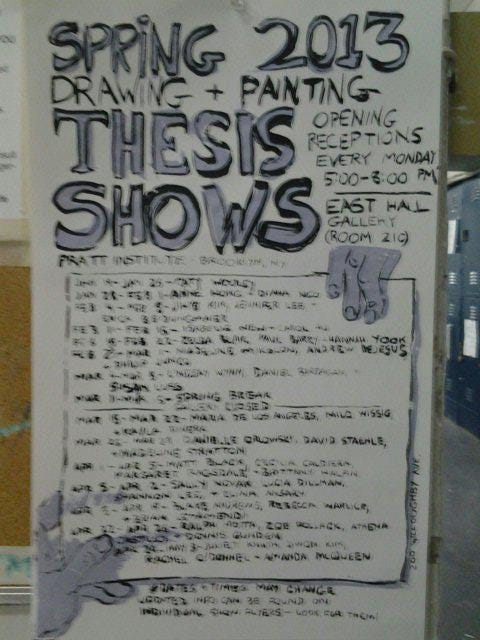
It included the phrase “dates and times may change” at the bottom, which was true: the roster wasn’t definite, and I had also copied the names of my classmates from a sheet on which they were incorrect, and I think some of them have also changed their names since. I haven’t kept in touch enough that I’d be able to confidently correct or redact images of it but would do so if they asked. But the phrase was treated as prophetic, because the building burned down on the night of Valentine’s Day, and the majority of the shows were canceled.
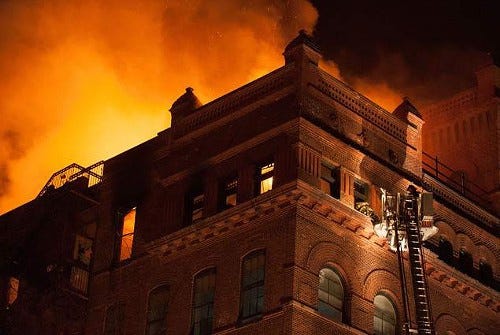
Now I’ve written about the fire before, but at the time I was performing a degree of respectability that’s gotten me nowhere. I’m not going to say anything that isn’t public record, but let’s face it, as a Pratt alum I don’t even get access to the library. I have no reason to protect the institution, and I have no reputation to protect. But for those who don’t know about it, our studios were on the sixth floor of the Main Building, and the whole floor went up in the middle of the night, and all our work was destroyed, as well as our materials and workspace, with considerable damage to the floors below.
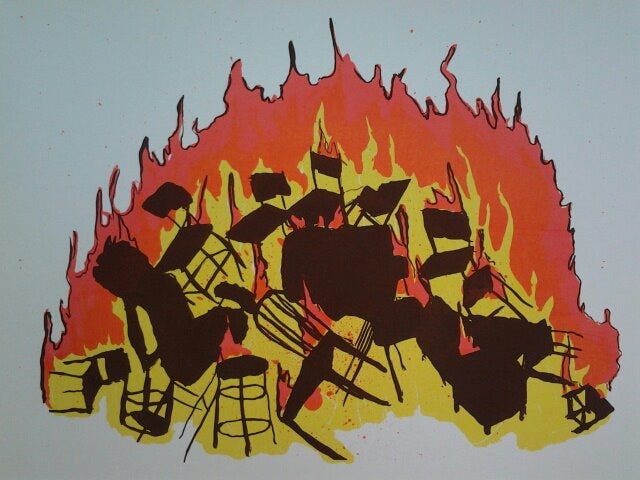
In the summer before the fire, I’d taken an extra silkscreen and metal shop class, trying to reduce the number of credits I’d take during senior year. In the end, I was only taking one class in my final semester. One of the prints I made was a heap of burning chairs. It was intended as technical practice in color combination using translucent inks: the red and yellow of the flames blending in the middle into orange. I did not discuss this after the fire, because it wouldn’t have been seen as prophetic, but as suggestive of arson.
I mean, we’d all seen “Art School Confidential,” which focuses on the lengths art students will supposedly go to for attention, validation, fame, and just to get laid. It was based on cartoonist Daniel Clowes’s experiences at Pratt, though it wasn’t filmed there. And why it wasn’t filmed there: legend had it that until the year I went there, the Pratt campus had banned commercial filming because a segment of the classic porno “Debbie Does Dallas” was filmed in the library in the ‘70s. The library actually kept a VHS of this around, and my friends and I tried to watch it together. Which culminated in prying the tape out of a busted TV/VCR with a pair of table knives.
I bought the TV/VCR from this guy who repaired TVs and such that he found in the street and sold out of his dorm room, which looked like a warehouse, every surface covered in electronics. This was the time in which analog TV was being phased out, so many TVs were on the curb with the cords cut. He soldered new cords on and sold them to other art students for one last hurrah. Every time I saw him he’d be a little more swole, and I figured it was from carrying electronics up and down the street.
Returning to Art School Confidential: The notion that art students will do anything for fame was a particularly toxic emotional miasma post-fire. But the days in which those sorts of antics could actually produce fame — the sort of fame one could profit from -- seemed to already be over. Yes, our art school burned down. Who got famous from that? Who got a career? Nobody.
A few of us were mentioned in the newspaper. We even had a show staged by Gagosian —that is to say, the man who’s been described as “the biggest art dealer in the history of the world” — it didn’t matter. The ones who were already skilled in business may have been able to leverage it into their already promising careers, but the rest of us weren’t taught those skills, or didn’t have the class clout to use them if we had. The only thing we were really taught about gallerists was, essentially, these people are inscrutably insane and powerful and you’re going to have to engage with them like they’re faerie-creatures in order to get representation.
The show was framed as a sort of charity event for the school, for a bunch of students who’d gone through a rough time. We’d had a few months to scramble to create new work that represented us professionally after a crisis that had most of us struggling to decide what to create. The idea of being taken seriously as professional artists was never on the table unless we had already established ourselves as such.
There was a former student who slept on campus in a tent. Later on, she moved on to sleeping in classrooms at night. Everyone called her Tent Girl. She would cover the blackboards in colorful, intricate drawings in the night, and disappear by morning. I saw her once, brushing her teeth in the slop sink while I was working on my junior painting project. Students had reported thefts and seen people sleeping in the studios: their descriptions didn’t sound like Tent Girl, but that meant there were multiple people breaking in.
In response, the fire escape on our floor had been nailed shut. We heard that someone had been injured in the fire but fled the scene, refusing medical attention. We speculated that that person was Tent Girl. Investigations showed no sign of arson, or even that the fire had been set by someone accidentally: it seemed to be electrical in a building with bad wiring. If someone had just come in to sleep and fled, it was most likely because they weren’t supposed to be there and couldn’t afford a hospital bill.
This was not the only issue with the building, of course: the reason it burned so completely was that the fire alarms did not work, and it was not until the fire broke through the roof and set off a burglar alarm that anyone was alerted to it. Curiously, that alarm didn’t seem to deter burglars.
New temporary studio structures were built after the fire. First we were put in a gallery space, then once construction was complete, we were moved to the gym. There were a series of meetings on how to construct the space during this time, and I recall having to demand things like sinks and ventilation. I regret bringing up the fear of theft. The response was to install security cameras.
Students were accustomed to an amount of privacy in the studios. They didn’t realize security was watching not just potential intruders but their own actions. A student was confronted by security for skating inside the studio -- because skating wasn’t allowed in the gym, in which the studio had been built. It felt like a violation of our space. The studio was not the gym; it was a separate entity, and the basketball court below was protected by a layer of plywood. When I was in the studio, I (though I didn’t yet think of myself as disabled and had a great deal more energy than I have today) used a rolling stool as a mobility device, often pretending I was a squid as I scooted around the floor. I imagined skaters did the same: skated to reduce fatigue. Upon realizing this — that they could be seen on the cameras — students were scandalized because many of them changed clothes in their studios.
As far as I know, only a single object that was actually burned in the fire was retrieved from the wreckage. It was mine, and I have it today.
I took metal shop a second time after my injury because I wanted a second shot at the forge. I designed a metal stool where the seat was a giant bottle cap, based on a beer I liked: Belhaven Scottish Ale. However, I used the cap from their IPA instead because I preferred the design. I wound up not using the forge at all: my professor cold-bent the steel himself while I watched. This allowed for much cleaner bends and was more appropriate to the design, but I wondered if he was taking on all the physical labor because he was afraid I’d hurt myself.
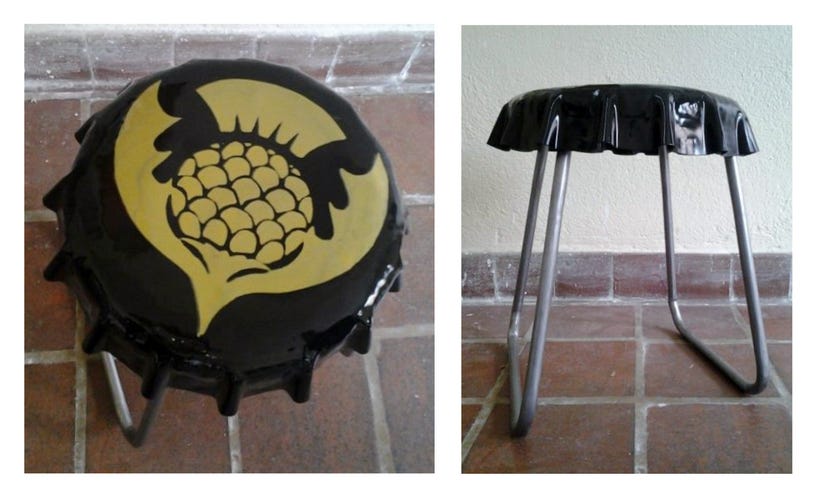
Three of my friends saw the chair sticking out from the heaps of rubble outside the building. They rescued it for me, just before we were definitively told not to go in there.
The original paint coating is nearly completely burnt off: the black and gold winged thistle of the Belhaven cap, faintly visible. There is a smear of red paint, most likely cadmium, across it where it is believed, in the fire, tubes of paint fired off like rockets and hit things. The legs are broken, and the chair is unstable, making it no longer safe to sit in.
Now back to the poster I drew for the senior shows: Some students at Parsons held a post-fire collaborative art show with us to help us out. They decided to reuse the hands I’d drawn for my original posters in theirs.
I hadn’t had time to make any new work by then, so I re-stretched a painting I’d made as a sophomore based on a photo of my friends from Orlando. And I brought the chair. I leaned on it precariously for a photo shoot:
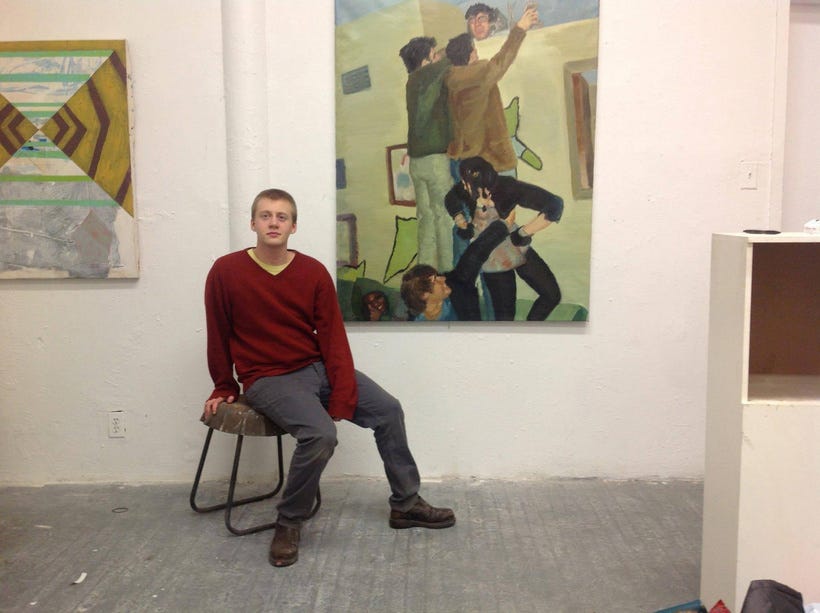
Since it was too damaged to sit in and was heavy and took up a lot of space, I eventually removed the legs and kept the bottle cap seat and used it as a wall hanging. It struck me as symbolic, though I wasn’t sure of what. I’d made the chair at the same time as the print of burning chairs. Was it prophetic? Maybe if you make enough stuff, you’ll inevitably make something prophetic.
Milo Wissig (he/him) — small paintings, long [th]reads, trans rites, OSHA violations. More work: Patreon | Website | Instagram | Substack
No posts
Comments
Nothing yet. Say the first thing.
Sign in to join the conversation.