
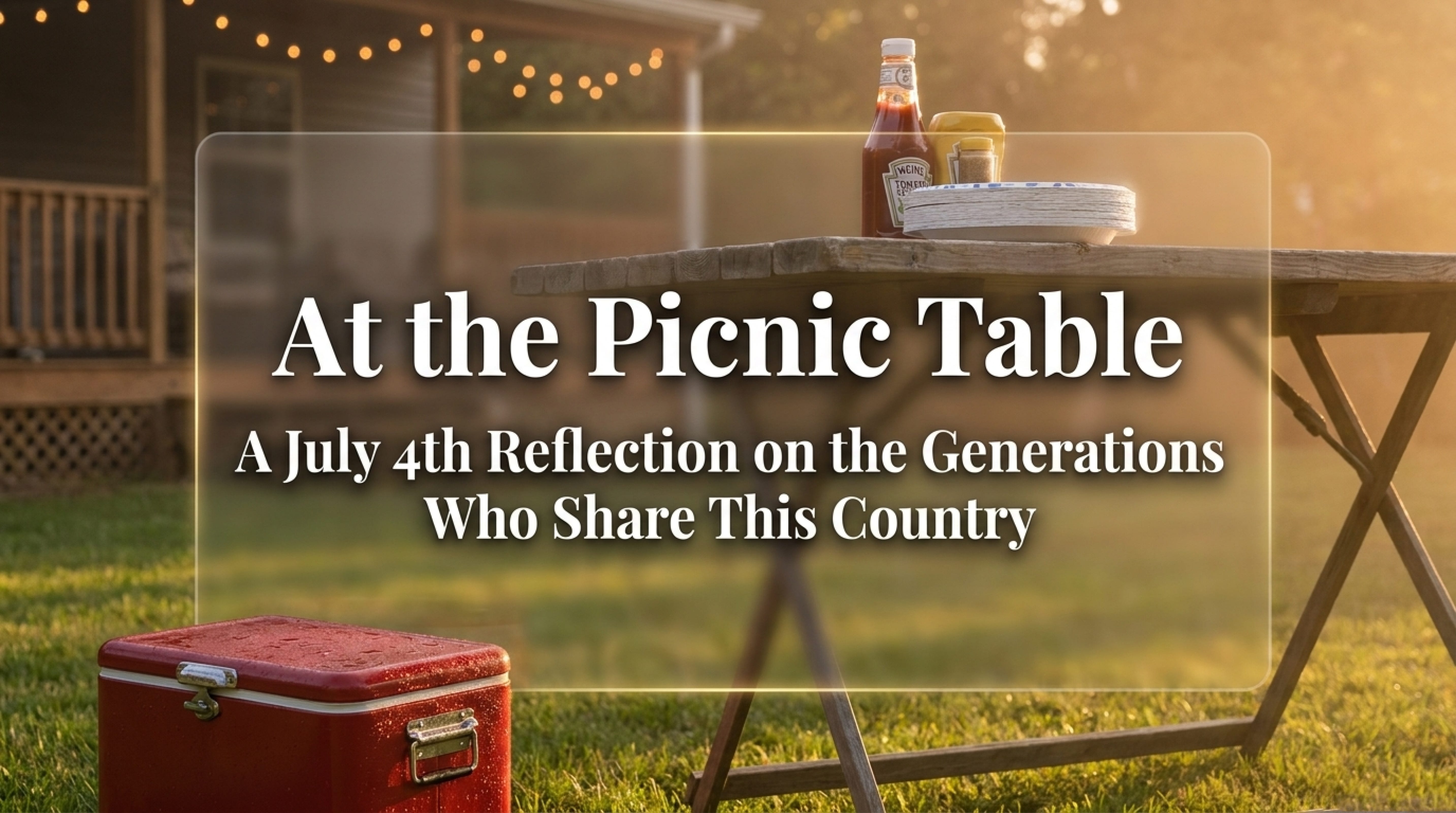
It’s the Fourth of July, and somewhere near you a folding table is going up in a backyard. Paper plates and a stack of napkins pinned down by a ketchup bottle. A cooler sweating in the grass. Somebody’s uncle is already worked up about something, and somebody’s kid is half-listening, half-somewhere-else, thumb moving across a screen. The grill ticks. A flag hangs off the porch, or it doesn’t, and either way somebody notices.
And around that table, if you stop and actually look, three or four generations of Americans are about to spend an afternoon in the same patch of shade.
Which, lately, is no small thing.
We don’t gather like we used to. The family dinner table — that nightly ritual where the old told their stories and the young rolled their eyes and everyone stayed in the room long enough to be changed by it — has mostly gone quiet. But the picnic table survives. Once a year, on this strange hot holiday, it gets dragged out into the yard and we sit down together anyway. Different politics, different memories, different ideas about what that flag on the porch even means. And we pass the potato salad across all of it.
So I don’t want to spend this Fourth wondering about who is waving a flag and why, nor do I wanna spend it writing the hundredth hot take about everything that’s wrong. America turns two hundred and fifty this year, and that feels like it deserves something quieter and more reflective than either.
It deserves a question. The kind you’d actually ask at a table.
Who’s at your table this year? Who used to be? Who did you stop calling, and why, and was it worth it?
Two hundred and fifty is a big, round, serious number. The kind that shows up on banners and commemorative coins, that gets a parade and a postage stamp. A birthday, and a milestone, and all the bunting that comes with it.
But a number that big is also a mirror. You can’t turn two hundred and fifty without catching your reflection in it — without some part of you asking how the years have actually gone, what you meant to be by now, how much of the distance between the promise and the present is just the ordinary settling of time, and how much is something you’d rather not look at.
There are two easy ways to handle a mirror like that, and both of them are a dodge. One is to wave the flag a little harder and call it gratitude — the nostalgia that needs the story to stay clean. The other is to roll your eyes at the whole production — the cynicism that’s already decided there’s nothing here worth saving. Both let you off the hook. Neither one requires you to stay in the room.
The harder thing, the thing worth doing, is the thing you do for anyone you actually love: you tell the truth about them anyway. You can hold a country the way you hold a difficult parent — with real affection and clear eyes at the same time, refusing both the airbrush and the autopsy.
And here, I’ll admit, the astrologer in me can’t help but notice the timing. Pluto takes about two hundred and forty-eight years to circle the Sun — longer than any of us gets — which means no person ever lives to feel their own Pluto return. But a country can. And a few years ago, America did. Around 2022, Pluto came back around to the exact spot it held in the summer of 1776, and it spent the years since doing what Pluto does: dragging old buried things up into the light, making us look at the gap between what we declared on paper and what we actually built. It wasn’t comfortable. It wasn’t supposed to be.
The good news, if you’re looking for some, is that the exact hit has passed. The transit that began around 2022 has technically wound down. This is the first Fourth of July on the far side of it.
But Pluto doesn’t sweep up on its way out the door. Crossing the finish line of a return isn’t the same as being done with what it dredged up — and if it still feels like we’re in the thick of it, that’s because in every way that matters, we are. The degree on the chart has moved on. The reckoning hasn’t. We’re not standing in the calm after the storm so much as in that strange, ringing stillness right after the loudest part, ears still going, not yet sure what’s left standing.
Which is maybe the more useful thing to sit with this Fourth of July. Not whether the country deserves a party. But whether we’re actually becoming who we said we’d be — and who, exactly, gets to answer that.
You know the gathering I mean. Maybe not this one, maybe not this year, but you’ve been to it. The one where somebody says the thing, and the table goes quiet in that particular way, and you can feel everyone deciding at once whether to let it go or pick it up. The one where an afternoon that was supposed to be about hot dogs and horseshoes turns, somewhere around the second helping, into a referendum on everything. Where you look across at someone you have known your entire life — someone who taught you to ride a bike, or whose diapers you changed — and you realize you genuinely do not know how they got to where they’re standing.
And it isn’t really about politics, even when it sounds like politics. It’s that you’re each living in a different country. You learned safety from different decades. You learned what a good life looks like, what’s worth fearing, what’s owed and to whom, in different worlds — and then you sat down at the same table and expected the translation to come easy. It doesn’t. It was never going to.
There used to be more practice at this. The dinner table did it for us, back when it still happened every night — that unglamorous nightly ritual where the generations were simply stuck with each other for an hour. Nobody chose it. The grandfather told the story for the fortieth time, the teenager seethed, the kid kicked the table leg, and somehow, in all that low-grade friction, the wisdom and the grudges and the recipes and the warnings got passed down anyway. You didn’t have to agree to be in the room. You just had to show up to dinner.
That table’s mostly gone now — to the two jobs, the long commutes, the screens, the thousand small conveniences that let us never be bored in each other’s company again. And I won’t pretend that was all loss; some of those nightly dinners were their own kind of misery. But we gave up something in the trade we haven’t found a way to replace. We got very good at only being around people who already agree with us, and we forgot that the other thing was a skill.
And here’s what it costs, the part we don’t tally. When the thread between the generations frays, you don’t just lose an argument. You lose the story that only your aunt knew, the one that dies with her. You lose the chance for the old wound to be witnessed by the one person who could finally say I know, I was there. You lose the thing the young were going to teach the old, and the thing the old were carrying for the young, because neither one stayed in the room long enough to hand it over.
Mostly, though, you lose people. Not to death — to distance. There’s a chair at your table that used to be full. A number in your phone you don’t call anymore. A fight that hardened into a silence that hardened into a habit, until you couldn’t quite remember whether the thing you fell out over was ever actually worth it.
It usually wasn’t.
Here’s where astrology becomes surprisingly useful.
Pluto spends about twenty years in each sign of the zodiac — long, slow soaks. Long enough that everyone born inside one of those windows gets steeped in the same deep archetype, whether they ever look up at the sky or not. It’s the underground water everyone in that cohort drank from growing up. And like anything that shapes you that early, it hands you a gift and a shadow in the same motion. The lens doesn’t excuse anybody. It just lets you see what they’re working with.
So look around the table again.
Your Boomer father or grandmother — born somewhere between 1938 and 1956 — came up under Pluto in Leo, the sign of the self made visible, the heart that needs to be seen to know it’s real. This is a generation that learned its worth by being recognized, that built whole identities around standing out and leading the charge. The gift is the fire: they changed the world precisely because they believed they were meant to. The shadow is what happens when the spotlight moves on. When your father can’t let go of the wheel, when he needs the last word, it’s worth remembering that the thing he’s actually afraid of isn’t losing the argument. It’s becoming invisible.
Your Gen X relative — Pluto in Virgo, roughly 1956 to 1972, and I’ll cop to being one of them — got the sign of the fixer, the worker, the one who keeps the machine running and quietly cleans up the mess. Latchkey kids, raised to figure it out themselves, and they did. The gift is competence and grit; they’re the ones who’ll have the cooler organized and the grill lit while everyone else argues. The shadow is the wall that competence builds. That arm’s-length self-sufficiency, the dry cynicism — it’s usually a kid underneath who learned early that the only hands you could count on were your own.
(If you’re sitting between those two and don’t quite see yourself, you might be Pluto in Libra, 1972 to 1984 — the bridge cohort, the natural diplomats, the ones who’ve spent their whole lives translating between the generations on either side of them. And by now you’re probably used to having your cohort only mentioned parenthetically. Truth is, that’s probably where you’ve usually been most effective.)
Your Millennial niece or kid brother — Pluto in Scorpio, about 1984 to 1995 — got the sign that physically cannot abide a lie. Scorpio goes to the bottom of things; it’s allergic to surface, to spin, to fine, everything’s fine. They inherited a stack of systems they could see straight through, and they refuse to pretend otherwise. The gift is depth and honesty. The shadow is that the intensity never clocks out — they can’t just let the cookout be a cookout, because under everything they can feel what’s not being said.
And the Gen Z kid on the phone — Pluto in Sagittarius, 1995 to 2008 — got the seeker’s sign, hungry for meaning and the genuine article. They can smell a hollow answer from across the yard. What looks like checked-out apathy is more often exhaustion: the specific tiredness of wanting things to actually mean something and being handed branding instead.
None of this is a verdict. It’s not a box you put your father in and snap the lid on. It’s a guess — a decent, generous guess — at what he’s quietly working through, the same way you’re working through yours. The person across the picnic table isn’t a demographic. They’re a parent, a kid, the aunt with the story nobody else remembers. They showed up today carrying something they were handed and something they’re still trying to set down.
But knowing all this and doing it are two different animals.
Because curiosity is easy to recommend and difficult to practice. You can read every word of this, nod along, mean every bit of it — and then sit down across from your actual father, and the old grooves take over, and within ten minutes you’re right back in the argument you’ve been having for thirty years. Good intentions don’t survive contact with the people who can hurt you the most. I know mine often don’t.
What’s usually missing isn’t the willingness. It’s the way in. A question that isn’t a trap. Somewhere to start that isn’t the same worn-out fight or the same careful small talk that keeps everyone safely strangers. Most of us were never taught how to ask the people we love the things we actually want to know — so we don’t, and the afternoon passes, and the chance goes with it.
That’s the whole reason this next thing exists.
Recently, my partner and Collective Souls Podcast co-host Mari built something out of exactly this ache — a way to get people at a table to ask each other the questions that matter and then, harder, to actually listen to the answers. It’s generous and earnest in a way that, frankly, only a Pluto in Libra soul could have made: that bridge-generation instinct for standing in the gap between people and gently translating one to the other, turned into something you can actually hold in your hands. She called it At the Picnic Table.
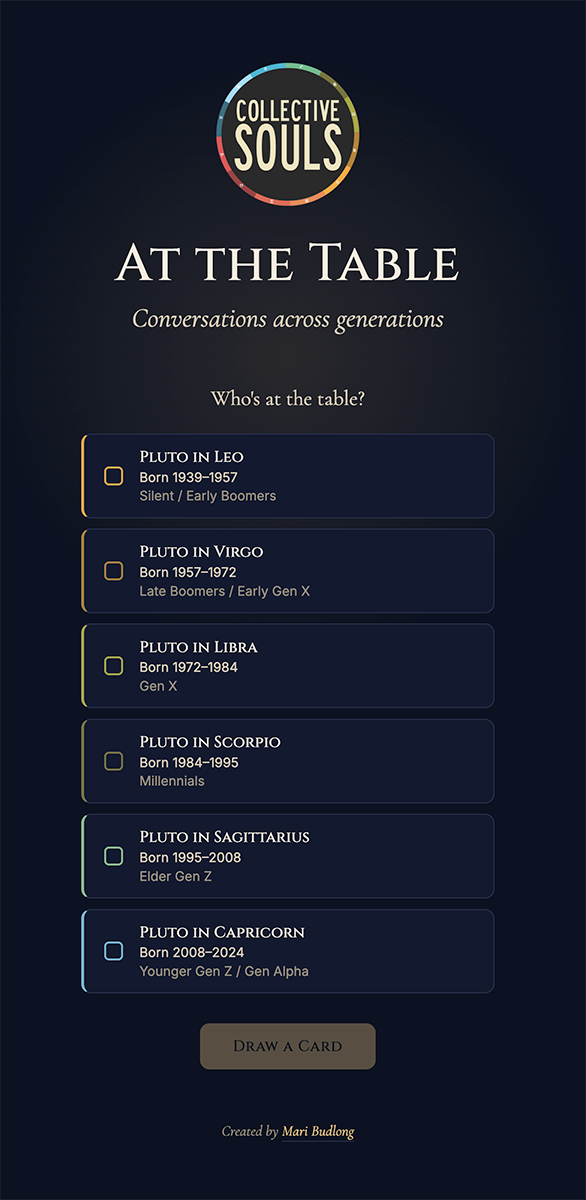
Try the web app here. No download necessary.
It works about how you’d hope: no scoring, no winning, no hot seat. Just questions — some light, some that sneak up on you — meant to be passed around a table the way you’d pass the potato salad. What’s something you believed at my age that you don’t anymore? When were you the most scared? What do you wish someone had told you? The kind of thing you’d never think to ask your uncle, and that your uncle has maybe been waiting his whole life for someone to ask.
The point isn’t to fix the family or settle the argument. It’s smaller and sturdier than that. It’s to remember that the person across from you has a whole interior life you’ve been driving past for years — and to give you a door into it that isn’t the front door everybody already knows is locked.
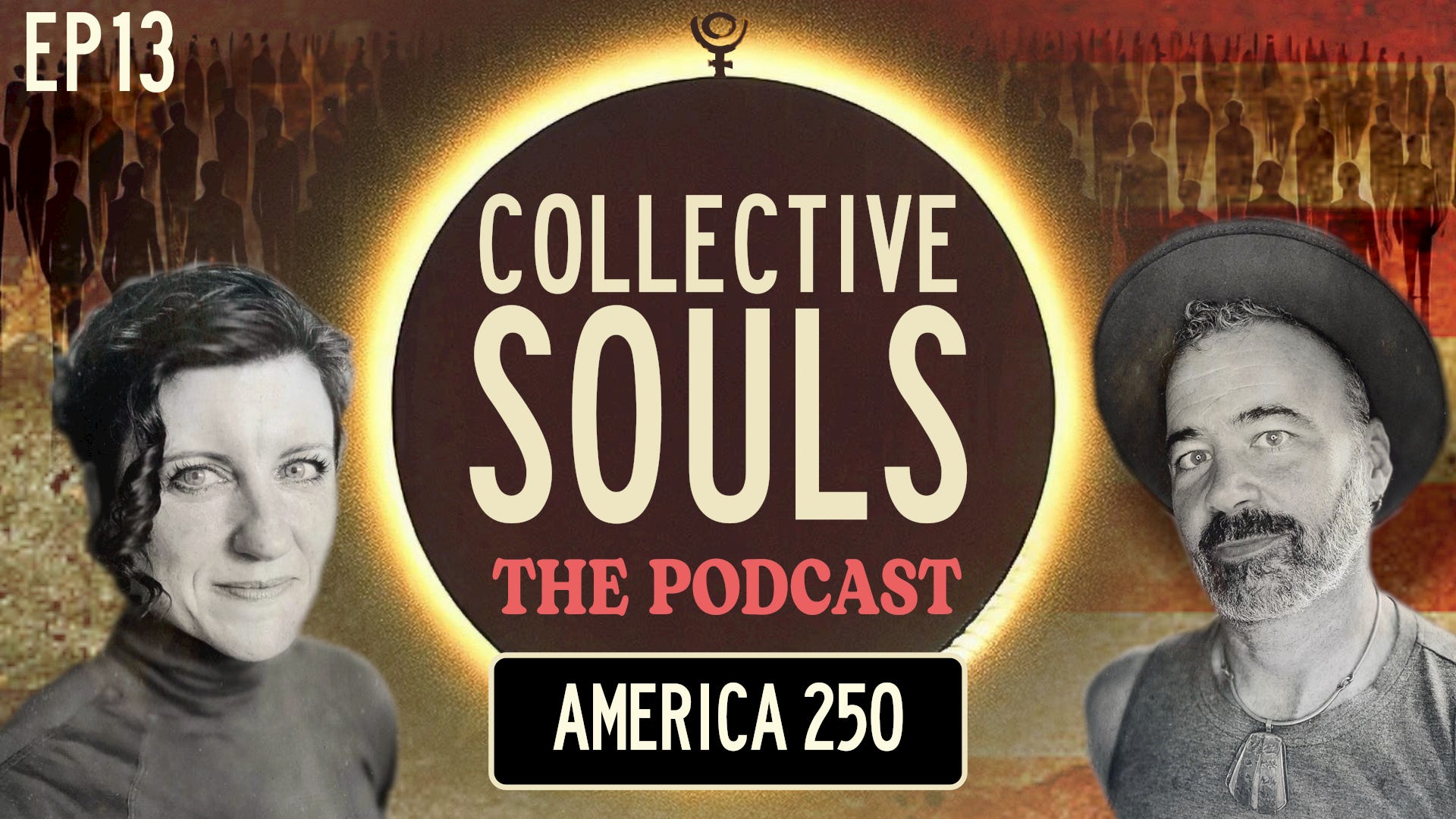
For the Fourth, Mari and I sat down and recorded an episode of the podcast in that same spirit — two people from different generations talking honestly about what this two-hundred-and-fiftieth birthday actually stirs up, where we land differently, and what it takes to stay in the conversation when it’d be easier to leave. It’s a link below, if you want company while the burgers cook.
None of this is a prescription. I’m not telling you to download a thing or fix your family by sundown. The app is just a tool, the episode is just two people talking, and the only real invitation underneath both of them is older and plainer than either: find your way back to the table. Whatever your table is. Whoever’s still at it.
Two hundred and fifty years is a long time for any experiment to run, and the thing about this one was always that it never finished. It doesn’t get finished by elections or speeches or whoever’s in charge this year. It gets finished, or it doesn’t, in a thousand small rooms and backyards — in whether we keep showing up to the table, and whether we let the people already there be more complicated than the version of them we’ve settled on.
The country isn’t a monument you visit. It’s a conversation you’re in, whether you meant to join it or not. And the conversation only continues if somebody’s willing to sit back down.
So that’s the whole of it. Not who’s right. Not who ruined it. Just — pull up a chair. Pass the potato salad. Ask the question you’ve been meaning to ask. The reckoning will still be there tomorrow; the afternoon won’t.
Happy 250th, America. Enjoy the fireworks, and stay safe out there.
Comments
Nothing yet. Say the first thing.
Sign in to join the conversation.