
All the news that’s fit to be tied
Subscribe via RSS feed musicwire.substack.com/feed
June 25, 2026
By David Gross, Punmaster MusicWire
With the passing of Clive Davis at age 94, the music world has lost one of its most influential figures—not a singer, songwriter, producer, or musician, but something far rarer.
A listener.
There are record executives who chase trends.
There are record executives who create trends.
And then there was Clive Davis, who somehow spent more than six decades doing something even more difficult: recognizing greatness before everyone else did and then having the patience not to ruin it.
That may sound simple.
It isn’t.
The history of the music business is littered with executives who heard something unusual and immediately tried to make it more commercial, more predictable, more radio-friendly, more like whatever sold last year.
Clive Davis often did the opposite.
At a time when artists were frequently viewed as products, Davis understood something many executives never learned: the very qualities that made an artist difficult to market were often the same qualities that made them great.
When a rough-edged blues singer from Port Arthur, Texas named Janis Joplin exploded onto the national scene, she wasn’t exactly the kind of artist corporations typically built around. She was wild, unpredictable, impossible to package neatly.
Davis understood that was the point.
When a young New Jersey songwriter named Bruce Springsteen delivered albums that sold modestly but hinted at something larger, Davis resisted the temptation to measure the future by current sales figures.
Davis saw the future.
When Simon & Garfunkel seemed too literary and too thoughtful for the conventional rules of pop radio, he saw poetry where others saw limitations.
When Santana blended rock, jazz, blues, and Afro-Latin rhythms into something that sounded unlike anything on American radio, Davis didn’t ask Carlos Santana to simplify it.
He let Santana be Santana.
That’s a surprisingly rare skill.
The Grateful Dead spent much of their career functioning as if they were actively trying to confuse record companies. They built a massive audience while largely ignoring the traditional rules of the music business. Yet Davis understood that the Dead’s value wasn’t in forcing them into a conventional mold.
It was in recognizing that the mold itself was the problem.
The same instinct appeared again and again.
Sly Stone was unlike anybody else.
Patti Smith sounded like nobody on the radio.
Miles Davis reinvented himself so often that even jazz purists occasionally lost track of where he was headed.
Whitney Houston possessed one of the greatest voices of the twentieth century, but even extraordinary voices require someone capable of recognizing just how far that gift could go.
Different artists.
Different eras.
Different audiences.
The common denominator was Clive Davis.
What made Davis unique was that he could hear both art and commerce at the same time.
Most people in the music business lean heavily toward one side or the other. Artists often hear only the art. Accountants hear only the numbers.
Davis heard both records and careers.
He could recognize a hit single while simultaneously understanding that careers are built over years, not weeks.
That’s why his influence stretches across such wildly different corners of popular music.
Janis Joplin.
Santana.
Simon & Garfunkel.
Bruce Springsteen.
Patti Smith.
Whitney Houston.
The Grateful Dead.
Sly and the Family Stone.
Miles Davis.
The list looks almost impossible on paper. These artists have about as much in common as a jazz club, a psychedelic ballroom, a New York poetry reading, and a New Jersey bar band.
Yet Davis found something in all of them.
Authenticity.
He seemed to understand that audiences could detect the real thing.
Not immediately, perhaps.
But eventually.
The irony is that Clive Davis became one of the most powerful executives in music history by repeatedly betting on people who didn’t fit established formulas.
The industry often talks about visionary artists.
It talks less about visionary listeners.
But that’s really what Davis was.
A listener.
A listener who heard possibility in Janis Joplin’s howl.
A listener who heard greatness in Bruce Springsteen’s sprawling songs.
A listener who heard poetry in Simon & Garfunkel.
A listener who heard transcendence in Santana.
A listener who heard genius in Miles Davis.
And a listener who understood that sometimes the most important thing a record executive can say is nothing at all.
In an era increasingly dominated by algorithms, market research, streaming metrics, and instant reactions, Clive Davis represented something almost old-fashioned: human judgment.
One pair of ears.
One set of instincts.
One remarkable ability to recognize talent before the rest of the world caught up.
The artists made the music.
But Clive Davis built something almost as impressive.
He built the space for that music to happen.
And as the music world says goodbye to him, that may be his greatest legacy of all.
By David Gross, Punmaster MusicWire
David Clayton-Thomas, the powerhouse vocalist whose arrival transformed Blood, Sweat & Tears from an ambitious musical experiment into one of the biggest bands on the planet, died June 24, 2026, in Toronto. He was 84.
For a brief but unforgettable stretch of time, Clayton-Thomas possessed one of the most commanding voices in popular music—a voice that could sound like a blues shouter, a jazz singer, a soul man, and a rock frontman all within the same song.
His story is one of rock’s great second acts.
When Blood, Sweat & Tears founder Al Kooper departed after the group’s 1968 debut album, many assumed the band’s daring fusion of rock, jazz, blues, and horn arrangements might not survive. Instead, the arrival of the gravel-voiced Canadian singer from Toronto ignited a commercial explosion few could have predicted.
Suddenly, Blood, Sweat & Tears wasn’t merely an intriguing experiment—it was a phenomenon.
The band’s self-titled 1968 album became a cultural earthquake, spawning hits including “Spinning Wheel,” “You’ve Made Me So Very Happy,” and “And When I Die.” It went on to win Album of the Year at the Grammy Awards, beating a little record called Abbey Road.
That victory remains one of the most surprising upsets in Grammy history.
Yet statistics alone fail to explain Clayton-Thomas’s impact.
Blood, Sweat & Tears featured virtuoso musicians, sophisticated arrangements, and enough brass to stock a small orchestra. But it was Clayton-Thomas who connected the band’s complexity to the back row of the arena. His voice was the bridge between jazz charts and transistor radios.
He didn’t sing songs so much as attack them.
On “Spinning Wheel,” he sounded like a carnival barker delivering life lessons. On Laura Nyro’s “And When I Die,” he seemed to stare mortality directly in the face and shrug. On stage, he prowled, growled, preached, and testified.
Unlike many rock singers of the era who chased mystique, Clayton-Thomas projected grit. He sounded less like a counterculture poet and more like a man who’d already lived three lifetimes before stepping into the studio.
Which, in many ways, he had.
Long before fame, he survived a difficult youth, reform school, odd jobs, and countless miles on the Canadian club circuit. Those experiences never left his voice. Every note carried the weight of somebody who had earned it the hard way.
As musical fashions shifted through the 1970s, Blood, Sweat & Tears’ moment at the center of popular culture faded, but Clayton-Thomas never stopped performing. He remained one of the most recognizable voices to emerge from the era when rock bands dared to mix sophistication with commercial ambition.
Today, the phrase “jazz-rock” often sounds like a genre description.
In 1969, it sounded like David Clayton-Thomas.
He arrived as the replacement singer in somebody else’s band and somehow became the sound most people remember.
Not a bad legacy for a guy who wasn’t there at the beginning.
But without him, Blood, Sweat & Tears’ story would have been very different—and perhaps far shorter.
David Clayton-Thomas leaves behind one of the great voices of the rock era: tough, soulful, unmistakable, and powerful enough to make an entire horn section sound like it was following him rather than the other way around.
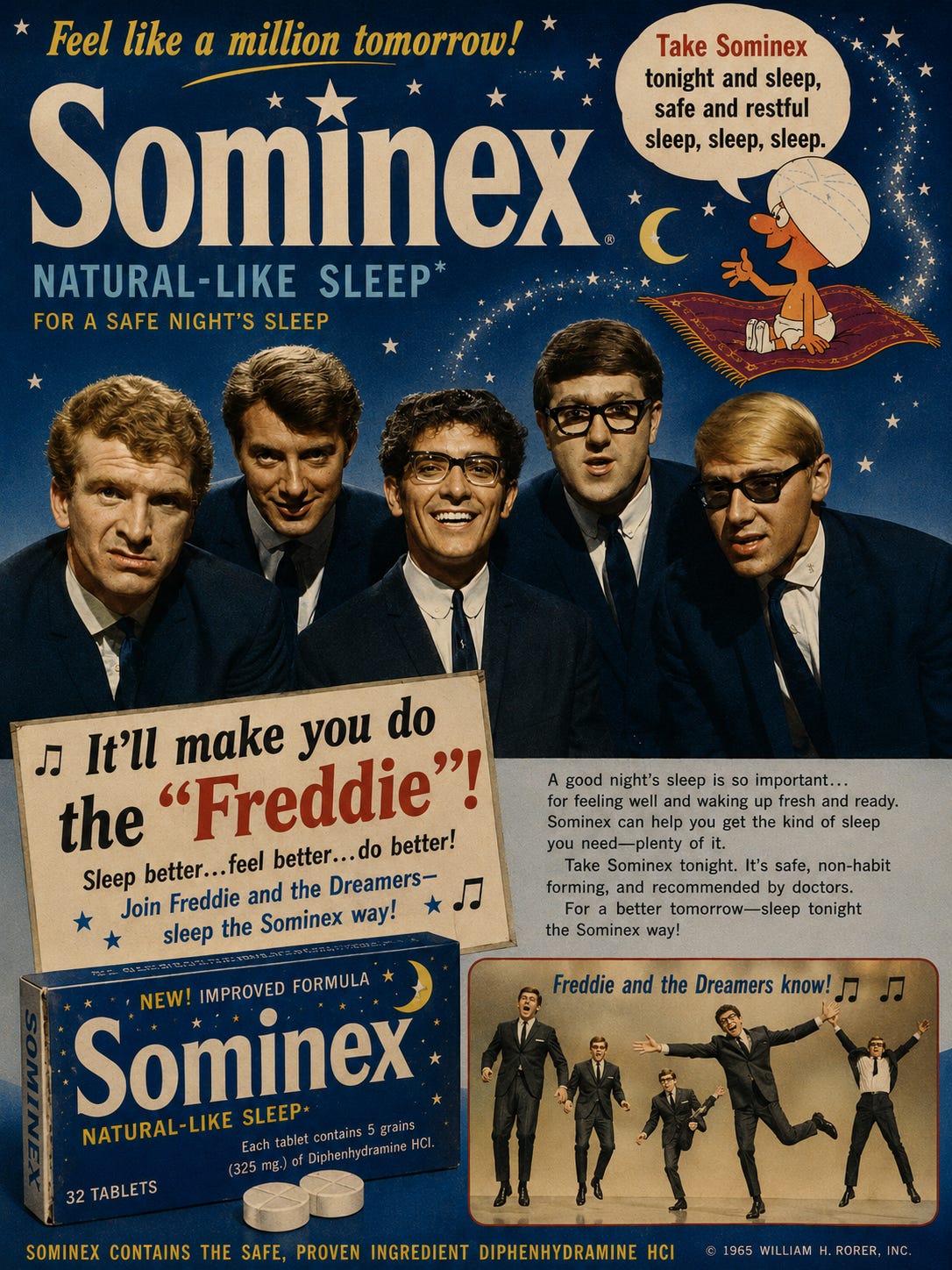

What do these songs have in common?
Mother-in-Law, Runaway, Quarter to Three, and Travelin’ Man.
The answer will appear in the next MusicWire...
The Traveling Wilburys owe their name to a six-word sentence spoken during the recording of George Harrison’s Cloud Nine album.
Question:
What was that sentence?
Bonus Question:
What was the original proposed name before “Traveling Wilburys”?
Answer: "We'll bury 'em in the mix"
Bonus Question: The Trembling Wilburys
Thanks to this week’s winners: Matthew Bolin, Paul “Lobster” Wells

Two turbo-charged hours of high-octane roots, rockabilly & revved-up classics!
Rebroadcast Saturday nights at 7PM
Kickstart your weekend—guaranteed.
Listen live at KRSH.com
Download the free KRUSH mobile app
Or tune in to 95.9 The Krush in Sonoma County, CA
Tell 40 or 50 of your closest friends!
Check out the web site at rockabillyroadhouse.com
It's time to get down to the Main Gazane with Big Dave!

BREAK OUT THE HEADPHONES!
Hosted by Big Dave, the Saturday Night Album Trax features some of the greatest albums ever recorded. Deep cuts, live albums, extended tracks, rarities and themes. Plus get the background and inside stories on these classic albums.
These are the good old days!
STREAM IT LIVE at KRSH.com

“I’m a part of the I like ice cream watermelon soup generation.” ~ Allen Ginsberg
“Rock journalism is people who can’t write interviewing people who can’t talk in order to provide articles for people who can’t read.” - Frank Zappa
“The older you get, the better you were!” - Leslie West
“I opened the door for a lot of people, and they just ran through and left me holding the knob.” - Bo Diddley
“I’m as country as a dozen eggs.” - Elvin Bishop
“Elvis may be the King of Rock and Roll, but I am the Queen.” - Little Richard
“If you think you are too old to rock ‘n roll, then you are.” - Lemmy Kilmister
"If you tried to give rock and roll another name, you might call it 'Chuck Berry’.” - John Lennon
“The old-timers schooled me good. They brainwashed me to respect music, whether we were playing rockabilly or blues or rock and roll.” - Dr. John
“It’s much too late to do anything about rock & roll now ...” - Jerry Garcia
“Hippies? Why, I’m the original.” - Jerry Lee Lewis
"David Gross (Punmaster MusicWire) is the Arianna Huffington of music news!" - Barry "The Fish" Melton
"Rock and roll is here to stay.” - Neil Young
“The reason kids like rock ‘n roll is their parents don’t.” - Mitch Miller
“Rock ’n roll is really swing with a modern name. It began on the levees and plantations, took in folk songs, and features blues and rhythm. It’s the rhythm that gets to the kids – they’re starved of music they can dance to, after all those years of crooners.” - Alan Freed
“If I were not a physicist, I would probably be a musician. I often think in music. I live my daydreams in music. I see my life in terms of music.” - Albert Einstein
“The music business is a cruel and shallow money trench, a long plastic hallway where thieves and pimps run free, and good men die like dogs. There’s also a negative side.” - Hunter S. Thompson
"Mike Love, not war." - Scott Mathews
"I have outlived my dick" - Willie Nelson (2008)
Visit the archive: https://musicwire.substack.com/archive
Subscribe via RSS feed musicwire.substack.com/feed
No posts
Comments
Nothing yet. Say the first thing.
Sign in to join the conversation.