
Dear Music Thinkers around the world,
Welcome to your May listening session. This month, we are exploring what happens when the intense discipline of classical music collides with high-level science. How do you “tune in” to a team under immense pressure? How do you map out a journey into the unknown - whether it’s an academic department or a NASA space probe? And what does an outside walk listening to bird songs might have in common with K-POP?
Grab a cup of tea or coffee, and let’s dive into the intersection of sound, strategy, design, and cosmic curiosity.
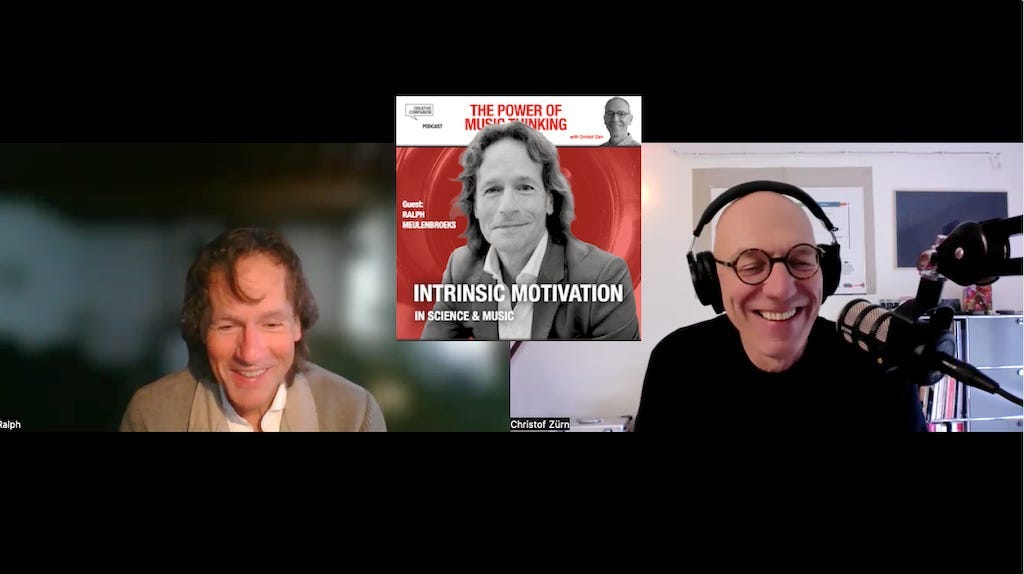
What can silently tuning a delicate 18th-century instrument under immense pressure teach us about leading a modern team of 120 academics?
In our newest episode, we explore the fascinating parallels between extreme musical performance and high-level scientific leadership. Our guest is Ralph Meulenbroeks, a true polymath who has led a remarkable multitrack life. He is a full professor of scientific literacy at Utrecht University, but he also spent ten years touring the world as a professional, award-winning viola da gamba player.
First, you will discover the intense psychological pressure of playing Bach’s St. Matthew Passion. Ralph describes the nerve-wracking reality of waiting backstage for 45 minutes, silently adjusting highly sensitive gut strings to changing temperatures. More importantly, he reveals how this intense musical discipline translates directly into “tuning in” to the emotional temperature of his academic team.
Furthermore, Ralph shares his expert research on what almost everyone gets wrong about ‘intrinsic motivation’. You will learn why true motivation means the activity itself is the reward, and why the ultimate leadership tool is practicing the instant forgiveness found in musical ensembles from classical to free jazz.
🎧 Click here to listen to Intrinsic Motivation in Music and Science with Ralph Meulenbroeks.
You can also listen to it on:
Spotify, Apple, and YouTube or wherever you listen to podcasts.
A companion episode from the archive
Did Ralph Meulenbroeks’ fascinating dual-track life in science and music leave you wanting more? If so, we have the perfect companion episode for you from our archive.
In Episode 46, we head into outer space with Dr Mariana Wagner. She is an astrophysicist, a songwriter, and a composer who creates immersive live shows about sound and space.
Her career journey is truly unique. She started out studying the physics of oceanography, worked as a songwriter for German pop stars (Schlager!), and ultimately became a doctor of astrophysics studying exoplanets. Instead of choosing just one path, she found a way to combine them all.
In this episode, Mariana brings some incredible actual space recordings to the podcast:
A fascinating “conversation” between Saturn and one of its icy moons.
An excerpt from the famous Golden Record that has accompanied the Voyager spacecraft since 1977.
The actual grooving, rhythmic sound of moving plasma from inside the sun.
If you love exploring the intersection of science, music, and the universe, you will not want to miss this one.
🎧 Click here to listen to:
Music and Astrophysics with Dr. Mariana Wagner
Listen on Spotify, Apple or any other player.
Are you enjoying these deep dives into the minds of musical polymaths? Make sure to subscribe to this Substack and follow the podcast on your favourite app so you never miss an insight!
Every month, I share one of the jam cards with you for inspiration, to think out loud, or just as a trigger to train your music thinking.
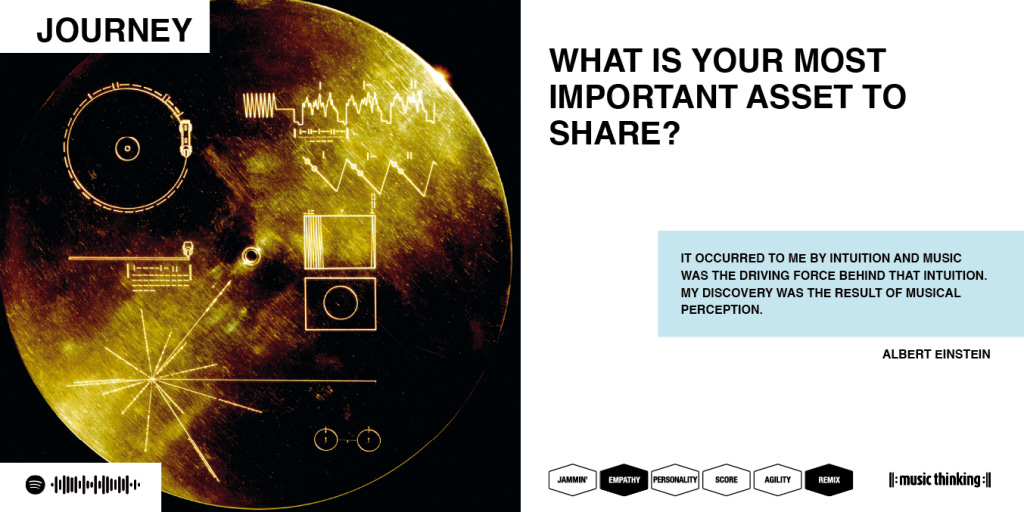
The essence of the Journey card is to think about what our most important assets are. It means, what is the most important asset that we have to keep when we are going on a journey. This is important when you think about a space mission, but also when we think about our products and services, our companies communication, brand message and the values we want to share with our stakeholders. Stakeholders we know now, but also potential stakeholders of the future. When considering the ultimate asset for a grand journey, Albert Einstein pointed directly to a force driven by music thinking.
The Quote
“It occurred to me by intuition, and music was the driving force behind that intuition. My discovery was the result of musical perception.”
Albert Einstein
Backstory
Look closely at the JOURNEY card graphic. In 1977, NASA launched two spacecraft on a grand tour of the solar system and into the mysteries of interstellar space. Attached to each of these probes is a golden phonograph record containing pictures and sounds as a message for extraterrestrial intelligence that might encounter it. Each record is encased in a protective aluminium jacket, together with a cartridge and a needle. Instructions, in symbolic language, explain the origin of the spacecraft and indicate how the record is to be played.
So from a service design perspective, NASA has given instructions for extraterrestrials how to use this record. That is a great job and you should have a look on the website if you would be capable in understanding these instructions. The idea of the golden record was to send the most essential probes of our culture into space, so that extraterrestrials would understand our nature, wow! So the record has been featured in several works of science fiction. In the 1984 film “Starman,” a race of aliens discovers the record and sends an emissary to Earth to learn more about our planet.
The Golden Record consists of 115 analogue-encoded photographs, greetings in 55 languages, a 12-minute montage of sounds on Earth and 90 minutes of music. But did the American team include Russian music at the height of the Cold War?
Find the answer on the Behind the Cards page plus a complete playlist of the Golden Record.
Every day, I find something interesting that connects to listening, sound, and co-creation from a music-thinking perspective; it drives me to read and think. I am sharing this with you to start exploring and having a conversation. Let me know your thoughts via Substack.
In a study at the University of Tübingen published on ScienceDirect in early 2026, 233 people walked through the botanical garden in groups, with one group asked to pay deliberate attention to birdsong. Blood pressure, heart rate and salivary cortisol all fell after the half-hour stroll.
Effects of nature experience on mental well-being and physiological stress parameters in an experimental bird walk setting – the role of bird song.
A beautiful digital story about Growing up with K-Pop from the fabulous Pudding website, where two friends tell the story of their friendship through every generation of K-Pop.
What started in 2011 as an idea and framework has officially evolved. 2026 marks our transition into the Music Thinking Society - a Foundation in the making.
I am truly looking forward to sharing this pivotal 15th-anniversary year with you, as well as the next fifteen years leading us toward 2041. If you are interested in navigating the cues and rhythms of business and life strategies through a musical lens, I am honoured to have you in the ensemble.
Please forward the newsletter if you think you can make someone happy!
Let’s listen, tune, play, and perform together.
Best regards,

Founder, Music Thinking Society
No posts
Comments
Nothing yet. Say the first thing.
Sign in to join the conversation.