
Who can show you the right way? Since years, the traditional ‘command and control’ models are breaking – and leaders are searching for new ways to organise, innovate, and connect.
How can Music help? There are patterns and structures in music, that can also be applicable for well, you name it. I call the analogies, learnings, instruments or whatever musical strategies there are Music Thinking, with the intention to inspire people who want to lead, with unknown patterns they can apply in their field.
So, Music Thinking might provide the structure you are missing today. Among other things, it offers a dynamic-strategies framework to turn abstract purpose into concrete performance.
My name is Christof Zürn - founder and music thinking evangelist - and this publication is the digital home of the Music Thinking Society.
I show leaders and thinkers how to use musical principles to transform the way they work, communicate, and lead. Subscribe for insights from my book, research, and practice to help you become a more humane, adaptive, and co-creative person.
Most business books use music as a superficial, high-level metaphor. We read about the conductor that controles everything and everyone, the creative jazz player and there are ex[ressions in our language that come from music, like: playing the first fiddle, let’s rock this, riffing about a theme or pulling the stops.
Music Thinking wants to go deeper – it uses music as an analogy to examine how people work, communicate, and create together. If we take the afore menioned conductor, is he really the leader? Or is he tthe first follower of the composer? And what happens behind the scene, how do people get paid and how does the audince enter the room. I think you get the idea. If we dive deeper we find more patterns and principles how people work together.
For example, classical music is not better than jazz, nor is pop superior to folk. Instead, they represent different organisational dynamics. The framework helps you understand these dynamics and fluidly shift your leadership positions – from the visionary Composer and detail-oriented Orchestrator to the real-time Improviser and supportive Producer. And back again if this is needed.
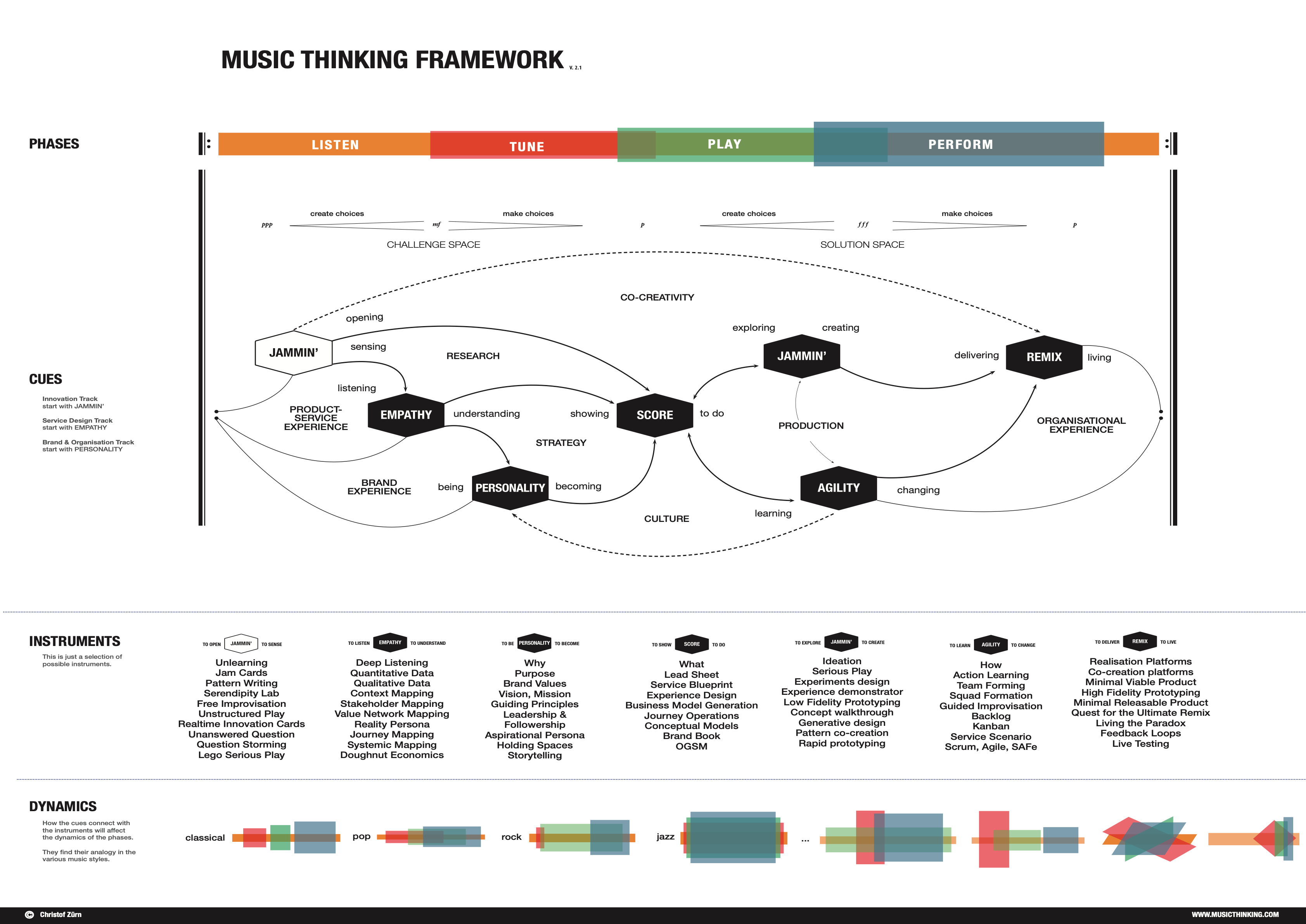
To visualise the main relationships I created a framework. It has four overlapping phases: Listen, Tune, Play, and Perform.
Listen: Getting new qualitative and quantitative information in the broadest sense.
Tune: Making decisions based on insights from that information, aligning with your purpose.
Play: Challenging insights and co-creating unexpected solutions.
Perform: Putting it all together to execute and ship the best possible outcome in the given time.
Listening is active across all phases – our ears are “always on”, constantly receiving and filtering data. And please recognise the ||: repeat signs :|| everything is a big loop like in real life. You can use it for your personal endeavour, team, organisation, or for whatever you think it helps.
Here is the static version of it, imagine that every element is free to take any place and any relation - like in a modular synthesizer. But that is a different story.
To help you navigate the rich library of resources, essays, and interviews compiled over years of practice, I have organised them into three distinct pathways. It is a start to get into as quick as possible and get a hang of what I mean with analogies. And there are fun as well :-)
You can jump directly into what matches your current challenge.
Most of them are from The Power of Music Thinking podcast and you can listen along conversations with extraordinary people that are exceptionable in their field and also musicians.
For leaders who want to move from rigid command-and-control structures to adaptive, high-performing ensembles.
Read: Why modern leaders need to stop conducting and start synthesising – Explore how to transition from an authoritative classical conductor on a podium to a synthesizer who “patches the cables” between team capabilities.
Listen: Leading an Orchestra of Leaders with Harvey Seifter – Discover how the Orpheus Chamber Orchestra has performed flawlessly without a conductor for 50 years by giving every musician the “full score” instead of just their individual parts.
Listen: Brands as Patterns with Marc Shillum – Learn how brands can maintain operational consistency without becoming static by using flexible cadences and organizational patterns.
For teams navigating complex, messy environments where rigid planning fails and real-time co-creation is required.
Listen: The Jazz Process to Innovation with Adrian Cho – Learn why high-performing teams must manage uncertainty and “play through mistakes” just like a seasoned jazz quartet.
Listen: From Beethoven to AI Agents with Matthias Röder – Discover why generative AI should be treated as a “living archive” or a co-creative collaborator rather than a functional replacement.
Listen: Modular Strategies with Rikkert Achtereekte – Experience how modular synthesizers perfectly mirror the input-output dynamics of highly successful IT engineering and collaborative team design.
For teams seeking to build psychological safety, break down silos, and cultivate a deeper sensory awareness.
Listen: A Love Letter to Sound with Dr. Nina Kraus – Learn the neuroscience behind how our daily engagement with sound shapes our brains, biology, and capability to communicate.
Listen: Active Listening and Sonic Diversity with Steve Keller – Discover how simple acoustic and sensory hacks can break automatic habits and open up your team to genuine, active listening.
Listen: Deep Listening with Sharon Stewart – Explore the practice of “listening with” others rather than just “listening to” them, and learn how to draft your own “text scores” for business workshops.
If you want to hold the analogies in your hands and bring them directly into your physical workspace, we have developed two foundational instruments:
The Book: The Power of Music Thinking (2022) A visual, black-and-white guide designed to be coloured with your own experiences. It lays out the complete mechanics of the framework, mapping out how the six cues and four phases help you solve complex challenges.
Where to get it: Available at major book retailers globally or directly from BIS Publishers (use the code musicthinking20 for a 20% discount).
The Deck: The Jam Cards (2018) A set of 38 large, visual inspiration cards sized like 45 rpm vinyl records. Every card features scannable Spotify codes to trigger auditory inspiration, alongside prompts, trigger questions, and quotes.
Where to get it: Available via musicthinking.com/jam-cards/
We believe the future of leadership is not about conducting from a high, isolated podium – it is about the fluid, shared dynamics of an interactive ensemble (on stage and off stage).
Free Subscribers: You will receive our monthly newsletter containing the latest podcast episodes, curated essays, archive highlights, and recommended academic research.
Paid Supporters: By pledging your support, you help keep this publication independent and ad-free. In the future, this tier will unlock exclusive downloadable PDFs, step-by-step facilitation scripts for the Jam Cards, and ready-to-use “Text Scores” to guide your team meetings.
If you are ready to stop managing the noise and start synthesising value, subscribe below to join our community for free now.
This is for people with a music heart and a wicked job!
If you are interested in custom-made corporate programmes, coaching, or bringing a Music Thinking Masterclass to your leadership team, please reach out directly via our Course Overview or email: backstage@musicthinking.com
No posts
Comments
Nothing yet. Say the first thing.
Sign in to join the conversation.