
The three stages every master passes through — and what each one demands before the next one opens.
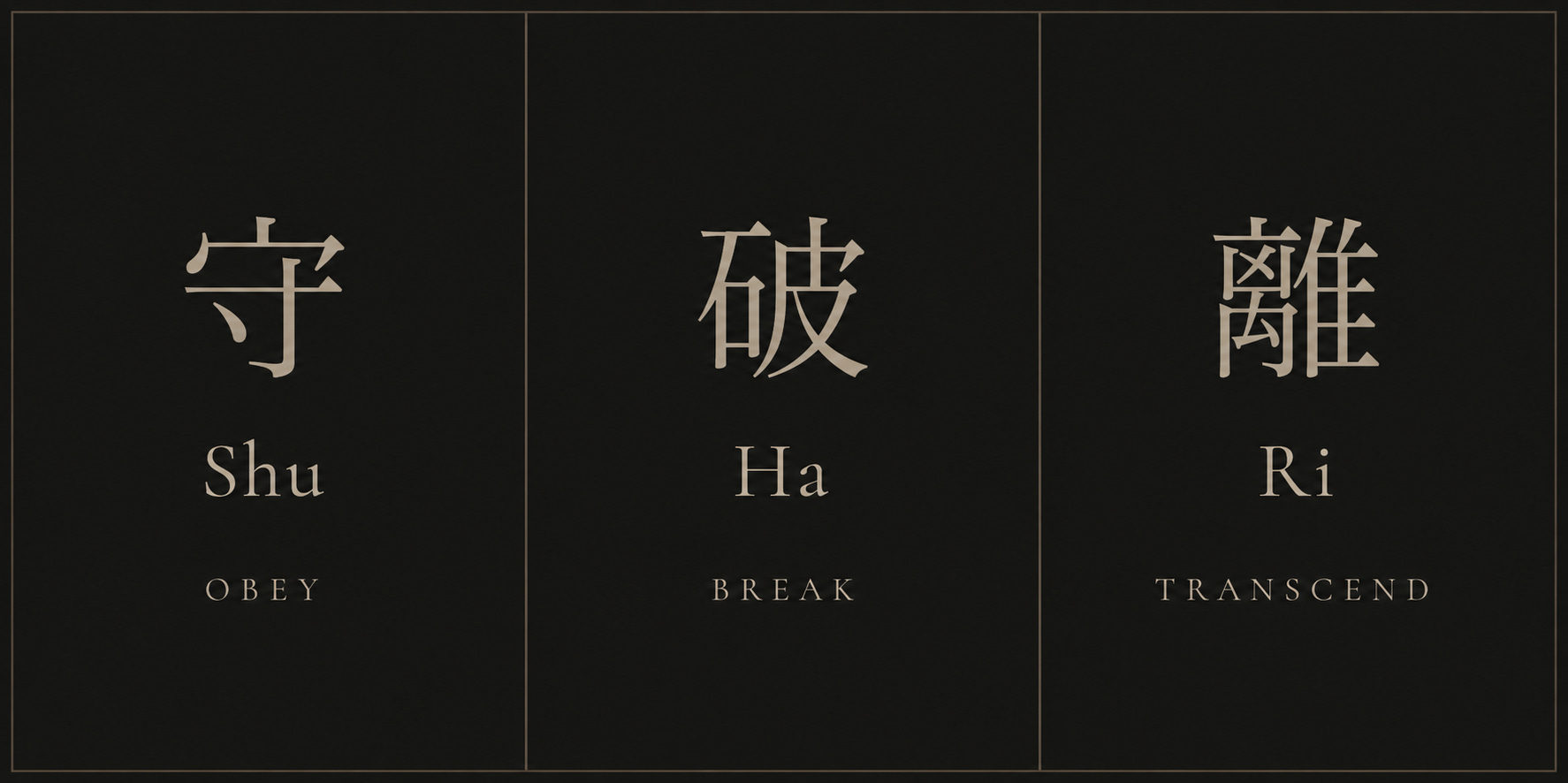
Mastery is not a destination. It is a progression through three distinct stages, each with its own demands, its own disciplines, and its own specific danger. The Japanese called this progression Shu-Ha-Ri. And understanding where you are within it is one of the most useful things a practitioner can know.
Most practitioners who are pursuing excellence, in any discipline, are operating without this map. They are working hard, applying themselves, accumulating experience, and wondering why the progress feels uneven, why certain things click and others resist, why what worked at one level seems to stop working at the next. The answer is almost always that they have moved into a new stage without recognising it and are therefore applying the wrong tools to the new terrain.
Shu-Ha-Ri gives you the map. It does not make the journey easier. Nothing makes the journey easier. But it tells you where you are, what the current stage requires, and what the next stage will demand when you arrive at its threshold. That knowledge is not comfort. It is orientation. And orientation, on a long path, is everything.
“It is said that the student of the arts should follow the master’s instructions with care, without deviation.”
— Zeami Motokiyo, on the foundations of Shu-Ha-Ri
Obey the rule · The stage of discipline
The first stage is the hardest to accept and the easiest to understand. Shu means to protect, to obey, to follow without deviation. The student in Shu does not question the form. He does not improvise. He does not bring his own interpretation to the technique before he has mastered the technique as it was given to him.
In the sword tradition, this meant years of repeating the same cuts, the same stances, the same sequences, thousands of times, until the body knew them without the mind’s involvement. The beginner who wants to express himself before he has earned the right to expression is the beginner who will never move beyond this stage. Because Shu is not a limitation. It is a foundation. And a foundation that has been skipped cannot be built upon.
The danger of Shu is impatience. The student who can see the next stage, who can glimpse what breaking the rules might look like, who finds the repetition of fundamentals beneath his sense of his own progress. This is the most common failure on the path to mastery. Not the inability to learn the fundamentals but the unwillingness to stay in them long enough for them to become instinct rather than effort.
Musashi spent years in Shu. He did not arrive at sixty duels undefeated by being creative in his first fight. He arrived there by mastering the foundation so completely that when the time came to depart from it, the departure was not a rebellion against the form but a natural outgrowth of it.
IN YOUR DISCIPLINE
You are in Shu when the fundamentals still require conscious attention. When you have to think about the mechanics of the thing rather than simply doing it. When the form is still external to you rather than part of you. This is not failure. This is the correct experience of the first stage.
The instruction here is singular: do not leave early. The foundation is not a phase to pass through quickly. It is a territory to be inhabited completely before the next territory opens.
Break the rule · The stage of exploration
Ha means to break, to detach, to begin the process of departure from the form that Shu established. But the breaking of Ha is not rebellion. It is not the impatient student deciding the rules no longer apply to him. It is something far more specific and far more earned: it is the practitioner who has mastered the form so completely that they can now see its edges, understand its limitations, and begin to test what lies beyond them.
Comments
Nothing yet. Say the first thing.
Sign in to join the conversation.