
I was standing in the Vancouver Art Gallery, in front of a five-foot monolith made of dead phones, typing notes about it into my phone.
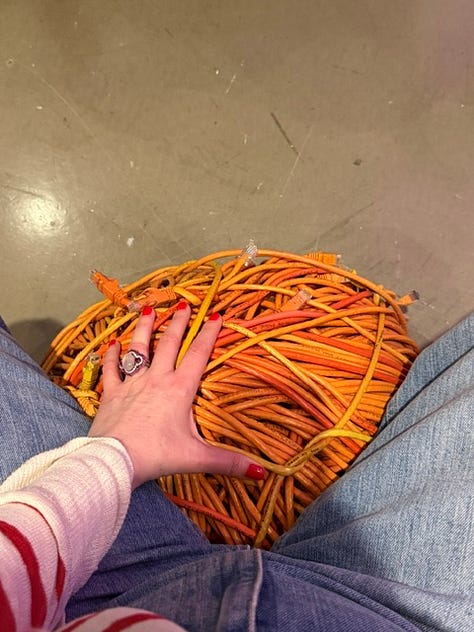
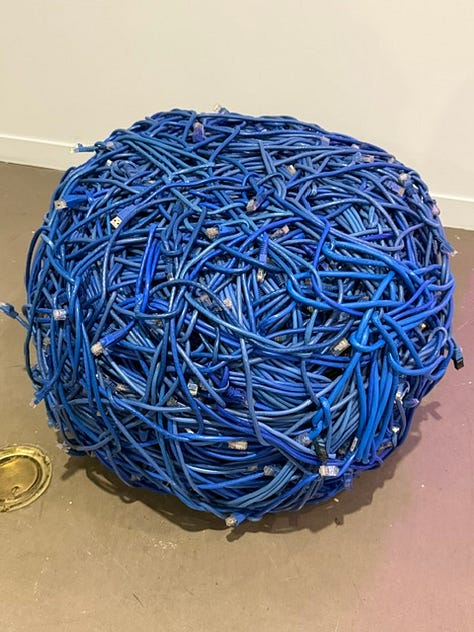
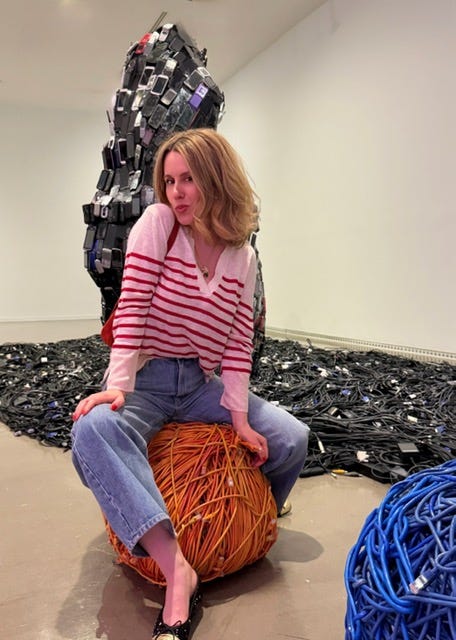
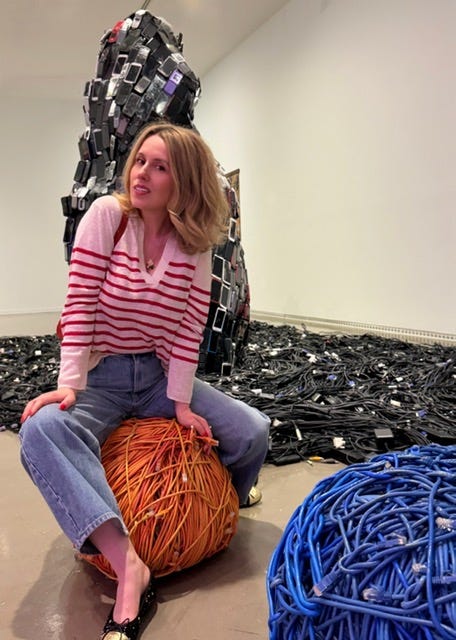
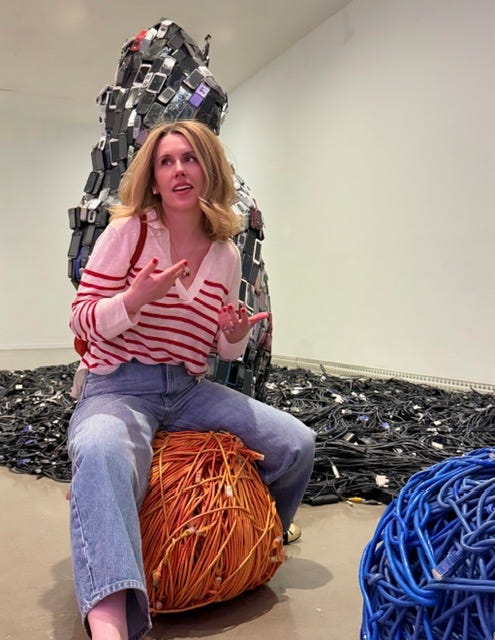
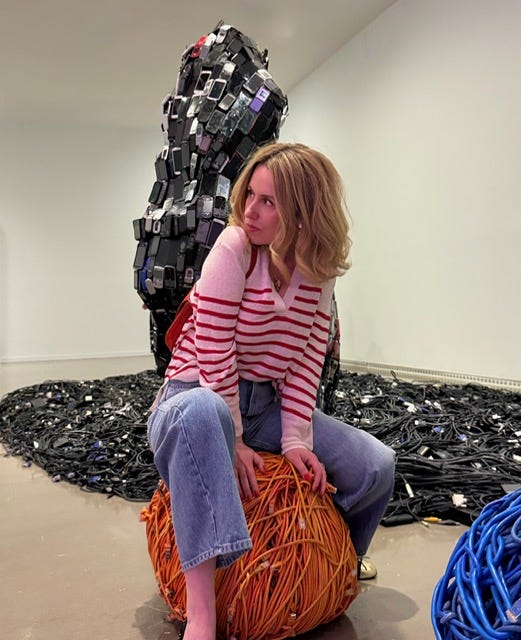
In the moment it felt entirely natural, which is the whole problem, and possibly the whole essay. My friend was beside me, and we were doing what people do in galleries now, which is talk about the work while simultaneously documenting ourselves in relation to it (me, not my friend who doesn’t even have social media). I sat on a great orange ball of tangled ethernet cables, and he took photos of me perched there like a hen on a very stupid egg, and between poses I kept returning to the Notes app, because the first sentences of this essay had already arrived. My memory is excellent; ask anyone who has ever wronged me. I typed them into the phone because typing was easier than remembering, and easier has become a default setting without my ever having selected it.
That is the real subject here. Comfort… The soft, upholstered laziness that nobody warned us about, because it never looks like laziness. We call it efficiency today.
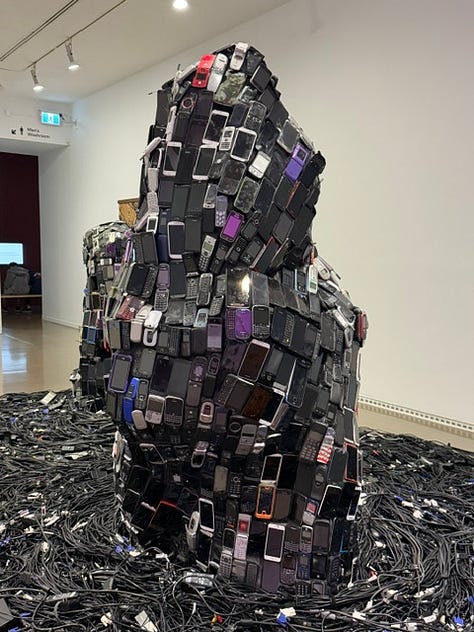
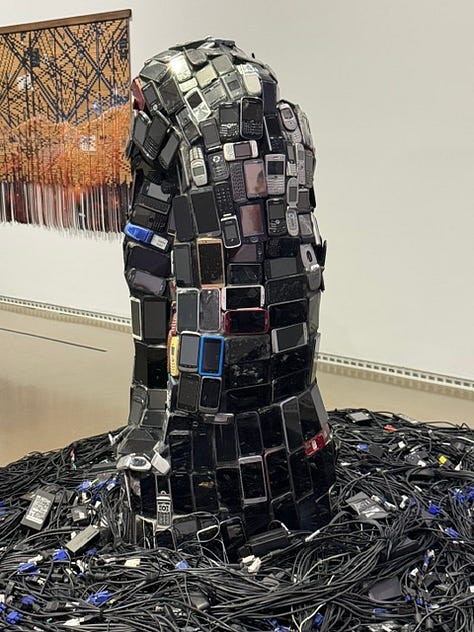
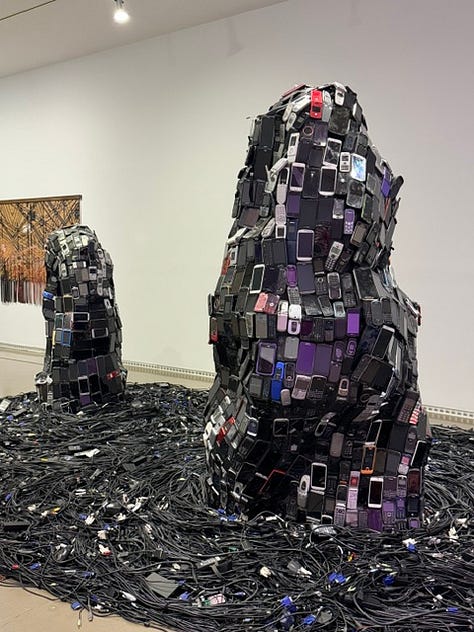
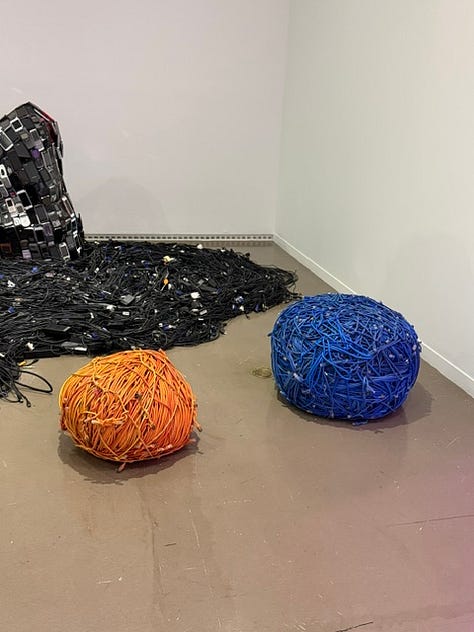
The art installation is Jean Shin’s “Huddled Masses”, from 2020, currently part of the gallery’s climate exhibition. Three dark, hulking forms rise out of a black surf of discarded cords and adapters, and when you get close you see that their skins are made entirely of obsolete mobile phones. BlackBerrys with their little rosaries of keys. Flip phones. A Motorola Razr in red, which in 2004 was the most desirable object for some people. Early iPhones with cracked faces, phones with actual antennae, phones in cases still bearing someone’s taste in colours.
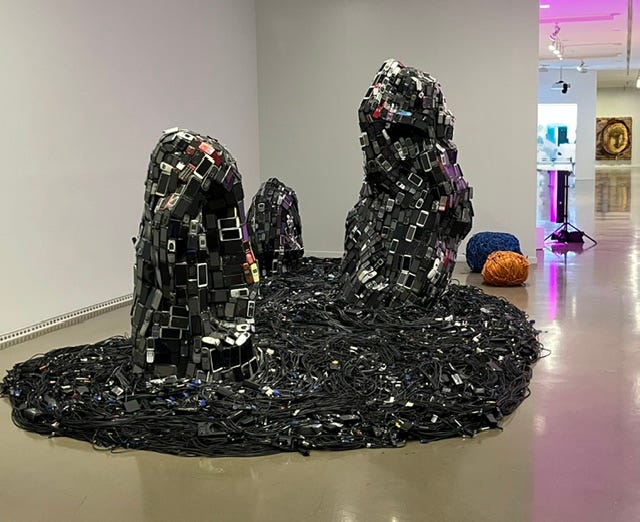
Shin modelled the forms on Chinese scholar’s rocks, the gongshi that literati kept on their desks for centuries, stones so strangely eroded that contemplating them was said to be contemplating nature itself, condensed. A mountain you could own. The joke, and it is a serious joke, is that our era’s equivalent of the venerated stone is a sediment of consumer electronics. Future archaeologists will find these strata and know us completely. They will not need to dig very deep.
The title comes from Emma Lazarus, of course, the poem on the Statue of Liberty. “Give me your tired, your poor.” Shin’s huddled masses are the devices themselves, refugees of the upgrade cycle, and the numbers behind them are worth sitting with for a moment because they are really obscene. The world produced 62 million tonnes of electronic waste in 2022, and less than a quarter of it was formally collected and recycled. The rest went into drawers, landfills, informal dumps in countries that never got a vote. Every phone in that sculpture was once unwrapped by someone whose heart rate went up slightly as they peeled the plastic film off the screen. You remember that feeling. There is no film-peeling equivalent at the other end of the object’s life. It just stops being loved, and then it stops being seen.
So far, so climate essay, and the exhibition frames it that way, reasonably. But standing there, that was honestly the lesser horror for me. What got under my skin was that every one of those entombed phones once contained an entire human life, and the lives might still be in there. Sealed. Photographs of children now grown. Text messages from people now dead. Voicemails nobody will ever retrieve, banking passwords, half-written apologies in drafts folders. The sculpture is a reliquary. My friend said it looked like a memorial, and I said, “memorial to what?”, and he replied, “well, to us”...
There is a philosophy paper that explains what I felt in front of that monolith better than any digital detox article ever will. In 1998, Andy Clark and David Chalmers published “The Extended Mind” with a thought experiment about a man named Otto, who has Alzheimer’s and carries a notebook everywhere. When Otto wants to go to the museum, he consults the notebook for the address. Clark and Chalmers argued, scandalously at the time, that Otto’s notebook is not a tool his mind uses. It is part of his mind. The cognition happens across the boundary of the skull. If the information is reliably there and automatically trusted, then it functions exactly as biological memory does, and drawing the line at the skin is just prejudice.
They wrote this before smartphones existed. Reading it now is like reading a prophecy that came true so completely nobody bothered to notice.
Because the phone is Otto’s notebook, perfected and universalised.
We keep talking about phone addiction as though the phone were an appetite bolted onto an otherwise complete person, like cigarettes. Wrong picture. The phone has been incorporated. It holds our transactive memory, to borrow Daniel Wegner’s term for the way long-married couples divide up remembering between them, one spouse keeping the birthdays, the other keeping the tax deadlines, each half-brained and jointly whole. We have all entered such a marriage, discreetly, without a ceremony, and our spouse keeps everything. The birthdays and the tax deadlines. Also, the boarding passes, the blood pressure readings, the ovulation windows, the parking payments, the insulin logs, the train tickets, the photographs of the wine label you meant to buy again, the recording of your grandmother’s voice. It remembers so that we don’t have to. Nobody ever asks what we were saving the effort for.
Do the exercise! Take a piece of paper, a real one, and try to write down from memory everything your phone currently does for you. Every function you have delegated. I tried it that evening, in the car going home, scribbling on the back of the exhibition leaflet while the city slid past the window, and I got to fourteen items before stalling, feeling rather pleased with myself, and then I opened the phone to check and found I had forgotten roughly forty things, including the app that controls the heating at home, meaning my radiators in another country were, at that moment, more reachable than my own memory.
The gap between your list and your phone’s reality is a precise measurement. Of what, I keep going back and forth. Dependency, certainly. Perhaps something closer to prosthesis.
And here is the distinction that I think actually matters in 2026, the one that gets lost in every hand-wringing article about screen time.
Addiction and dependency are different conditions and they have different exits.
Addiction is the doomscrolling, the games, the reels, the little dopamine slot machines; that part is habit, and habit can in principle be broken, there are whole industries devoted to helping you break it, most of them accessible via app, which tells you something.
Dependency is structural and no amount of willpower touches it. You cannot digitally minimalise your way out of two-factor authentication. Your bank requires the app. The parking meters in my neighbourhood no longer accept coins. Concert tickets are QR codes, medical results arrive through portals, your children’s school communicates exclusively through a platform whose notification sound you will hear on your deathbed, and last month my boulangerie, my boulangerie, introduced a loyalty app.
Try to quit, actually quit, and you discover that the institutions of ordinary life have rebuilt themselves, noiselessly, floor by floor, on the assumption of your carrying the device. A gambler can walk past the casino and still collect their pension.
There is no version of my life in which I abandon the phone and still function as a citizen. Nobody enslaved us. We subscribed. That is new. I don’t think we have fully registered how new.
Which is why “slaves to our phones” is the phrase everyone reaches for, and why I reached for it too when I started drafting this in front of Shin’s monolith, and why I now hesitate over it slightly.
A slave knows he is enslaved. The condition announces itself; the chain is legible. What we have is stranger and softer. The average person checks their phone somewhere north of a hundred times a day, depending which study you believe, and each check is experienced as a free choice, a small act of will. Nobody forces us. We reach for it the way the hand reaches to scratch an itch, below the threshold of decision. Merleau-Ponty wrote about the blind man’s cane, how with practice it stops being an object the man perceives and becomes the thing he perceives with, an extension of his sensing body. The phone crossed that threshold years ago.
We do not look at our phones anymore. We look through them, at the world, at each other, at art installations made of their ancestors.
I keep thinking about one particular phone in the sculpture. A small silver flip phone, mid-2000s, the one that made a satisfying snap when you closed it, ending calls with punctuation in a way no glass rectangle ever will. Somebody chose that phone once. Somebody stood in a shop and weighed it against another model and felt the small consumer thrill of deciding. It rang at funerals, probably. It received the message every phone eventually receives, the one that divides a life into before and after. And now it is grouting. Texture. A pixel in someone else’s argument.
My friend and I left the gallery and walked out into a warm, honey-coloured Vancouver evening, the sort of light that makes strangers forgive each other, and within ninety seconds, I had taken the phone out again to photograph the light, or to see whether anyone needed me, or for no reason I can now reconstruct. The hand reached before a reason arrived. That is the tell. That is how you know something has stopped being a tool.
That night I went through the photos I had taken of “Huddled Masses”. There were thirteen of them. The phone had already sorted them, recognised my friend’s face, suggested a little animated montage with music, and offered, helpfully, to back everything up to the cloud so that these memories would be safe forever. I sat there for a while with my thumb over the button, the window open to the warm night, thinking about the small silver flip phone in the sculpture and whoever had loved it once.
Somewhere a scholar’s rock was sitting on a desk it had occupied for four hundred years, doing nothing at all, wanting nothing from anybody. The rock asks for nothing. The phone asks for everything and calls it help. And I pressed the button, obviously. Of course I pressed it…
Then I set the phone face-down on the bedside table and plugged it in for the night, and it occurred to me, right on the edge of sleep, that we may be the first captives in history who tuck their captor into bed each evening, tenderly, so it will have the strength to hold us again tomorrow. The photos are safe now, whatever that means, stacked in a server farm humming in some cooled warehouse, the newest layer of the sediment, and one day, I suppose, its stratum too.
Yours at eleven per cent and falling, written, I confess, on the device in question, somewhere between the hundredth and the hundred-and-first glance of the day, and backed up to the cloud before you ever opened it, so that this essay, like everything else we cannot bring ourselves to carry in our heads, will outlive us both in a windowless building neither of us will ever visit,
Tamara
Not a tip jar. A ledger for what you underlined in your mind.
MUSEGUIDED exists because of its amazing readers. If you want to be part of it, subscribe or upgrade, I would be glad and grateful to have you.
Comments
Nothing yet. Say the first thing.
Sign in to join the conversation.