
“Vanity of vanities; all is vanity” – Ecclesiastes
Age beautifully? Nah… You can’t do it unless you start practicing really REALLY early. There’s no way you can decide in your 50s that it would be nicer to age with dignity. You wouldn’t know what to do.
Of course, you hoped for a successful “paradigm shift”, but what you actually get when you look in the mirror is just a less convincing version of yourself.
The truth is, the older you get, the less reasonable you become. You will “naturally” start losing precision not only in gestures, but also in thoughts. And in goals. You become more and more confused. And, much to your disappointment, your confusion will make the younger ones suspect you have no privileged access to any mysteries of life. Now you’re not only old, you’re also an idiot. A scared idiot. (according to them, obviously!)
Moreover, the great work you’ve done in your maturity years cannot back up your present projects. There seems to be a tension between what you’ve done before and what you’re doing now. This tension between then and now will turn against you the moment you fail to manage it wisely. And the truth is, the moment you realise the future starts to narrow down, you panic and start fumbling with options, objects, and desires.
I think there is only one way to start aging beautifully: becoming enormously selective. Learning the concision, striving for precision. In every counter-intuitive manner imaginable.
What does old age mean anyway?
It looks like it is a vague notion of a confusing something that somehow involves your body, your mind and your ability to even think about death. The older you get, the lesser your chances of proving yourself ready for dying.
Does this sound like a major paradox? It is not.
The truth is, the aged ones are fully and anxiously motivated to accomplish something the younger ones simply fail to accomplish: living for today, kindly refusing to think ahead.
Have you ever opened a geriatrics magazine?! Even Vanity Fair is more pessimistic!
Old age and health are redefined year after year. A deep and fascinating mentality (and demographic) revolution has started: the old age is not the old age anymore, it is the NEW age. Aged people make great patients, great consumers of fine hotels, great owners of luxury cars, great seekers of highly comfortable houses, great clients in general, and great hedonists in particular. Furthermore, they are retired; which means, they have all the time in the world. And all their time is now. A never-ending present.
Then on the other hand, we grow older and older and the next thing we know, we are very old.
We grow even older than that, and so a void grows within us. A void so compelling, that we, with time, endure it without actually seeking escape.
First we lose the desire to be entirely awake. And then we lose the desire to remain present. What does not become absent, it is a lie! Presence is a trick of the world.
A sense of waste; a sense of chills; and then The Absence. One is truly old when one is experiencing these three without extreme suffering, when one cannot bring one’s self to be devastated by them.
The Waste…
...is, in every respect, enormous. Illnesses wasting the body; nostalgia wasting the heart; those long, empty hours that waste the old man’s willpower, turning it into something arbitrary and somehow dispensable. When neither the gain nor the loss makes sense, EVERYTHING’s a waste.
The Chill
An old body warms up slowly and chills down quickly. An imperceptible shivering becomes its second nature. Shivering is the answer to all lively matters. It keeps one aware of being alive. But then again, shivering is the grossest hint to death. Growing old as growing cold…
The Absence
As the world deflates becoming no more than a ghost-army of half-forgotten names, The Absence expands. The Absence unfolds itself like a blooming, inodorous, dark flower; first, obstructing the corners of the room; later on, covering empty chairs and dusty tables, shrouding faces and genealogies, and, finally, congesting the nostrils of the soul.
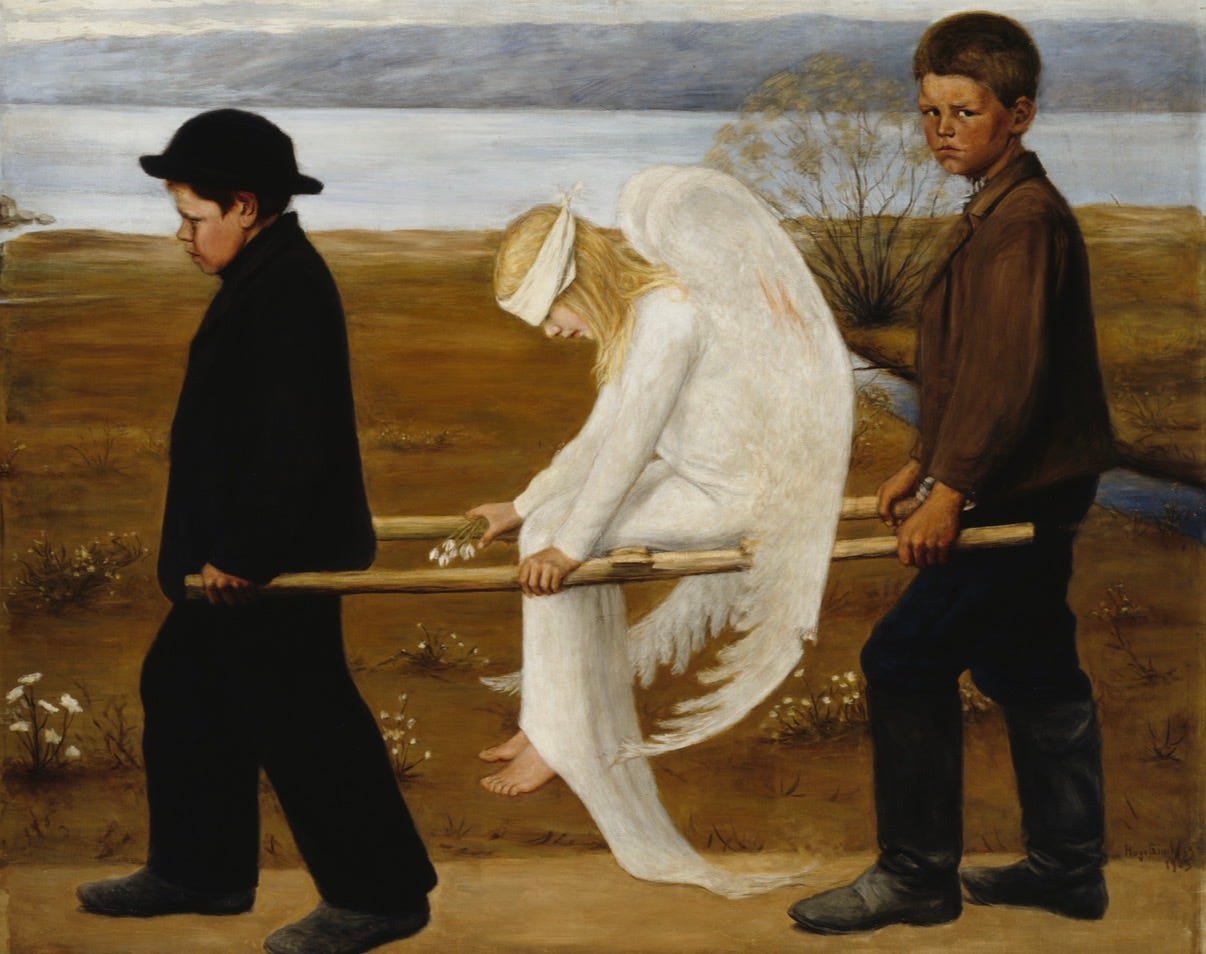
The moment when an old soul is no longer able to breathe in hopes and exhale promises, the absence comes to life for real. It turns from an insidious velvet flower into a lively beast: the shocking angel.
Just like Jacob upon his return to Canaan, the old one struggles with The Absence itself, with the solid, dashing Absence of everything he used to be, of everything that is rapidly growing out of his reach.
But there is no way for him to see “the face” of this Absence – his Absence – and live sanely. He either lives on in a sanctuary of illusions, hallucinating by the edge of reality, or he dies promptly. If he, however, chooses to live a sane kind of old life, the ambiguity will creep in, interfering with his last throb of vigour. It is a throb of a social kind. An absurd plan of mobilisation. A moral and an identity matter.
“Who am I?” he will ask himself.
Who is he, the man who won the battle with his own Absence?
“Who am I?” will ask himself once more.
Who is he, the man who trips on his shoelaces, drops the teacup, and stumbles in everyday recollection?
“Who am I?” will ask himself anew.
Who is he, the man who has no social legitimation to be alive, yet no existential justification to function in the world?
“Who am I to be?“ will ask himself one last time, with some vague idea of duty in mind.
With this question, everything ends.
The old is ontologically distinct from the young. And nothing can fill up the gap between that which is ontologically desirable (because socially triumphant), and that which is ontologically a waste (because socially absent).
… you will find him lying there, dead or alive, exuding inhumanity.
And you will look away. Naturally. The young always look away because the inhumanity on that face is not some stranger’s property. It is theirs. Postponed, that’s all! You cannot rehearse this. I said so at the beginning, and it stays true even when repeated clumsily. No method waits at the end of a well-managed life. Nothing waits.
So learn concision now, while it still costs you something. Refuse. Every refusal leaves the waste of one bad thing less to swallow, and takes a chair away from the Absence before it can sit.
The old man exudes inhumanity. You will lean in for a closer look. The face is yours……
Present, living in the moment,
Tamara
MUSEGUIDED exists because of its readers. If you want to be part of it, subscribe or upgrade, I’d be very grateful to have you.
Not a tip jar. A ledger for what you underlined in your mind.
Comments
Nothing yet. Say the first thing.
Sign in to join the conversation.