

My latest game, The Legendary Hero, is an action card game that required illustrations for 13 different cards. I saw this as an opportunity to try AIs for generating art and learn more about this new technology. This post compares the results from 4 AIs: Dall-E, Stable Diffusion, Lexica Aperture, and Craiyon.
My evaluation is based on their applicability to this project and my requirements.
My requirements for an AI image generator were:
As a hobbyist working on a month-long game jam project, I needed it to be free.
It needed to generate smallish (60 x 70 pixels) images to use as card art.
The asset pack that I used (https://schwarnhild.itch.io/peacefulpixels00) was pixel art, so I wanted the card art to be in a pixelated style.
The game and card effects had medieval and magic themes (spells, potions, etc), so the AI needed to generate images with those themes.
Last, but not least, I wanted each AI-generated image to be a consistent style that wouldn’t cause an untrained eye to balk. This, to my understanding, is one of the hardest pieces to get right with AI image generation.
I was NOT trying to generate sprites for the character, tiles, objects, or anything else in the game. Only for card art. I haven’t seen an AI image generator (keep in mind - this post is written in mid-2023) that produces crisp pixel art sprites. The results usually have stray and inconsistent pixels. Plus, I haven’t seen AIs that can produce animations for you.
Finally, I was NOT making a commercial game. This was a game jam project. The results only needed to be “good enough”.
I tried 5 different AIs: Dall-E, MidJourney, Stable Diffusion, Lexica Aperture, and Craiyon.
I provided each of them with the same prompt:
“pixel art medieval traveler sitting by a campfire at night”
Here are the results:


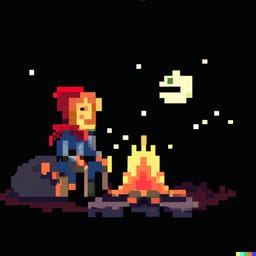
I quite liked these results. They’re a little cartoonish, but relevant, consistent, and charming. In fact, three of the cards in the final game came from Dall-E.
However, I decided NOT to use Dall-E because I realized you have limited “credits” (requests) in the free usage tier, which was a deal-breaker for me.
Free Tier: Limited credits per month (I think 15?)
Paid Tier: As of May 2023, $15 for 115 credits (each request is a credit)
I’ve heard that MidJourney provides the best results.
The weird thing about MidJourney is that to get free results, you have to post your prompts in Discord. I didn’t like this.
I attempted to join the Discord and try it because of the good things I’ve heard. However, I couldn’t figure out how to get it working after 10 minutes.
Ultimately, I decided it wasn’t worth the effort and that I wouldn’t use MidJourney if it was this difficult to get started.
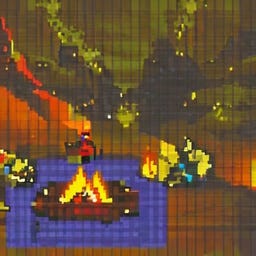


I really didn’t like these results because they barely resemble pixel art.
Free Tier: As far as I can tell, this is all that Stable Diffusion offers and is unlimited.
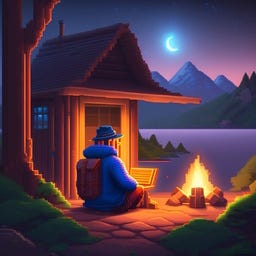

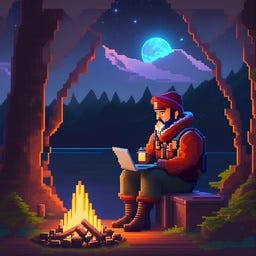

While I kind of like this art, it’s a weirdly specific style. And for some reason, it really likes putting laptops in the “medieval” setting.
Free Tier: Limited to 100 queries per month
Paid Tier: Ranging from $8 per month to $60 per month


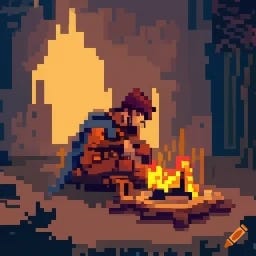

Craiyon took a while to generate results (usually about 1 minute). But it was worth the wait - the results perfectly fit the style I wanted for my game. You can see how the pixels aren’t crisp, but it didn’t contrast too much from the other game assets and was acceptable for card art in a game jam (but it wouldn’t work for sprites).
Free Tier: Unlimited queries as far as I can tell but it can be slow (~1 minute) to generate results
Paid Tier: $5 per month to $24 per month (no watermark, no ads, faster)
Craiyon served my purposes best: its free version did not have quantity restrictions and I was pleased with the pixelated art it produced for my cards:


It was interesting to see how each AI had its own distinct style:
Dall-E was a bit cartoonish
Stable Diffusion looked like embroidery, barely pixel art
Lexica Aperture was crisp and tended towards purple hues & laptops
Craiyon almost looked like paintings
While the AI-generated art served my purposes (free, static art, no sprites or animation, casual game jam), I would not recommend it for commercial games. I think the AI-generated results are too inconsistent and art in a game is too important to settle for the lack of consistent quality.
Again, keep in mind this opinion comes in mid-2023 - AIs will improve and I wouldn’t be surprised if my opinion changes.
I plan to continue looking for opportunities to try AI-generated art for games. I believe the quality of the images is dependent on the prompter and I think I have a lot to learn. Next, I want to try using AI for generating NPC dialogue.
No posts
Comments
Nothing yet. Say the first thing.
Sign in to join the conversation.