
As mentioned in last week’s post, and to repeat: I enjoyed the New York Times take, earlier this month, on identifying the quintessential American movie (talk about a fun and impossible task). Some obvious and unobjectionable choices, including There Will Be Blood, Dazed and Confused, and Nashville; some inexplicable, and stupid choices, like Dirty Dancing, Zabriskie Point, and…Disclosure Day??
(Not my first rodeo, either: I “tangled” with the NYT last year, taking a deep look at the best movies of the 21st Century: it’s a five part series that concludes here.)
So I could neither respect nor live with myself if I didn’t voice my objections the old fashioned way: by making a list of my own. With obvious conditions and constraints: to keep it remotely manageable, I’d limit myself to the second-half of the 20th Century (this time), but to keep myself from cherrypicking (or worse, cutting and pasting), I’d avoid choosing movies I’ve already celebrated at length—movies that I could happily select as quintessential American films, including Chinatown, Five Easy Pieces, Serpico, The Conversation, Apocalypse Now, The Deer Hunter, They Live, Goodfellas, Caddyshack, The Insider, and Dead Man (more on Taxi Driver later this summer…).
So, two movies from each decade. None of these choices should seem especially controversial, most or all recognizable by name and capable, by that alone, of making a case for themselves. I’ll include succinct assessments and a clip from each which, needless to say, should be more convincing than anything I can accomplish.
Ten Definitive American Movies from the Second Half of the 20th Century
The Searchers (1956)
The closing shot? I mean my goodness. What more do we want from a movie, from art, from life? It could be only semi-facetiously offered that the entire film is a delivery device for the perfection of its ending. Or that every western was a prelude, or all of American history, etc. And to a Gen X’er with a certain disposition to loathe just about everything John Wayne did or stood for, it takes on whole other layers of meta and meaning to just shut up and celebrate this perfection. Period.
Vertigo (1958)
Ditto James Stewart. I mean he’s insufferable except when he’s ideal and I’m both capable and willing to concede he was ideal many times. Oh well. Point being, I’m not a big fan, except when I am, and the fact that there’s so much complex meta stuff happening alone makes Vertigo a sort of Sui generis effort, singular in Hitchcock’s canon. Like The Searchers, Vertigo can—and must—be adored on its own terms, but the stories inside the story (both fictional and about the director, the stars, the circumstances, the psychology, and so on) can fill books and endless conversation.
Also: best soundtrack ever? For my money, it’s surpassed only by Taxi Driver (also, of course, courtesy of Bernard Herrmann—and again, more on him and that movie in a couple of months…)
So…another “delivery device” moment? Even if the movie offered little else, this museum-worthy shot of an America that’s, sadly, long, long gone is worth savoring, but also that wallpaper and the swelling music and the regal, miraculous Kim Novak and…oh my God.
Bonus content and shout-out, with spoilers (don’t watch if you’ve never seen the movie and if you’ve never seen the movie, see the movie). I’ve celebrated this on my blog many times over the years as an uncanny and astonishingly clever mash-up; a great example of how art can be in conversation with itself.
Dr. Strangelove (1964)
In a longer piece entitled “Making the Case for Kubrick”, I assessed his remarkable career (find that HERE). Also, strictly speaking this isn’t an “American film” so much as it’s a British-ish or tag team—but since the subject matter (and ostensible locales) are American, it counts.
*
Is it possible to get tired of a tour de force like Dr. Strangelove? Understanding that Kubrick intentionally asked George C. Scott to add one “over the top” take for each scene (knowing full well that those were the takes he planned to use) causes one to further appreciate the perfection.
This truly is one of those exceedingly rare movies that can be enjoyed, over and over, for the simple joy it provides. It’s hilarious, and the intelligent viewer innately understands—and appreciates—the grim alternative reality simmering constantly below the surface. It is one of the out-and-out funniest films ever made, boasting what has to be one of the all-time great casts. For much of this, Kubrick deserves credit and kudos. His ultimate achievement, aside from the steady craftsmanship and originality, might be the realization that Dr. Strangelove had to be a comedy. The novel he adapted, Red Alert was a dead-serious potboiler; Kubrick instinctively understood how poorly that would play on screen (at least in most directors’ hands) but also how crucial it was to satirize. The results, equally a tribute to that crackerjack cast, are a testament to Kubrick’s intelligence and vision.
When we speak of Kubrick we inexorably address his fixations and obsessions and his (IMO, at times self-defeating) perfectionism that lends certain famous scenes a certain chilliness. But what might not get mentioned enough is his masterful deployment of irony. Some see pessimism, but attentive viewers understand that Kubrick, for all his precision, always removed himself from the acting and the action. If his films have moments that are more aesthetically perfect than emotionally convincing, Kubrick could never be accused of being cynical. Like our very best directors, he consistently conjures up other times and places while offering profound comment on the here and now.
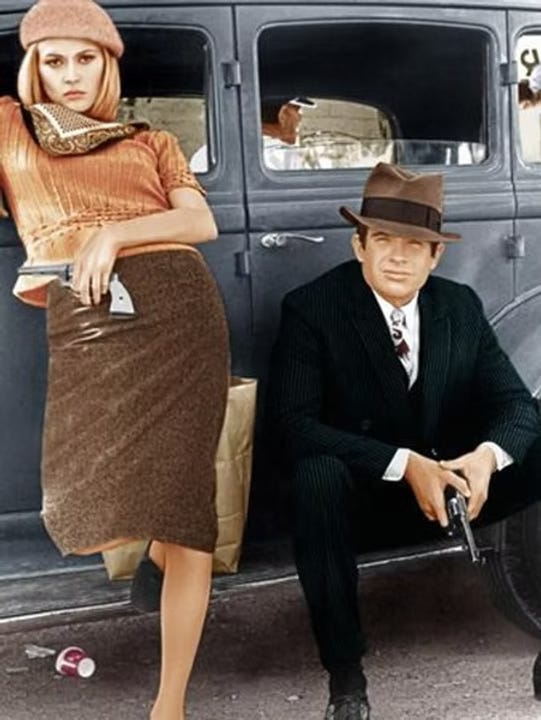
Bonnie and Clyde (1967)
A rare miracle that sums up a previous America, comments pointedly on the present, and is quite prescient about the future. There’s a fairly crooked line connecting Clyde Barrow to everyone from Gordon Gekko and Donald Trump to O.J. Simpson and Luigi Mangione. Americans have a soft spot for sociopaths, and the charismatic ones can make careers out of it (it also never hurts if you’re as handsome as Warren Beatty).
Bonus dose of self indulgence, from a longer piece on my favorite crushes: By 31 I’d been there, done that, at least figuratively speaking. I was already a lost cause, a sad clown whose fate lay in recognizing all his soul mates had been born before his time (or had never been born at all, literally speaking). Still, perhaps because we long most for what we can never attain, I carried a tragic-comic torch for Faye Dunaway. Back to the future: 1967, Bonnie Parker, the perfect woman. Did any actress ever look as good in any movie? Not for all the money I don’t have in my bank account. And even though I wasn’t as exciting or nearly as pretty as Warren Beatty, I understood her pain. I could give her what she really needed (sorry, Clyde); I could help her help herself. I could help her help myself. Or something. I suspected, then, and know, now, that like me, she was simply searching for something she couldn’t find, something she could never have.
McCabe and Mrs. Miller (1971)
Warren Beatty, again? Well, I could also have chosen another Altman movie (Nashville, M.A.S.H., or The Player all leap to mind), or Beatty (in Shampoo or The Parallax View). We also are about to see Faye again (and already saw her via Chinatown which, I’ll never tire of repeating, is the most perfect American movie—ever). All of which is to say, for about ten years there were only a handful of actors who left their mark via more acclaimed films than Warren & Faye. Attention must be paid.
What I love most about this movie is how much doesn’t happen, and how it obliges reflection on all the things that are happening (offscreen and in our minds). Without preaching and without pretense, Altman offers up a coruscating indictment of capitalism, the myth of western “expansion” and discovery, colonialism, sexism (on many levels), a story within a story about celebrity and received wisdom, and so much more. A lot going on for such a quiet, languidly paced film! And there’s a great deal of humor, too.
Spoiler-ish alert for the uninitiated, but no primary characters are involved in this scene which, well, contains multitudes—all of them ugly, predictable, familiar, and heartbreaking. Altman captures an entire history lesson in under three minutes, which is what geniuses do.
Network (1976)
Right now Paddy Chayefsky is:
a. Rolling over in his grave
b. High-fiving Peter Finch in heaven
c. High-fiving Peter Finch in hell (where it’s Happy Hour 24/7)
d. All of the above
There are any number of examples that could be (and probably have been) offered up to illustrate how prescient Chayefsky’s screenplay for Network really was. Think of phony purveyors of moral outrage ranging from Morton Downey Jr. to Jerry Springer, and the whole concept of infotainment to the hastening-of-the-apocalypse proliferation of Reality TV, etc. Stage it and they will come is now the (un)official mantra of media’s M.O. And, in the end, it’s all pretty much a tempest in a teapot. Or, a tempest in a tea party. Which brings us, inevitably, to Fox News. Of course, fabricated indignation has been good business in America since Jonathan Edwards first perfected the formula with Sinners in the Hands of an Angry God back in 1741, shortly before the advent of cable television.
Capitalizing on the nervous consciences of the faithful created steady work well into the 20th Century, and Sinclair Lewis codified the archetypal character in Elmer Gantry (1926). That pernicious tradition was carried on faithfully by Confidence Men like Pat Roberston, Jerry Falwell, Benny Hinn and Rick Warren. But of course this act has always been too tempting for politicians not to embrace with every inauthentic bone in their bodies. The only hucksters that can outhustle the pols are the preening simpletons who rile up the credulous citizens who dial in each day for another dose of bad medicine. At the appointed hour, the idiot box transfigures into a burning bush and these rapt minions who otherwise behold Christ in their breakfast food (or, proving how crafty and omnipotent the Lord can be, at lunchtime too), get their Godhead on in the form of third-rate carnival barkers.
As incendiary, and insufferable, as all of them, ranging from Rush Limbaugh and Bill O’Reilly to Glenn Beck, Tucker Carlson, and the truly, spectacularly cretinous Jesse Watters are, you tend to appreciate how they sometimes can’t keep a straight face as they shovel the horseshit, whipping simpletons into a righteous lather for a steady paycheck. Yes, they are contemptible and yes, they wield their petty power over the powerless in incredibly irresponsible fashion. But with them you know to expect less than little in terms of originality, integrity, or intellectual rigor. Thus, you have to remain content, in a free country, to let them hold sway over a semi-sentient audience who would crawl over molten coals for them. A pox on all these empty suits with empty minds, offering regurgitated jeremiads and faux populism to a genuinely distressed viewership looking for answers but disinclined to trust the dirty Socialists who want to ensure they have a semblance of security and a modicum of healthcare.
Anyway, Network used to be difficult to enjoy simply because it was too on the nose; in 2026 it’s a depressing watch because we realize, in quintessentially American fashion, we’ve taken the absurdity further than fiction ever dares contemplate.
King of Comedy (1982)
The Joker would have been terrible, anyway, but the ways all of its unreached potential was already done to perfection courtesy of two Martin Scorsese movies made it insultingly bad (that it made tons of money, generated tons of discussion, and got tons of critical and commercial love only proves why we can’t have nice things). If it was intellectually dead on arrival as an exceedingly poor man’s Taxi Driver; it also had precisely the kind of provocative social commentary served up on a platter by King of Comedy.
Anticipating everything from social media to Reality TV, it supersized the uniquely American pathology of mediocre people willing to immolate their dignity to be famous or be in close proximity to fame. It rubs our faces in the style over substance ethos that came to dominate the last quarter of the 20th Century, and goes even deeper, showing that some (most? all?) of these wealthy celebrities are equally miserable in their way. It’s a unique example of a film that would have aged terribly except for the fact that America, unable to help itself, not only supersized, but turbocharged the neuroses and sociopathies on display.
The Mosquito Coast (1986)
There Will Be Blood was one of the NY Times selections, and it’s widely regarded as one of this century’s best movies. It’s also one of the most American—specifically as it traces the twin evils of organized religion and (take your pick) unregulated capitalism, the corrupting machinations of monopolies, or just Money being the root of all Evil (bringing the symbiotic, always uneasy relationship with Religion full circle). More on this film another time, and my only real quibble is that the two antagonists are a bit extra. Yes, by design, but also because the director can’t help himself.
For a bit more nuance and a movie that has two powerful forces (one representing religion but also its colonialism and exploitative tendencies; the other a—take your pick—proxy for The Individual or The Genius or Hubris or The Last Honest Man Driven Insane by the Insanity of the World, etc.) playing off each other, The Mosquito Coast covers a lot of ground with much of the subtlety and ambiguity TWBB lacks.
It is also prescient in its way; Allie Fox (Harrison Ford doing some career best work) starts out lamenting the ways America is outsourcing everything to Japan (how 1985), which seems quaint to the point of comedy in a country polluted by 24/7 content, appalling health care, and riding a greased rail to oligarchy. (Imagine what Fox would make of Fox News or Elon Musk, much less Bezos or…Trump).
Bob Roberts (1992)
This was too intelligent a movie, most likely, to become a blockbuster; it was also entirely too on point—putting everything from politics, the media, the religious right, and even Saturday Night Live in its sights. Much like Network and King of Comedy, it’s still an instructive, if depressing watch: like certain sci-fi novels and dystopian fiction, things that might have seemed worst-case fifty or one hundred years ago now seem…cute. Nothing in this movie was over the top in the early ‘90s, but we’re so far through the looking glass (George W. Bush seemed like an embarrassing apotheosis, little did we know what was still coming down the pike).
I can’t recommend this enough: it’s America looking at itself, through the glass darkly. An essential treasure, and a tribute to Tim Robbins, who truly caught lightning in a bottle (added bonus: he did career defining work in Altman’s The Player, which not only could also easily make this list, but came out the same year!)
Malcolm X (1992)
Watching this movie over three decades later, at least we can say we left racism in the rearview mirror. Just kidding! This film—based of course on X’s seminal autobiography—is an American story on myriad levels. It manages to inform, infuriate, and inspire—sometimes all at once. It being a Spike Lee Joint, there’s unbelievably cliched dialogue at times, totally over the top indulgence, and an unbearably maudlin soundtrack. But Lee, for all his often intolerable faults and excesses, knows how to frame gorgeous scenes and make a picture pop. He also had the energy and ambition to understand the assignment and Go Big for a topic that warranted such extravagance. Featuring God Level work by Denzel Washington, this has all the ingredients. It’s a masterpiece and necessary medicine to take, if for no other reason than to keep the rust off and remind you why we’re alive.
What did I miss? Whaddya got? LMK in the comments.
No posts
Comments
Nothing yet. Say the first thing.
Sign in to join the conversation.