
Hey folks,
This is Pavel, welcome to a new edition of our Emerging Manager Files where we dive into the stories of fund managers who’ve recently closed their funds and ask them 10 rapid-fire questions about what it actually takes to raise LP capital.
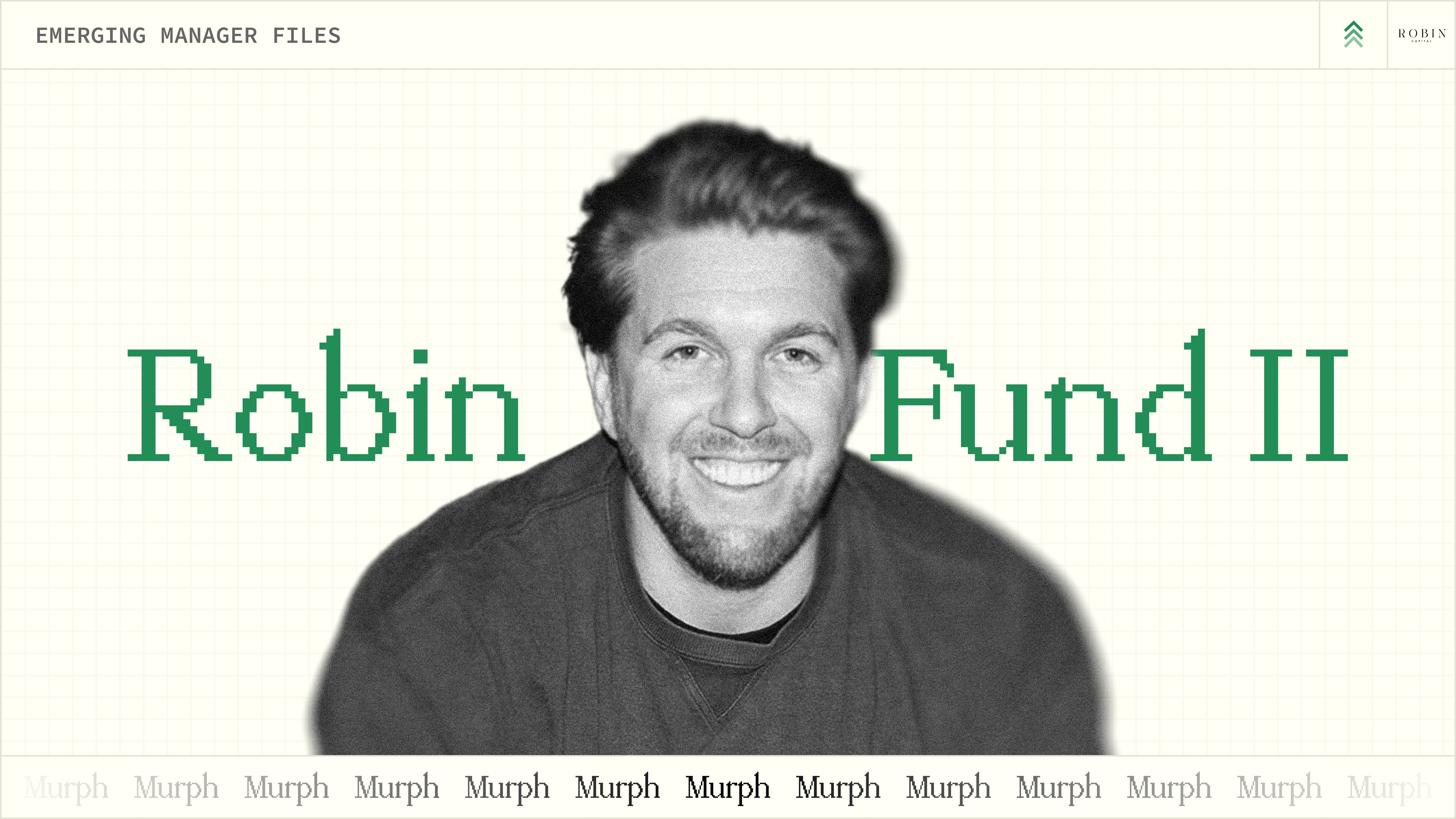
Today’s guest: Robin Haak, Founder and Managing Partner of Robin Capital.

Legion is a high-signal marketplace matching emerging GPs with relevant LPs, featuring seamless fund admin, built-in secondary liquidity, and over $300M in investor capital flows.

Harmonic aggregates real-time data on 30M+ companies and 190M+ people to surface the signals that actually matter – all through AI-powered workflow.
Rings AI is an intelligent CRM built for VCs and LPs with auto-enriched data on 100M+ contacts, and a visual map of who-knows-who across your network.
Cura is a VC portfolio intelligence on autopilot that connects your Granola notes, iMessage, LinkedIn data and more to automate support and intelligence.
Wonderstruck is the storytelling and design studio venture-backed companies call when they outgrow their brand. Trusted by 1517, Kindred, Sunflower & 200+ founders.
A recurring question from the emerging managers we talk to at Murph Capital is what it actually takes to make a solo GP model work past a Fund I, past raising the next vehicle and into a track record concrete enough that LPs stop asking you to prove the concept. Robin Haak, who’s been running the Berlin-based solo GP fund Robin Capital since 2023, is three years and two funds into that process, so I sat down with him to walk through how the fund is built, what’s worked, and where he’s had to deviate from his own playbook.
Robin Capital is small by design. Across the two funds, Haak has made around 50 investments so far) 35 in Fund I and close to 15 in Fund II since it opened in January 2026) mostly €100,000 to €600,000 checks into European enterprise and mid-market startups. His personal investing track record, which predates Robin Capital, now runs to around 80 investments and 8 unicorns, including Arx. The stated model is built around diversification: around 30 positions per fund, no board seats, no single bet meant to carry the portfolio.
His route into venture was unconventional. Haak grew up in Hanover, with a father from Ostfriesland, and started his career in late-stage M&A at Axel Springer, working alongside colleagues who’d come from BlackRock and Goldman Sachs. From there he co-founded the Axel Springer Plug and Play Accelerator, which made around 100 investments in total, about 50 of them during his time there. He doesn’t have an official return figure, but the portfolio has since been sold and he estimates it generated “around 8x DPI.” His first check, made in that period, went into N26, which later became one of Europe’s more recognizable neobanks.
Watching founders operate up close is what pulled Haak toward founding a company himself. He co-started Jobspotting with a group of former Google employees that reached profitability, 3 million users, 12 countries and 4 languages before merging into SmartRecruiters in San Francisco, working alongside founder and CEO Jerome Ternynck, who is now a Venture Partner at Robin Capital. Robin relocated to the Bay Area, first as a shareholder and then as COO, and helped scale the combined company to 550 employees and $220 million raised from investors including Silver Lake, Insight Partners and Mayfield, with customers such as Visa, Twitter, Bosch and IKEA. SmartRecruiters went on to become both a unicorn and a centaur, surpassing $100 million in ARR and turning profitable before SAP eventually acquired SmartRecruiters last year. That founder chapter still anchors how Haak describes himself: less a career investor than, in his words, a former founder who later moved into growth equity, where he was also part of the founding team – founder DNA he says shapes how he invests today.
After fully vesting out, he stepped away from operating work entirely for a stretch: buying a coffee shop in Bhutan, working a harvest at Domaine de la Romanée-Conti in Burgundy, and training to fight professionally in Muay Thai in Thailand, while sitting on advisory boards for Slush and The Stepstone Group – a roughly 4,000-employee firm with more than €1 billion in revenue, whose largest investor is KKR.
He returned to investing in 2020 as one of three General Partners and a member of the founding team at Revaia, helping grow the firm from a €250 million growth fund to around €600 million in AUM. While Haak enjoyed growth investing and remains passionate about the asset class, he ultimately decided to launch Robin Capital to return to earlier-stage investing. Haak says, “I loved my time at Revaia and learned a tremendous amount. Growth investing offers a unique opportunity to partner closely with founders at a critical stage of company building, and I could absolutely imagine coming back to it one day. But I realized that what energizes me most is working with founders from the very beginning – being there for the first product, the first hires and the first customers, and helping build enduring companies from day one. That is what ultimately motivated me to start Robin Capital as a Solo GP.”
His new focus led him to launch Robin Capital as a solo GP in 2023, a structure he says was partly inspired by US solo investors like Elad Gil. He has since completed 3 growth SPVs (Arx Robotics, Almetra and Ground A) and plans to cap that at 2 more, citing the operational load each one adds.
The portfolio construction reflects that same logic of staying close rather than staying big. Robin Capital writes checks between €100,000 and €600,000, primarily into European companies with some exposure to the US and Israel, and it is weighted almost entirely toward mid-market and enterprise startups – only 2 companies across both funds fall into the SME category.
Looking back at Fund I, Haak says the portfolio ended up about 90% AI, much of it agentic, spread across fintech, HR, robotics and manufacturing, along with about 60% serial entrepreneurs, both figures he attributes to how individual deals were selected rather than to a thesis set in advance.
Fund II is targeting €15 million and stood at around €12.6 million after its second close, with a final close planned for the fourth quarter. It carries a similar enterprise-AI orientation but centers more explicitly on moat: proprietary data, hardware-enabled data acquisition and infrastructure layers, which has pulled the portfolio further into deeptech, including robotics, space tech and other hardware-heavy categories. Haak frames Fund II as a tighter version of the same thesis, shaped by three years of deal selection rather than a planned pivot.
He targets around 30 investments per fund, spread across geographies including France, the UK, Sweden, Germany, the broader DACH region and Central and Eastern Europe, and across verticals that share a similar enterprise go-to-market motion.
He says he’s avoiding a concentrated, board-seat-heavy model on purpose, describing his preferred role as a supportive follower rather than a controlling investor – a posture that makes Arx, where his exposure runs well past a normal position once the fund and its growth SPV are combined, the clear outlier in the portfolio.
Arx is a defense-tech company founded by three former German military officers who each served about 12 years, including deployments in Afghanistan. Robin Capital invested €1 million into Arx from the fund, plus another €2 million through a dedicated growth SPV. On Haak’s current numbers, the fund’s own position, invested at around €1 million, is now marked between €10 million and €20 million.
He isn’t yet certain whether Arx raises at a €1 billion or €1.5 billion valuation in the fourth quarter, but says the SPV should hopefully land somewhere between “10x and 15x TVPI” by the end of the year if that round comes together as expected.
That range is easier to see against the fund’s own math than as a standalone multiple. Fund I closed at around €15 million across 35 companies, putting the average check at about €250,000. A single position marked as high as €20 million is already worth more than the fund itself, meaning Arx alone could plausibly return somewhere between 1x and 5x of Fund I before counting the other 34 companies in the portfolio – which is how Haak arrives at a potential fund-level DPI in the 3x to 15x range. Robin told me the decision to lean in came down to conviction he arrived at independently: extensive reference checks, his own investment memo, and a read on the founders that he says other investors were slower to reach, partly because a founding team of former soldiers doesn’t fit the profile most GPs default to. He describes himself generally as “a high-conviction, non-consensus investor” – someone who reads signals and pattern recognition like any GP, but says he won’t let them substitute for his own diligence.
Fund I launched in June 2023 and is now just over 3 years old, with a current TVPI Haak estimates at 1.4x to 1.6x. He considers that a solid mark for a fund at this stage and believes it has already cleared the J-curve. He’s hoping that number moves to around 2.6x TVPI by January, if Arx‘s anticipated fourth-quarter round is marked at the valuation he’s expecting.
That performance is inseparable from reputation, and Haak’s case for why founders choose him centers on being useful after the check clears rather than before it. He ranks his own value-add roughly in this order: fundraising, secondaries, M&A, finance strategy, and packaging support such as decks, branding and design, followed by lighter involvement in product, go-to-market, sales, customer success and talent. Where his own expertise runs out, he relies on 3 venture partners and a network of about 100 operators. He attributes a strong track record in competitive follow-on situations to the combination of having been a founder who went through a full exit and having sat on the other side of the table as a growth investor, which he argues gives him credibility across a wider range of stages than most solo GPs can claim.
That reputation now has a visible platform behind it. The firm’s branding is tied to its name – Haak points to “robin” and its red-breasted-bird equivalents across languages, Rotkehlchen in German, as the throughline for a media presence that now reaches nearly 10,000 newsletter subscribers and around 3 million monthly impressions across newsletter, YouTube and events.
None of that is being built toward scaling into something bigger, though. Haak was clear that he isn’t building toward a larger, more traditional fund. He already ran that version of the job at Revaia, helping grow it to around €600 million in AUM, and says he has no interest in repeating it.
The plan instead is to keep running early-stage funds at their current size, then add a growth continuity vehicle as Fund IV that would follow on into the strongest existing portfolio companies (similar to Benchmark model) rather than continuing to layer on new SPVs. Asked how he thinks about the firm at this point in his career, he didn’t frame it as a stepping stone. He called it the version of venture investing he wants to keep doing.
So we covered how Robin Capital got here – the path into venture, the fund’s shape, and the bet that’s carrying Fund I’s numbers. For the rest, we went with our usual format: 10 rapid-fire questions straight to Robin. And here is our fireside chat:
Our superpower is backing exceptional humans before exceptional companies – founders whose resilience, grit, and persistence are unmatched, supported by a community of operators and founders who have built, scaled, and been through it themselves.
Around 90 days of active fundraising, split into three 30-day fundraising sprints over a 12-month period, allowing us to spend the majority of our time investing rather than fundraising.
No. We had no placement agent and no institutional fundraising support. Fund I was built entirely through cold outreach – I contacted thousands of people, around 700 replied, and ultimately about 70 became LPs. Every investor relationship was built directly.
Fund I has 70 LPs and Fund II currently has 40 LPs. Around 60% are founders, 30% are private equity and growth investors, and 10% are operators and entrepreneurial family businesses. We deliberately built a community of people who have founded, scaled, or invested in businesses themselves.
Five minutes. The fastest commitment came from Kombo.dev. I had been a founder in HRTech myself, and as a former growth investor I always do my homework before a first meeting. By the time we got on the call, there was no pitch – I was simply asking questions to validate my thesis. We both had conviction, and the subscription was signed during the call.
Pattern matching. Many institutional LPs preferred former partners or employees from firms like Index, Accel, or Sequoia over a founder-turned-emerging manager.
Strategy fit. Our approach is high-conviction, non-consensus, and diversified, investing alongside both Tier 1 and emerging funds. Some LPs preferred managers that exclusively followed established Tier 1 firms, even if that meant paying significantly higher entry prices.
Mandate constraints. Some fund-of-funds, family offices, and institutional investors had allocation or policy requirements (e.g. manager profile, DE&I, or other mandate criteria) that we simply didn’t fit.
Founder references. The strongest signal was when prospective LPs went the extra mile and spoke directly with founders and people I had worked with. They wanted to understand how we behave when no one is watching.
They understood our edge. The best LPs recognized that we are not a traditional VC. We combine the perspective of a former founder with the discipline of a former growth investor, allowing us to back high-conviction, non-consensus opportunities others often overlook.
They saw our founder access. Once LPs realized that exceptional founders actively wanted to work with us (and that we consistently won allocations in competitive rounds) they understood that our ability to access and win great companies is a durable competitive advantage.
Most LPs focused on pattern recognition. They looked closely at our co-investors, who we worked with, our network, portfolio construction, geographic strategy, and whether we fit established venture frameworks. Many wanted to see Tier 1 co-investors as external validation.
My view is different. At the end of the day, venture is a people business. I’d rather back an exceptional GP with relentless hustle, differentiated access, and a genuine unfair advantage than optimize for a perfectly constructed spreadsheet.
Don’t optimize for your network – optimize for your reputation. Networks can get you your first LPs. A reputation built over years of serving founders is what builds a lasting franchise. Play the long game, and eventually you’ll reach the point where your work speaks louder than your pitch.
Get the foundations right. A great fund administrator, legal setup, auditor, tax advisors, reporting, and operations are not exciting, but they are critical. I was fortunate to invest in that from day one, and it allowed me to focus on what actually matters: finding exceptional founders. I see too many emerging managers underestimate the operational side of building a fund. A venture fund is a business – treat it like one from the start.
Learn more about Robin Capital: Robin Capital Fund II second close announcement.
Who do you want me to interview in the next episode?
We’d love to hear your ideas – hit reply below.
No posts
Comments
Nothing yet. Say the first thing.
Sign in to join the conversation.