
Hey folks,
This is Pavel. Welcome to Emerging Manager Files, where we go through how a fund actually got raised (the LP funnel, the terms, the deck drafts, the emails) with the manager who raised it. Each edition closes with 10 rapid-fire questions.
Today’s guest: Patrick Murphy, Co-founder and Managing Partner at Tapestry VC

Legion is a high-signal marketplace matching emerging GPs with relevant LPs, featuring seamless fund admin, built-in secondary liquidity, and over $300M in investor capital flows.

Harmonic aggregates real-time data on 30M+ companies and 190M+ people to surface the signals that actually matter – all through AI-powered workflow.
Rings AI is an intelligent CRM built for VCs and LPs with auto-enriched data on 100M+ contacts, and a visual map of who-knows-who across your network.
Cura is a VC portfolio intelligence on autopilot that connects your Granola notes, iMessage, LinkedIn data and more to automate support and intelligence.
Wonderstruck is the storytelling and design studio venture-backed companies call when they outgrow their brand. Trusted by 1517, Kindred, Sunflower & 200+ founders.
Sometime around 2019, Patrick Murphy left a friend’s wedding to go recruit a partner. The couple had married at lunchtime and dinner was still hours away, so he went back to his coworking space, still in the suit, and took a meeting with Audrey Miller.
Miller had left Goldman Sachs, started a company in London, been through Entrepreneur First, and drifted into advising early-stage founders on how to build a deck – investment bankers being unusually good at making decks and raising money. Murphy explained to her that all of it could be a job, and that the job was called venture capital.
She asked what he was wearing. Then she said yes.
That exchange is the whole of Tapestry in miniature, because a few years earlier Murphy had needed someone to explain the same thing to him. He grew up in Blackrock, a village in County Louth on the Irish border, and learned to code by typing listings out of PC World Magazine into the family computer while none of his friends were interested. He studied mechanical engineering and spent years wondering why nobody around him was turning research into companies. That there was a profession devoted to exactly that, with a name and offices and people whose whole job it was, he found out much later – in New York, when banking work started putting venture capitalists in front of him.
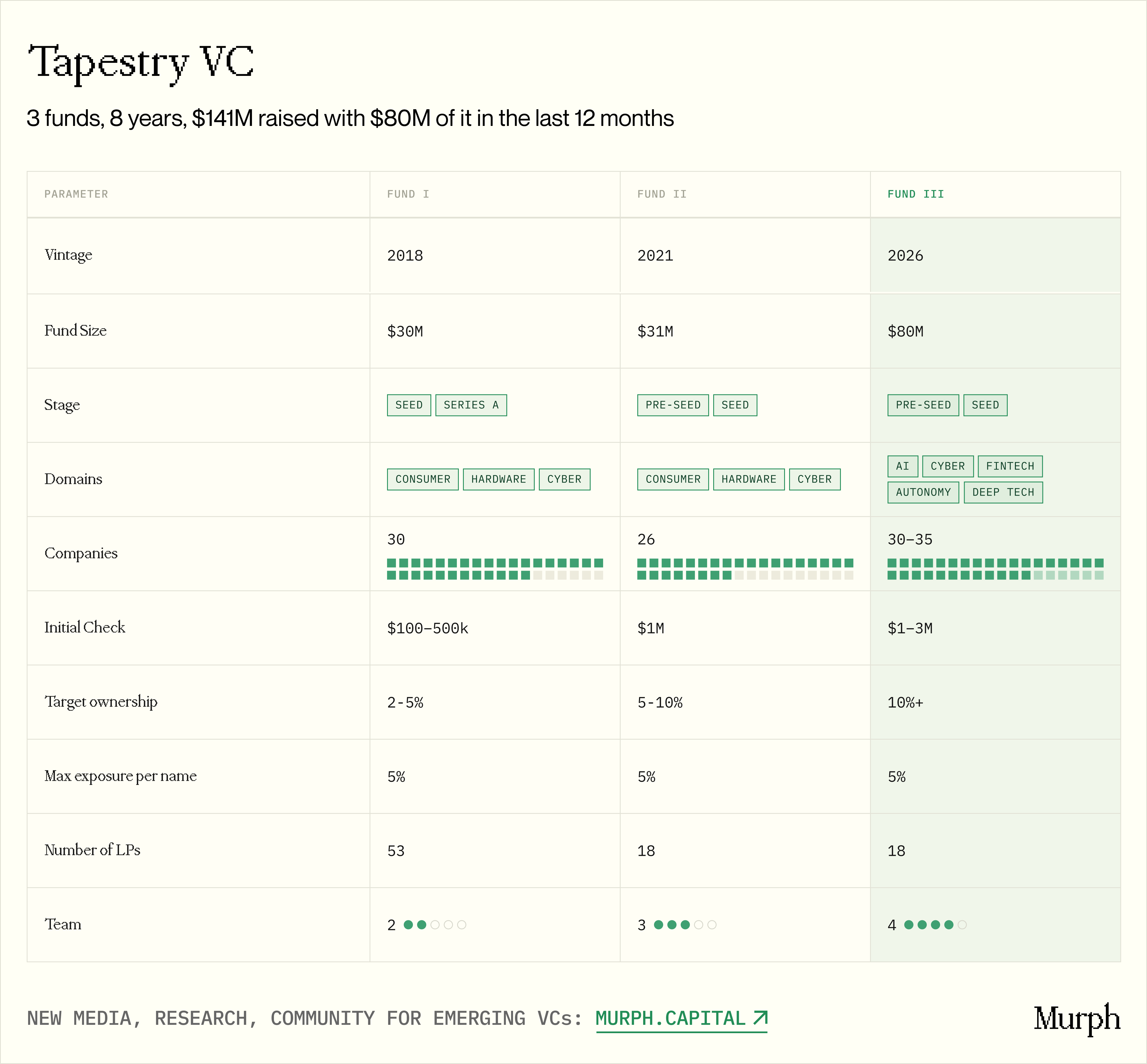
Tapestry VC is now three funds and 8 years in. Fund I returned half its capital by year 3. Fund II did roughly a third by year 3. Fund III closed in July at $80M, with up to $40M of it from a single sovereign investor.
Murphy joined Goldman Sachs after a first business ended badly with a co-founder, on the theory that he needed to understand how business actually worked. He spent 5 years as a technology, media and telecoms banker in London, then New York.
The relevant deal was Parlophone. Goldman advised Universal Music Group on selling roughly half the EMI catalogue (Coldplay, Pink Floyd, David Guetta) to Warner Music, a disposal forced by regulators after Universal’s acquisition of EMI. Working the sale, Murphy found out what else was on Universal’s balance sheet: a stake in Spotify, a hand in Beats Electronics, and, unexpectedly, a position in Uber.
Universal wanted more of that and asked how. Murphy, still an adviser at Goldman, wrote it up: start a corporate venture fund, and do not restrict it to music. Use the brand to invest across technology. They liked the memo enough to ask him to execute it.
The fund was meant to be $100M and never got there. The board changed a couple of years in, the dynamic shifted, and Murphy left in 2017 having done around 30 deals and deployed roughly $15M. Three of the companies sold for a combined $400M, one became Pluto TV.
The thesis arrived as a post-mortem. Looking back over the portfolio, roughly half the companies had been started by people who had built a venture-backed company before, and half by first-timers. The repeat founders had done conspicuously better – Pluto TV, Streamlabs, Meerkat, which became Houseparty and sold to Epic Games. None of it had been deliberate. Those were the deals that happened, and the ones that worked shared a trait.
Murphy got his green card. Then he quit.
He started the firm with David Kelly, a co-founder of Web Summit, whom he had met when Goldman sponsored some of the events. Their conversation turned to what would happen if they invested in the network they already had. Miller joined in 2020.
For a firm that has never had more than four people, Tapestry has produced an unusual number of investors. Luke Byrne went on to co-found Pebblebed. Declan Kelly founded Foreword. Alex Mackenzie is now a partner at General Catalyst. For all three, Tapestry was their first job in venture – which is a reasonable proxy for how a small fund actually spends its time.
The full thesis had three parts:
Repeat founders outperform
Global-first companies get bigger than single-market ones
Companies started by immigrants end up larger.
On the last, Murphy is careful with wording – Tapestry says global companies rather than immigrant founders, because people hear the wrong thing.
Murphy had never met an LP in his life. He did not know a single person at a family office.
“I don’t think I’d met an LP before. Frankly. I was incredibly naive.”
Patrick Murphy, on starting the Fund I raise
What he did know was that he could talk like an institutional allocator, so he started at sovereign wealth funds and worked downward. For a $25M target this was, as he puts it now, probably wrong, and not something he would repeat. It produced a year of relationships with very large LPs, none of whom converted – until one did. Railpen, a UK pension scheme, and Molten Ventures, a listed fund-of-funds, anchored the fund and have been in every Tapestry VC vehicle since.
The first hard commit came from neither.
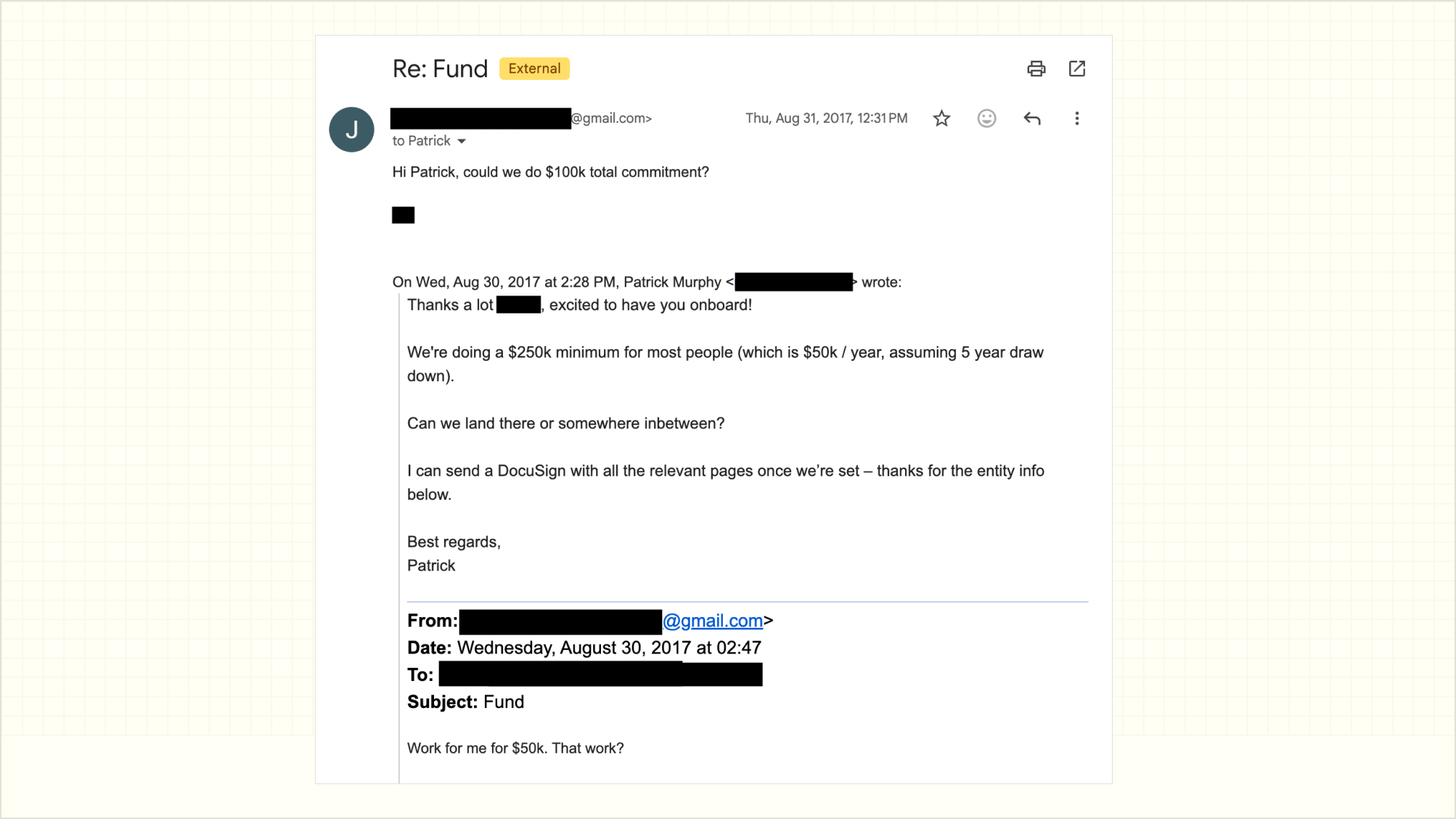
Around that first cheque he assembled a group of operators: Sarah Friar, then CFO of Square and now CFO of OpenAI, a former CEO of Verizon Wireless, a former CTO at Blackstone, and a set of founders.
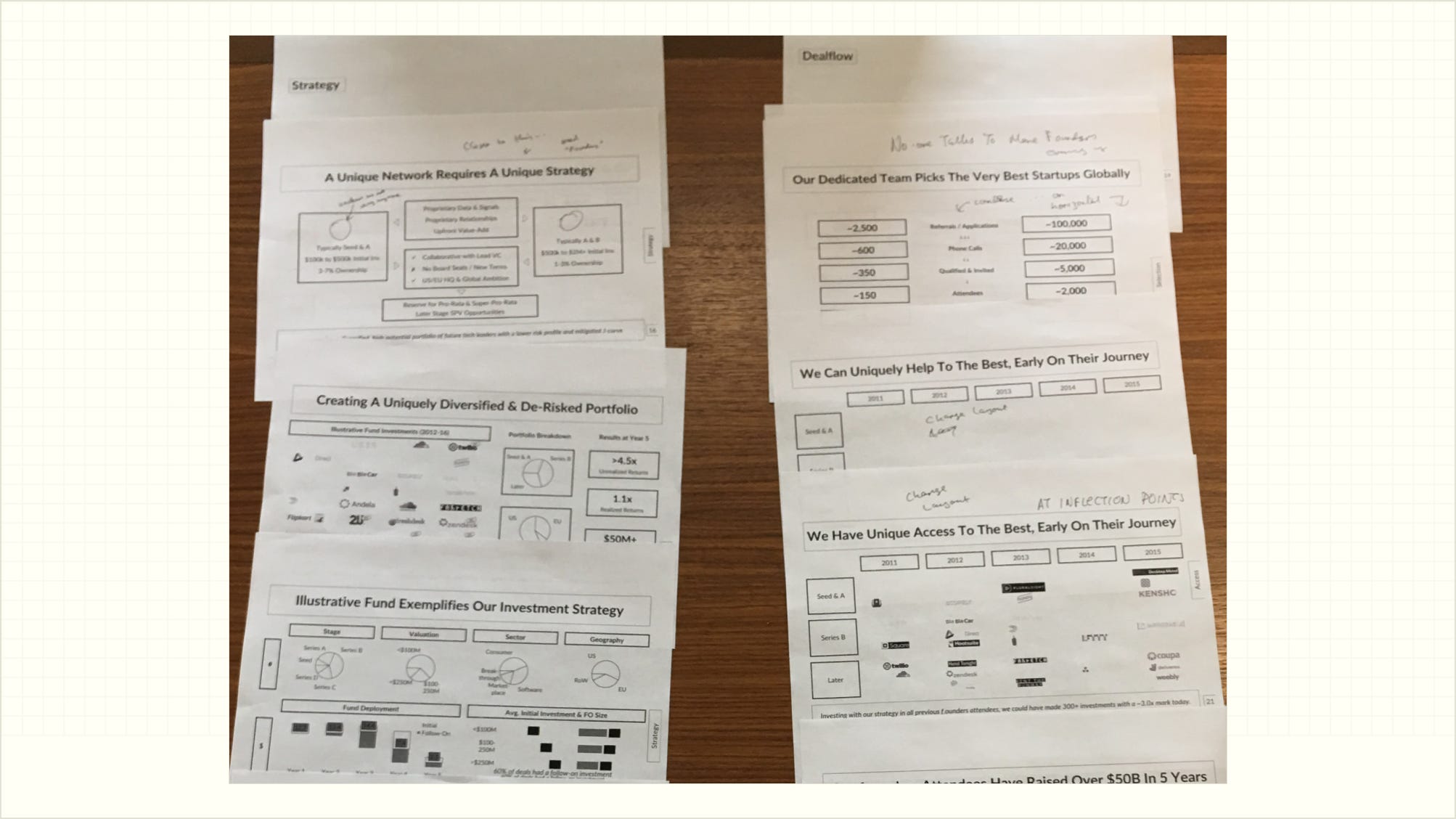
The deck he was pitching is more specific than the thesis he describes today. Fund I targeted $100-500k initial cheques for 3-7% ownership, explicitly collaborative with the lead investor and explicitly taking no board seats, with reserves earmarked for pro-rata, super-pro-rata and later-stage SPVs. The opportunity fund that Tapestry runs today was in the plan from the beginning.
The dealflow section is the part worth studying. One page walks a funnel of roughly 100,000 applications down through 20,000 phone calls and 5,000 qualified invitations to 2,000 attendees, with a handwritten note across the top: “No-one Talks To More Founders”. The deck sold access before it sold analysis. The dealflow page put a number on the network Kelly brought from Web Summit, and that number was the argument – though Murphy is clear it was one part of the case rather than all of it.
Hopin. Murphy came across Johnny Boufarhat in October 2019 and describes the first-use reaction as one he has had only a handful of times with software – the same feeling as first opening Notion, or Granola. The traction predated the pandemic, groups were already convening this way because travel is expensive and teams are distributed.
Tapestry committed in November 2019 at a valuation just under $40M. Between lawyers and Christmas, the money cleared on 4 February 2020. On 4 March the world locked down, and Hopin’s customers started calling to ask for annual contracts.
The company peaked at $7.75bn. Tapestry sold in June 2021.
Murphy’s reasoning: past a billion dollars you are in quasi-public markets with real liquidity, and a seed investor’s job there becomes risk management assessed with the temperament of a public investor. Competitors were multiplying and the world was being vaccinated. He had faith in the founder and none in the macro.
“We said to the founder, with respect, we’d like to manage our risk here. And he said, totally fine.”
Patrick Murphy, on selling Hopin at the peak
There were buyers.
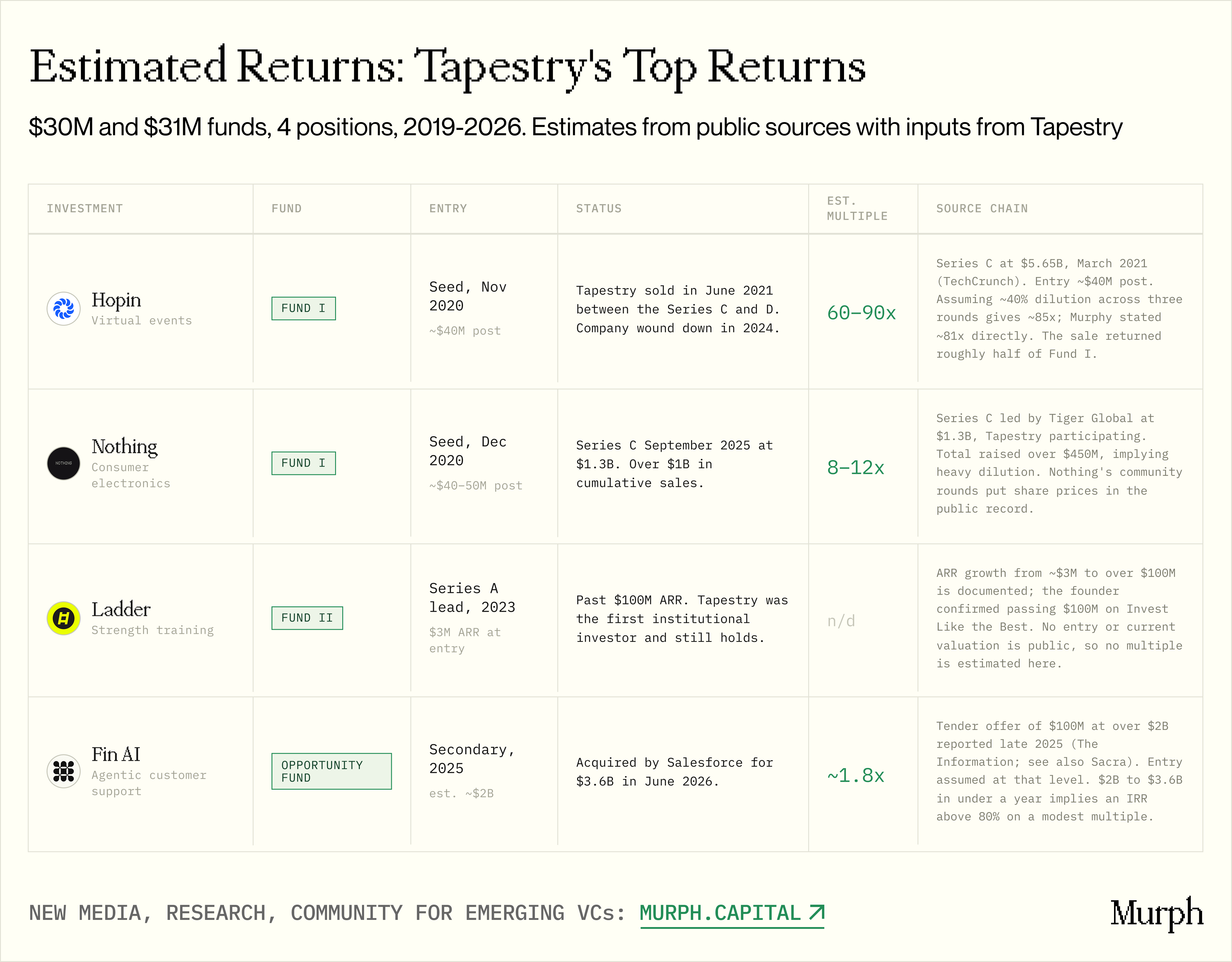
The first cheque returned roughly 81x, according to Patrick. The sale returned half of Fund I in year 3. Hopin itself wound down in 2024, selling parts of the business to Bending Spoons and RingCentral and returning over $650M to investors – a haircut of around 50% for those who were still in, and an orderly exit by the standards of a company that had been worth $7.75bn.
Other Fund I names: Nothing, backed at the seed round at a $40-50M entry and now worth around $1.3bn, Manna, the Irish drone delivery company now live in Oklahoma and competing with Zipline and Google Wing on a fraction of their capital, and Relay Financial, a Toronto company banking over 100,000 US small businesses.
Carl Pei’s account of how Tapestry came into Nothing corroborates the mechanism Murphy describes: the firm already knew what he had built, understood the pitch for a new kind of consumer electronics company immediately, and committed on the spot – then kept adding.
“When we started Nothing I made a few calls to those I thought would believe. Patrick and Tapestry VC knew what I had built before. When I said I wanted to build a new type of consumer tech company, they understood and committed immediately – and tripled down since.”
Carl Pei, CEO, Nothing
In 2021, with every seed manager in the market doubling, Tapestry VC raised $31M and did not go to market. No material new LPs – the same base, one of whom wrote a bigger cheque, plus two small additions. In SaaS terms, Murphy says, “net revenue retention was 100%”.
The strategy changed even though the size didn’t. Fund I ran roughly half its capital as follow-on. Fund II pushed the 5% target exposure in earlier, cut Series B follow-on entirely, and moved later-stage activity into a separate opportunity fund – which is why Tapestry’s reported AUM has appeared as high as $100M against fund sizes that never exceeded $31M.
Ladder is the clearest illustration of what the thesis actually buys. Its founder Greg Stewart had run two prior ventures, in fintech and real estate, and Murphy knew him through both. When Greg described a consumer fitness app, Murphy had the reaction anyone would have to consumer fitness after Peloton. What kept him in the conversation was the working method rather than the thesis: Tapestry stays with repeat founders through the decision tree, before there is a company to invest in. That proximity let him watch product-market fit arrive while the rest of the market showed no interest. Tapestry led a $7M Series A at low single-digit ARR, bringing in a family office with more firepower than the fund had. Ladder is now above $100M ARR, on Murphy's account, and Tapestry still holds it.
And there are a few other companies in Fund II highlighting:
Sustain.Life, in sustainability software, sold for $100M to a US-listed acquirer and returned about a third of the fund – also in year 3.
Sunrise Robotics, Maze and one stealth AI company are the names Murphy flags as still building.
The British Business Bank first met Tapestry VC 6 or 7 years ago, before COVID, and got an update roughly annually thereafter. About half of Tapestry’s deals have historically had a UK angle, and Murphy claims a 100% graduation rate on the firm’s UK seed investments – from seed or first round through to Series A or beyond. Over the same period the Bank grew into the UK’s de facto sovereign investor. The commitment of up to $40M, announced on 1 July, came with a requirement that roughly half the portfolio be UK-related – which is how Tapestry had been deploying anyway.
“It probably took about a year, but it also took eight years.”
Patrick Murphy, on how long Fund III took to raise
That is worth sitting with, because it is structural rather than particular. Government money is “30-50% of the European venture market” in Murphy’s estimate, occupying the position pensions and endowments hold in the US. Not by preference: legislation across individual European countries restricts pension funds from taking this kind of risk, leaving one pool of capital compounding at around 4% a year while Singapore’s GIC, Gulf sovereigns and Australian superannuation compound at 15-30% and hold direct positions in the largest private technology companies. Decades of that produce very different places to be standing.
There is a reporting artefact buried in it too. When I mentioned our Q2 data showing the British Business Bank as the most active fund investor globally, Murphy pointed out that governments face freedom-of-information obligations and must disclose, while most private LPs never issue a press release. The visible league table of active LPs is partly a league table of who is required to tell you.
New money in Fund III came from some additional founders and one multi-family office. The rest are the same people who have been there since 2018.
Two of the objections he describes are the ones that made the first two funds hard:
LPs did not believe a manager could invest well across both Europe and the US and wanted him to pick one geography – he says they understand it now.
And what they examined most closely by Fund III was DPI, and specifically how it had been generated.
A small marker of where that leaves Tapestry VC in the allocator conversation: the day before the fund was announced, the pseudonymous allocator account Endowment Eddie asked publicly which London GPs were worth meeting, setting a floor of $75M in fund size – then volunteered Murphy’s name as one nobody else had mentioned.
“Patrick Murphy at Tapestry. This man is a complete star. Great partner to founders, thinks independently… and a lovely Irish accent."
Endowment Eddie, on the best GPs in London >$75M fund size
Timing was organic – Tapestry declined the 2021 hype and deployed Fund II slowly. The last Fund II deal closed at the end of last year and the first Fund III looks started in January.
Portfolio construction has been constant across all three funds and is built backwards from exposure rather than ownership. Murphy targets 1-3% of the fund in a name at entry, scaling to as much as 5% in the ones that work. On $80M that is up to $4M in a single position, and 20x on one name returns the fund.
What changed is where in a company’s life that 5% goes in:
Fund I got there through follow-on.
Fund II front-loaded it.
Fund III front-loads it further, with initial cheques of $1-3M and target ownership moving from 3-7% to 10% or more.
Sourcing runs on a back-end system crawling GitHub, LinkedIn and X for signals that someone sold a company, shut one down, or started something new. Each name gets an expensive AI research pass, and the output ranks who the humans contact. Murphy is candid that the crawling is table stakes and that the value is in the ranking, because the raw signal is mostly noise. The intended contact point is before the founder has decided to start anything – which, he argues, “earns Tapestry the right to be in the room later”. Asked what protects that once every fund runs the same detection systems, his answer is that at a small cheque size founders pick people they want to work with, and no system produces that.
On picking: is there a path to 100 million of something, is the thing physically possible (a question he says the engineering training earns him in deep tech) and then the people, benchmarked against repeat founders he knows intimately.
“That’s our expensive experience. It’s only something that comes with time, and is why investors have gray hair.”
Patrick Murphy, on pattern matching against founders he already knows
Which is where the model has to work harder than the pitch. Murphy volunteers that benchmarking against archetypes is pattern matching and that pattern matching carries bias – a heuristic built from the excellent people you happen to know is shaped by who you happen to know.
Gamma shows what the model costs. Tapestry held Pitch, another presentation software company, in Fund I, and Pitch was moving into AI at the point Gamma appeared. Murphy treated that as a conflict, so he and his wife took a small personal angel position in the May 2023 seed instead. Gamma reached a $2.1bn valuation on $100M of ARR in late 2025. He says he wishes it had been in the fund.
Repeat founders also price higher, and on a pre-seed portfolio entry price determines returns more than anything else. And the Fund I deck sold a fund that took no board seats and wrote $100-500k alongside a lead. Fund III writes $3M and leads. Same deal count, nearly three times the capital, is a different fund wearing the same thesis.
Murphy has moved from San Francisco to London, where Tapestry VC has opened its flagship office. His time split has gone from roughly 60/40 in favour of the US to 40/60.
He frames it as arbitrage. American funds are opening European offices (Sequoia, IVP, Bessemer) and European funds are opening in San Francisco. In San Francisco people joke there are more venture funds than startups, in London the ratio runs the other way, and those companies are underserved by the partners available to them.
What is your fund’s superpower in one sentence?
Helping repeat founders figure out their next dent in the universe.
How long did the active fundraising process take?
About a year - but many relationships built long before that.
Did anybody help you during fundraising: existing LPs, fellow GPs, placement agents?
My peers and those a few clicks ahead have all been incredibly open, collaborative and helpful. The emerging VC manager community as a whole is helping each other thrive through great events, media and intros - and I try to pay it forward too with connections and info.
How many LPs are in the final cap table, and what’s their breakdown?
The majority of capital is a small number of institutions, with a handful of families and exited tech founders/execs too. It’s less than twenty LPs.
What was the fastest check – time from first call to signed subscription?
We had one amazing repeat founder say “yes” to this fund in our first meeting, and then turned around the docs in a week. That was great!
We’ve also had fun things happen over the years as we build relationships with exited founders ahead of them starting a new company, where they then turn around and invest in us instead. We’re incredibly thankful - but we also want them to build again!
What were the top 3 reasons LPs said “NO”?
Top reason? No Money! E&Fs with great emerging manager programs but no capital; FoFs who have yet to first close the new fund; families who are no longer comfortable with the long term hold required in early stage VC.
More specifically, in the past many folks didn’t understand or agree that we could invest well ‘globally’ across both Europe and the US - they preferred managers pick one geography. They get it now though.
I think a pass after diligence is a much stronger signal than people give it credit - folks much more likely to re-engage and commit in the future if you’re doing what you said you would do.
What were the top 3 signals that an LP was truly interested in your fund?
They came to visit us on-site and built a personal relationship.
They were familiar with us or our portfolio companies previously, often from follow-on investors or co-investors with us.
They were truly off-put by the scale of megafunds and want to be part of the future.
What did LPs actually pay close attention to during fundraising?
They focused mainly on our strong DPI and how we (actively) generated it; they wanted to understand our portfolio model evolution with (evidence for) expanding check size; and how our follow-on decisions (incl our Opportunity Fund) has worked out.
What’s the biggest mistake fund managers make when fundraising?
I believe a lot of emerging managers forget that an emerging fund investment is a highly personal relationship for the LP too, and that the LP’s career hinges on the small number of fund bets they can make, and how they reflect on them - not just the money or returns.
What advice would you give to your future self and to other emerging managers about fundraising?
Pick great companies. The rest will look after itself!
Learn more about Tapestry Fund III: Tapestry Fund III announcement.
Who do you want me to interview in the next episode?
We’d love to hear your ideas – hit reply below.
No posts
Comments
Nothing yet. Say the first thing.
Sign in to join the conversation.