
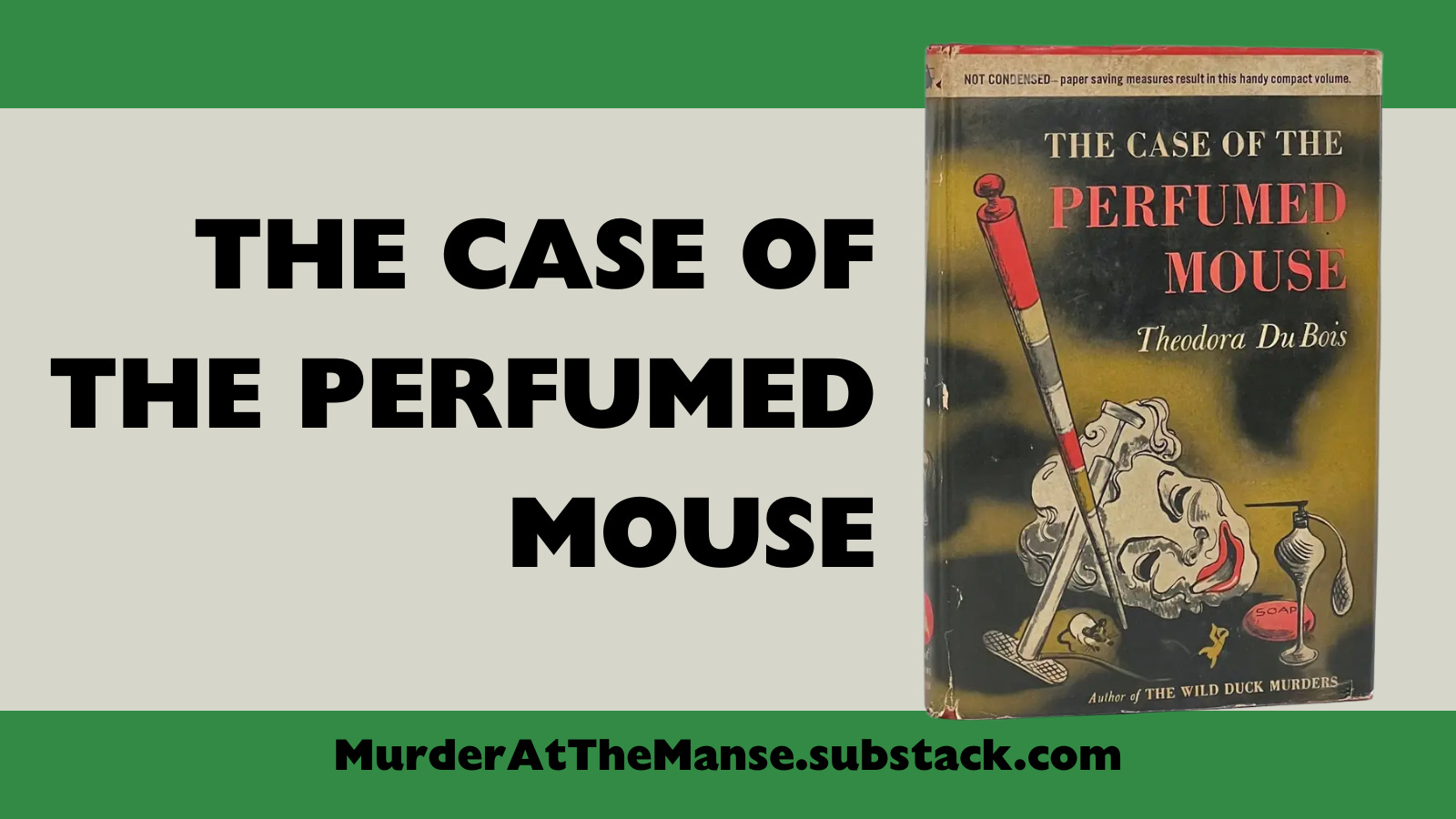
This is the sixth instalment in my occasional Forgotten Book series, where I review some of the less-remembered items on my TBR shelves. Unsurprisingly, my experiences of these rarer books have been mixed: I’ve read some unjustly neglected gems (e.g. Double Detection by Belton Cobb), but also some books that were forgotten for a reason (e.g. Four Past Four by Roy Vickers). Today’s item for investigation is the 1944 book The Case of the Perfumed Mouse by Theodora Du Bois. I was drawn in by the excellent title and the intriguing synopsis. But does the book deliver on this intrigue? And is it suitable for someone with musophobia?
Theodora Du Bois was born the day before Agatha Christie in September 1890, in New York.1 Du Bois had an interest in drama from a young age, and her first published works were a series of children’s plays included in John Martin’s Book between 1916 and 1918. Her first published short story followed two years later, by which point Theodora McCormick had married a man called Delafield and become Theodora Du Bois.2 In the 1930s, she started writing novels alongside short stories and plays. This included a series of detective novels, beginning with Armed with a New Terror (1936).
In total, Du Bois published 24 mystery novels, 19 of which featured her series sleuths Anne and Jeffrey McNeill. Anne began life as Miss Holt, but the couple fell in love during their first case, when Jeffrey vindicated her character after a false accusation of murder. Jeffrey is a medical researcher and their cases often have medical or scientific themes. According to Lisa Kucharski, there are three types of McNeill investigations: in some cases, Anne takes the lead while Jeffrey is busy working, in others the spouses investigate together while travelling, and in others the plot is closely related to Jeffrey’s scientific research.3
The McNeill mysteries received mixed reviews. Anthony Boucher described Death Comes to Tea (1940) as a “small masterpiece”, but he was less enamoured with The Listener (1953), writing:4
In view of the fact that I’ve read close to three thousand mysteries as a professional re- viewer, and a large number non-professionally, this is probably a rash statement: but at this moment it seems to me that Theodora DuBois’ THE LISTENER (Doubleday, $2.75) is the most utterly foolish detective story I have ever read.

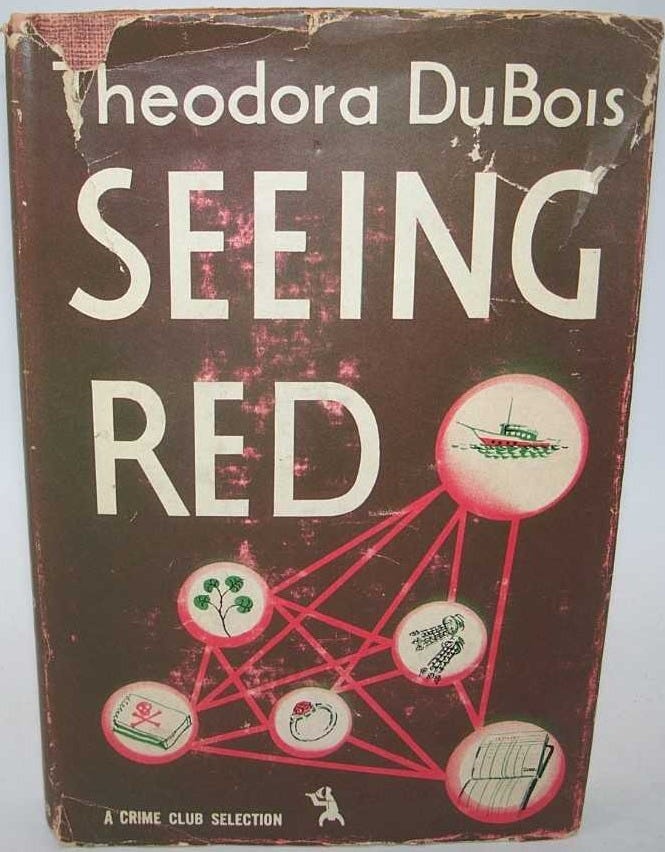
Du Bois received an even worse reception to her 1954 novel Seeing Red, bringing an end to Anne and Jeffrey’s adventures. This book was a sequel to Murder Strikes an Atomic Unit (1946), a book doubtless inspired by her husband’s involvement in the Manhattan Project, where he helped to develop the first atomic bomb.5 Controversially, Seeing Red featured a critical depiction of the House Un-American Activities Committee, a panel which investigated alleged communist subversion. Her indiscreet comments provoked a negative public response and Du Bois was dropped by her publisher. She continued writing, but her career did not enjoy the same success after this point.
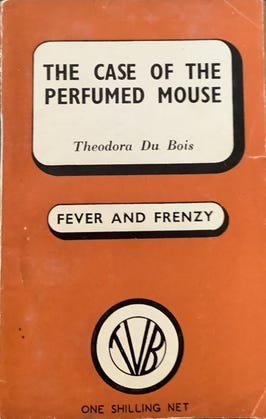
The Case of the Perfumed Mouse is the 10th book in the Anne and Jeffrey McNeill series, reviewed by Anthony Boucher as “highly satisfactory and somewhat off-the-beaten-track”.6 For this intriguingly-named case, the McNeills are summoned to Ivory Tower, a curious establishment overseen by Jacqueline Granville. Mrs Granville has a self-appointed mission to rehabilitate troubled individuals, rescuing each one from their own “private and particularly superheated hell”. On their arrival, the McNeills are initially puzzled by their summons, as the two main problems Granville seems to be facing are an infestation of rats and a teenager who is behaving erratically:
“I think you need a pediatrician for the child and a good rat-and-roach company for the house. My husband and I are quite plain dealers in murder cases.”
Granville, though, persuades the detective couple to help by mentioning a suspicious death and raising the sinister suggestion that someone may be using rats for murderous ends. The couple accept the case: after all, they need the money as their house “had been destroyed last winter by a bomb in the cellar.” After their arrival, the household continues to experience a spate of unusual happenings, including more rat bites, the discovery of a creepy dummy in an abandoned house, and the eponymous mouse (eponymouse?), bathed in perfume as if she “was goin’ to a mouse’s dinner party”. How are all these oddities connected? And is someone actually plotting to kill people with rats?
The characters at Ivory Tower are mostly interesting personalities, with their troubled backgrounds providing an air of ambiguity that adds to the unpredictable atmosphere. They include Corny O’Connor the one-armed doctor, Paul Barleigh the spurned vicar whose wife ran away with a cornetist, and Miss Flaherty the objectionable nurse. At the centre of the narrative is Katrinka, an erratic 13-year-old who collects skulls and whose thoughts are especially mysterious. The unexpected arrival of Mr Granville (missing, presumed dead) adds to the sense of dread. Theodora Du Bois is clearly fond of creepy mysteries.
This case falls into the category of investigations where Anne takes the lead while Jeffrey is busy with work. Although Jeffrey accompanies Anne at the beginning, he soon has to return to the Bradney Hall of Medical Research, leaving Anne (the narrator) to probe the events at Ivory Tower mostly alone. At one point, she provides a detailed explanation of their detective methods:
“I list the people involved with a catch phrase characterizing them after each name, and next I write a fairly full small biography of each person. I list everything I consider a clue and, on one page in red ink, put any red herrings that I have traced as such. Also, I make a fever chart on graph paper of emotional crises, with each individual involved represented by a different coloured crayoned line…
When we have collected enough data, Jeffrey wants to take curves of individual behaviour from these charts and reduce the curves to equations—if he can. He says that if he is able to do that we should be able to solve any detection problem three-quarters of the way through by mathematics.
This sounds impressive, but the reality in this case is less remarkable. There are no equations or fever charts, and the compilation of clues is fairly limited. Anne undertakes very little actual detection until chapter sixteen. One lead that is mentioned at the start of chapter two is forgotten for the next 60 pages. Another lead in the final chapters is pursued successfully, but implausibly (and with a complete disregard for data protection). Jeffrey’s input is mostly related to the scientific side of the case, with Anne making an enlightening trip to his research institute.
The McNeills are an interesting example of a sleuthing couple, especially when we discover that they have a three-year-old son. Normally, if detectives have young children at home, they are just mentioned obliquely. Little Michael McNeill, however, is both seen and heard—and remarkably untroubled by his parents regularly abandoning him in the pursuit of justice. There are a few fun interactions between mother and son: “Oh, Mummy, we have a new black kitten!” There are some moments of affection between husband and wife too, leading to one of my favourite lines from Anne: “He kissed me very nicely.”
The mystery itself is a mixed bag. Du Bois highlights a short list of key clues, which accompany the reader through the investigation, and I’m annoyed that I didn’t join up some of the dots sooner. Later on, there is one especially interesting sound-related clue. The unusual murder method, and the suggestion of deadly rodents, adds to the interest of the mystery. The book suffers, though, from the lack of actual detection through the central section of the book and an insufficient justification of the culprit’s identity.
The book is stronger on atmosphere, which I understand is true of other novels in the series. According to Lisa Kucharski, the author’s strength “is that she is really good at creeping out the reader, building tension with palpably real characters.” Based on The Case of the Scented Mouse, Du Bois is also strong at creating imaginatively quirky descriptions and dialogue, of which my favourites include:
“She was a thin thirteen-year-old, with tightly braided hair, and had one of those faces that looks rather as if it should belong to a grasshopper.”
“No turtle I’ve ever known has seemed unduly intense or emotional.”
"It's the only chance I'll ever have to boil the rat."
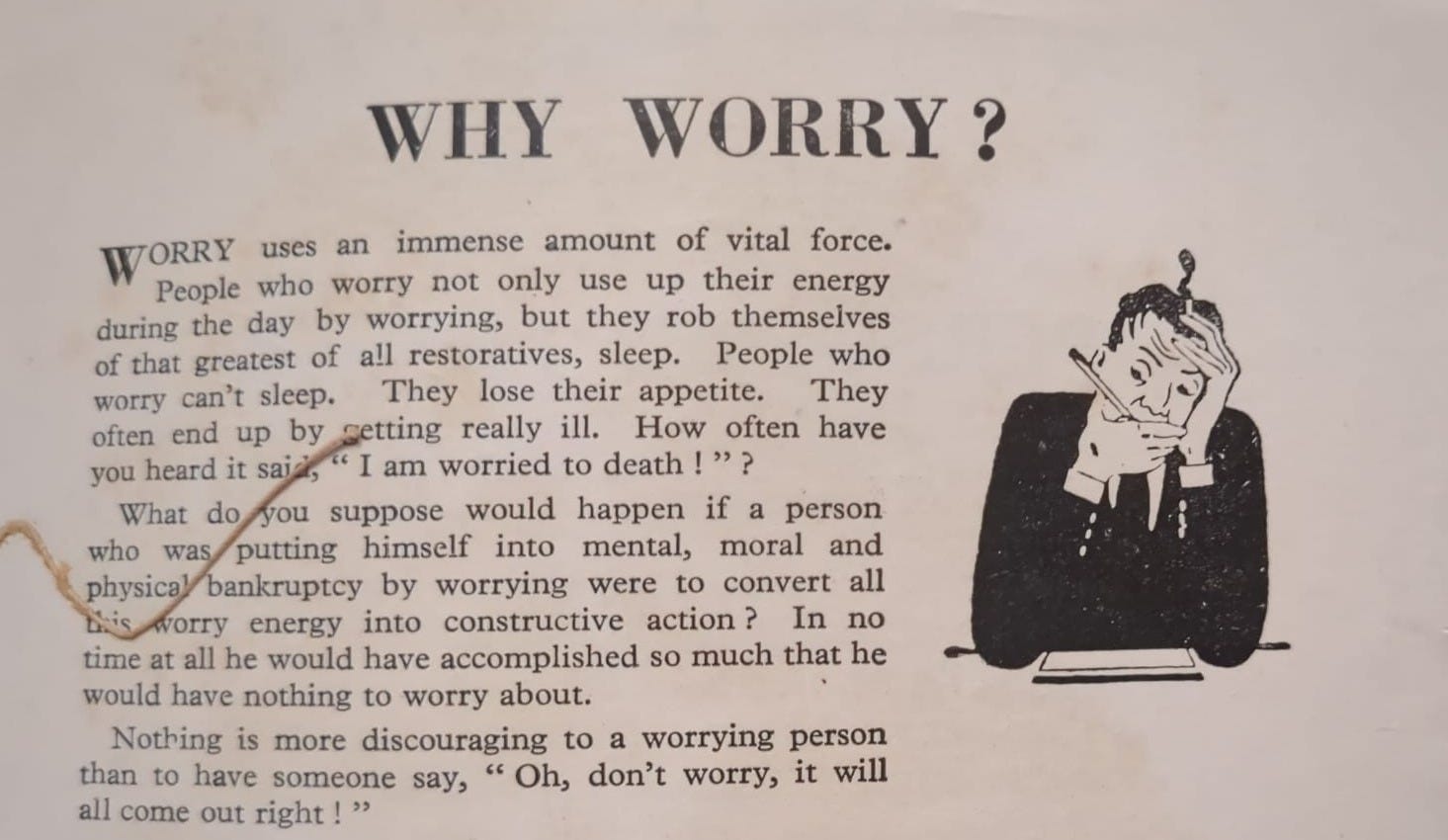
It’s not easy to get hold of Theodora Du Bois’ books, and I’m not sure I’ll spend effort hunting out another, but the oddness of this novel was still enjoyable. My copy also ends with a helpful advert for the Pelman Institute: “People to-day are all too prone to complain they just have to worry. But once they become Pelmanists they cease this negative form of thought.” You can request an introductory book, completely free, by writing to the Pelman Institute, 244 Norfolk House, Wigmore Street, London W1.
Verdict: ⭐⭐⭐ (3/5)
Read in the 1946 T.V. Boardman paperback
Scavenger Hunt item: A mask
She continued to use her maiden name for historical romances.
San Francisco Chronicle, September 24, 1944. In the same column, Boucher reviewed The Dark Tunnel by Kenneth Millar (“remarkable debut”), The Glass Mask by Lenore Glen Offord (“a wonderful 8-year-old”), The Murder of a Quack by George Bellairs (“very little mystery”), The Case of the 16 Beans by Harry Stephen Keeler (“I enjoyed it, in a dazed sort of way”) and Dark Waters by Frank and Marian Cockrell (“is it the cryptic fat man?”).
No posts
Comments
Nothing yet. Say the first thing.
Sign in to join the conversation.