
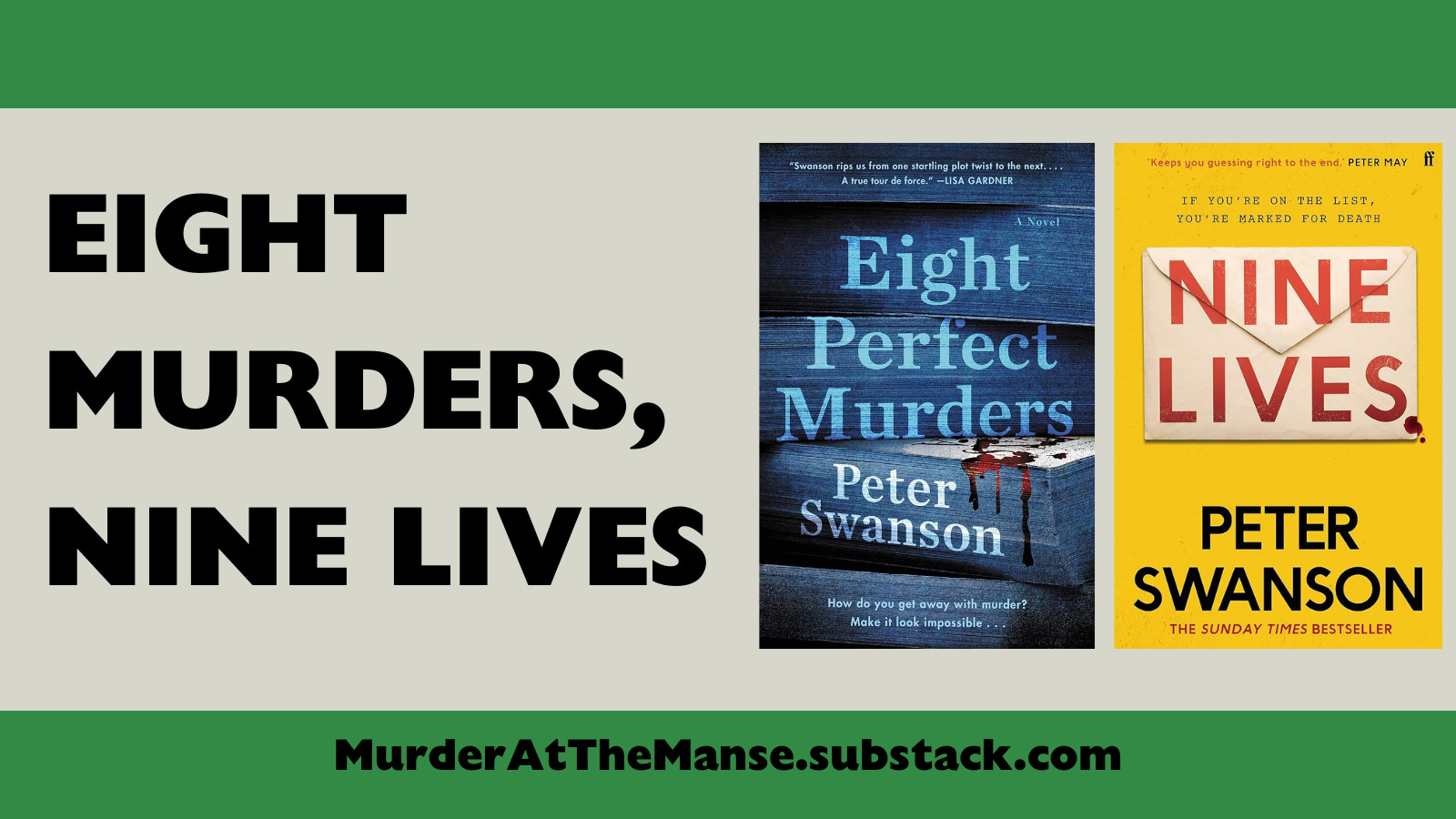
I was recently enticed into reading two books by American author Peter Swanson, based on a Publishers Weekly promise that “classic whodunit fans will be in heaven” and a cover blurb from Peter May announcing “a clever homage to the Golden Age of mystery.” The books in question were Eight Perfect Murders (aka Rules for Perfect Murders, 2020) and Nine Lives (2022).1 Both novels have interesting premises, and contain a number of nods to classic detection. But did I enjoy the heavenly experience that Publishers Weekly promised? Keep reading to find out…

In 2004, fictional Boston bookseller Malcolm Kershaw wrote a blogpost called “Eight Perfect Murders”, which has now become the subject of an FBI inquiry. There’s nothing nefarious in the blogpost itself: it’s merely a list of eight works of crime fiction “in which the murderer comes closes to realizing that platonic ideal of a perfect murder.” The titles include Malice Aforethought by Francis Iles, The ABC Murders by Agatha Christie and Strangers on a Train by Patricia Highsmith.2 So why the FBI interest? Well, it seems that someone is now re-enacting each of the murders on the list, one by one. Malcolm Kershaw undertakes his own investigation to work out how the murders are connected, and whether someone is trying to send him a message.
The novel is presented as the first-person memoir of Kershaw, but we soon discover he won’t be an entirely reliable narrator. In the first chapter, he mentions that he has lost his interest in crime fiction, but “it’s not something I can talk about.” He continues being evasive about other parts of his life history too, before telling us what we had already guessed: “I have more to do with these crimes than I’ve been letting on.” Through the rest of the book, Kershaw remains an ambiguous character and we are left to discern how suspicious we should be. This was definitely one of the strengths of the book: Swanson has created an intriguing narrator whose personal history adds an extra layer of mystery to the writing.
I have mixed feelings about the plot itself. With the early mention of The ABC Murders and the Publishers Weekly promise, I was hoping for a clever twist on classic detective fiction. Sadly, my hopes were not entirely realised. Although Eight Perfect Murders draws inspiration from various vintage mysteries, it’s not packaged as a whodunnit puzzle, but as a straightforward thriller with an over-the-top ending. It’s a well-paced thriller, but the investigation elements are somewhat weak and the revelation of the murderer’s identity is unsatisfying because of the lack of meaningful clues.
Eight Perfect Murders has another characteristic that will frustrate many classic crime readers: Swanson insists on including egregious spoilers of some vintage mysteries, without advance warning.3 If you haven’t read The Red House Mystery, The ABC Murders, And Then There Were None or The Murder of Roger Ackroyd, Swanson will spoil them all for you, along with lesser-known works like John D. MacDonald’s The Drowner (1963), Ira Levin’s play Deathtrap (1978) and Donna Tartt’s The Secret History (1992). For some readers, that will be reason enough to avoid this book. Thankfully, I had already read all but one of the books from Kershaw’s list that I plan to; I had to skip a few paragraphs to avoid any unwanted revelations about Strangers on a Train.
Overall, this wasn’t as engaging a read as I initially hoped. And I definitely disagree with Publishers Weekly: classic whodunit fans won’t necessarily be in heaven when reading this book. But if you want a bibliophilic thriller with some nods to classic crime and an interesting narrator, you may enjoy this more than I did.
Verdict: ⭐⭐⭐ (3/5)
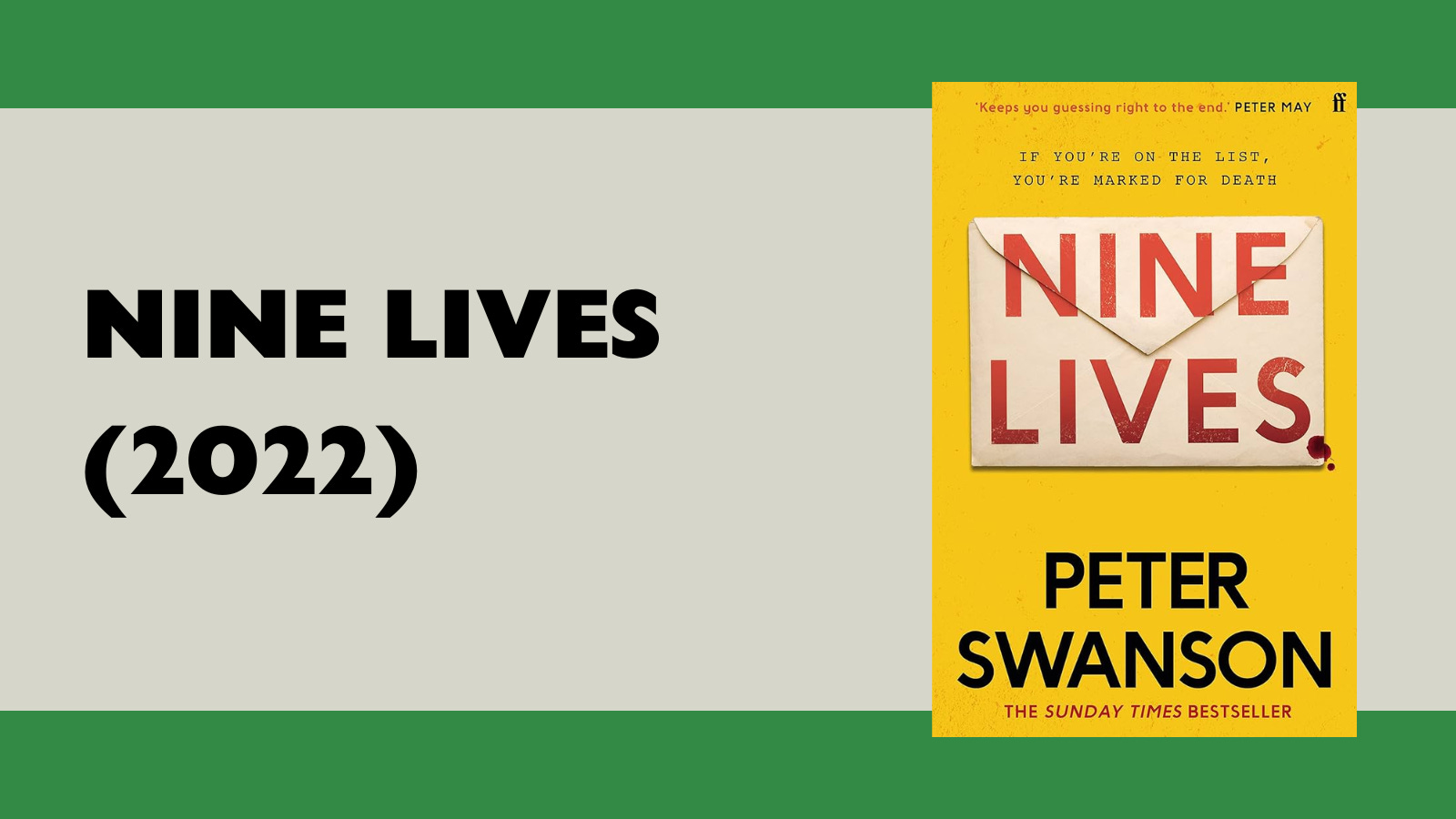
Matthew Beaumont. Jay Coates. Ethan Dart. Caroline Geddes. Frank Hopkins. Alison Horne. Arthur Kruse. Jack Radebaugh. Jessica Winslow. Nine people who have at least one thing in common: They’ve all received a single sheet of paper through the post containing a list of these nine names. Some are tempted to ignore the letter as a random computer error, but the list proves to be more sinister when the nine recipients start getting murdered. The FBI desperately attempts to protect the potential victims, discover a possible connection between the nine lives, and stop the murderer before the list is 100% deceased.
As with Eight Perfect Murders, it’s an intriguing set-up and there are some very clever aspects to the plot. Swanson makes good use of dramatic irony, especially with a few of the names on the list. There is also one particularly excellent twist, where we discover a perspective-shifting fact about one of the characters. Despite the frequent shifts of narrative viewpoints, the nine main characters are distinct enough to follow their various paths without getting confused. And the final explanation of the list is satisfying, even if the last chapter is anticlimactic.
Contrary to Peter May’s blurb, though, I wouldn’t describe Nine Lives as “a clever homage to the Golden Age of mystery.” It is clearly inspired by And Then There Were None, which gets several mentions in the book. But, like Eight Perfect Murders, it’s essentially a modern thriller with some references to classic crime, and a couple of borrowed plot points. It definitely has merits as a thriller, but I suspect many Golden Age mystery fans would share my dissatisfaction. And some would be unhappy that Swanson again includes spoilers for The ABC Murders.
Arguably, the in-plot comparison to And Then There Were None highlights some of the book’s weaknesses. Like Christie’s book, Nine Lives is told through a series of short chapters shifting between different character perspectives. But Swanson’s novel lacks the strong foreboding atmosphere that Christie sustained on Soldier Island. There is one character whose storyline involves significant tension, but otherwise the letter recipients seem remarkably unbothered about being marked for death. The distance between the characters, and the lack of a closed circle of suspects, doesn’t help in terms of tension either.
At the end of Nine Lives, my conclusion is: Peter Swanson is probably not an author I’ll return to, regardless of what seductive promises his book jackets may contain. I’m not claiming these are bad books; in fact, for the right kind of reader, they would be very good books. But sadly, I don’t think “classic whodunit fans” are the right kind of reader.
Verdict: ⭐⭐ (2/5)
Not to be confused with the 2016 film of the same name, in which Kevin Spacey plays a businessman who finds himself trapped inside the mind of a cat.
There is no John Dickson Carr on the list, which prompts one blog commenter to write: “Anyone who writes a list of perfect murders that doesn’t have at least one John Dickson Carr on it obviously knows nothing about anything.” Which is a fair comment.
There’s an oblique spoiler warning when Malcolm Kershaw first mentions his list, but readers still aren’t prepared for the level of detail Swanson later provides, or for the spoilers of books that aren’t on Kershaw’s list.
No posts
Comments
Nothing yet. Say the first thing.
Sign in to join the conversation.