
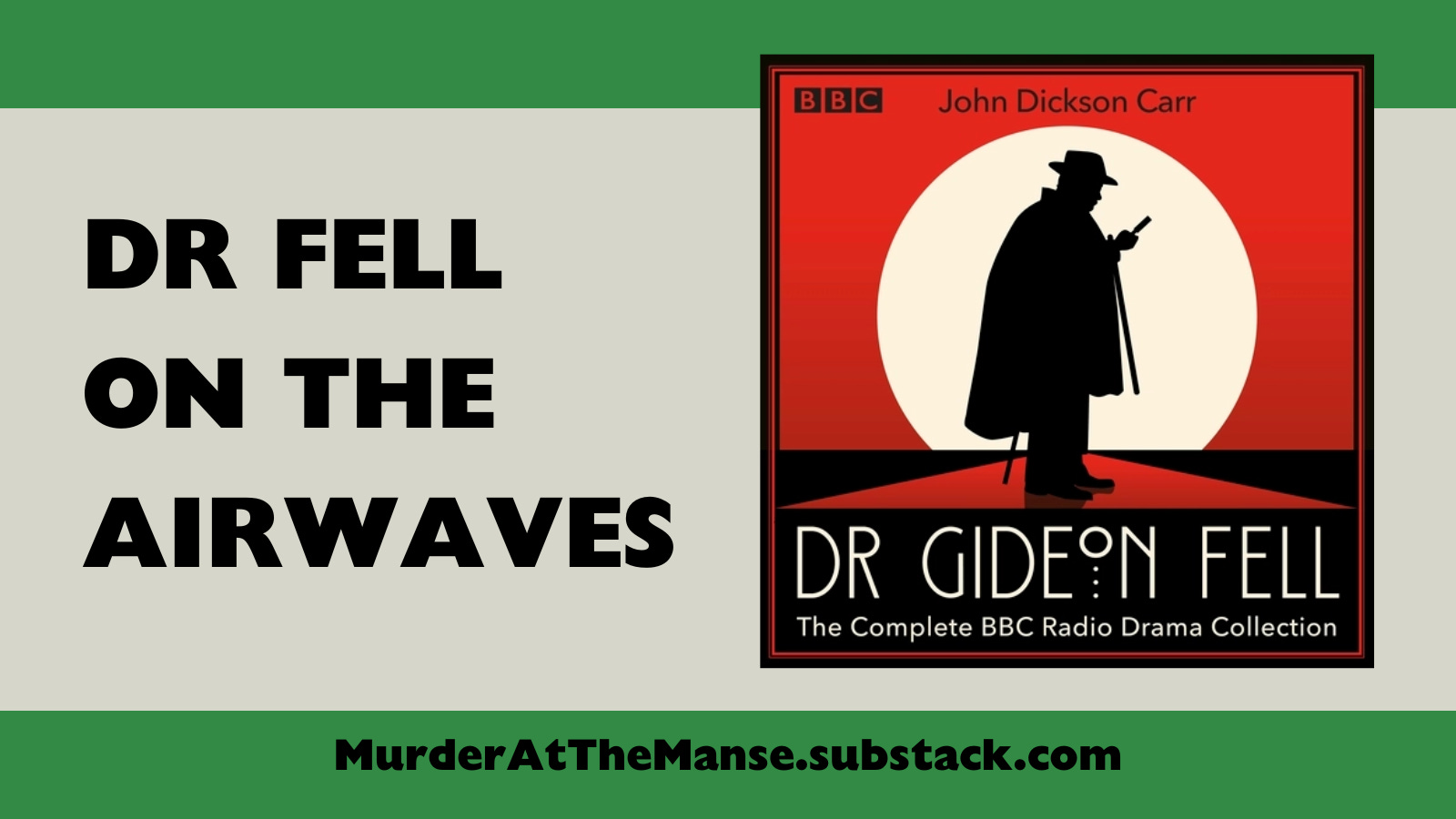
Having finished my chronological Dr Fell readthrough earlier this year, I decided to fill the Fell-shaped hole in my life by listening to some of the adaptations produced for BBC Radio in the 1990s. Thankfully, these adaptations were redistributed in audiobook form in 2021 and are now easily hearable through a selection of stores and streaming services.1 I don’t normally listen to radio dramas, but I’m glad I pressed play on these. They weren’t amazing audio adventures, but they did still provide an enjoyable antidote to my Fell-sickness.
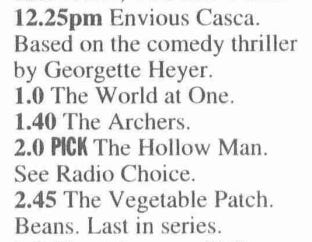
In total, eight Dr Fell dramatisations were broadcast on BBC Radio 4 between 1997 and 2001. These were directed by an experienced producer of radio crime, Enyd Williams, whose other credits include radio adaptations of 39 Agatha Christie novels. The scripts were written by Peter Ling, co-creator of the oft-maligned British soap Crossroads — but don’t let that put you off.
The episodes were initially broadcast in the coveted 2pm Wednesday slot, after The Archers. The first three productions in 1997 were 90-minute dramas in two parts: The Hollow Man, The House in Gallows Lane (a.k.a. Till Death Do Us Part) and To Wake the Dead. These were followed by a series of shorter dramas, under one hour long.2 Each episode was introduced with startlingly jaunty theme music, which would probably have been more suited to a 70s sitcom, as heard here:
0:00
-0:42
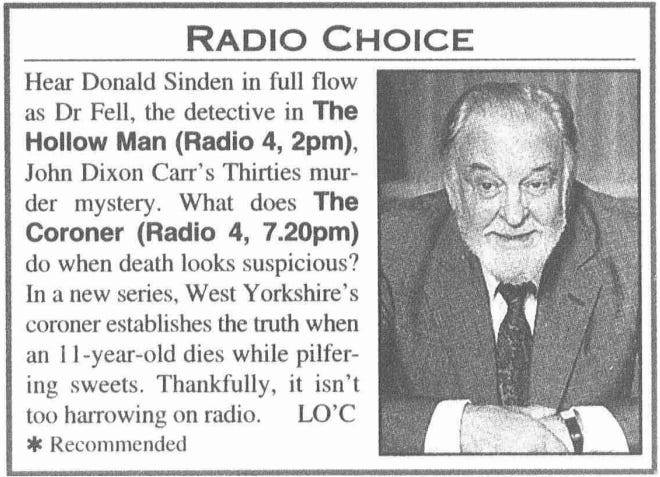
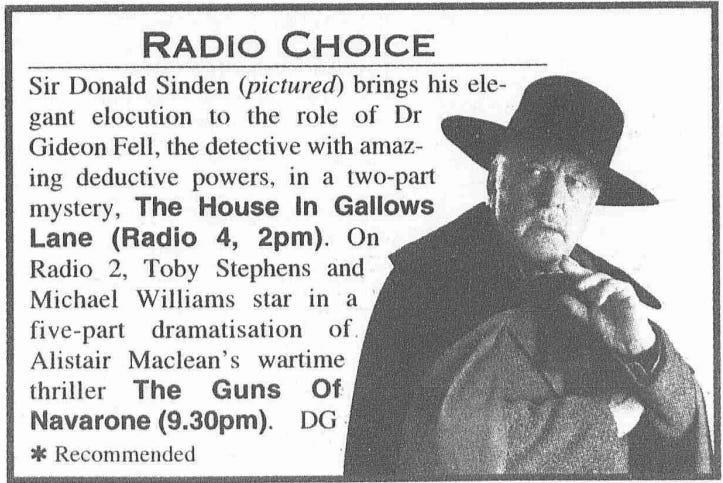
The starring role was filled by Donald Sinden, an experienced actor in his 70s who was (in the words of his BBC obituary) “renowned for his rich, booming voice and commanding presence”.3 I think Sinden’s voice was a good choice for Fell, both in his speech and in his chuckle — although his utterance of “Archons of Athens” was not entirely convincing. Financial Times columnist Martin Hoyle praised his portrayal, writing that “Sinden’s evident relish as the sleuthing Dr Gideon Fell is infectious.”4 Sinden was accompanied by John Hartley as Inspector Hadley (later Superintendent Hadley). Among his other credits, Hartley appeared as various characters in several of Enyd Williams’s Agatha Christie dramatisations, as well as playing the part of Mycroft Holmes in the 1990s radio adaptations of the Sherlock Holmes stories.
Dr Fell and Inspector Hadley in conversation:
0:00
-0:23
So far, I’ve listened to two of the dramas: The Hollow Man and The House in Gallows Lane.5 Despite the unnecessary title change for Till Death Do Us Part, Peter Ling’s adaptations are largely faithful to Carr’s original writings. The stories are re-told through a mixture of narration from Dr Fell, conversations between Fell and Hadley, and dramatic dialogue involving the wider cast. With a few small exceptions, events unfold in line with Carr’s original timeline and most of the main clues are preserved. The pacing of the dramatisations matches the novels too — for both, the end of Part 1 roughly corresponds with the midway point of the novels.
For the uninitiated, The Hollow Man begins in the Warwick Tavern on Museum Street, where Professor Grimaud is discussing Hungarian vampires with some friends. The conversation ends when Grimaud receives a sinister threat from an illusionist called Pierre Fley. A few nights later, Grimaud is found dead in his locked study, with no apparent way for the murderer to leave the room. This is the first of two impossible crimes: on the same night, another puzzling murder takes place in a snowy cul-de-sac, in front of eyewitnesses. For added measure, Dr Fell and Inspector Hadley are also confronted with a spooky story about three coffins in Transylvania.
The cast is sensibly downsized for the adaptation. Dr Fell’s American friend Ted Rampole is absent, with Inspector Hadley taking some of his dialogue. One of the potential suspects from Grimaud’s house is also missing. Among the supporting cast, Jillie Meers gives an especially memorable performance as Ernestine Dumont. Interestingly, her interpretation of the character includes an exaggerated continental accent, whereas in the novel Ernestine speaks “almost without accent”. Similarly, Sean Baker ensures that Pierre Fley’s “harsh, husky, and faintly foreign” voice is not faint in its foreignness. And Yorkshire-born Steve Hodson emphasises the Irishness of Michael O’Rourke, who in the novel “spoke like an American.”
Ernestine Dumont:
0:00
-0:12
Pierre Fley:
0:00
-0:14
Michael O’Rourke:
0:00
-0:11
Overall, the cast works well together, and the interrogation scenes are well-adapted. I also appreciate a few added touches of humour. On entering the crime scene, for instance, Dr Fell lags behind the others, with the comment: “My figure is built for comfort rather than speed.” The mixture of Fell’s narration and dramatic dialogue works well, and the solution is efficiently explained. The atmosphere, though, is slightly lacking: the production takes a minimalist approach, with little sound outside of the dialogue and therefore a limited sense of location or ambience. I feel the radio play format could have been better exploited.
There’s a more significant weakness in the dramatisation’s handling of evidence. Peter Ling changes some of the wording of one character’s initial witness statement, inadvertently introducing an extra impossibility into the crime scene, which is left unresolved at the end. Dr Fell’s final explanation also relies on a few clues that are either excluded or unhelpfully abridged in the earlier narrative. An adaptation like this will obviously have to be selective around clues, but sadly I felt these inconsistencies detracted from the element of fair play. It’s still an enjoyable listen, but perhaps more of a car journey accompaniment than an evening’s entertainment.
Verdict: ⭐⭐⭐ (3/5)
I was more satisfied with The House in Gallows Lane (Till Death Do Us Part), which follows the travails of Dick Markham. A visit to the fortune teller at a local fête leads to the awkward discovery that Markham’s new fiancée, Lesley Grant, may in fact be a murderer. Unsurprisingly, this rumour is accompanied by a fresh local murder. Markham is lured to the crime scene by an eerie phone call, and discovers the victim in a locked room. Fortunately, Dr Fell is staying nearby in Hastings, so Markham can get expert advice on whether it’s safe to marry his beloved, or whether he should have proposed to Cynthia instead.
Peter Ling has again made a few character changes. Intriguingly, Superintendent Hadley has only just received his promotion from Inspector — in the novels, this happens between Death-Watch and The Hollow Man. I guess this change does give a modicum of character development between the first two radio dramas. In another intriguing change, the doctor’s name is changed from Middlesworth to Minster. More understandably, one of the potential suspects is again removed. This results in more lines for Bert Miller, who is wonderfully voiced by Brian Parr as a rustic village policeman. Among the supporting cast, I also enjoyed John Woodnutt’s colourful portrayal of Major Price.
Bert Miller:
0:00
-0:07
Major Price:
0:00
-0:16
This dramatisation better captures the atmosphere of the book, through both its dialogue and its added effects. This is especially noticeable in the opening scene at the fête and later in the climactic moments leading up to the murderer’s unmasking. Ling’s script also convincingly depicts the village setting, with its attendant risk of gossip and suspicion. Robert Portal, playing Dick Markham, makes a good contribution to the atmosphere with his reactions to various revelations, although his character does not fully reflect the tensely ambiguous situation Markham faces in the novel.
As far as I noticed, The House in Gallows Lane does not share The Hollow Man’s issues with distorted clueing. The script prepares for all of the elements of Fell’s summing-up and avoids any unhelpful rewording of evidence. Overall, if you want to explore the radio series, I would suggest starting with this instalment, rather than The Hollow Man. As a final comment, it’s worth noting that this drama includes the first instance of Donald Sinden uttering Fell’s immortal catchphrase “Archons of Athens!”
0:00
-0:01
Verdict: ⭐⭐⭐⭐ (4/5)
I look forward to listening to the other 6 cases. Do you have any other detective radio dramas to recommend? Let me know in the comments!
The Blind Barber (1997), The Black Spectacles (1998), The Mad Hatter Mystery (1999), He Who Whispers (2000) and Below Suspicion (2001).
The Hollow Man was first broadcast on Wednesday 26th March and Wednesday 2nd April 1997, and The House in Gallows Lane on Wednesday 8th and 15th October 1997.
No posts
Comments
Nothing yet. Say the first thing.
Sign in to join the conversation.