
John Singer Sargent spent three weeks on a portrait of Lady d’Abernon in a white dress. One morning, a few minutes into what was meant to be the final portrait sitting, he stopped, picked up his palette knife, and scraped the whole thing out.

There are several stories like this in Evan Charteris’s 1927 biography of American expatriate artist Sargent. Charteris was friends with Sargent and actually watched him paint. Sargent narrated his own process as he went, calling out each stroke, “often condemning it” before the paint was dry. “That is how not to do it! . . . Keep the planes free and simple.” Besides talking to himself through the process, Charteris noted that Sargent never tried to repaint a head once he realized there was something wrong with the drawing structure. You cannot patch a bad foundation. He would watch Sargent aggressively scrape down or rub out a painting, then redraw, sometimes discarding the canvas altogether and picking up a fresh one he kept ready for such an occasion.
Philadelphia artist Scott Noel does something similar. He scrapes down the whole wet area of his oil painting with his palette knife at the end of the day, leaving a ghost image underneath that becomes the platform for the next day’s work. I have heard stories from Noel’s students that they are shocked when he asks them to scrape down at the end of class. A classtime’s worth of effort, gone in a few passes of the palette knife. But he is giving them a lesson in not being too precious, and a starting point when the class picks back up a week later. They will know where they need to start. In the following class, they are looking at a ghost image with fresh eyes. The scrape down has given them an on ramp to start painting again.
There’s no undo button in painting. Digital tools have spoiled us. The scrape down is the closest thing we get, and it doesn’t reset at all. Undo erases and resets, but scraping down keeps the ghost of the paint. You’re not pretending the last few hours didn’t happen, you’re using what they taught you.
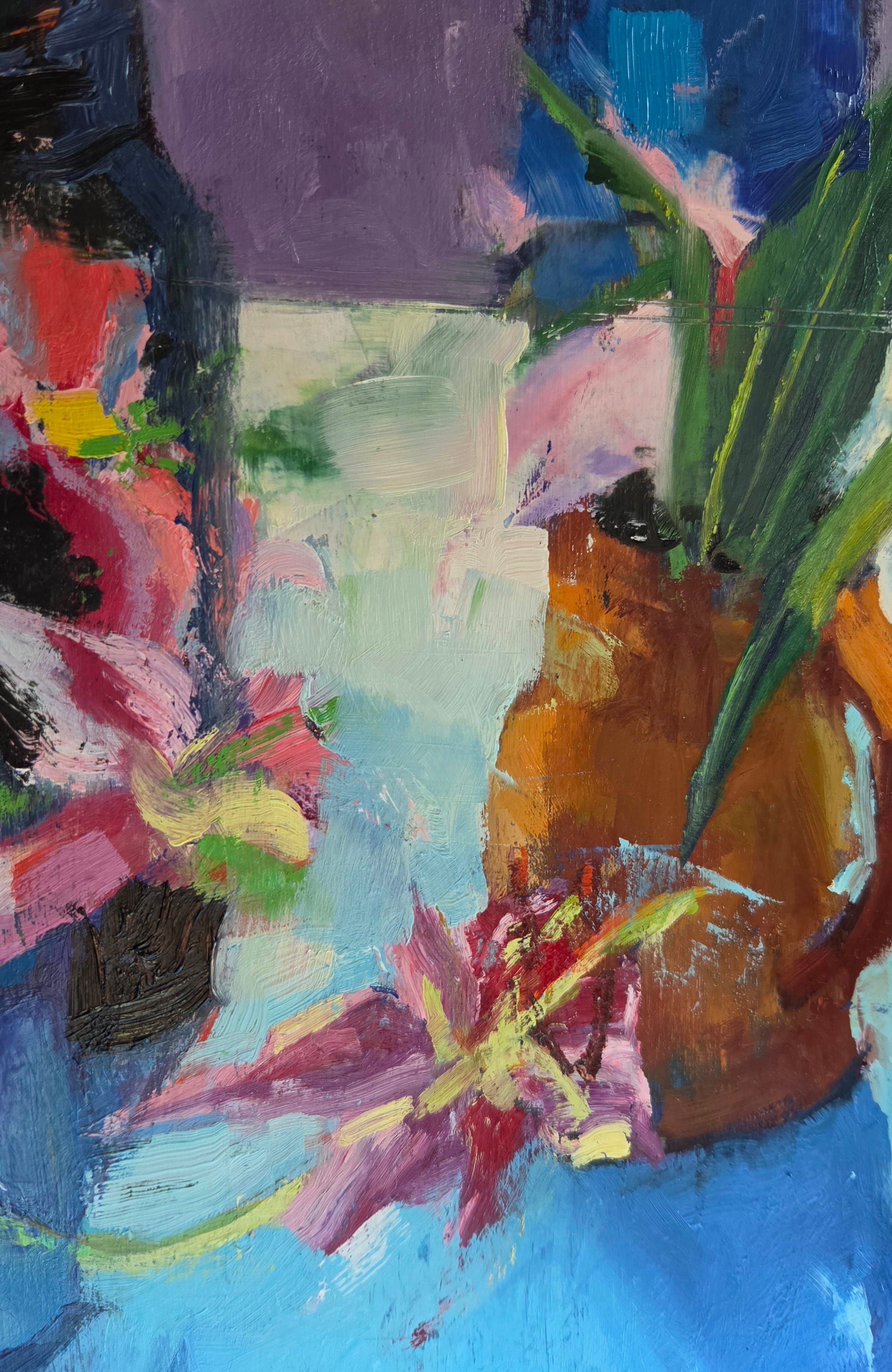
After the scrape down there is a trace of what you knew, which is visible enough to build from. This keeps you from piling on to the bad paint.
Scraping down is a skill. You’re deep in a painting, hours in, fully focused, and something goes blindingly obvious that wasn’t visible twenty minutes ago. The arm is too short. The horizon is tipping. That color, the second it hit the canvas, was wrong in a way you couldn’t have predicted when you mixed it on the palette. You didn’t miss this the first time because you were careless or bad at art. You missed it because you hadn’t looked closely enough yet to see it. Painting is how you find out what you don’t know you don’t know.
The instinct at that point is to fix it in place. Push some paint around, adjust a value here, throw a highlight on top. This is almost always the wrong move. Working wet into a wet mistake without clearing space for it first gets you mud, and mud on top of a structural error is worse than the error alone, because now the error is a muddy error. You can’t see the shape of the problem anymore, just the general unease that something is wrong.
Honor what you noticed and learned. My kid sends me videos of his deadlift PRs and honors the hard work behind them the same way. The moment you see the flaw in a painting is not a failure, it’s the payoff of having looked at something long enough for it to talk back to you. You understood the subject more after an hour of work than you did in the first fifteen minutes. That’s the whole point of the hour. Scraping down is just what you do with the understanding once you have it.
The artist Aimee Erickson, who also recommends scraping out, was doing a class demo once, put down a brush mark, and said, “I disagree with that decision.” We are in dialogue with our own work, understanding it more deeply as we go, and we are allowed to learn as we go too.
Scraping down is a hard skill to learn, and the first few times you do it, it takes real bravery. Standing over hours of work with a palette knife in your hand, no guarantee the next version will be better. It gets easier, not because the loss stops mattering, but because you start trusting what you’ve learned and trusting the skill of your own hand.
Sargent scraped out a nearly finished white dress, in front of his sitter, a viscountess, no less. Look closely at the painting at the top of this post, the one he actually finished. She isn't wearing white at all. If he could scrape down hours of work with a royal audience watching and not apparently lose his nerve, the rest of us can probably survive an afternoon's repainting.
Here is a short video from my You Tube on picking your palette knife.


4 tomatoes large, sliced or chopped (or many grape tomatoes)
1/2 red onion, thinly sliced
1/5 cup pitted olives, in their oil marinade
2 tablespoons marinade oil from the olives
1/3 cup fresh mint leaves, torn
1/4 cup fresh basil leaves, torn
1/4 cup parmesan, shaved
1 tablespoons extra olive oil, to finish
1 tablespoon balsamic vinegar
Slice and combine: Slice up the tomatoes and toss them straight into a dish with the onion and olives.
Drizzle the marinade: Drizzle in some of the marinade oil from the olives.
Add the rest and toss: Throw in the mint and basil leaves, torn, parmesan cheese and extra olive oil and balsamic vinegar. Toss everything together in the dish.

Thanks for reading Finding Creative Ground ! This post is public so feel free to share it.
Comments
Nothing yet. Say the first thing.
Sign in to join the conversation.