
People discover they’re leaders through lived values, real responsibility, doing the work, and the fruit that comes out of it.
The reality of how we do this is that we’re trying to embody it, not become talking heads who only discuss it.
When you actually live this stuff out, it creates a gravitational pull. You begin to find people who say, yeah, that’s me. That’s what I’m called to do too.
Years ago I was leading as a vocational leader within the Vineyard Church. Vineyard would describe itself as a movement. As we talked about what it means to be a leader within it, one of the pieces of language we kept using was this: this is not something you join, it’s something you discover that you are.
We weren’t trying to recruit people to a thing. We were trying to live out and embody a certain DNA.
Most denominations and movements would say we aspire to values. But some people begin to discover those same values, that same way of approaching it, that same process of growing into leadership. They're going to join in that sense. They're going to discover that they are and become part of it that way.
That language resonated because when I got around these leaders, I thought, this is what I’m called to do. For that season, it was people going after doing what Jesus did, doing it the way Jesus did it, living it out as a lifestyle. They called other people to do it alongside them, experiencing discipleship shoulder to shoulder. There are some things I do differently now in my understanding. But the point stands: this was something we discovered we were, and became part of through that.
That idea stuck with me, that this can happen two ways. Leaders can emerge out of the harvest or out of training within a group or a tribe, where you’re raising them up on purpose. And it can also happen as we connect with others and they say, wow, those values, that process you’re engaging in, going from lost to leader. That resonates. That’s what God is doing in my life too. It can be a process of self-identifying: everything you’re doing, the values, the way you’re going about it, matches what God has been speaking to me.
People discover they’re leaders, and that they’ve found the right tribe, through lived values.
I remember, in that same season, we talked about how you can go to a church website, read the About page, the What We Believe page, the Values page, and find an amazing vision cast of what this church believes. Then you go join the small groups, walk into the Sunday gathering, and think, did I walk into the right church? Is this the one on the website?
We write about one thing. And we live out something else. We aspire toward this thing. That’s why we use the word values. People write values on a website, and leaders don’t live them out. So how do leaders discover they’re leaders, that this is the right tribe to be part of? They’re looking at more than what’s written on a website.
Values come down to time, money, and energy. You discover somebody’s values not just by what comes out of their mouth, that’s a starting place, but by where they invest their resources.
We’re all looking for leaders to follow, and we want to follow leaders who live out what they call people to. We want their time to match the vision they’re sharing. We want their money to back it up, the way they spend it, save it, think about it, matching what they say. And their energy: where are they putting it, who are they investing it into? All of that tells us what they actually value.
So much of the kingdom is caught, not taught.
That's what it comes down to when we talk about doing something like an immersion, in person, as opposed to a webinar. We do labs online too, those have value. But an immersion in person causes those values, how we spend our time, our money, our energy, to actually show up.
It also lets us discover who has the same values, because getting in person costs everybody involved: time, money, energy, even the home team hosting it. Just by the nature of doing something in person instead of virtual, you find out who’s going to value it enough to prioritize it, carve out time for it, spend money to be there. That alone gets the people in the room who are serious about it, with other people who are serious about it. It usually means fewer people, but a much higher quality of interaction, of learning together through the doing of it.
And it causes you to lock arms with others who have the same values.
He not only did the work as he entered the scene in Galilee. The way I read it, he was also trying to be found by the guys who would have the right DNA to carry things forward. So the question is, how do you get found by that kind of person? For Jesus, it started with doing the stuff he was looking for.
He was asking, who has the character qualities, the skills, who has what it takes to count the cost and make this the priority in their life? And how do you find that type of person? You go and do it.
So Jesus went out. He started with his own relationship network. He shared with them, went out preaching repentance and belief, praying for the sick, doing the stuff he was looking for. As he did that, there were guys who began to see it, who had multiple touch points with him over and over, where he’s saying, come join me, come follow me. And eventually they did.
Jesus didn’t just invite them to watch. He sent them out to preach, heal, and report back. Responsibility helped reveal who they were becoming.
In this process, there’s an invitation he’s extending, a model he’s living out. And once people begin to say, yeah, I think this might be me, it’s time with him. Jesus invites them into time with him, and it’s not a classroom. As they sacrifice, their time, their money, their energy, to rearrange their life around what he’s inviting them into, a few chapters in you find this moment where the crowds are growing.
Instead of leaning into the crowds, instead of setting up shop to preach to more and more people, Jesus goes up on the mountain and retreats. He calls to himself those he wants, the ones who sacrificed around those values. These guys are going to be the leaders within this emerging movement.
I think that’s a countercultural idea, and I don’t think we’re alone in taking steps like it.
Paul called himself the scum of the earth in 1 Corinthians 4:13. In 2 Corinthians 10:13-16, he also defended the field of work God had assigned him. People looked at him, looked at what he was doing, and dismissed it completely. I’ve taken comfort from that, especially in the way this man, trying to follow the model of Jesus, planted a stake in the ground and said, this is what I’m going to be doing.
To the best of my understanding, this is how I’m going to live out what Jesus has entrusted to me. That’s a challenging thing to call people to, and to live out. But it’s also necessary.
The whirlwind is real. Your whirlwind is different than mine, but it’s similar in that there are constantly things that are challenging and distracting, even the enemy lying to us to get us off track. But if we feel clear conviction around some values, around what we see Jesus do, and we read about other leaders and echoes of Jesus throughout history, our job is to go.
I use this analogy all the time: go take a run until people begin to join you on either side, and you start a running club that way. It’s not an easy thing to do, but it’s the model of Jesus.
We keep asking one question: what’s it going to take?
It's worth it, because Jesus is worth it. He understood what it was going to take to serve the Father's vision, for every people and every place to see multiplying disciples. All the way back to the beginning: be fruitful, multiply, subdue the earth. What that led to, in co-vocational terms, is many people tilling the ground as farmers, taking care of their animals.
As things developed, people ended up in so many parts of our society, people who work in shops, coaches on teams, people who run a nail salon, or work at Walmart.
If we’re going to talk about what it’s going to take to see the Great Commission happen, that’s what our laser focuses on. Jesus has all authority and he’s commissioned us to see disciples happen in every people, in every place, which is what he wants. Most people who work a job, who are there nine to five on a normal day, far from God, are not going to walk into the doors of a church building.
They’re not going to experience the gospel unless people work alongside them, people who share their hobby, people who live in their building, begin to talk with them.
So if the gospel is going to permeate every pocket of every people in every place, where people live, work, and play, we’ve got to call people to that. Jesus started by going out and doing it himself, so he could find who else was going to count the cost, their time, their money, their energy, and join him in doing that too.
It’s worth it. We backtrack all the way to what it’s going to take, live it out, and build a tribe of other people who discover that too.
Jesus says the kingdom grows like yeast working through dough. You don’t get the credit. You may not even see the extent of what God does through it. That’s part of what helps me count the cost and go do it, realizing the way Jesus talks about the kingdom coming isn’t a promise I’ll get to oversee it.
It’s a process of trusting God: if I live it out faithfully, God can work it through the whole lump in ways I may never see.
There are different phases of our leadership journey. Early on, for those who see these examples in Jesus, in the disciples, in the New Testament, or who read John Wesley and say, I want to do that, our job is to join what’s happening and get to work and serve.
How do leaders begin to discover it? You’ve got to go get to work.
As we get to work and engage those around our own oikos, sharing the gospel, making disciples, that’s going to make us discoverable. We’ve got to begin to do the stuff. As we do that, our fruit is going to speak. That’s the biggest piece of it: we’ve got to continue to do the work and let our fruit speak for us.
And on the other hand, we’ve got to keep our head down, and at some point lock in.
I want to bring in Nehemiah here. Nehemiah is an amazing example of a leader God called and trusted with a job to do. He went and started to lock in on that job. And then, a couple chapters into the book of Nehemiah, men like Sanballat come along and say, hey, come down, can we talk about this, becoming a distraction to him in the work.
His job was to lock in and say, this is what I’m doing. Those who want to contribute, come get shoulder to shoulder with me and let’s do it. He wasn’t going to be distracted.
Part of our job is to recognize that, and it’s what allows us to be found by leaders who are a step or two ahead, and lets us serve and pass off what God is doing. If God has gotten me to a point where I’m clearly locked in on a contribution, my job is to lock in and not become distracted. We see that same kind of focus in Nehemiah, and even more clearly in Jesus.
That is how leaders discover they’re leaders. They get to work, they lock in, and over time the fruit speaks.
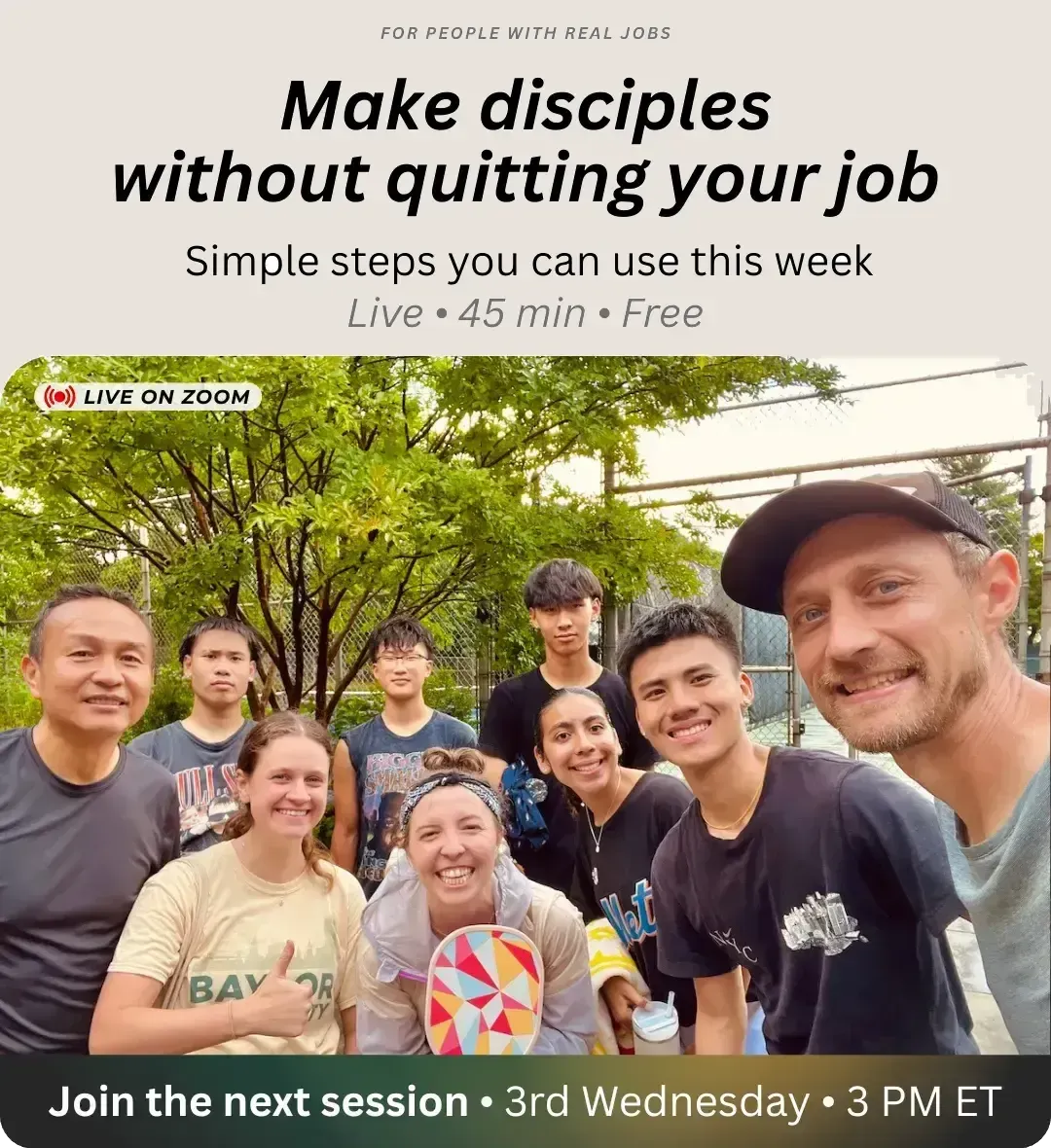
Upcoming: “4 Questions to Get Started Making Disciples”
(Wednesday, August 19th at 3PM ET).
Use four simple questions to choose one person, start one conversation, and plan next steps.
Finally, join our CoVo WhatsApp Field Room to connect with other practitioners: https://covomultipliers.com/s/6Wanp8
Comments
Nothing yet. Say the first thing.
Sign in to join the conversation.