
Years ago, my wife and I caught a vision. We wanted to see people hear the gospel and watch the model of Jesus multiply through ordinary disciples making disciples and reaching the lost. So we started sharing that vision with friends who were already Christians, people we thought we could lock arms with.
They lit up. They too wanted to see the kingdom come outside the four walls of the church.
They wanted the lifestyle of Jesus, as they understood it, showing up in day-to-day life. So we started gathering, first in our living room, then in theirs.
Within a few months we had around five families meeting regularly. We worshiped together. We cast vision for reaching the lost and knowing God. In our minds, this was the beginning of something like the book of Acts.
Then we noticed something. Megan and I were the only ones with actual stories from the harvest. We were the only ones going on prayer walks, sharing with the lost, making space for the Great Commission outside the gatherings.
Everyone else was showing up for the meeting.
Once we saw it clearly, we realized what had happened.
These families weren’t moving toward mission. They were reacting against traditional models of church. What they wanted was healthy community, not disciples made out of the harvest. So we made the call. We told the group we were starting over in our living room, this time with people who wanted to build rhythms of prayer walking and harvest first and let everything else follow from there.
One person came with us for the restart.
That was the lesson, and it was a hard one. If you start with the mission, you get community and mission together. If you start with community around people who want to see what Jesus did, you usually just get Christians gathering in a cozy room.
To be clear, that’s not a knock on community itself. God’s design is for us to walk in deep relationship with other believers. Christians need that.
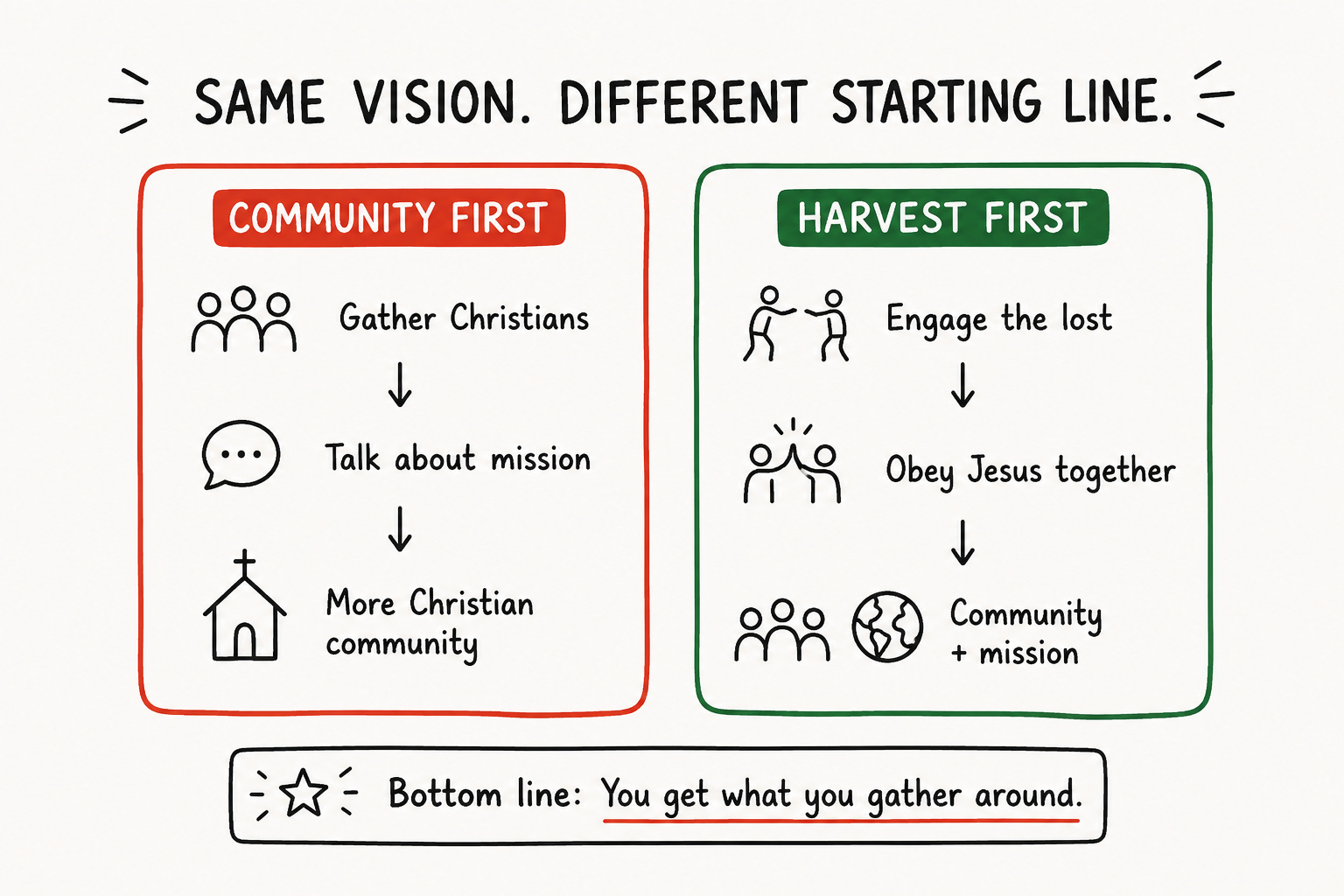
The mistake we made wasn’t valuing community as we gathered. The mistake was assuming that if you bring together people who intend to make disciples and multiply the kingdom, the gathering itself will produce the mission. It doesn’t work that way. We had gathered Christians who wanted to make disciples, sure, but the actual organizing principle of the group was Christians gathering with Christians. The mission was an aspiration hanging over the room. It was never the DNA of the room.
We told ourselves community would eventually spill over into mission. It didn’t. Community mostly just produced more community.
When we went back to look at the model of Jesus, we saw the order was backward from what we’d assumed. Jesus doesn’t gather a community of disciples first and then teach them to go on mission later.
He enters the harvest. He does the very thing he wants to reproduce in others, and then invites people to join him while he’s already doing it. He proclaims the kingdom. He engages people. He heals people. He eats with outsiders. And he calls people to follow him while he’s already in motion, already doing the work.
The mission is moving before the community ever takes shape.
I think of it like a runner who wants to start a running club. If you want a running club and you don’t know a single runner yet, you don’t call a meeting to discuss running with a room full of people who don’t run. You go take a run. Then you take another one. You keep running until people start showing up on your left and your right. The community forms around the running, not the other way around.
Jesus does exactly this across Mark 1 through 3. He’s moving through Galilee doing the mission he wants others to join, watching for who will vote with their feet.
By Mark 3, it comes to a head. His own biological family shows up at the door expecting him to drop everything and prioritize them. Instead, Jesus says something striking. The family he’s building isn’t defined by blood. Looking at those seated around him, he says whoever does the will of God is his brother and sister and mother.
He doesn’t gather people around shared need. He forms a new family around obedience.
Here’s the principle underneath all of this: we get what we gather around.
Gather Christians around a desire for community, and the questions that surface in the room will be community questions. Do I feel known here? Are my needs being met? Do I even like these people, and are we getting closer? None of those are bad questions. But they can’t carry the mission of Jesus. They aren’t built for it.
Gather people around obedience instead, and the questions change shape entirely. What is God saying to us right now? How are we obeying it? Who have we told what we’re learning? What is Jesus asking us to do next, and who’s coming with us?
Aim at community, and you get community without mission. Aim at mission together, and you get both, because you get the DNA of whoever’s actually in the room, not the DNA you hoped for. That means we have to stop recruiting based on potential. We have to stop looking for the people who say the right things, who get excited about disciple-making in theory, who light up when you talk about the book of Acts. A lot of Christians love the idea of what they read in Acts. That’s not the same as being the kind of person who does it.
What we’re actually looking for are people who vote with their feet. People who spend real time, money, and energy on the harvest, on making and multiplying disciples. People who show up for a prayer walk in their neighborhood and then invite someone else to come next time. People who open up their basketball game for disciple-making. People who share the gospel with a coworker, or tag along while someone else does.
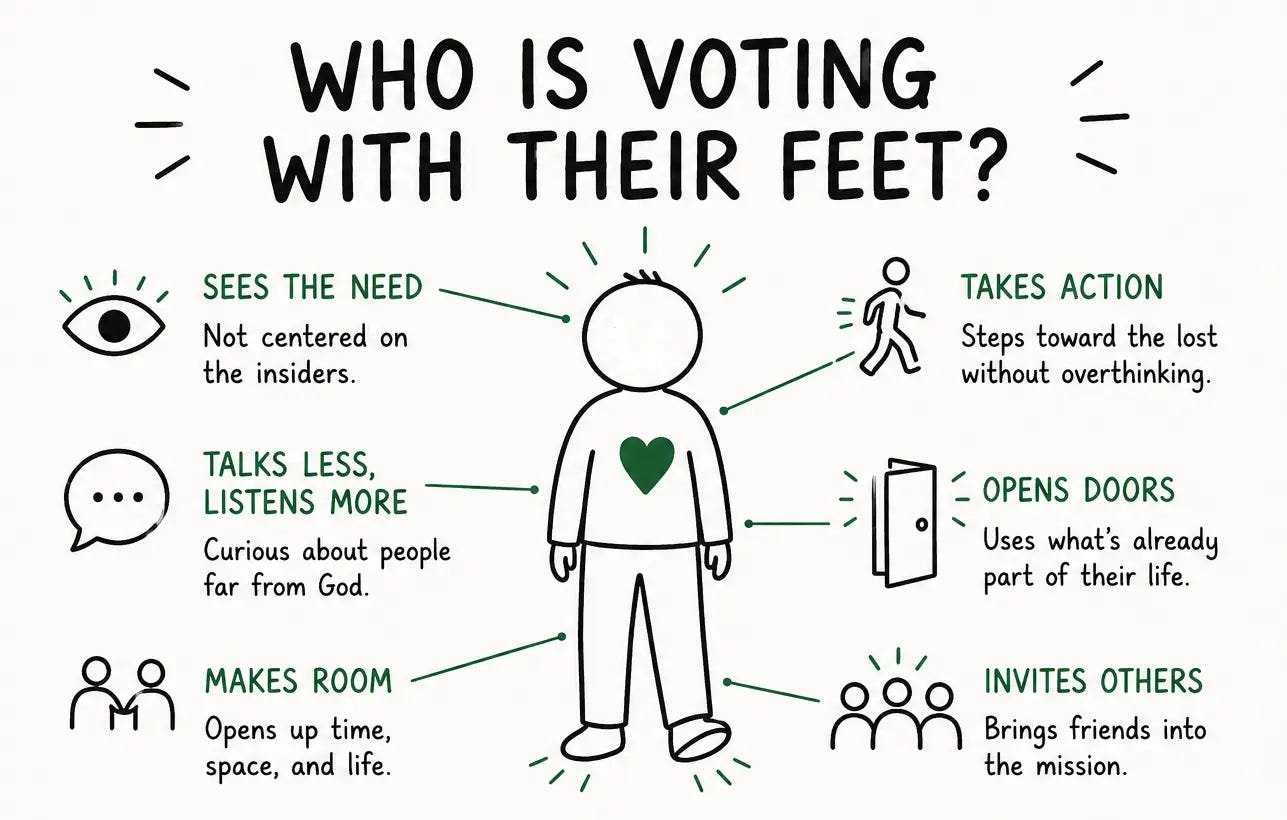
Watching someone take one of those actions tells you more than six months of sitting in a living room talking about disciple-making ever could. It shows you they’ve got the DNA of action, not just the vocabulary of vision.
Which brings me to the line I keep coming back to: the living room is not the starting line. It’s the result of going out into the harvest. It’s a valuable piece. We need the gathering. But the harvest is where things actually begin.
I learned this the hard way. We learned how difficult it is to start with community and mobilize outward from there. The gravitational pull is almost always back toward the people already in the room. You have to start with the harvest and go. Other Christians may join you shoulder to shoulder along the way, but you don’t start by gathering them in a living room first and hoping mission follows.
Here’s what surprised me most. Community still matters, a lot. It just matters in the right order. And when it comes in the right order, it gets richer than anything we built the first time around.
The people I gather with now have shared stories from actually following Jesus somewhere together. Shared risk. A shared community of practice, learning through both failure and celebration, depending on God because the stakes are real. We’re not starting from a room full of our opinions about community and trying to manufacture vulnerability out of thin air. We’re letting the kingdom form us through the process of obedience itself. Vulnerability shows up on the heels of mission, not as an agenda item before it.
We’re becoming brothers and sisters through obedience, not through simply spending more time in the same room.
Mission actually produces the depth of community that community-first Christians are looking for in the first place. The very thing people are chasing when they organize around community, real camaraderie, real family, shows up faster and deeper when you stop chasing it directly and start obeying together instead.
Start by engaging the harvest and the lost. Build regular rhythms and habits around it. Then watch who begins to join you.
Take the run. See who starts showing up on your left and your right.
Don’t start by asking who wants to make disciples. Start making disciples and see who comes with you.
The living room isn’t the starting line.
The harvest is.
Upcoming: “The Church Circle”
(Wednesday, September 16th at 3PM ET).
Learn a simple biblical map for practicing church where you live, work, and play.
Comments
Nothing yet. Say the first thing.
Sign in to join the conversation.