
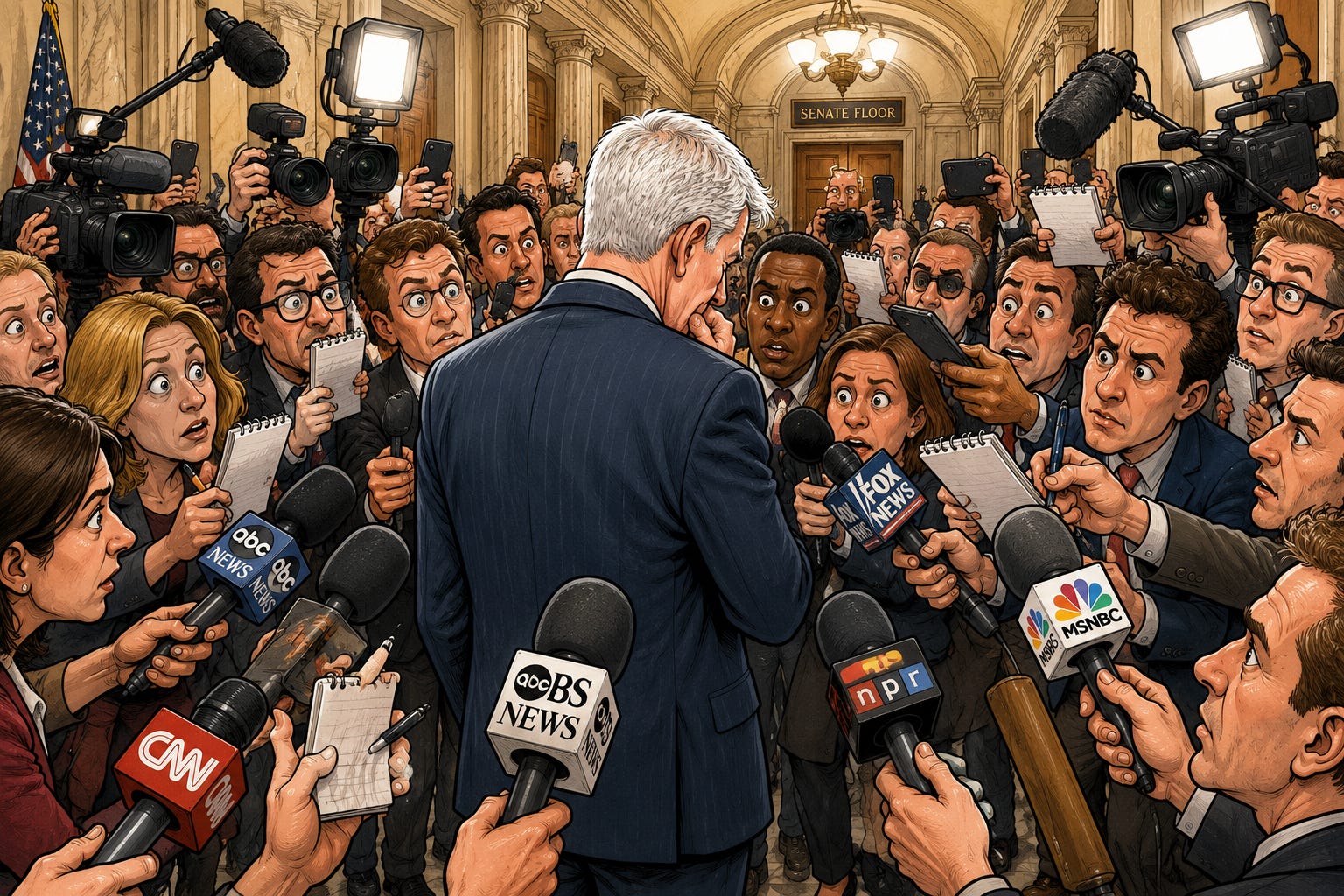
Washington is a city of performed conviction, manufactured outrage, and carefully scheduled spontaneity. Nobody accidentally ends up on camera. The hallway is chosen. The timing is chosen. The expression, the furrowed brow, the hand to the mouth, the look of a person carrying the republic on their shoulders through a corridor in the Russell Building, all of it is choreographed. Someone on the senator’s staff made a call. C-SPAN did not find Bill Cassidy looking conflicted outside the chamber by luck. They were invited.
Somebody has to do it. Cassidy does it well. So this week, he was the Designated Skeptic.
You will not find the position listed in any party document. There is no official title or duty list. Nobody is sworn in. The Senate parliamentarian has never been asked to rule on it. But the role exists, it gets filled, and the Republican Party depends on it the way a magician depends on misdirection.
The Designated Skeptic’s job is simple. When the party is about to do something that truly stinks, confirm the unconfirmable, pass the indefensible, ratify the corrupt, someone has to furrow their brow. Someone has to ask the hard questions. Someone has to be seen wrestling with their better judgment in full view of the cameras. And then, after the appropriate interval of visible soul-searching, that same someone will go ahead and vote with the party anyway.
Somebody has to pretend the GOP has a conscience.
What the party gets out of this arrangement goes beyond political cover, though it is that too. Democracy claims to derive its legitimacy from deliberation. From the idea that elected representatives actually wrestled with a question before casting a vote. As if doing the right thing is what matters most. The Designated Skeptic does not just take the stink off a bad vote. They simulate the deliberative process that makes the outcome feel legitimate. They are a legitimacy machine.
Without them, a party-line vote on something nakedly corrupt looks exactly like what it is. A cabal ratifying a decision already made in a room the public was not invited into. The historical record reflects that. Journalists write it plainly. Voters see it clearly.
With the Designated Skeptic, the same vote becomes a considered judgment. Concern was raised. Questions were asked. Assurances were extracted. Deliberation occurred. The vote was not just cast. It was earned. The stink gets released into the atmosphere instead of settling on any particular set of shoulders.
The Designated Skeptic does not change the vote. They bless it. Hands clasped. Head bowed. Then back to their seat.
Susan Collins of Maine has held the position longer than anyone in recent memory and has elevated it to something close to performance art. She has the furrowed brow. The armful of binders. The carefully worded reservation and the dramatic pause that keeps political journalists camped outside her office like they are waiting on a papal announcement. Over three decades she has perfected the announcement of concern so thoroughly that her name became a verb before it became a punchline. You can now buy your own fake Collins pearls to grasp in the Capitol Visitor Center gift shop, upper level.
The cadence is always the same. Measured. Maine. Vaguely Episcopal. The voice of a woman who has given the matter serious thought and finds herself, regrettably, unable to look away. Will Trump reward the January 6th felons. She is concerned. Will her GOP colleagues fund ICE warehouses. She is concerned. Will there be whoopie pie with lunch. She is concerned.
But in the end, she almost always votes yes.
When Brett Kavanaugh was nominated to the Supreme Court, Collins delivered a forty-minute floor speech so meticulously constructed and so lawyerly in its apparent anguish that people watched it live waiting for the no. It was a masterpiece of performed deliberation. All that struggle. And she managed to wrestle that concern aside and vote yes. Roe fell four years later and she expressed concern about that too. She said Kavanaugh had misled her about his respect for precedent. Her concern is self-generating now. It feeds on itself. It requires no external fuel and has never once changed an outcome.
Bill Cassidy of Louisiana is newer to the role. His version has a particular tone, laced with intellectualism and compassion, because he is a physician, a fact he has never allowed anyone within earshot to forget. Senator Dr. Bill Cassidy has a great furrowed brow. The best furrowed brow. But he really sells it when he rests his fist lightly against the tilted chin. It is a whole production. Standing on the chamber floor this week, he looked like a man bearing the weight of a decision he believes history will remember. As a liver specialist he has had years of practice projecting grave concern. He has simply repurposed it.
His finest hour as Designated Skeptic came with the anti-weaponization fund. The $1.8 billion fund, born from a settlement between the IRS and a president who effectively sued his own government, was designed to compensate people who claimed the federal government had been weaponized against them. The intended beneficiaries included January 6th defendants and other political allies, many of whom have gone on to commit more and even better crimes. Critics in both parties called it a slush fund. Cassidy called it worse. “A slush fund with no legal precedent,” he said. Congress should decide.
Fresh off losing his Senate primary to a Trump-backed challenger, knife still in his back, with nothing left to lose and no future votes to protect, he said all the right things with deep visible skepticism. He then co-filed a federal court brief with Democratic Senator Cory Booker calling the fund an immediate and dire threat to the constitutional order. The brief argued the settlement was collusive, that Trump had effectively sued himself, that the fund violated the spending, appropriations, and appointments clauses of the Constitution. Strong words. Federal court words. Words that cost something to put your name on.
When the vote-a-rama came, the marathon amendment session attached to a multibillion dollar immigration enforcement bill, Cassidy spent hours consulting with the Senate parliamentarian trying to craft language that would kill the fund on his own terms. He slowed the entire process. He was the story. So was all his concern.
Then Senate Minority Leader Chuck Schumer brought the amendment that would have permanently ended the fund. The one that actually had a chance. The one where Cassidy could have acted on everything he said and filed and stood for by voting yes. Cassidy voted no.
He filed a brief calling the fund a constitutional threat in federal court in the morning. He voted to let it survive in the afternoon. He played the role, then stuck with the party. Poor Cory Booker’s name is still on that brief.
The concern was not the prelude. The concern was the product.
Lisa Murkowski of Alaska is in a class by herself. The Tea Party tried to end her in 2010. She survived being primaried by winning as a write-in candidate, correct spelling required, and showed back up in Washington like the man they left for dead in The Revenant, with a glint in her eye and owing her party exactly nothing but revenge. She has been collecting on that ever since.
Her brow does not furrow. Her voice never wavers. She simply expresses her skepticism about whatever is going on, slides her hand toward the small of her back, and waits. The room goes quiet. Someone always hands over the cash. The implicit message has always been clear. Nice legislation you got there. Be a shame if it got hung up in a king crab net.
Her concern rings the bell and Alaska gets a biscuit. The response is Pavlovian at this point. She plays dual roles with pioneer efficiency. Designated Skeptic and Shakedown Artist. Alaskans already get the Permanent Fund dividend. They also get the Murkowski one.
The receipts are a matter of public record. Food stamp exemptions for Alaska. Rural hospital funding. Coast Guard money. Low income housing grants. Clean water infrastructure. The list reads like a very specific shopping list delivered to Senate leadership along with her concern. But even Murkowski has been cheated. There was the time she thought she had negotiated protection for Alaska’s wind and solar projects, only to discover afterward that no such agreement existed. She said she felt cheated. Very concerning. She had already voted yes. Even Soapy Smith got rolled occasionally. The operation continues regardless.
Cassidy and Collins could never pull that off.
Together these three cover the full spectrum of how the role gets played. Collins is the institution. Thirty years in, fully professionalized, concern as brand. Cassidy is the specialist. The physician’s gravity, the furrowed brow, the role discovered late but played with conviction. Murkowski is the hybrid. Independence proven in actual elections, spent selectively, extracted profitably. She might be concerned but she is not worried about the party.
The role does not stay with one person. It rotates. It gets passed and adjusted and refined across careers and cycles while the function stays exactly the same. Someone always fills it. Someone is always being watched. Someone is always almost certainly about to break with the party any day now, just you wait.
The party gets more out of this than a single vote. It gets a pressure release valve. One senator performing the unease so forty-nine others do not have to. It gets media management. Journalists camped outside the Designated Skeptic’s office while dozens of senators who never considered voting no avoid scrutiny entirely. It gets negotiating leverage with the White House, because a senator visibly on the fence is a bargaining chip leadership can spend. It gets plausible deniability when the predicted disaster arrives, because someone asked the questions and got the assurances and acted in good faith.
Most importantly it gets the appearance that the vote was contestable. That a reasonable person examined the thing seriously and found it acceptable. That reframes every uncomfortable outcome from a cabal’s foregone conclusion into a deliberated judgment that reasonable people reached after careful deliberation.
It is the illusion of democracy performing the function democracy is supposed to actually perform.
There is one more player in this production and it is not a senator.
The performance only works because it gets covered. Every “will Collins break with Trump” story is free advertising for the act. Every breathless hallway stakeout, every “senator has concerns” chyron, every panel segment about which Republicans might peel off. All of it is the stage the Designated Skeptic performs on. The press did not build the stage exactly. But they keep the lights on.
The journalists are not fooled. They know the history. They have covered Collins for thirty years and they know how it ends. But a senator on the fence is a better story than unanimous compliance, and the Designated Skeptic provides the suspense the political press needs to justify the coverage. The concern becomes the story. The vote becomes a footnote. The thing that needed blessing gets blessed.
Washington called. C-SPAN has your shot list. Senator will be available in the hallway at two, looking conflicted, the republic heavy on their shoulders, the vote already decided.
The big pretending is ready for its close-up.
Illustration: AI-generated. Text and photographs © Lynn McMorris.
Comments
Nothing yet. Say the first thing.
Sign in to join the conversation.