
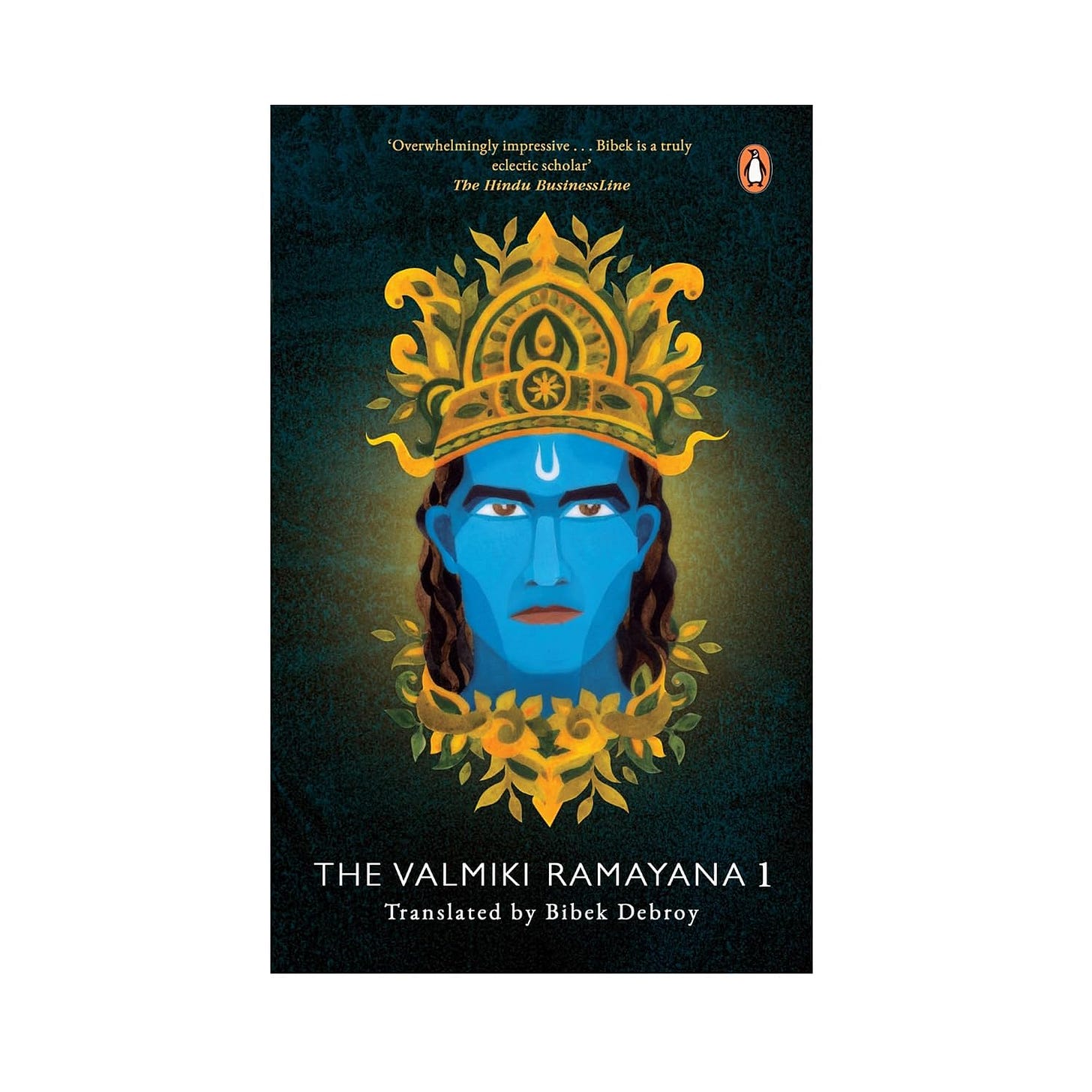
Bibek Debroy’s translation of Valmiki’s Ramayana restores the complete, unabridged original to English readers, revealing a text far more complex, emotionally rich, and morally layered than popular television adaptations or condensed retellings suggest. This is the Adi Kavya—the first poem—the original work from which virtually all subsequent Indian literature and culture flows, composed by Valmiki himself as a direct witness to events he narrates.
Debroy begins by highlighting what makes the Ramayana unique among sacred texts: Valmiki didn’t receive divine revelation—he was moved to poetry by grief. Watching a hunter’s arrow kill a bird mid-embrace with its mate, Valmiki cried out spontaneously in verse, and this moment of pure human anguish became the seed from which the entire epic grew. The Ramayana is therefore born from the question of why innocent beings suffer—giving it an emotional authenticity that resonates millennia later.
The translation captures Dasharatha’s heartbreak with particular force. When his beloved queen Kaikeyi demands Rama’s exile and Bharata’s coronation—calling in two boons earned decades earlier—Dasharatha doesn’t argue or resist. He simply collapses. Debroy’s rendering preserves the original’s devastating portrait of a man destroyed not by enemies but by love itself, dying of grief days after Rama’s departure while repeatedly whispering his son’s name in the dark.
Debroy’s Rama is more human and conflicted than popular devotional versions allow. He weeps openly, doubts himself during Sita’s abduction, and expresses anger and despair that simplified retellings sanitize away. When he encounters Shurpanakha, when he kills Vali from behind a tree—these morally uncomfortable episodes are preserved fully, inviting readers to wrestle with complexity rather than accept convenient heroism.
The translation’s treatment of Hanuman stands as perhaps its greatest achievement. The Sundara Kanda—the most beloved section describing Hanuman’s extraordinary leap to Lanka—crackles with energy and devotion. Debroy captures how Hanuman’s strength flows entirely from his love for Rama, how his encounter with Sita in Ravana’s garden is simultaneously terrifying and tender, and how his burning of Lanka before returning demonstrates that even the most disciplined devotion contains contained wildfire.
Debroy also restores the controversial Uttara Kanda, which most popular retellings omit—Sita’s second exile, her final disappearance into the earth, Rama’s lonely kingship. These closing chapters transform the Ramayana from triumph into tragedy, revealing that doing one’s duty perfectly doesn’t guarantee happiness, that dharma sometimes demands unbearable personal cost.
The Ramayana emerges not as a simple story of good defeating evil but as civilization’s most profound meditation on duty, devotion, and the unbearable costs of righteousness—a text that rewards readers not with comfortable answers but with the rare gift of questions worthy of an entire lifetime’s contemplation.
Get it here : USA | India | UK or get this audiobook for FREE on Audible.
Comments
Nothing yet. Say the first thing.
Sign in to join the conversation.