
Everyone tells you to update your CV before applying for a UX role. And yes, at some point you’ll have to. But if you don’t know what you’re trying to communicate before you open that document, no amount of tweaking will make a real difference.
I’ve seen this play out many times with mentees — especially career switchers. They come in with a CV that lists their past experiences in a logical and chronological order. And yet, it tells me almost nothing about why they’d make a great UX Designer.
Not because they lack the skills. But because they haven’t made the connection themselves yet.
Here’s the framework I now recommend: two phases, in this exact order.
Before you write a single bullet point, you need to figure out what makes you you in this field. Not in a vague, motivational-poster kind of way — I mean concretely. What is your edge?
This might come from a previous career. Career switchers often have more transferable experience than they realize: communication skills from a client-facing role, the ability to keep complex projects organized, sharp attention to detail from a completely unrelated field. These are all relevant to UX. But if you don’t see the connection, your CV won’t show it either.
It might also come from skills you’ve built alongside your design practice. Maybe you’re comfortable with vibe coding and can prototype ideas that most designers can’t. Maybe a background in Psychology makes you sharper in user research — you know how to read between the lines in an interview, you understand cognitive biases at a deeper level. Maybe you have domain expertise in Fintech, or Healthcare, or Education, that makes you immediately valuable to a specific type of company.
The point is: there is something that sets you apart. Your job in Phase 1 is to find it and own it — without apology.
A few questions that help:
Are you more of a generalist or a specialist? What do you genuinely love doing?
What knowledge or skills do you bring from outside of design that could be an asset?
Which kind of products do you want to work on — and why are you well suited for them?
What are you passionate about, even beyond design?
And then there’s the flip side of this: insecurity. I’ve seen people downplay real achievements because they weren’t sure they “counted”. You should never oversell yourself — but displaying your skills and experience with confidence is a different thing entirely. Confidence in interviews can come with time. On paper, you can absolutely show up fully from day one.
Once you know your positioning, you don’t throw it out the window for each application. You keep it, and then you do something several candidates skip entirely.
You read the job posting carefully.
I know, it sounds obvious, but there’s a difference between reading a job posting to decide if you want to apply, and reading it to understand exactly how to present yourself as the right candidate for that role.
As a junior, I was sending the same CV to every company: I thought a solid, well-written document was enough. It wasn’t, especially in a market where many companies now use ATS systems that filter candidates based on specific keywords before a human ever glances at your profile.
What I did during my last job search was keeping a solid “base” version of my CV and then iterate from it every time I apply. I look at the job posting and ask: what language do they use? Which skills do they emphasize? What kind of designer are they looking for? Then I make sure my CV reflects that — not by inventing things, but by making sure the right parts of my experience are visible and framed in a way that resonates.
Think of it as a “translation” exercise: you have a set of skills, experiences, and strengths. The company has a set of needs. Your CV is where those two things meet, and it’s your job to make that meeting as clear as possible.
I know that it sounds like extra work (it is, a little). But it’s the difference between a CV that gets read and one that gets filtered out before anyone even sees it.
Know your edge. What makes you a strong UX designer specifically? What do you bring that others don’t? Define this clearly before you write anything.
Match it to the role. Keep your positioning consistent, but adapt how you express it based on what each company is actually asking for.
Do this and more companies will put your CV in their “Yes” pile"!
If this resonated, I recently gave a talk called Beyond the Application — a strategic guide to landing UX roles that covers everything from building your online presence (CV, LinkedIn, portfolio) to interview prep and long-term strategies for bringing opportunities your way. One of the attendees described it as:
“Incredibly helpful and encouraging. Breaking into UX can feel overwhelming, but [the talk] broke it down into practical, actionable steps that made the process feel more manageable and less intimidating.”
You can watch it for free on my LinkedIn here!
Good luck with your job search 🤞
- Maria
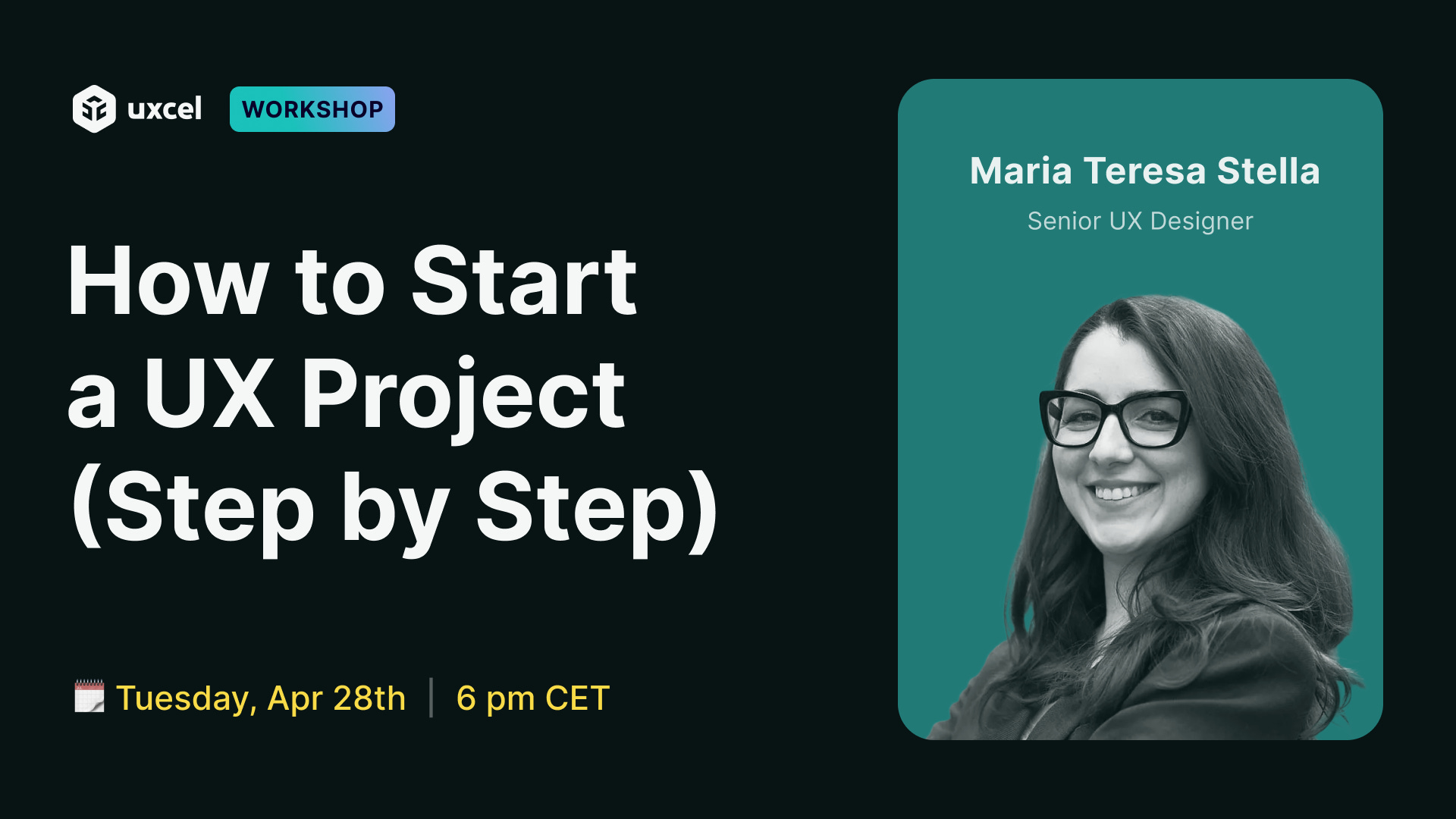
🎓 Join me at my next live workshop On April 28th I’m running Start UX Projects with Confidence — a 1.5 hour live session with Uxcel for early-career designers who want a clear, repeatable way to kick off UX projects (or design challenges during your job search). You’ll leave with a practical framework and a reusable checklist. The first edition sold out fast — grab your spot before this one does too. 🗓️ April 28th | 6pm CEST / 12pm EDT / 9am PDT | 40 seats only 👉 Reserve your seat here
Comments
Nothing yet. Say the first thing.
Sign in to join the conversation.