
Agents are becoming the way users, and increasingly other agents, interact with products. Traditional UIs, workflows, and dashboards are no longer the main experience. The product is the agent.
OpenClaw was the first truly great agent experience I had. You could build things with chat before, but this was the first time it actually worked the way you expected.
Once set up on Telegram (my OpenClaw interface), I went from zero to building in <1 minute. I onboarded myself through the interaction itself - no docs, tutorials or upfront learning required.
It didn’t feel like I was “using a product” at all. It felt like I was just…doing.
There was no moment where I stopped to think “how does this work?” or “where is that feature?” I just described what I wanted, and it figured out the rest. That’s a pretty big shift in what a product can do.
With agents, products aren’t something you learn anymore; they meet you where you are.
Without the interface, it’s just intent → outcome. And that changes what matters: it’s less about a clean UI or feature depth, and more about whether the agent actually understands you well enough to get you what you want quickly.
What makes a great agent product experience is very different from SaaS. The best agents will do a few things really well:
Onboard you as you use it
Extract the right context
Take action toward your goal
Build trust and gradually earn more autonomy
Use the right model for the job (quality / cost)
Under the hood, the agent is building more skills and capabilities. But from your perspective, it just feels like it can do more over time.
It doesn’t feel like SaaS at all. The experience is fundamentally different:
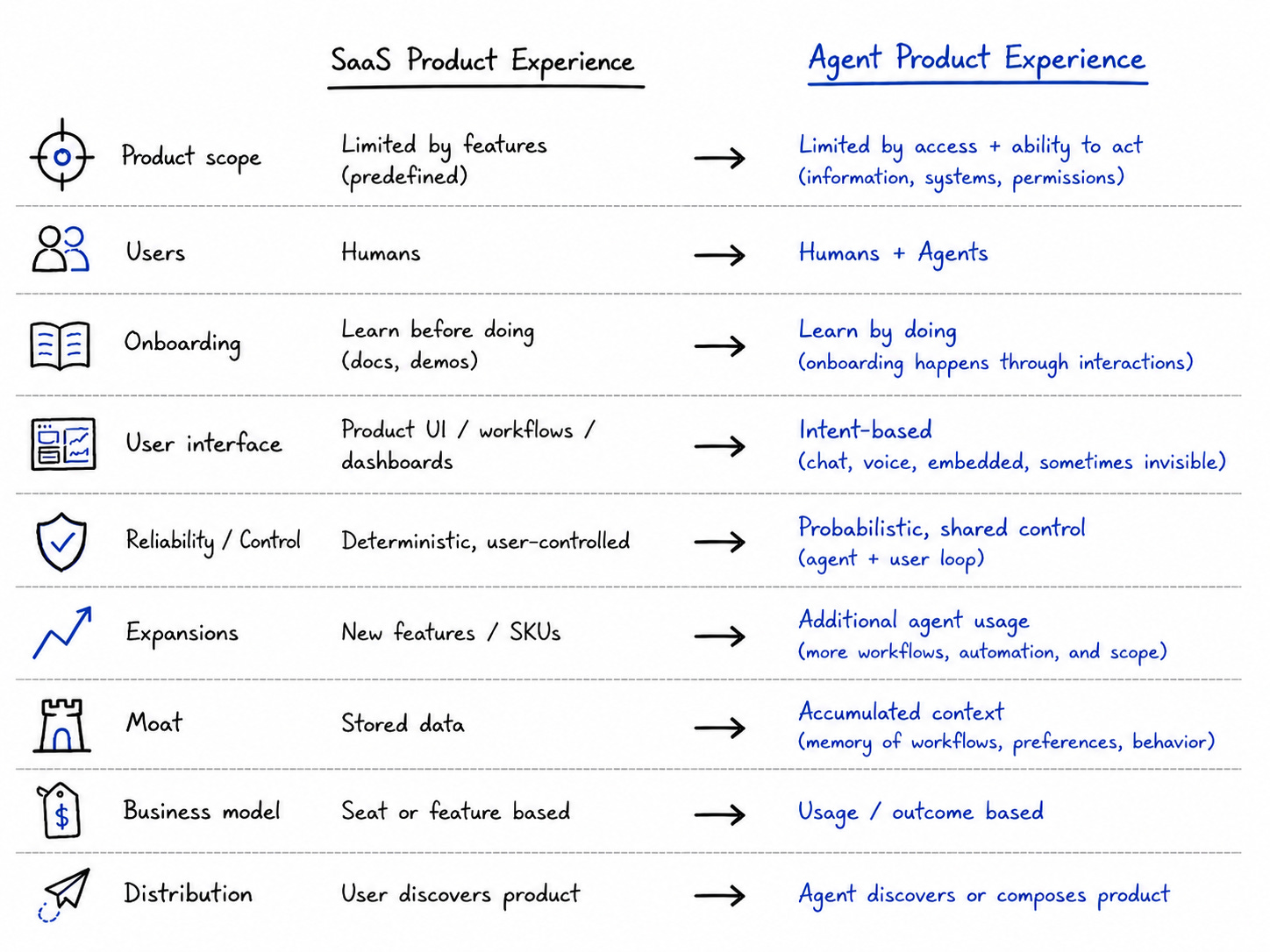
Many companies are still straddling the SaaS and agent worlds. And I get why - building an agent-based product is fundamentally different from SaaS.
The sunk cost fallacy is real - especially for companies that raised tens or hundreds of millions to build traditional point-and-click software.
It’s hard to shift. But failing to transition to agents will quite possibly be the end of most SaaS companies.
Agents aren’t perfect yet. They’re incredibly frustrating when things break. For instance, when Anthropic dropped support for OpenClaw, it took a while to get back to usability.
Reliability / determinism, debuggability (what went wrong?), and control (how much autonomy vs oversight) aren’t solved problems - and areas I’m actively looking to invest in companies around.
There are still a bunch of open questions around how the agentic world actually plays out, particularly where value will accrue.
A few questions that I’m curious about:
If the agent is the interface, who actually owns the user relationship - the agent or underlying product?
Do users have master agents that work across products (and sub-agents)?
What does lock-in look like now - data, memory, workflows, or something else?
What will the value divide be between the agent the user interacts with, and the underlying model?
Despite the open questions, one thing is clear: products are shifting to agents. And I think the companies that define the agent user experience first will win.
No posts
Comments
Nothing yet. Say the first thing.
Sign in to join the conversation.