
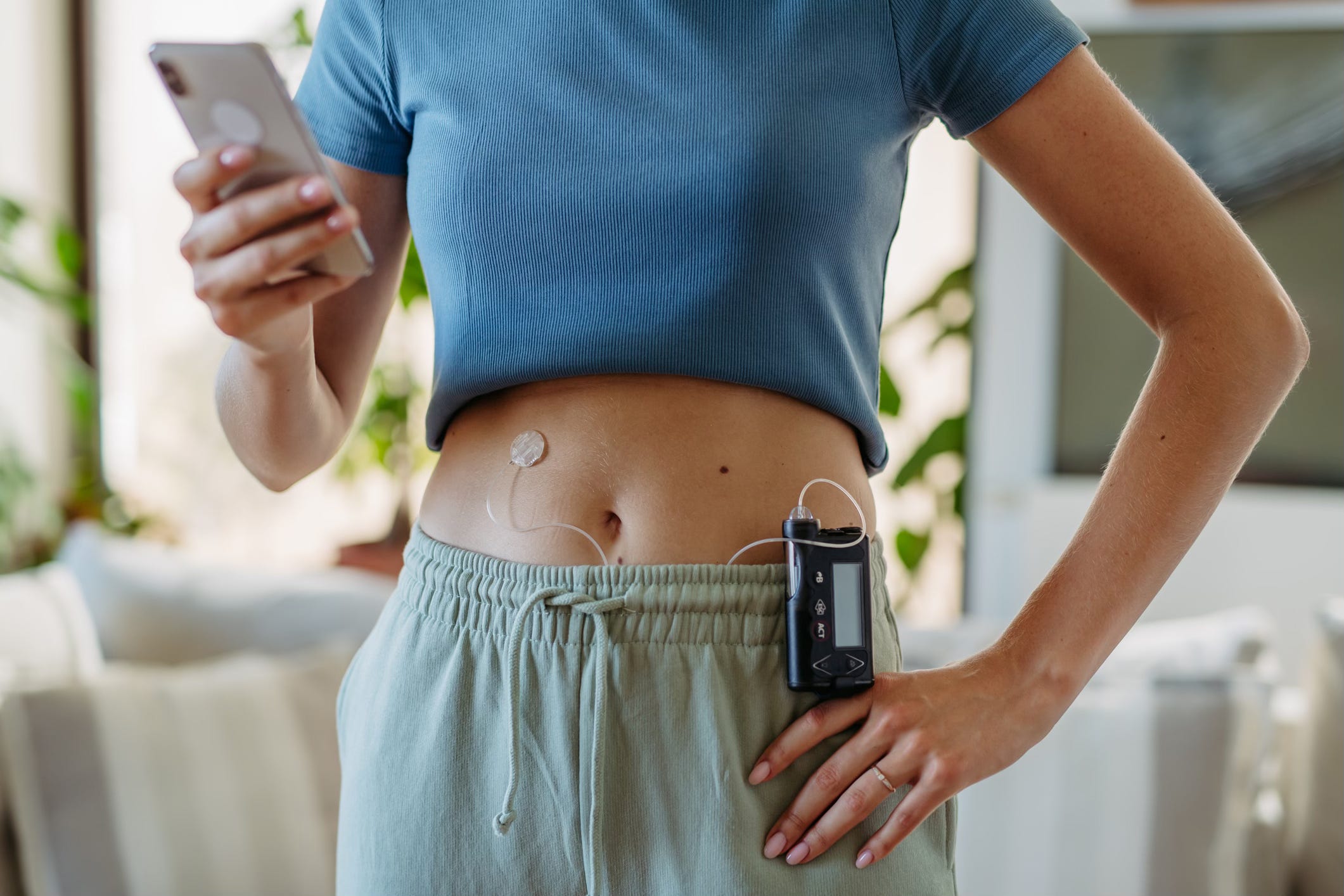
When was the last time you ate something without some input from a medical device? For me it was 2010. I was diagnosed with Type 1 diabetes aged 22 whilst seeing the GP for a UTI - which is quite undramatic as Type 1 diagnoses go. Since then, every meal starts with either a blood test or a look at the app screen of my continuous glucose monitor (CGM) and an injection of insulin. It is very easy to get this dose wrong given that some of the factors that can affect your blood glucose other than what you’ve just eaten include: stress, the temperature, illness, alcohol, certain medications, the stage of my menstrual cycle, and exercise. This doesn’t even come close to being an exhaustive list.
And so that is why one day, over a year ago, I inputted the word ‘FURY’ to my CGM after it alarmed on and off for a few hours whilst I tried to work, and a few weeks after that my consultant said “regular states of fury do suggest this might be impacting your mental health”, and a few months after that I ended up being approved for an insulin pump, for which I attended an education evening this week.
There are two means of delivering insulin to a Type 1 diabetic: multiple daily injections via a pen, or by an electrical device that attaches either directly to your skin or via a tube and cannula. The pump more accurately mimics the pancreas by drip feeding the dose of insulin over a period of hours. Cleverly, pumps now also communicate with CGMs and can (alongside occasional human input) use a rising or falling blood glucose reading to help keep you in range.
One does not simply get an insulin pump. Some Type 1s prefer the idea of pens to being stuck to another medical device. Others have to meet the eligibility criteria for funding. The criteria where I live involves a specific HbA1C blood test reading that suggests your blood glucose control could be better (which I don’t meet), considering pregnancy (nope), or that regular hypos are impacting your mental health. Well just ask 7 out of 10 of my post-prandial patients about that while I shove precisely eight Haribo Goldbears down my neck. I qualify.
What that criteria doesn’t take into account though is what I was seeing in my own diabetes management. The slow creep upwards of my HbA1C alongside a level of burnout that’s impossible to quantify on a blood test but is directly related to sixteen years of mental arithmetic and option weighing before and after every meal, sleep and bout of exercise. I’m not in crisis, I’m just tired, and unspectacularly getting worse at this full time job of sixteen years. And yet the thing that might help is not widely available.
Which is, funnily enough, a theme running through this month’s MSKMag. In his article The Biggest Wins in the NHS are Cheap, Luke Kellaway explores why lower cost, efficiency-boosting programmes get reduced funding versus costly, complex interventions. Just as prevention and glucose management doesn’t shout the way a crisis does, neither does a smoothly running MSK pilot that reduces waiting times.
Meanwhile, Chloe Wearmouth issues a plea for more thought to be given to Paediatric services where all manner of presentations and specialties are shoehorned into one catch-all Paeds department in The Forgotten Child of MSK.
Benoy Mathew shares insight of a presentation that can drastically change a patient’s outcome if we sit on it too long. Read The Diagnosis that Keeps Getting Missed: Adult Hip Dysplasia and avoid hip replacements in the young.
In her article Beyond the Bump: Reframing High-Grade AC Joint Injury, Angela Cadogan highlights the value of looking beyond simply strapping up the ACJ and getting on with it in her advice-packed piece covering ACJ rehab.
And finally, a philosophical viewpoint from Matthew Low in Off the Treadmill, Into the Field, which asks us to stop thinking about the body as a fixed thing that occasionally breaks, and start thinking about it as a process that never stops moving. Matthew suggests that a patient isn’t a stable object briefly interrupted by injury, but a flow of circulation, metabolism and circadian rhythm that clinicians step into and move alongside for a while.
Folks, I have been living this for sixteen years: I just didn’t have the word for it. My blood glucose is not a problem I fixed in 2010 and have been managing ever since. It is a flow that moves with every meal, every goal Newcastle United score or miss, and sometimes for no apparent reason at all. It never pauses to let me get it right and then leaves me alone. There is no version of me that is ‘fixed’. There is only a version of me that is in closer or looser conversation with it, hour to hour, and a pump is simply a slightly better way of me getting a word in edgeways.
Which perhaps is the real case for funding the insulin pump, the pilot scheme, the paediatric service or the properly rehabbed AC joint before crisis point: not because it fixes anything once and for all, but because bodies, like health systems, don’t hold still long enough to be solved. They only ever get better tended, or worse neglected.
Consider this issue your own insulin pump education evening without the need to self-cannulate: five articles on the difference between fixing and tending, between waiting for crisis and listening for the creep. I hope by the end that you’ll feel just a little more in-range.
Comments
Nothing yet. Say the first thing.
Sign in to join the conversation.