
The Trump Administration’s recent actions, particularly the State Department report Cuba: The Capital of 21st Century Communism, new sanctions, and Executive Order 14404, are redefining the Castro regime as a strategic threat to U.S. national security. The author argues that this narrative is intended to prepare public opinion for a tougher policy toward Havana and raises the question of whether it represents the prelude to broader coercive measures.
The United States appears to be doing something that previous administrations rarely attempted in a systematic way. It is informing the American public about the strategic nature of Castro communism and its role, over the course of decades, in advancing Marxist revolutionary movements throughout the Western Hemisphere and beyond. It is not treating Cuba simply as a human rights issue. Nor is it framing the matter as a bilateral dispute dating back to the Cold War. The Trump Administration’s recent measures increasingly portray the Cuban communist regime as a persistent threat to the national security of the United States itself.
The State Department’s July 2026 report, Cuba: The Capital of 21st Century Communism, documents that history with unusual clarity. It brings together, in a single comprehensive document, decades of accumulated evidence concerning Havana’s support for revolutionary organizations, intelligence operations, terrorist groups, propaganda networks, and ideological movements dedicated to undermining democratic institutions. Much of this information has long existed in academic literature, intelligence assessments, congressional investigations, and declassified government documents. What is new is that the U.S. Government has consolidated these findings into an official narrative intended for the general public.
For most Americans, Cuba remains frozen in time: an impoverished Caribbean dictatorship sustained by Soviet nostalgia and economic failure. Few understand that, from the earliest years of Fidel Castro’s revolution, Havana deliberately transformed itself into the world’s leading exporter of Marxist revolution. Throughout Latin America, the Castro regime financed, trained, armed, and advised guerrilla movements seeking to overthrow democratic governments. Cuban intelligence services established close operational relationships with the Soviet KGB and later forged strategic alliances with dictatorial governments hostile to the United States.
Less well known is communist Cuba’s persistent effort to influence political developments within the United States itself. Over several decades, Havana sought to cultivate relationships with revolutionary organizations, activist networks, intellectual circles, and ideological movements whose objectives aligned with weakening American influence or advancing anti-capitalist political causes. The State Department report argues that this activity was part of a long-term strategy rather than isolated episodes of Cold War opportunism. Whether or not one agrees with every conclusion in the report, it unequivocally reframes Cuba as an active ideological combatant rather than merely a passive totalitarian state.
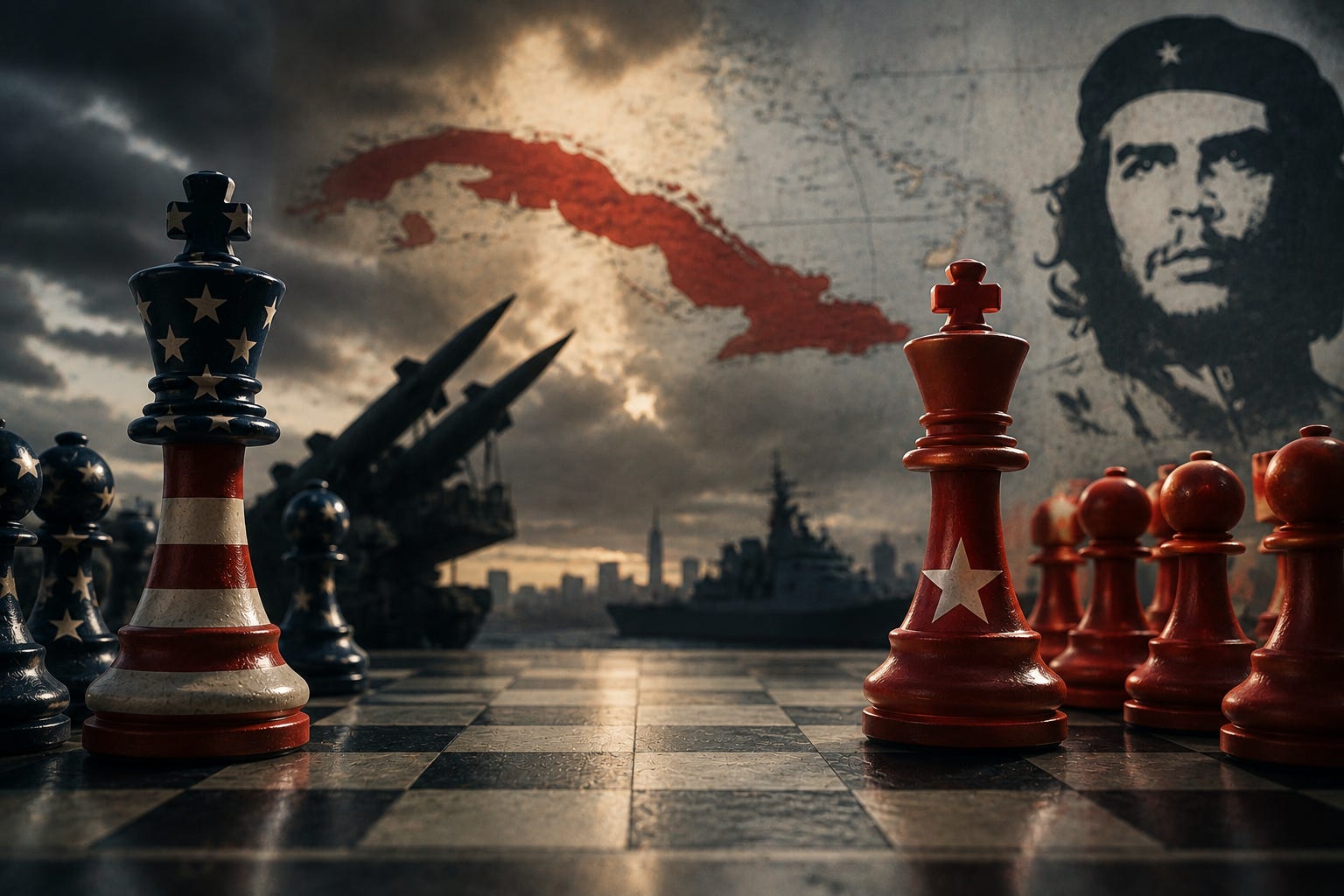
On July 23, Secretary of State Marco Rubio announced additional sanctions under Executive Order 14404, targeting entities and individuals involved in financing the Castro regime through sectors such as energy, financial services, and the overseas medical labor program. The Administration described these labor export arrangements as exploitative practices that generate billions of dollars for the regime while denying fundamental labor rights to Cuban medical professionals, something international organizations have repeatedly condemned.
These measures are not isolated economic sanctions. They are part of a broader campaign that increasingly presents Castro communism as a hostile state apparatus whose activities extend far beyond repression within Cuba. Executive Order 14404 itself identifies the conduct of the Castro regime as an “unusual and extraordinary threat” to the national security and foreign policy of the United States. It should be recalled that this presidential order authorizes sanctions against foreign individuals and institutions that materially support the Cuban dictatorship.
Taken together, the report, the executive order, and the expanding sanctions regime suggest a coordinated effort to redefine public perceptions of Cuba. Rather than emphasizing humanitarian concerns alone, Washington is constructing a historical and strategic case that correctly portrays Cuban communism as a persistent adversary that has been engaged for decades in an ideological war against the United States and the broader Western democratic order.
It remains unclear whether this effort will ultimately serve primarily as justification for greater economic pressure, broader diplomatic isolation, or additional coercive measures. Governments often prepare public opinion before undertaking significant foreign policy shifts, particularly when national security considerations are involved. Establishing the historical record may itself become part of preparing the political environment for future decisions.
Although this does not necessarily mean that military action is imminent, it does signal a fundamental departure from the conventional approaches to addressing the Cuban communist threat that have prevailed for decades. It is reasonable to observe that governments typically seek to explain why a foreign regime constitutes a strategic threat before adopting substantially more forceful policies. The current campaign appears designed to convince Americans that Castroism is not merely Cuba’s internal problem, but rather a continuing source of regional instability and anti-American subversion.
Critics will argue that additional sanctions merely repeat policies that have failed for decades. Supporters respond that sanctions alone have never been accompanied by a comprehensive effort to expose the regime’s international revolutionary infrastructure and ideological operations. They contend that the current strategy seeks to redefine the debate by focusing not only on Cuba’s internal repression, but also on its long history of exporting Marxist and neo-Marxist revolutionary doctrine. It also encompasses the regime’s collaboration with governments and movements hostile to the United States.
If that assessment proves correct, then the State Department report may ultimately be remembered less for the information it contains than for the strategic purpose it serves. It indicates that Washington increasingly views Castro's communism not as a relic of the Cold War, but as a persistent geopolitical actor whose influence extends well beyond Cuba’s shores. By documenting that history in an official government publication and accompanying it with increasingly severe sanctions, the Administration appears determined to foster broad public understanding of the long-term challenge the regime poses to U.S. national security.
It remains to be seen whether this evolving strategy will culminate in intensified economic pressure, greater international coordination, or other forms of coercive policy. What is already evident is that the United States is attempting to redefine how Americans perceive the Cuban communist regime: from an impoverished dictatorship surviving through inertia to a revolutionary state whose ideological ambitions and international activities continue to carry strategic consequences for the United States and the Western Hemisphere. The evidence that those familiar with Cuba’s reality have known for decades is now available to the general public in an official and indisputable format issued by the U.S. Government. These are, without question, very good news.
Washington’s strategy reflects a significant shift in the way it presents the challenge posed by the Cuban regime, placing it within the broader context of strategic competition and national security rather than the traditional debate over human rights or the Cold War. Whether this shift in messaging will ultimately lead to intensified economic pressure, greater international coordination, or measures of a different nature remains uncertain. What does appear clear, according to the author, is that the Administration is seeking to establish a new public understanding of Castroism as a geopolitical actor with direct implications for the strategic interests of the United States and the Western Hemisphere.
A political scientist, author, lecturer, and media commentator, Julio M. Shiling is the director of Patria de Martí and The CubanAmerican Voice, two leading platforms dedicated to the defense of democracy, human rights, and freedom in Cuba and the Western Hemisphere. A frequent guest on television, radio, podcasts, and international media outlets, he is widely recognized for his analytical commentary on authoritarianism, democratic transitions, and ideological warfare. He is the author of fourteen books, including the highly acclaimed Dictatorships and Their Paradigms: Why Some Dictatorships Fall and Others Do Not, now in its third edition, a seminal work on comparative authoritarian studies. He holds a master’s degree in political science from Florida International University (FIU), is a member of the American Political Science Association and the PEN Club of Cuban Writers in Exile, and has been recognized for his contributions to the promotion of human rights and a culture of liberty.
The opinions expressed in this article are those of the author and do not necessarily reflect the views of the Miami Strategic Intelligence Institute (MSI²).
No posts
Comments
Nothing yet. Say the first thing.
Sign in to join the conversation.